
In the article Transformation of struvite from wastewater to a hydrogen fuel storage compound ammonia borane, the interesting and important future source of hydrogen, ammonia-borane is synthesised from wastewater. This not only opens the door to a new use of a widespread waste, it can also help alleviate the growing concerns about adequate treatment of wastewater.A more widely recognised use of organic wastes is their pyrolysis to produce useful oils, such as those that can be co-fed with traditional crude oil feedstocks. However, the biggest problem with such pyrolysis oils is often their poor quality. In Processing renewable and waste-based feedstocks with fluid catalytic cracking: Impact on catalytic performance and considerations for improved catalyst design, the optimisation of solid catalysts in FCC is shown to enable pyrolysis oils to be used as replacements for fossil oils with little impact on performance.One of the largest volume but little exploited natural resources is lignin which remains more of a waste than a feedstock despite its chemical potential. In Biocatalytic selective acylation of technical lignins: a new route for the design of new biobased additives for industrial formulations, technical soda lignins are chemically modified using a biocatalytic process. The resulting materials have useful properties that suggest possible real industrial application value.Many modern vaccines require the addition of adjuvants which are chemical entities that can induce a strong but controlled immune response. Despite their rapidly growing value, the rate of innovation of vaccine adjuvants has been very slow. In Cleaner synthesis of preclinically validated vaccine adjuvants, synthetic glycophospholipids have been developed. These not only have promising activity and low toxicity, they can be made using good clean synthesis techniques including regio-and chemo-selective reactions.The valorisation of biomass feedstocks is likely to become a vital part of the future chemical industry and we need to prove alternative technologies for this that go beyond traditional methods like pyrolysis. In the review article, Mechanochemistry and oleochemistry: a green combination for the production of high-value small chemicals, the little utilised mechanochemistry technique for oleochemistry is demonstrated in a number of recent articles. This includes original work aimed at creating new and efficient routes to important products including biodiesel, benzoxazine and solketal.Deep eutectic solvents are attracting increasing interest as green solvents but their use in biocatalysis has been little reported. In Harnessing the potential of deep eutectic solvents in biocatalysis: design strategies using CO2 to formate reduction as a case study, these fascinating solvents are successfully demonstrated in the important reduction of carbon dioxide to formate. This is achieved by a powerful combination of experimental screening and computational tools.The removal of lead from water is an important clean water strategy. In Improvement of magnetite adsorption performance for Pb (II) by introducing defects, the ability of natural magnetite to adsorb lead is improved by surface defect engineering specifically by calcination under argon. The creation and effects of surface vacancies are studied by equilibrium and kinetic adsorption experiments.Organic pollutants are of increasing concern to water purity and are becoming more common with the growth of many industries. Among the most worrying are organic dyes which are currently dumped in multi-thousand ton quantities around the world. In Kinetics and thermodynamics investigations of efficient and eco-friendly removal of alizarin red S from water via acid-activated Dalbergia sissooleaf powder and its magnetic iron oxide nanocomposite, a new cost-effective natural adsorbent is proven for the adsorption of the hazardous dye alizarin red S from water.The complex behaviour of pollutants in water needs good mathematical modelling to aid field remediation planning. In Modelling and optimization study on degradation of organic contaminants using nZVI activated persulfate based on response surface methodology and artificial neural network: a case study of benzene as the model pollutant, the degradation effects of activated persulfate on the common groundwater contaminant benzene are modelled and then used to optimise the process parameters and maximise benzene removal.Calcium carbonate is one of the most common natural substances on our planet and is made even more important because of its role in helping to abate the CO2 crisis and help combat ocean acidification. We need to make more use of this compound. In Improvements in the utilization of calcium carbonate in promoting sustainability and environmental health, both well-known and less well-known applications for CaCO3 are described. Utilization of pre-consumer and post-consumer recycled calcium carbonate is on rise and can help customers achieve their circular economy objectives.
Editorial07 January 2025
Editorial: Green and sustainable chemistry editor’s pick 2024
Deep eutectic solvents (DESs) have emerged as green solvents with versatile applications, demonstrating significant potential in biocatalysis. They often increase the solubility of poorly watersoluble substrates, serve as smart co-substrates, modulate enzyme stereoselectivity, and potentially improve enzyme activity and stability. Despite these advantages, screening for an optimal DES and determining the appropriate water content for a given biocatalytic reaction remains a complex and time-consuming process, posing a significant challenge. This paper discusses the rational design of DES tailored to a given biocatalytic system through a combination of experimental screening and computational tools, guided by performance targets defined by solvent properties and process constraints. The efficacy of this approach is demonstrated by the reduction of CO2 to formate catalyzed by NADH-dependent formate dehydrogenase (FDH). By systematically analyzing FDH activity and stability, NADH stability (both long-term and short-term stability after solvent saturation with CO2), and CO2 solubility in initially selected glycerol-based DESs, we were able to skillfully guide the DES screening process. Considering trade-offs between experimentally determined performance metrics of DESs, 20% solution of choline chloride:glycerol in phosphate buffer (ChCl:Gly80%B) was identified as the most promising solvent system for a given reaction. Using ChCl:Gly as a co-solvent resulted in an almost 15-fold increase in FDH half-life compared to the reference buffer and stabilized the coenzyme after the addition of CO2. Moreover, the 20% addition of ChCl:Gly to the buffer improved the volumetric productivity of FDH-catalyzed CO2 reduction in a batch system compared to the reference buffer. The exceptional stability of the enzyme in this cosolvent system shows great potential for application in continuous operation, which can significantly improve process productivity. Additionally, based on easily measurable physicochemical solvent properties and molecular descriptors derived from COSMO-RS, QSAR models were developed, which successfully predicted enzyme activity and stability, as well as coenzyme stability in selected solvent systems with DESs.
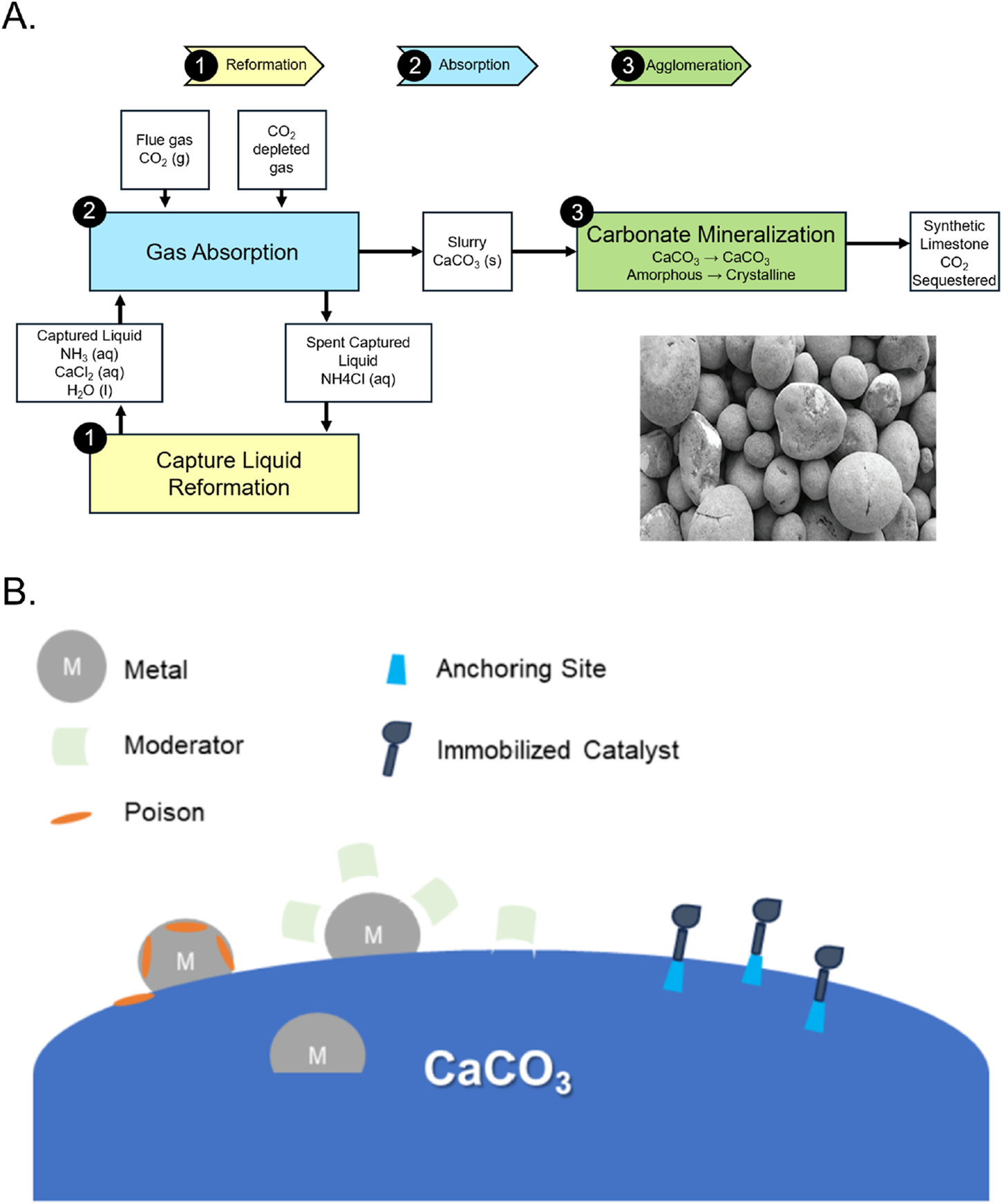
Calcium carbonate (CaCO3) is an incredibly abundant mineral on Earth, with over 90% of it being found in the lithosphere. To address the CO2 crisis and combat ocean acidification, it is essential to produce more CaCO3 using various synthetic methods. Additionally, this approach can serve as a substitute for energy-intensive processes like cement production. By doing so, we have the potential to not only reverse the damage caused by climate change but also protect biological ecosystems and the overall environment. The key lies in maximizing the utilization of CaCO3 in various human activities, paving the way for a more sustainable future for our planet.