Genotype-Independent Technologies for Genetic Transformation and Genome Editing

145kviews
ORIGINAL RESEARCH
15 March 2021
In planta Genome Editing in Commercial Wheat Varieties
Yuelin Liu, 13 more and Ryozo Imai

11,321 views

60 citations

METHODS
14 December 2020
A Stable Agrobacterium rhizogenes-Mediated Transformation of Cotton (Gossypium hirsutum L.) and Plant Regeneration From Transformed Hairy Root via Embryogenesis
Min-Long Cui, 2 more and Chuan-Liang Liu

10,613 views

46 citations

Overexpression of the Transcription Factor GROWTH-REGULATING FACTOR5 Improves Transformation of Dicot and Monocot Species
ORIGINAL RESEARCH
12 October 2020
Overexpression of the Transcription Factor GROWTH-REGULATING FACTOR5 Improves Transformation of Dicot and Monocot Species
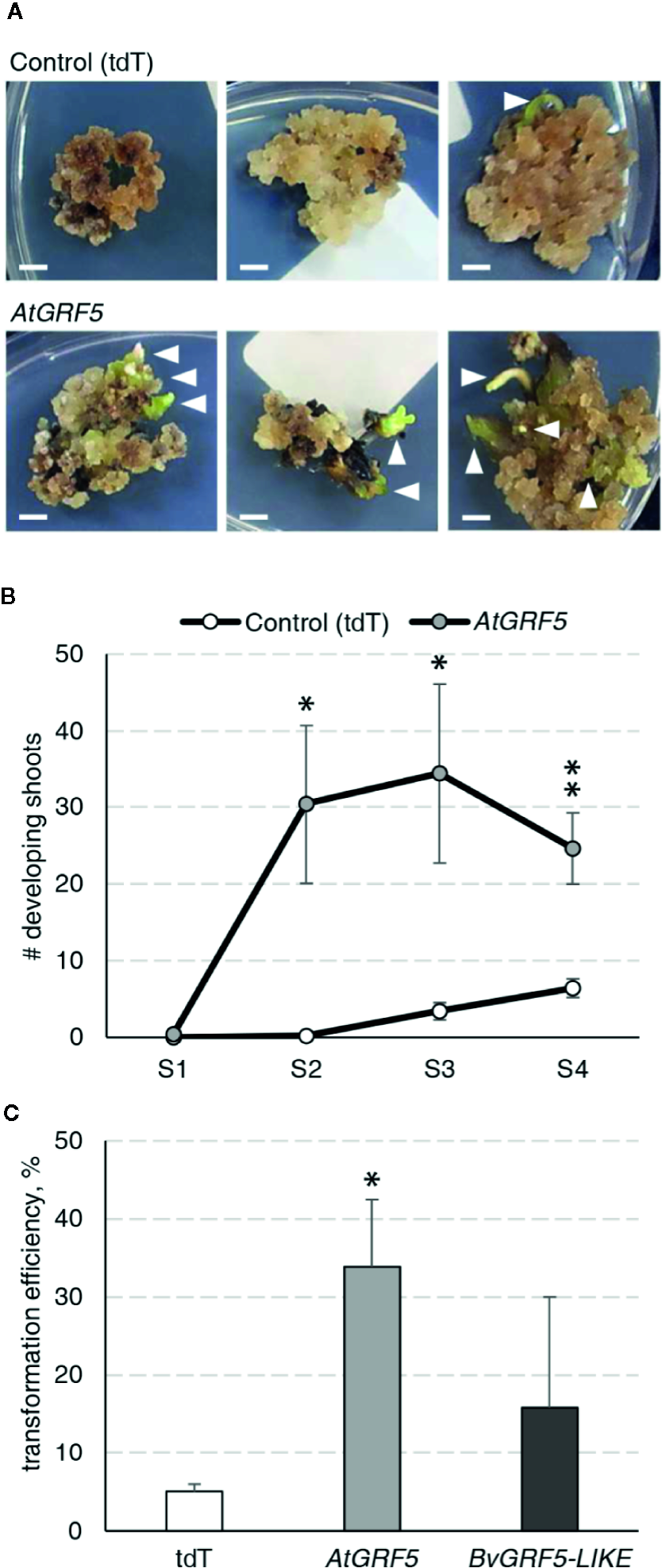
Successful regeneration of genetically modified plants from cell culture is highly dependent on the species, genotype, and tissue-type being targeted for transformation. Studies in some plant species have shown that when expression is altered, some genes regulating developmental processes are capable of triggering plant regeneration in a variety of plant cells and tissue-types previously identified as being recalcitrant to regeneration. In the present research, we report that developmental genes encoding GROWTH-REGULATING FACTORS positively enhance regeneration and transformation in both monocot and dicot species. In sugar beet (Beta vulgaris ssp. vulgaris), ectopic expression of Arabidopsis GRF5 (AtGRF5) in callus cells accelerates shoot formation and dramatically increases transformation frequency. More importantly, overexpression of AtGRF5 enables the production of stable transformants in recalcitrant sugar beet varieties. Similarly, in other organogenesis-based transformation protocols, the introduction of AtGRF5 and GRF5 orthologs into the dicot species soybean (Glycine max L.), canola (Brassica napus L.), and sunflower (Helianthus annuus L.) resulted in significant increases in genetic transformation of the explant tissue. However, significant increases in whole plant regeneration were not found in canola and sunflower, which could be attributed to the cell culture method used in plant regeneration. A positive effect on shoot regeneration via organogenesis in canola was also observed upon overexpression of other Arabidopsis GRF family members, namely AtGRF6 and AtGRF9. Interestingly, in soybean increased transformation was observed in both organogenic and embryogenic-based transformation methods, which resulted in fertile, healthy plants. Additionally, the transformation of two putative AtGRF5 orthologs in maize (Zea mays L.) increased transformation frequency and resulted in fully fertile plants. Overall, the results suggest that overexpression of GRF genes render cells and tissues more competent to regeneration across a wide variety of crop species and regeneration processes. This sets GRFs apart from other developmental regulators and, therefore, they can potentially be applied to improve transformation of monocot and dicot plant species.

25,378 views

211 citations

ORIGINAL RESEARCH
8 October 2020
Genotype-Independent Transformation and Genome Editing of Brassica napus Using a Novel Explant Material
Uyen Cao Chu, 5 more and Todd J. Jones

11,363 views

22 citations

ORIGINAL RESEARCH
24 September 2020
Direct Germline Transformation of Cotton Meristem Explants With No Selection
Yurong Chen, 3 more and Annie Saltarikos

5,924 views

11 citations

The first successful attempt to generate genetically modified plants expressing a transgene was preformed via T-DNA-based gene transfer employing Agrobacterium tumefaciens-mediated genetic transformation. Limitations over infectivity and in vitro tissue culture led to the development of other DNA delivery systems, such as the biolistic method. Herein, we developed a new one-step protocol for transgenic soybean recovery by combining the two different transformation methods. This protocol comprises the following steps: agrobacterial preparation, seed sterilization, soybean embryo excision, shoot-cell injury by tungsten-microparticle bombardment, A. tumefaciens-mediated transformation, embryo co-cultivation in vitro, and selection of transgenic plants. This protocol can be completed in approximately 30 - 40 weeks. The average efficiency of producing transgenic soybean germlines using this protocol was 9.84%, similar to other previously described protocols. However, we introduced a more cost-effective, more straightforward and shorter methodology for transgenic plant recovery, which allows co-cultivation and plant regeneration in a single step, decreasing the chances of contamination and making the manipulation easier. Finally, as a hallmark, our protocol does not generate plant chimeras, in contrast to traditional plant regeneration protocols applied in other Agrobacterium-mediated transformation methods. Therefore, this new approach of plant transformation is applicable for studies of gene function and the production of transgenic cultivars carrying different traits for precision-breeding programs.

23,069 views

49 citations

The genetic engineering method CRISPR has been touted as an efficient, inexpensive, easily used, and targeted genetic modification technology that is widely suggested as having the potential to solve many of the problems facing agriculture now and in the future. Like all new technologies, however, it is not without challenges. One of the most difficult challenges to anticipate and detect is gene targets that are inaccessible due to the chromatin state at their specific location. There is currently no way to predict this during the process of designing a sgRNA target, and the only way to detect this issue before spending time and resources on full transformations is to test the cleavage ability of the sgRNA in vivo. In wheat, this is possible using protoplast isolation and PEG transformation with Cas9 Ribonucleoprotein complexes. Therefore, we have developed a streamlined protocol for testing the accessibility of sgRNA targets in wheat. The first steps involve digesting wheat leaf tissue in an enzymatic solution and then isolating viable protoplasts using filters and a sucrose gradient. The protoplasts are then transformed using Cas9 Ribonucleoprotein complexes via PEG-mediated transformation. DNA is isolated from the CRISPR-transformed protoplasts and PCR is performed to amplify the gene target region. The PCR product is then used to assess the transformation efficiency of the chosen sgRNA using Sanger sequencing. This simplified protocol for the isolation and transformation of wheat protoplast cells using Cas9 Ribonucleoprotein complexes streamlines CRISPR transformation projects by allowing for a fast and easy test of sgRNA accessibility in vivo.

18,074 views

66 citations