Technological Innovations in Cardiovascular Medicine: Imaging, nanotechnology, tissue regeneration, genetic engineering, deep learning and beyond

Cover image for Research Topic "Technological Innovations in Cardiovascular Medicine: Imaging, nanotechnology, tissue regeneration, genetic engineering, deep learning and beyond"
114kviews
ORIGINAL RESEARCH
17 June 2022
A Cardiovascular Disease Prediction Model Based on Routine Physical Examination Indicators Using Machine Learning Methods: A Cohort Study
Xin Qian, 8 more and Shuxia Guo
A Cardiovascular Disease Prediction Model Based on Routine Physical Examination Indicators Using Machine Learning Methods: A Cohort Study
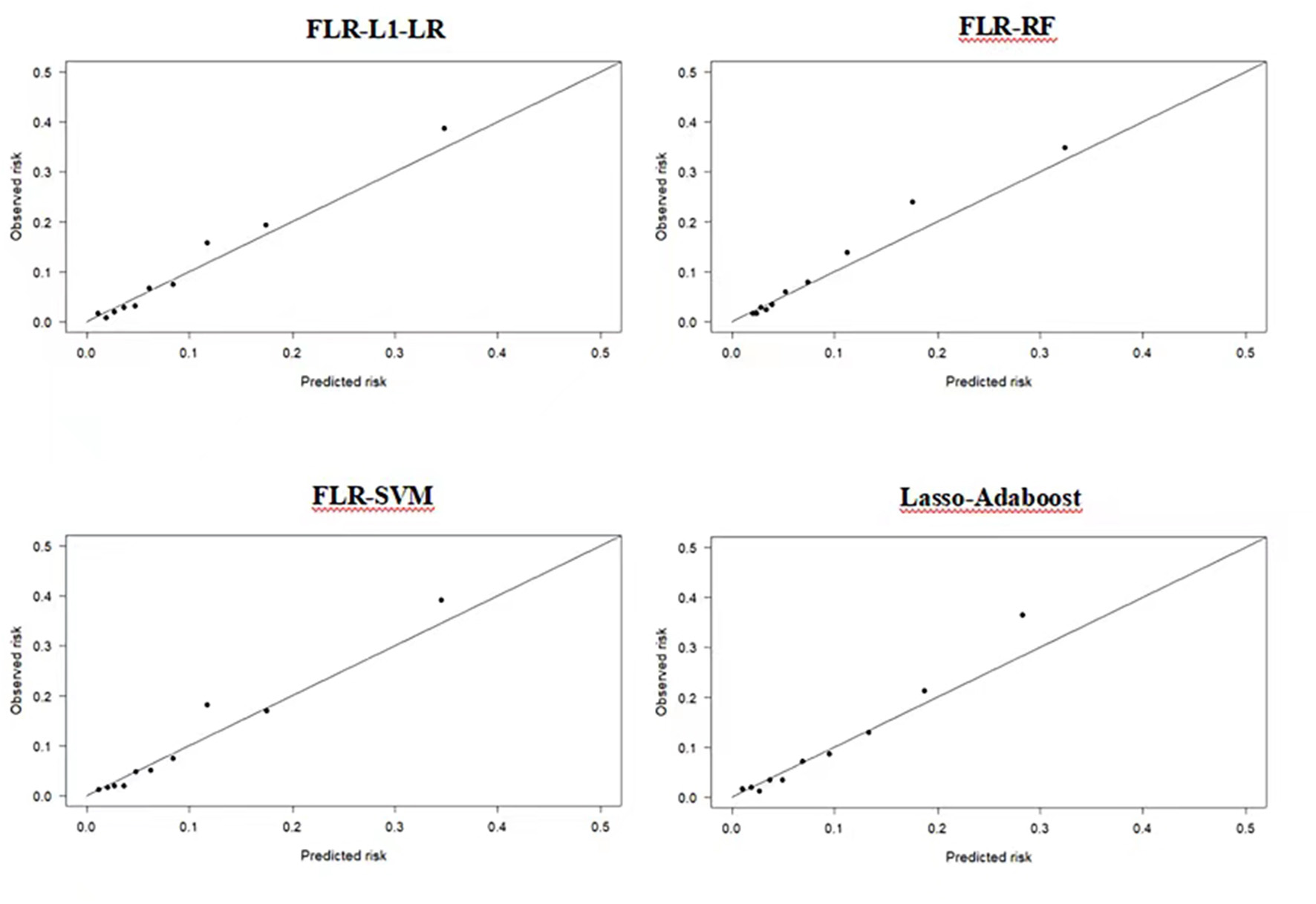
Background: Cardiovascular diseases (CVD) are currently the leading cause of premature death worldwide. Model-based early detection of high-risk populations for CVD is the key to CVD prevention. Thus, this research aimed to use machine learning (ML) algorithms to establish a CVD prediction model based on routine physical examination indicators suitable for the Xinjiang rural population. Method: The research cohort data collection was divided into two stages. The first stage involved a baseline survey from 2010 to 2012, with follow-up ending in December 2017. The second-phase baseline survey was conducted from September to December 2016, and follow-up ended in August 2021. A total of 12,692 participants (10,407 Uyghur and 2,285 Kazak) were included in the study. Screening predictors and establishing variable subsets were based on least absolute shrinkage and selection operator (Lasso) regression, logistic regression forward partial likelihood estimation (FLR), random forest (RF) feature importance, and RF variable importance. The selected subset of variables was compared with L1 regularized logistic regression (L1-LR), RF, support vector machine (SVM), and AdaBoost algorithm to establish a CVD prediction model suitable for this population. The incidence of CVD in this population was then analysed. Result: After 4.94 years of follow-up, a total of 1,176 people were diagnosed with CVD (cumulative incidence: 9.27%). In the comparison of discrimination and calibration, the prediction performance of the subset of variables selected based on FLR was better than that of other models. Combining the results of discrimination, calibration, and clinical validity, the prediction model based on L1-LR had the best prediction performance. Age, systolic blood pressure, low-density lipoprotein-L/high-density lipoproteins-C, triglyceride blood glucose index, body mass index, and body adiposity index were all important predictors of the onset of CVD in the Xinjiang rural population. Conclusion: In the Xinjiang rural population, the prediction model based on L1-LR had the best prediction performance.

12,375 views

38 citations

ORIGINAL RESEARCH
10 March 2022
A Prediction Equation to Estimate Vascular Endothelial Function in Different Body Mass Index Populations
Xiao Li, 5 more and Wenkun Bai

3,403 views

4 citations

CORRECTION
26 October 2021
Corrigendum: Notch Intracellular Domain Plasmid Delivery via Poly(Lactic-Co-Glycolic Acid) Nanoparticles to Upregulate Notch Pathway Molecules
Victoria L. Messerschmidt, 9 more and Juhyun Lee

1,683 views

ORIGINAL RESEARCH
28 September 2021
Notch Intracellular Domain Plasmid Delivery via Poly(Lactic-Co-Glycolic Acid) Nanoparticles to Upregulate Notch Pathway Molecules
Victoria L. Messerschmidt, 9 more and Juhyun Lee

3,975 views

7 citations

ORIGINAL RESEARCH
23 April 2021
Agreement of Angiography-Derived and Wire-Based Fractional Flow Reserves in Percutaneous Coronary Intervention
Hu Ai, 10 more and Fucheng Sun

4,431 views

16 citations

Development and Validation of a Predictive Model for Coronary Artery Disease Using Machine Learning
Early identification of coronary artery disease (CAD) can prevent the progress of CAD and effectually lower the mortality rate, so we intended to construct and validate a machine learning model to predict the risk of CAD based on conventional risk factors and lab test data. There were 3112 CAD patients and 3182 controls enrolled from three centers in China. We compared the baseline and clinical characteristics between two groups. Then, Random Forest algorithm was used to construct a model to predict CAD and the model was assessed by receiver operating characteristic (ROC) curve. In the development cohort, the Random Forest model showed a good AUC 0.948 (95%CI: 0.941-0.954) to identify CAD patients from controls, with a sensitivity of 90%, a specificity of 85.4%, a positive predictive value of 0.863 and a negative predictive value of 0.894. Validation of the model also yielded a favorable discriminatory ability with the AUC, sensitivity, specificity, positive predictive value and negative predictive value of 0.944 (95%CI: 0.934-0.955), 89.5%, 85.8%, 0.868 and 0.886 in the validation cohort 1, respectively, and 0.940 (95%CI: 0.922-0.960), 79.5%, 94.3%, 0.932 and 0.823 in the validation cohort 2, respectively. An easy-to-use tool that combined 15 indexes to assess the CAD risk was constructed and validated using Random Forest algorithm, which showed favorable predictive capability (http://45.32.120.149:3000/randomforest). Our model is extremely valuable for clinical practice, which will be helpful for the management and primary prevention of CAD patients.

7,447 views

37 citations

ORIGINAL RESEARCH
27 November 2020
Estimation of Major Adverse Cardiovascular Events in Patients With Myocardial Infarction Undergoing Primary Percutaneous Coronary Intervention: A Risk Prediction Score Model From a Derivation and Validation Study
Xiaoxiao Zhao, 10 more and Hongbing Yan

4,797 views

15 citations

Predicting Diagnostic Gene Biomarkers Associated With Immune Infiltration in Patients With Acute Myocardial Infarction
Objective: The present study was designed to explore potential diagnostic markers for acute myocardial infarction (AMI) and investigate the significance of immune cells infiltration in this pathology. Methods: Two public available gene expression profiles (GSE66360 and GSE48060 datasets) from human AMI and control samples were downloaded from the Gene Expression Omnibus (GEO) database. Differentially expressed genes (DEGs) were identified between 80 AMI and 71 control samples. Least absolute shrinkage and selection operator (LASSO) model and support vector machines recursive feature elimination (SVM-RFE) analysis were performed to identify the candidate biomarkers. From the receiver operating characteristic (ROC) curve, the area under the ROC curve (AUC) value was obtained and used for evaluating discriminatory ability. The expression level and diagnostic value of biomarkers in AMI were further validated in GSE60993 dataset (17 AMI patients and 7 controls). The compositional patterns of 22 types of immune cell fraction in AMI were estimated based on the merged cohorts using Cell type Identification by Estimating Relative Subsets of RNA Transcripts (CIBERSORT). Results: A total of 27 genes were identified. The identified DEGs are mainly involved in carbohydrate binding, Kawasaki disease, atherosclerosis, and arteriosclerotic cardiovascular disease. Gene-sets related to atherosclerosis signaling, primary immunodeficiency, IL-17 and TNF signaling pathways were differentially activated in AMI compared to control. IL1R2, IRAK3 and THBD were identified as diagnostic markers of AMI (AUC = 0.877), and validated in the GSE60993 dataset (AUC = 0.941). Immune cell infiltration analysis revealed that IL1R2, IRAK3 and THBD were correlated with neutrophils, monocytes, M2 macrophages, CD4+ resting memory T cells, T cells gamma delta, and activated NK cells. Conclusion: IL1R2, IRAK3 and THBD can be used as diagnostic markers of AMI, and provides novel evidence and clues for future research of the occurrence and molecular mechanisms of AMI.

11,279 views

141 citations