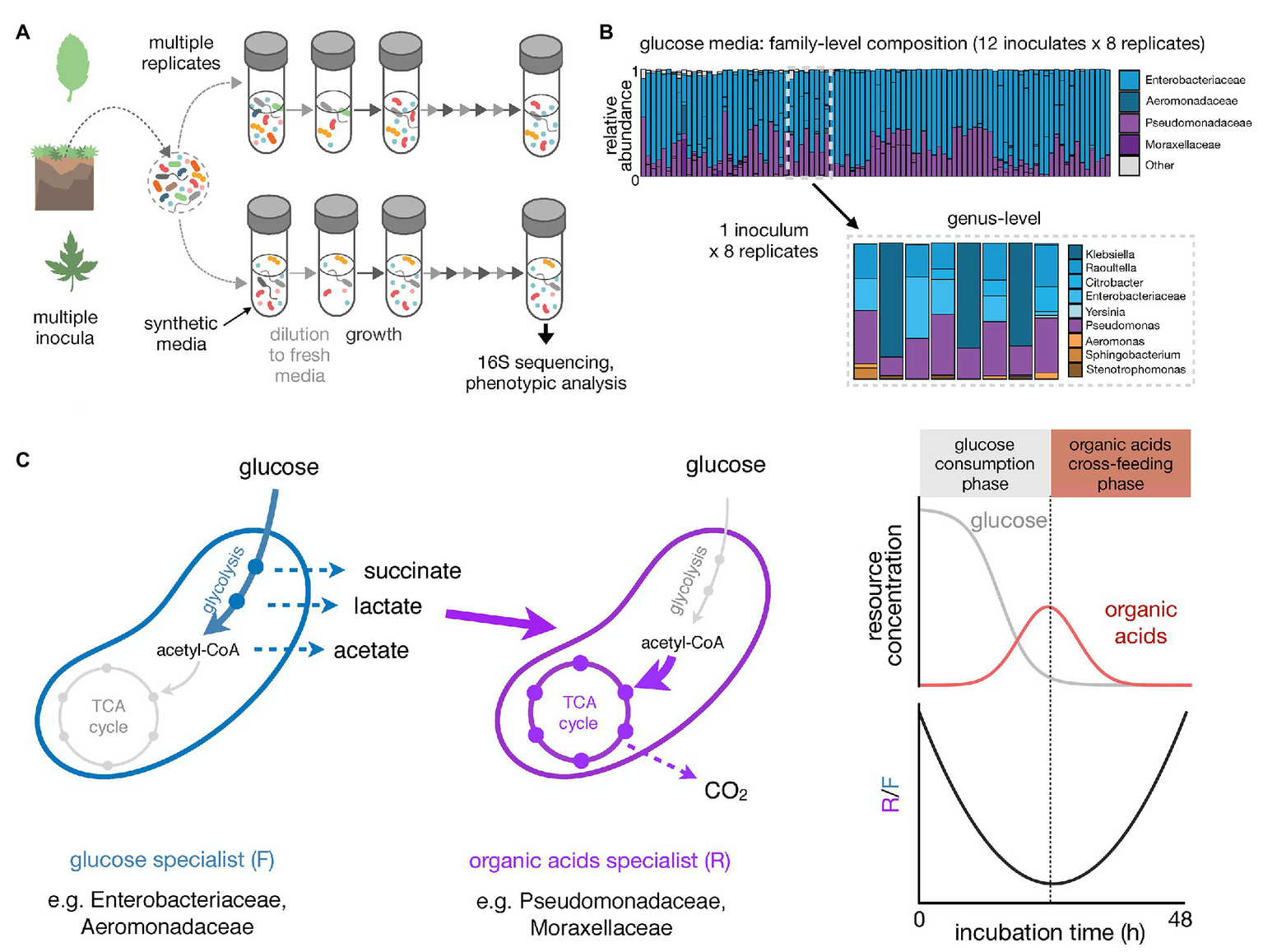
Synthetic microbial ecology seeks a holistic, dynamic, and mechanistic understanding of microbiota viewed as interactive and organized biological systems. However, the lack of mechanistic understanding of metabolic and ecological interactions is currently the main obstacle to the engineering of microbiota, ultimately preventing the restoration of compromised systems. Community genomics (metagenomics) has allowed the identification of numerous bacteria of interest, but omics data alone is limited in its ability to extensively probe complex ecological interactions, even if we know empirically that dynamic microbial communities are key to biotechnological and biomedical processes.Synthetic microbial ecosystems are model systems (i.e. amenable to experimental intervention and modelling) of reduced and known complexity used to investigate the organization and stability of communities ; these have the power to identify generic quantitative patterns and to measure the relative importance of stochasticity in community operation. Ultimately, the integration of in vitro experiments with mathematical modelling will both test our understanding and enable applications. This endeavor can typically be carried out in a bottom-up or top-down fashion, with the former focusing on the identification of conditions necessary to generate specific interaction patterns and dissecting competition and cooperation patterns, while the latter focuses on overall functions and the resilience of microbial systems.Estrela and colleagues 10.3389/fmicb.2021.657467 contribute a stimulating review stressing the value and benefits of enrichment communities, an inherently top-down approach. The authors note first that recent advances in robot-assisted culturing platforms and affordable genomic sequencing technologies have made it possible to establish and quantitatively track the assembly of enrichment communities in high-throughput. Therefore, by conducting community assembly experiments in up to thousands of synthetic habitats, where the extrinsic sources of variation among replicates can be controlled, the reproducibility and predictability of microbial community assembly at different levels of organization can be investigated, as well as their relationship with nutrient composition and other ecological drivers.The authors make a strong case for top-down approaches, noticing that the difficulties of externally controlling natural habitats, together with our incomplete understanding of the ecological forces at play, present significant challenges for theory development. All of these challenges can be circumvented in enrichment communities, which consist of natural microbiomes cultivated ex situ in a defined growth medium under wellcontrolled conditions. Thus, unlike engineered communities from the bottom-up, microbial enrichment experiments allow to control and manipulate the environment while avoiding to resort to assumptions about the relevant ecological interactions and trait distributions. The different forces driving community assembly can be rationalized into mathematical models that can be evaluated by their success at explaining the average abundance of species and their variability.The authors mention some of their own findings, for example that repeating the same enrichment experiment multiple times with the same inoculum often leads to different community compositions at the species level, yet to strongly convergent compositions at higher levels of taxonomy, thus probably reflecting an underlying metabolic structure. On the mathematical level, the authors have extended the classical model of resource competition model of MacArthur-Levins to include metabolic cross-feeding. This is a fundamental step as the productivity of many communities is co-limited by multiple nutrients at the same time, and entails the "diversity begets diversity" observation in microbial community assembly, as more niches may be created by cross-feeding as more species are added to a species-poor environment. The authors make a convincing point that understanding the fascinating question how colimitation affects biodiversity could be addressed using enrichment communities. Relevant to bottom-up approaches, they mention a simple rule (not necessarily observed in generalized Lotka-Volterra models) having a strong predictive value in small communities, and stating that in a multi-species mixed culture, only the subset of species that all coexist with one another in pairwise co-culture will survive, whereas those that are excluded by any member of that subset will go extinct.Schoustra and colleagues 10.3389/fmicb.2021.613450 report an exploratory study on the evolution of a type of competitive interaction known as interference competition. Contrary to exploitative competition, which occurs through the depletion of a common resource and where interactions among individuals are indirect (i.e. mediated solely through resource availability), in interference competition negative interactions occur directly through antagonistic traits such as the production of toxic chemicals. Interference competition contributes also to positive frequency-dependent interactions, driving the structuring of natural communities that way. Importantly, interference competition is modulable and involves a trade-off between the cost of producing the antagonistic trait and the benefits derived from eliminating competitors. In structured environments, protein-based toxins that inhibit closely related competitors has demonstrated benefits to the producer, but under well-mixed conditions, cheaters who gain some of the benefits but don't pay the cost of production reap the benefits because the toxin is shared among all individuals.The authors explored if antagonism could evolve by selection of a pyocin producing strain in a spatially structured environment for ten serial transfers in the absence or presence of one of three non-evolving clinical "recipient" strains. The evolved populations were assayed for fitness and their capacity to inhibit the growth of recipient strains relative to the ancestral strain that founded the evolution experiment. All strains, including those evolved in the absence of recipient, had a higher fitness in recipient environments than in environments without recipient, suggesting some adaptation to the conditions of culture and to the presence of a recipient. On the other hand, inhibition decreased in the absence of a recipient, while in the presence of a recipient, antagonism evolved in a way depending on the recipient used. Complementing their phenotypic characterization, the authors also sequenced selected evolved populations to monitor changes at the genomic level. Overall, populations from different treatments did not differ in easily interpretable ways, e.g. differences in inhibition were not obviously mediated by changes in bacteriocin production. Of notice, in addition to multiple mutations that were shared at the gene level, evolved strains with varying inhibition levels acquired novel prophage elements not present in the ancestral strain, reminiscent of previous reports of a possible advantage of harboring lysogenic prophages.de Vos and colleagues 10.3389/fmicb.2021.659450 report on interactions between the urinary microbiota and uropathogens. Among the numerous populations of microorganisms living in various human body niches, the urinary tract has been understudied, primarily because it was considered sterile in the absence of infection, although modern sequencing and enhanced culturing techniques proved this wrong with at least different species being isolated by now. The role of the healthy urinary microbiome in maintaining bladder homeostasis and preventing urinary tract infection is an emerging field. In particular, the effects of the resident microbiota on uropathogens and their mutual interactions are largely unknown, even if the gastrointestinal tract is commonly considered to be the origin of most bacterial infections in the urinary tract.The authors investigated interactions between uropathogens, isolated from elderly individuals suffering from urinary tract infections, and bacteria isolated from the urinary tract of asymptomatic individuals, using growth measurements in conditioned artificial urine media. In relation to the previous report of Schoustra et al., bacteria grown in conditioned medium can be viewed as acceptors, whereas bacteria from which the conditioned media were generated from are the donors. These experiences led the authors to observe that uropathogens and commensal bacteria can affect each other's growth, constituting and early step in elucidating the role of microbial interactions in urinary microbial ecosystems that harbor both uropathogens and pre-existing microbiota. Wisely, the authors acknowledge that the host may play an important role in the potential pathogenicity of uropathogens.Soil is a complex and heterogeneous matrix, and the mechanisms used by edible fungi like morels to acquire nutrients from soil environments in order to drive their fructification remain elusive. The study of Tan and colleagues 10.3389/fmicb.2021.656656 used a semi-synthetic substratum of quartz particles as an inorganic matrix, mixed with fermented compost to mimic the role of organic matters and microbiota in the soil. Compared with ordinary soils, this semi-synthetic system is more controllable and reproducible in many abiotic and biotic factors. Overall, microbiota successions, substrate transformation and the activity level of key enzymes were compared between the three types of substrata producing very different yields of morel fruiting bodies. The authors used these complementary measurements to compare the patterns between different types of semi-synthetic substrata with respect to key ecophysiological factors driving the fructification process. This allowed them to identify a substratum presenting microbiota-driven advantages in accumulating lipids and maintaining a constrained balance of nitrogenous (nitrate versus ammonia) substances.Last but not least, Del Frari and Ferreira 10.3389/fmicb.2021.659592 reflect on the fact that numerous definitions have been proposed for the term « microbiome », which is used nowadays in tens of thousands of scientific publications, and that its meaning shifted from organisms viewed as taxonomical units (microbiota) to their collective genetic material (pangenomes). Examining about hundred recently peer-reviewed microbiome articles, the authors monitored the use of terms for cultivability, taxonomic identification, microbial multiplicity (i.e. the number of organisms involved) and assemblage reproductibility, which led them to propose the function-centric term skopobiota (skopos means "purpose" in old greek) to refer to microbial blends that, unlike microbiomes, are intelligently designed to study component behaviors or to carry out well-defined tasks (e.g. biotechnological control).Notably, the authors acknowledge that inaccuracy might be more fundamentally rooted in the nature of knowledge rather than in terms, which might not necessarily be a bad thing, as already remarked by Feynman about the initial fuzziness of the electromagnetic field concept, which yielded several different but insightful points of view.

8 Authors
- HT
Hao Tan
National-Local Joint Engineering Laboratory of Breeding and Cultivation of Edible and Medicinal Fungi, Mushroom Research Center, Soil and Fertilizer Institute, Sichuan Academy of Agricultural Sciences, China
- YY
Yang Yu
National-Local Joint Engineering Laboratory of Breeding and Cultivation of Edible and Medicinal Fungi, Mushroom Research Center, Soil and Fertilizer Institute, Sichuan Academy of Agricultural Sciences, China
- JT
Jie Tang
National-Local Joint Engineering Laboratory of Breeding and Cultivation of Edible and Medicinal Fungi, Mushroom Research Center, Soil and Fertilizer Institute, Sichuan Academy of Agricultural Sciences, China
- TL
Tianhai Liu
National-Local Joint Engineering Laboratory of Breeding and Cultivation of Edible and Medicinal Fungi, Mushroom Research Center, Soil and Fertilizer Institute, Sichuan Academy of Agricultural Sciences, China
- RM
Renyun Miao
National-Local Joint Engineering Laboratory of Breeding and Cultivation of Edible and Medicinal Fungi, Mushroom Research Center, Soil and Fertilizer Institute, Sichuan Academy of Agricultural Sciences, China
- ZH
Zhongqian Huang
National-Local Joint Engineering Laboratory of Breeding and Cultivation of Edible and Medicinal Fungi, Mushroom Research Center, Soil and Fertilizer Institute, Sichuan Academy of Agricultural Sciences, China
- FM
Francis M. Martin
Université de Lorraine, INRAE, UMR Interactions Arbres/Microorganismes, Centre INRAE Grand Est-Nancy, France
- WP
Weihong Peng
National-Local Joint Engineering Laboratory of Breeding and Cultivation of Edible and Medicinal Fungi, Mushroom Research Center, Soil and Fertilizer Institute, Sichuan Academy of Agricultural Sciences, China

5 Authors
- LE
Laurens E. Zandbergen
Microbial Eco-Evolutionary Medicine Group, Groningen Institute for Evolutionary Life Sciences, University of Groningen, Netherlands
- TH
Thomas Halverson
Department of Microbiology and Immunology, Stritch School of Medicine, Health Sciences Division, Loyola University Chicago, United States
- JK
Jolanda K. Brons
Microbial Eco-Evolutionary Medicine Group, Groningen Institute for Evolutionary Life Sciences, University of Groningen, Netherlands
- AJ
Alan J. Wolfe
Department of Microbiology and Immunology, Stritch School of Medicine, Health Sciences Division, Loyola University Chicago, United States
- MG
Marjon G. J. de Vos
Microbial Eco-Evolutionary Medicine Group, Groningen Institute for Evolutionary Life Sciences, University of Groningen, Netherlands