Post-translational modification SUMOylation is an important modulator of protein function and plays a critical role in different biological processes including regulation of innate immune and inflammatory responses. SUMO modulates the activity of the NF-kB signaling pathway, a master regulator of innate immune responses, at different levels. Shi et al studied the modulation of NF-kB as well IRF1 by the E3 ubiquitin and SUMO ligase breast cancer-associated gene 2 (BCA2) and they show that BCA2 inhibits NF-kB, and activates or inhibits IRF1 depending on the cellular context (Shi et al., 2021). The relevance of SUMOylation in the modulation of innate immune pathways is highlighted by the development by pathogens of strategies to interfere with the SUMOylation pathway in order to avoid an efficient host immune response. An overview of the crosstalk between SUMO and immune pathways, as well as the ability of viral pathogens to target the SUMOylation pathway is provided by Sajeev et al (Sajeev et al., 2021).Many SUMO substrates can interact with SUMO in a non-covalent manner through SUMOinteracting motifs (SIMs). Non-covalent interaction between SUMO or SUMOylated proteins and SUMOylation substrates has important regulatory consequences as shown by Tripathi et al. who demonstrate that the non-covalent interaction between human cytomegalovirus protein IE1 and SUMO1 through two SIMs is critical for the transactivation activity of the viral protein (Tripathi et al., 2021). One of the best examples of functional interplay between SIMs and SUMOylated proteins is found in PML-nuclear bodies, dynamic structures that have a key role in immune response to invading pathogens. How SUMOylation can determine the outcome of the interplay between PML-NBs and pathogens has been reviewed by Patra and Müller (Patra and Müller, 2021).SUMOylation can crosstalk with other post-translational modifications such as ubiquitination or ISGylation and act in concert to modulate protein function and signaling pathways. Chelbi-Alix and Thibault reviewed the implication of the crosstalk between SUMO and other ubiquitin-like proteins for antiviral defense (Chelbi-Alix and Thibault, 2021).SUMOylation plays also an essential role in the regulation of immune response in insects as shown by Nayak et al., who demonstrate that the SUMOylation of Arginyl tRNA synthetase modulates the Drosophila innate immune response (Nayak et al., 2021). SUMOylation is also critical for plant response to environmental changes and during pathogen attack. The role of SUMOylation in plant immunity and the pathogenic strategies targeting plant SUMOylation have been reviewed by Sharma et al (Sharma et al., 2021). SUMOylation level of different proteins can be regulated by only one protein. The report of Kasera et al. showed how losing the negative regulator of basal defenses rps4-RLD1 (SRFR1) increases global SUMOylation, suggesting that SRFR1 plays a critical role in maintaining SUMOylation homeostasis (Kasera et al., 2021).In conclusion, the contributions to this research topic highlight the fundamental role of SUMOylation in innate immunity of eukaryotic organisms.
Editorial03 November 2021
Editorial: SUMO Proteins in Host Defense
Promyelocytic leukemia nuclear bodies (PML NBs) are multi-protein assemblies representing distinct sub-nuclear structures. As phase-separated molecular condensates, PML NBs exhibit liquid droplet-like consistency. A key organizer of assembly and dynamics of PML NBs is the ubiquitin-like SUMO modification system. SUMO is covalently attached to PML and other core components of NBs thereby exhibiting a glue-like function by providing multivalent interactions with proteins containing SUMO interacting motifs (SIMs). PML NBs serve as the catalytic center for nuclear SUMOylation and SUMO-SIM interactions are essential for protein assembly within these structures. Importantly, however, formation of SUMO chains on PML and other NB-associated proteins triggers ubiquitylation and proteasomal degradation coinciding with disruption of NBs. To date, a plethora of nuclear activities such as transcriptional and post-transcriptional regulation of gene expression, apoptosis, senescence, cell cycle, DNA damage response, and DNA replication have been associated with PML NBs. Not surprisingly, therefore, SUMO-dependent PML NB integrity has been implicated in regulating many physiological processes including tumor suppression, metabolism, drug-resistance, development, cellular stemness, and anti-pathogen immune response. The interplay between PML NBs and viral infection is multifaceted. As a part of the antiviral determinants, constituents of PML NBs are crucial restriction factors for many viruses and a mutual positive correlation has been found to exist between PML NBs and the interferon response. Viruses, in turn, have developed counterstrategies for disarming PML NB associated immune defense measures. On the other end of the spectrum, certain viruses are known to usurp specific PML NB components for successful replication and disruption of these sub-nuclear foci was recently linked to the stimulation rather than curtailment of antiviral gene repertoire. Importantly, the ability of invading virions to manipulate the host SUMO modification machinery is essential for this interplay between PML NB integrity and viruses. Moreover, compelling evidence is emerging in favour of bacterial pathogens to negotiate with the SUMO system thereby modulating PML NB-directed intrinsic and innate immunity. In the current context, we will present an updated account of the dynamic intricacies between cellular PML NBs as the nuclear SUMO modification hotspots and immune regulatory mechanisms in response to viral and bacterial pathogens.
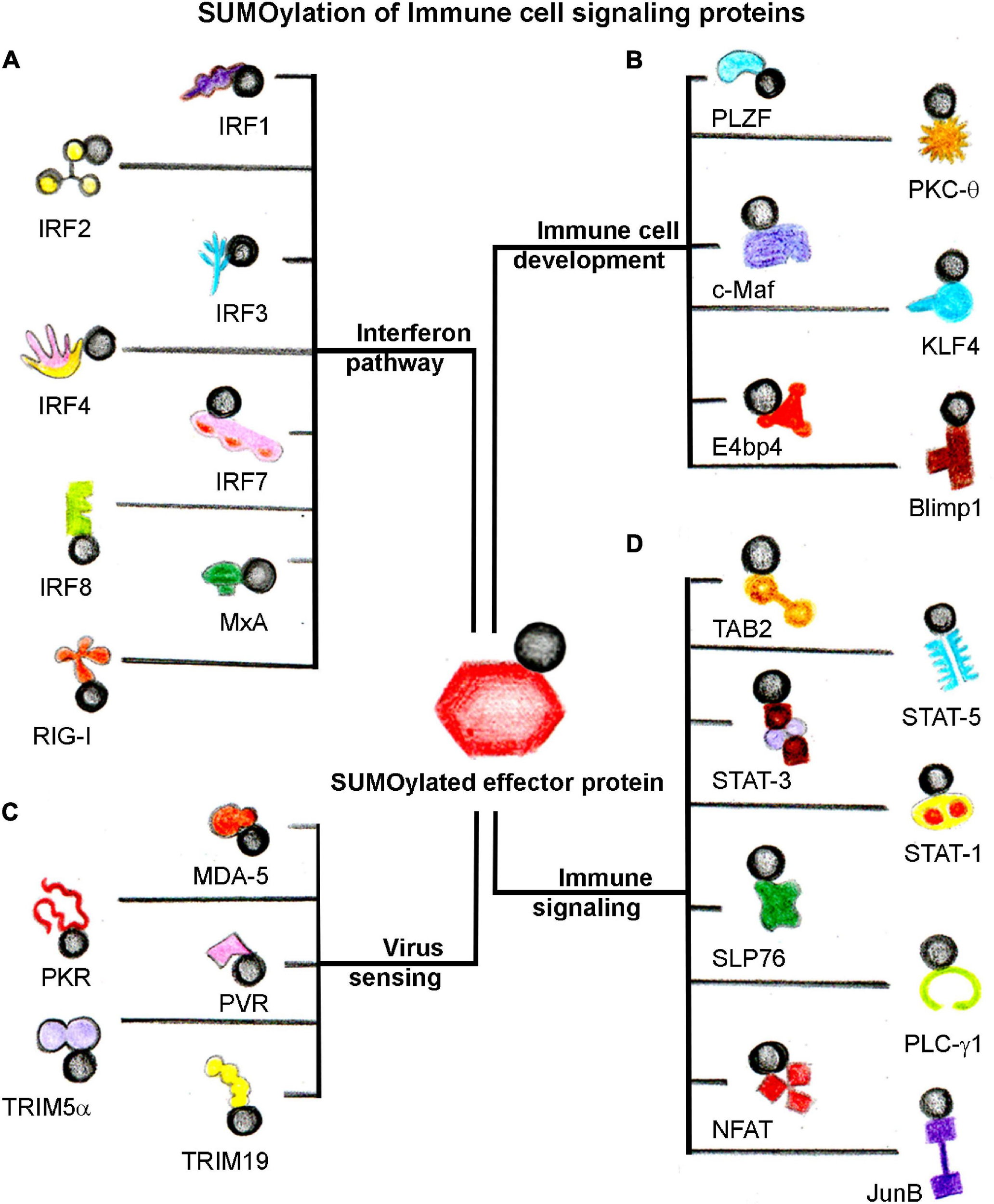
Pathogens pose a continuous challenge for the survival of the host species. In response to the pathogens, the host immune system mounts orchestrated defense responses initiating various mechanisms both at the cellular and molecular levels, including multiple post-translational modifications leading to the initiation of signaling pathways. The network of such pathways results in the recruitment of various innate immune components and cells at the site of infection and activation of the adaptive immune cells, which work in synergy to combat the pathogens. Ubiquitination is one of the most commonly used post-translational modifications by all host cells for both temporal and spatial regulation of immune response pathways. Over the last decade, ubiquitin family proteins, particularly small ubiquitin-related modifiers (SUMO), have been widely implicated in host immune response. SUMOs are Ubiquitin-like (Ubl) proteins that are transiently conjugated to a wide variety of proteins through SUMOylation. SUMOs primarily exert their effect on target proteins by covalently modifying them. However, the non-covalent interaction between SUMO and the SUMO-interacting motif (SIM) in target proteins is also crucial. Unlike Ubiquitination, SUMOylation alters localization, interactions, functions or stability of target proteins.
This review provides an overview of SUMO and immune pathways in general and then a detailed account of the regulation exerted by SUMO interactions and modifications of target proteins. Besides, a detailed account of the engagement of adaptor proteins, signalling molecules, transcriptional regulators, host immune factors, and pathogen proteins with SUMO pathway enzymes are utilized by the host immune system to mount a strong defense against the pathogenic infection. We also discuss the pathogen's ability to target the host SUMOylation pathway to infect the host and sustain the pathogenesis.
