In this editorial, we illustrate the ecological significance of the forest canopies and describe how a
collection of papers in this special issue describes the importance of understanding forest canopy
biodiversity and ecological processes in the age of Anthropocene. We lastly address prospects and
challenges in forest canopy ecology.
Forest canopies provide additional spatial dimensions
Traditionally, community assembly and ecosystem functions have been considered on a two□dimensional plane with reference points such as latitude, longitude, and elevation (or depth). Almost all
terrestrial and aquatic habitats, however, include complex structures that create multiple, rather than
just two, spatial dimensions (Basset et al. 2015, Oliveira and Scheffers 2019). One of the most prominent
multi-dimensional structures is found in forests (Ozanne et al. 2003), where the forest canopies function
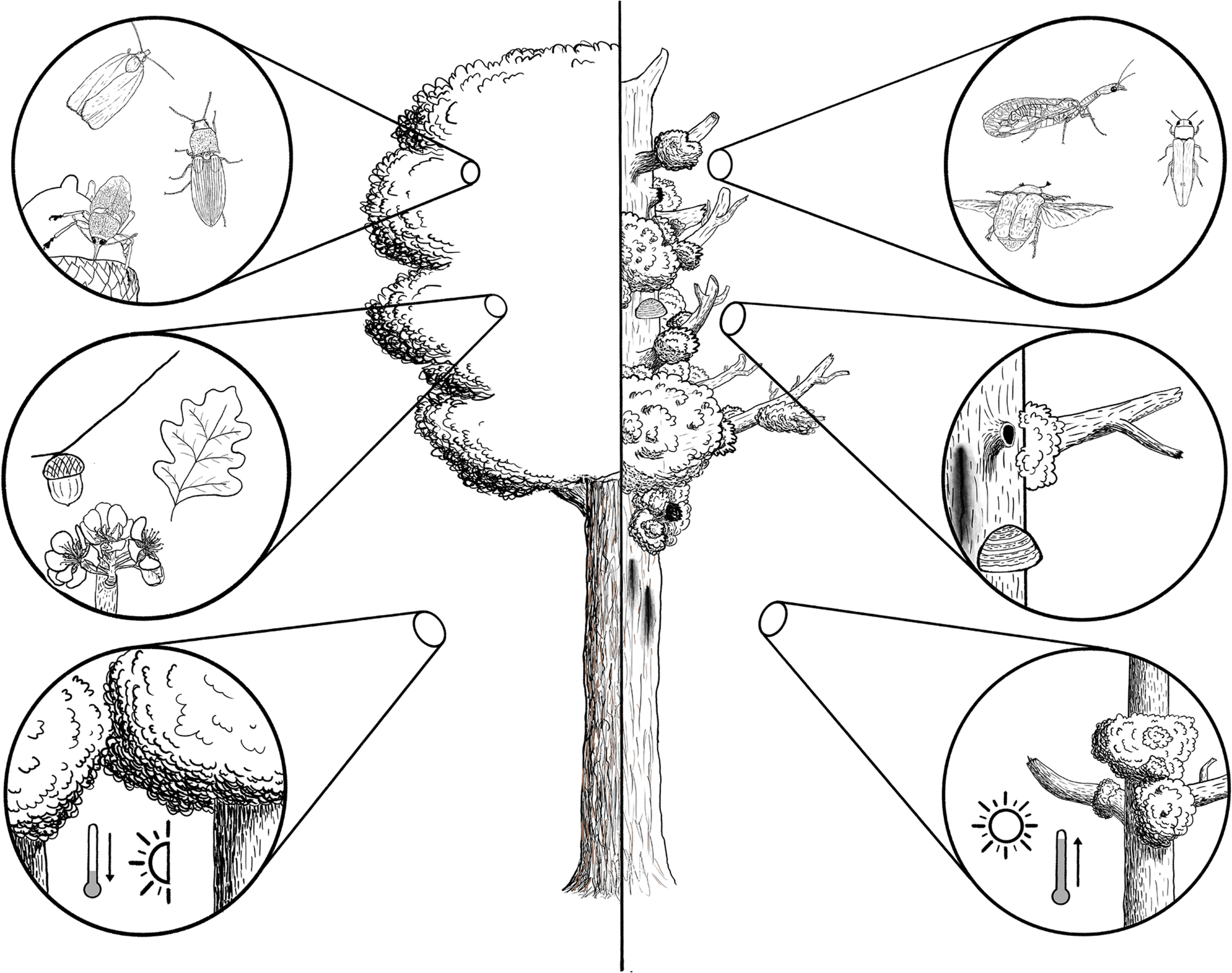
as climatic insulators that provide cool and moist climatic conditions in the understory compared with
the hotter and drier climate of the more exposed upper canopy (Frenne et al. 2019) (Figure 1). Despite
their harsher and variable climatic conditions, forest canopies harbor high biodiversity by providing
nesting and food resources and refugia to avoid predation and competition (Gámez and Harris 2022). In
addition, various microhabitats, such as bark, tree holes, lianas, fungi, and epiphytes, provide additional
above-ground resources and thermal refugia (Frenne et al. 2021). Where each of these above-ground
resources supports specialized consumers, then a whole dependent food web may be created (see, e.g.,
Kitching 2000). Epiphytes, for example, provide unique microhabitats in the forest midstory and upper
canopies, harboring a diverse array of trophic groups such as herbivores, detritivores, and predators
(Stuntz et al. 2002b). Epiphytes also create microclimatic refugia with stratified climatic conditions from
the epiphyte’s core to their underlying substrates (Stuntz et al. 2002a). However, these patterns of
microclimatic stratification may change depending on the vertical positions of the epiphytes and other
microhabitats (Figure 1), causing complex interactions of vertical structures that occur at various spatial
scales (Moffett 2013).
Forest canopy diversity and functions
Previous studies have demonstrated that forest biodiversity is stratified vertically (Stork and Grimbacher
2006, Oguri et al. 2014). In many instances, forest canopies harbor high diversity, with many species
only found in the upper strata (Basset et al. 2015). Although vertical stratification of diversity seems to
be universal regardless of the latitude and elevation of the forest systems (Ashton et al. 2016), studies to
date are limited geographically or taxonomically, and much more effort is required to fully understand
the spatiotemporal distribution of forest organisms. In this special issue, research on forest canopy
biodiversity and vertical stratification targets a variety of taxonomic groups, namely mammals (Haysom
et al.), invertebrates (Kuchenbecker et al., Nakamura et al., Sallé et al., Yoshida et al., Gossner and
Petermann, Sagar and Devy), epiphytes (Hu et al., Seshadri et al., Sagar and Devy), and pathogens (Lan
et al.). The studies represent a wide geographical coverage, including tropical and subtropical forests in
Brazil, Borneo, Indo-Burma, and the Western Ghats, and temperate forests in Japan, western Oregon,
and Germany. Some of these studies present wholly novel results and unique aspects of forest
biodiversity and functions. Gossner and Petermann, for example, describe vertical stratification of
aquatic communities in water-filled tree holes and suggest that not only tree hole microhabitat
properties but also ecological traits of the invertebrate species that utilize them are determined by
vertical position. Yoshida et al. focus on vertical stratification of “arthropod rain” (arthropods falling
from above ground, providing important food resources for ground-dwelling predators) and address the
importance of ‘wandering’ detritivores and herbivores falling to the forest floor.
The exposed nature of the forest canopy surface also makes community assembly of canopy organisms
more influenced by diel, seasonal, and annual variabilities in climatic conditions (Basham and Scheffers
2020). Kuchenbecker et al., indeed, demonstrated that temporal beta diversity of herbivorous insects
was much greater in the forest canopy than in the understory, implying that not only spatial but also
temporal dimensions of forest structures must be considered to better understand community assembly
and functions of forest ecosystems. Studies by Kuchenbecker et al. and Yoshida et al. both suggest
weather conditions are a significant driver of temporal changes.
Anthropogenic impacts on forests and their canopies
Forest canopies are an interface between the land surface and the atmosphere (Ozanne 2003); hence
the organisms in the forest canopies are “at the forefront of major changes in response to both direct
and indirect effects of climate change” (Sallé et al.). Impacts of climate change are likely to interact with
other anthropogenic disturbances (e.g., selective logging and biological invasions, Sallé et al.) that
impact forest canopy communities (Haysom et al., Seshadri et al.). Sagar and Devy show that canopies
are more exposed and experience higher temperatures in secondary compared with primary forests
(Figure 1A and B). This implies that forest disturbance may intensify the impacts of climate change on
forest canopy diversity and ecological processes, as predicted by Frenne et al. (2021).
Arboreality, elevation, and latitude
Elevation and latitude are proxies for environmental conditions where temperature and other climatic
conditions change spatially along with diversity and ecosystem processes. Nakamura et al. show a
decrease in canopy leaf herbivory and an associated increase in tannins and phenolics (plants’ defense
against herbivores) with increasing elevation. Similarly, forest organisms show elevational stratifications
of diversity (e.g., Wang et al. 2012) and ecosystem processes (e.g., Roslin et al. 2017). However, it should
not be assumed that elevational or latitudinal patterns in diversity and ecological processes will be the
same across forest canopies and the understory (Scheffers and Williams 2018). Forest canopies present
highly variable microclimatic conditions (Frenne et al. 2019, 2021). One recent study found that arboreal
ants were indeed exposed to highly variable climatic conditions and presented their elevational range
sizes greater than those found in the ground stratum (Leahy et al. 2021) (Figure 1C). This suggests that
the elevational Rapoport’s rule (i.e., organisms present larger elevational range sizes with increasing
elevation, Macek et al. 2021) may operate differently between the forest canopy and understory.
Current and future perspectives on forest canopy ecology
The papers published in this special issue add information and new insights to the body of work on the
ecology of forest canopies. Clearly, however, further study is needed at multiple spatial and temporal
scales to understand community assembly and the functioning of forest ecosystems in order to predict
the impacts of climate change and other anthropogenic disturbances. As has long been pointed out,
forest canopies pose challenging technical obstacles as accessibility to high canopy strata is often
limited, making it difficult to produce much needed data (Cannon et al.). Current technological advances
and infrastructure development have assisted the acquisition of data from forest canopies. The recent
development of canopy cranes across the globe (Nakamura et al. 2017), for example, makes it possible
to carry out spatially replicated intensive surveys and manipulative experiments that were not hitherto
possible using conventional techniques such as single rope climbing and scaffolding. The development of
mobile aerial platforms combined with advanced robotics (Cannon et al.) and next-generation
sequencing, such as barcoding mass samples and environmental DNA (Ji et al. 2013, Ladin et al. 2021),
provide additional research power that extends the capabilities of conventional surveys. Last, the
establishment of multidisciplinary communication platforms (e.g., the Canopy Science Community
Forum https://groups.google.com/g/canopy-science) and canopy-oriented conferences (e.g., the 8th
International Canopy Conference in Xishuangbanna, China, October 2022) provide opportunities to
share information and to collaborate with multidisciplinary communities for studying arboreality and
vertical dynamics of forest ecosystems (Cannon et al.).