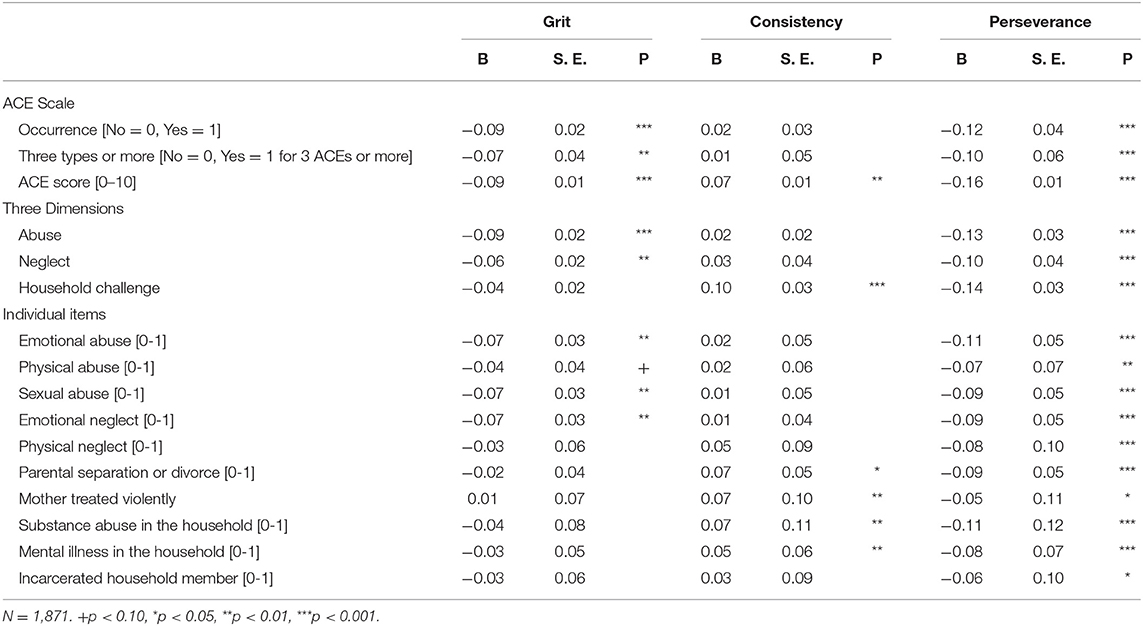
A popular research topic in psychology over the past decade, grit was first introduced in 2007 and defined as a compound personality of perseverance and passion to achieve long-term goals (Duckworth et al., 2007). Many earlier studies have shown the beneficial role of grit in achievement and life outcomes. For instance, higher levels of grit are associated with higher educational attainment, greater school and workplace performance, healthier life-style, better life satisfaction, more positive affect and less negative affect, and lower risks of mental disorders and problematic behaviors (Ferná ndez-Martí n et al., 2020;Datu, 2021). However, some recent studies start to question and re-examine grit, such as the factor structure of grit, its association with other similar constructs, and its predictive ability for outcomes (Tang et al., 2019Ponnock et al., 2020Morell et al., 2021;Tang et al., 2021;Jiang et al., 2022). This Research Topic aims to address those controversies and wishes to advance the frontiers of the grit research from a multidisciplinary perspective.
Scale (Grit-S) among 709 Chinese nurses. The authors found that the Grit-S retained a two-factor structure of the original scale, showed adequate internal consistency and test-retest reliability, had satisfactory convergent validity with the measures of self-control, psychological resilience and 'big five' personality traits. With regard to the criterion-related validity, perseverance of effort but not consistency of interest of grit was related to nursing task performance after controlling for age, gender, length of nursing work, and other personality factors. Additionally, the Grit-S exhibited good measurement invariance between nurses in general hospitals and psychiatric hospitals.These results are generally consistent with previous psychometric findings of Grit-S in other Chinese populations (Li et al., 2018;Zhong et al., 2018;Luo et al., 2020), suggesting the usefulness of Grit-S in Chinese nurses. investigated the association between social connectedness and grit; and they identified a battery of social connectedness factors linked to grit, including parental support, having been told by parents that they had done something bad, having been asked by parents to do homework, interest in school and satisfactory relationship with teachers.Fourth, from a perspective of transpersonal psychology, Agrawal et al. systematically explored the antecedents and consequences of grit in a sample of employed adults.The authors observed that several transpersonal factors (i.e., metacognition, empathy, optimism and flow) were linked to grit, which in turn enhanced job performance and job satisfaction. Taking those four studies together, they have deepened our understanding of the antecedents of grit, which may be helpful for the possible grit intervention designs.Additionally, an electroencephalography study by Aguerre et al. investigated the neurobiological substrates of grit in 120 young adults with diverse work experiences and educational backgrounds. The study found that participants with higher grit showed lower frontal theta/beta ratios during a learning task involving in top-down control processes. Moreover, perseverance of effort was found to be associated with entropy at task, indicating the task may need more effort and engagement. Importantly, these findings persisted after controlling for demographic variables and impulsiveness, a self-control related construct that is highly linked with grit (Pan et al., 2021). In line with the previous neural findings on grit (Wang and Li, 2021), those studies suggest that grit may share some unique neurobiological markers.Finally, Yu et al. focused on a type of domain-specific grit (i.e., math-specific grit) and tested its possible mediating role in the relation between math anxiety and math achievement. In study 1 based on 222 10 th -grade students, the authors observed that math-specific grit but not domain-general grit can mediate the linkage of math anxiety with math achievement. This finding was replicated in the study 2 in another group of 465 11 th -grade students; furthermore, there were a serial mediating effects of math-specific grit and math-specific procrastination on the relationship between math 6 anxiety and math achievement. Since recent literature has shown that domain-specific grit outperforms domain-general grit in predicting academic achievement (Clark and Malecki, 2019;Schmidt et al., 2019), this research may ignite more studies of domain-specific grit.As a whole, the papers in this Research Topic take multidisciplinary approaches and provide valuable insights to understand grit in different research fields. It has to be noted that given the limited data in this volume, it may be premature to draw a conclusion about the major controversies on grit. However, we hope that this volume will stimulate more scientific investigations on grit and hopeful many of its controversies can be resolved.