
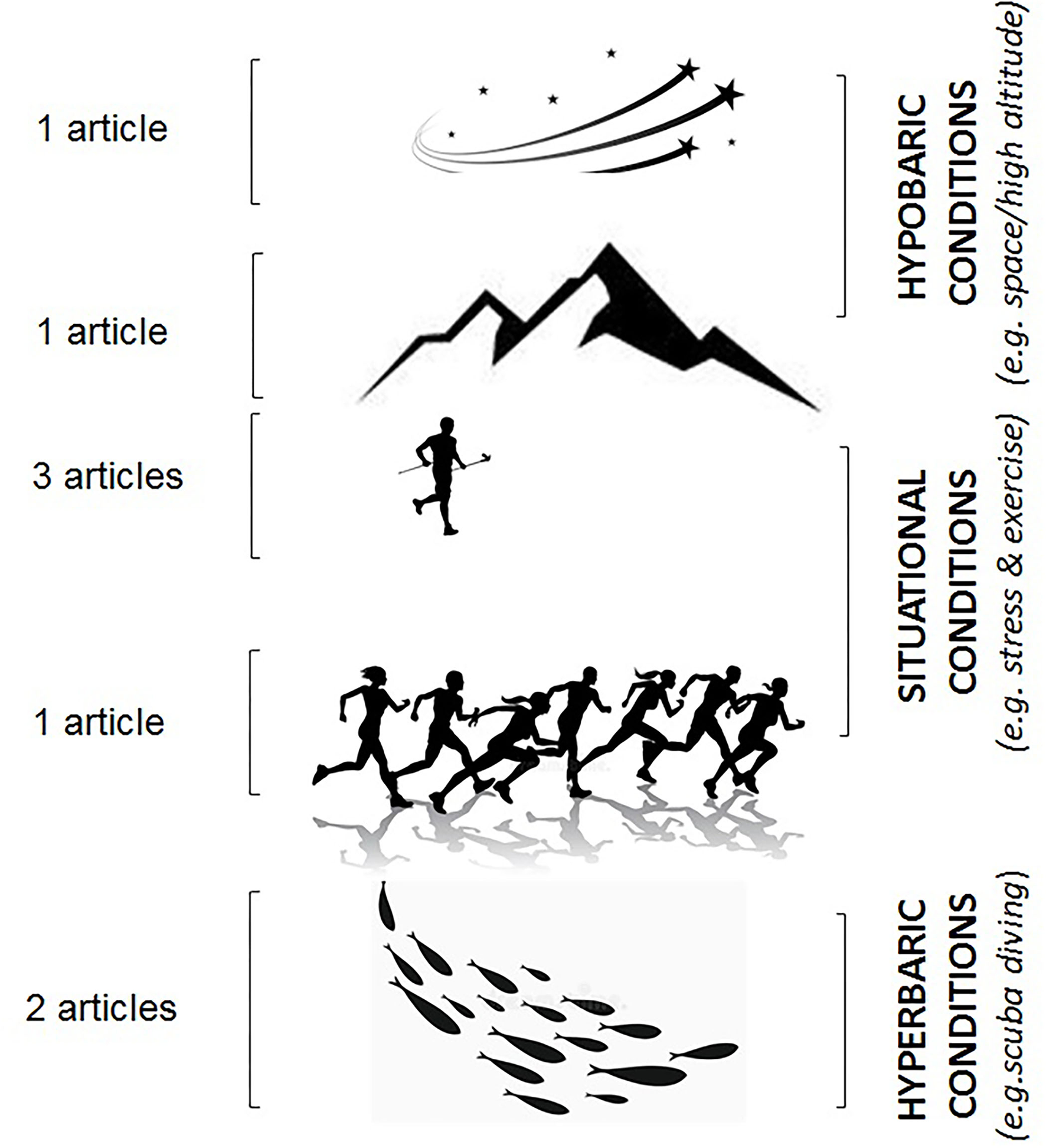
Extreme physiological conditions can be environmental, such as hypobaric (space or altitude) and hyperbaric (diving) or situational, like strenuous exercise.For the hypobaric section, one contribution by Ray AK et al focused on monitoring health due to permanence in space, by the evaluation of small nucleolar RNA (snoRNA), a type of short non-coding RNA (60-300 nucleotides), involved in cardiometabolic pathophysiology and cancer (1). Results showed changes of snoRNAs in peripheral blood mononuclear cells and plasma exosomes in astronauts after a relatively short (median 12 days long) Shuttle mission, warning about the significance of the potential translational value of snoRNAs as biomarkers to predict astronauts' health and/or disease.The article of He S et al discussed the role of neutrophil to lymphocyte ratio, a widely studied index of inflammation in recent years, which appeared to be a possible simple to calculate and cheap biomarker to assess cardiovascular risk in populations living at high altitudes (2).Three articles combined the challenging response to high altitude with the demanding effort due to ultramarathon, two focused on biochemical markers, and one on echocardiographic measurements.Specifically, the two manuscripts by Le Goff G et al evaluated the trends of biomarkers in cardiac fibrosis, remodeling and inflammation in athletes participating to the Ultra-Trail du Mont-Blanc (105 km, total elevation gain: 5600 m) and in the Tor des Geants® (330 km, +24,000 m in the Valley of Aosta, Italy) (3,4). In the first manuscript, the evaluated biomarkers increased transiently, the majority of them returning to baseline levels at 7 days after the race, suggesting more an adaptative response than a real cardiovascular injury. In their second contribution, the authors observed biphasic kinetics of cardiac fibrosis, with a relative recovery during the second half of the event, highlighting that this type of exercise may be less deleterious than shorter and more intense endurance events and that these markers of cardiac fibrosis might be measured and correlated to cardiac magnetic resonance results to assess myocardial fibrosis. Always in ultramarathon running, Wolff S et al assessed exerciseinduced cardiac fatigue (EICF) using Doppler echocardiography and myocardial deformation analysis (i.e., global longitudinal strain obtained through speckle tracking echocardiography), as a reduction of >5% of either left ventricular global longitudinal strain or right ventricular free wall strain (5). Results showed that endurance sports held at mild-moderate altitude (1,800-3,200 m) seems to induce EICF in a considerable proportion of recreational athletes, with the decrease in right ventricle function more accentuated among older subjects. However, training status, or other factors (e.g. race time or dehydration level), did not appear to be associated with EICF. In the context of endurance sports, Venturini E and Giallaura F discussed the main determinants of the marathon athlete performance to overcome the barrier of 2 h, yet to be broken, with a special focus on environmental (e.g. topography and pollution) and biomechanical factors (e.g. sheltered position, shoe technology), as well as individual characteristics (e.g. nationality, genetics and sex) (6).Over the past few decades, scuba diving has become a highly popular and widespread discipline, which, however, places the body under considerable stress which may vary according to the frequency and intensity of exercise, the duration and load of training, and environmental conditions. Two manuscripts focused on this topic. The article by Dumic J et al evaluated different cardiac and inflammation biomarkers (copeptin, immunoglobulins A, G and M, complement components C3 and C4, and differential blood count variables, including neutrophil-to-lymphocyte ratio) in recreational SCUBA divers, evidencing the progressive development of a beneficial anti-inflammatory status which might contribute to cardioprotection and confer other multiple health benefits.Instead, Mahendiran et al reported a rare case of spontaneous coronary artery dissection in a 65-yearold female diver, which rise the suspect a relationship between physical stress associated with scuba diving and the event, bringing attention to this possible complication also in female and older subjects (8).In general, the data from these studies show that extreme environments, hyperbarism and hypobarism, such as extreme conditions, like strenuous and prolonged exercise, have an impact on the cardiovascular system, which reacts through adaptive or homeostatic responses in order to preserve and protect himself. This response is immediate, transient and reversible. A testimony to this is Duric's study, which highlights the activation of an adaptive and cardiovascular protective mechanism in SCUBA diving. It can, therefore, be concluded that the adaptive response to an extreme environment or condition by normal subjects is similar to a disease state. However, the substantial difference is that these homeostatic/adaptive mechanisms are transient, i.e. in healthy subjects they are activated and deactivated, resolving with the return to normal, whereas they are continuous activated in the disease condition. The continuous activation of these systems makes them less efficient over time and, above all, causes a swift of their effect from adaptive to toxic for organs and tissues, favouring the progression of the disease. Thus, the study of athletes, i.e. superhealthy subjects, allows us not only to deepen our physiological knowledge of the limits of the human body, also with a view to improving performance, but also to gain a better understanding of the physiopathological mechanisms activating in disease conditions.