
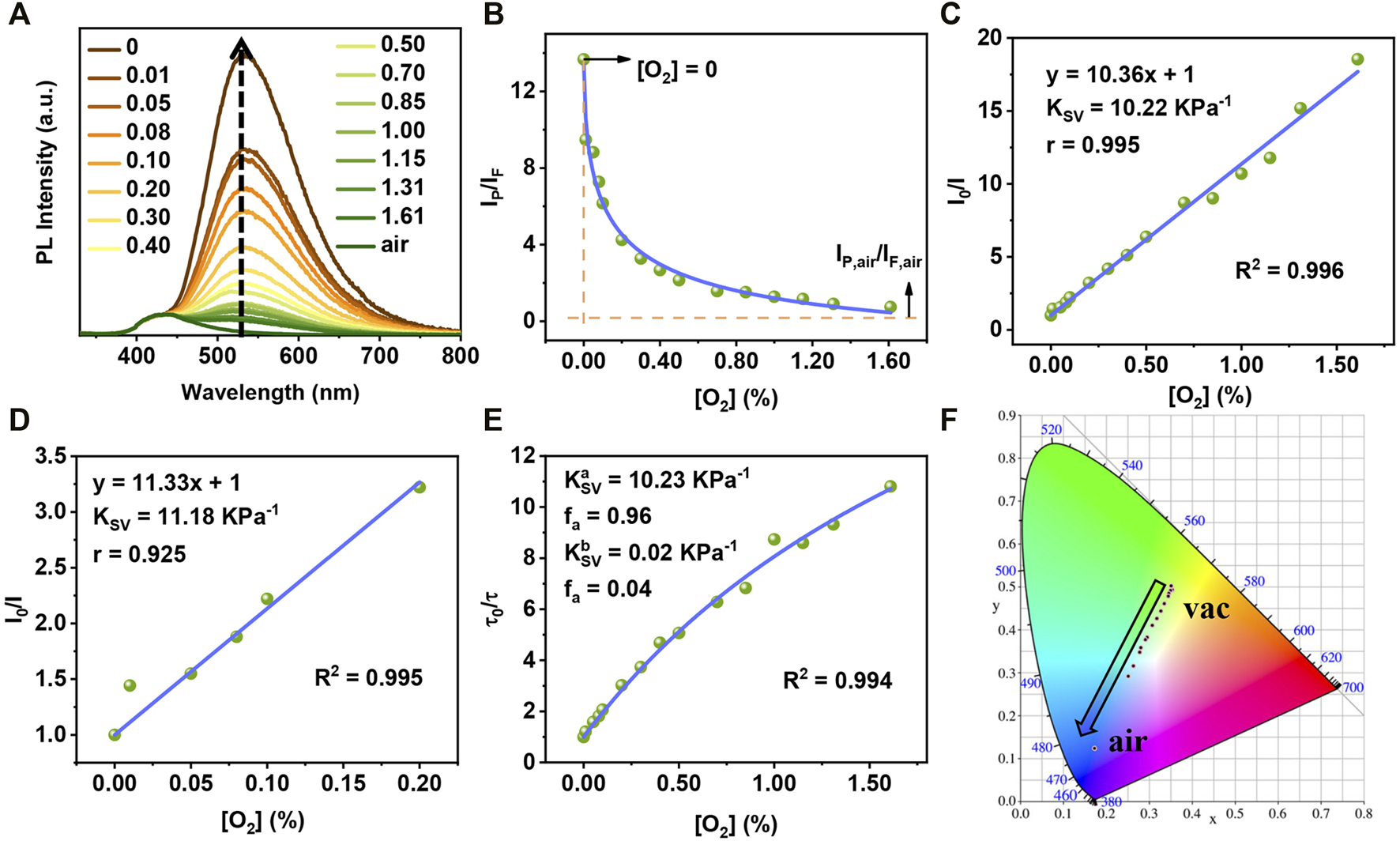
doped into amorphous polymer matrices. The thianthrene chromophores show dual emission of fluorescence and RTP in the polymers because folding-induced spin-orbit coupling of the chromophores greatly enhances the RTP characteristics. Ratiometric imaging owing to the dual fluorescence and the enhanced RTP allows easy quantitative detection of oxygen under a variety of conditions. Furthermore, the relationship between the RTP intensity and oxygen concentration provides quantitative information about the oxygen permeability in solid materials.As different triplet-quenching characteristics independent of oxygen, a study by (Thomas et al.) investigates the change of the triplet nonradiative processes of RTP chromophores doped in a polymer host under an inert condition depending on different preparation techniques of the films. Residual solvents and the role of guest chromophores in enhancing the intermolecular interactions of the polymer matrices are proposed as reasons for the different nonradiative deactivation from the triplet state. For the interaction between the guest chromophore and polymer host, the tendency of smaller triplet deactivation using polymers with lower molecular weights is also introduced.A study by (Kusama et al.) investigates the nonradiative process from the triplet state of guest chromophores under the oxygen-free condition from the viewpoint of the intramolecular nonradiative transition of the guest and the endothermic intermolecular triplet quenching between the guest and molecular host. Experiments using large different persistent RTP yield depending on thermo-reversible amorphous/crystal changes of the host-guest solid reveal that the different diffusion constants of the molecular host are largely related to the magnitude of the endothermic intermolecular triplet quenching. Although metal-free RTP materials and their applications have been reported recently, the articles in this themed issue provide proposals and novel insight for previously unclear points regarding the photophysical processes related to the triplet state from the viewpoint of RTP. The editors believe that this collection of articles will inspire readers to consider the idea of improvement of a variety of optoelectronics and photonics applications, as well as enhancement of the RTP characteristics.

9 Authors
- QZ
Qing Zhou
Engineering Research Center for Eco-Dyeing and Finishing of Textiles, China
- ML
Man Liu
Engineering Research Center for Eco-Dyeing and Finishing of Textiles, China
- CL
Chuchu Li
Engineering Research Center for Eco-Dyeing and Finishing of Textiles, China
- SL
Shijia Lu
Engineering Research Center for Eco-Dyeing and Finishing of Textiles, China
- BL
Bin Lei
Dali Silk (Zhejiang) Co., Ltd., China
- JJ
Jiantang Jiang
Engineering Research Center for Eco-Dyeing and Finishing of Textiles, China
- YY
Ying Yin
Engineering Research Center for Eco-Dyeing and Finishing of Textiles, China
- YZ
Yuanchao Zhang
Engineering Research Center for Eco-Dyeing and Finishing of Textiles, China
- YS
Yifeng Shen
Engineering Research Center for Eco-Dyeing and Finishing of Textiles, China
5 Authors
- AV
Aleksey Vasilev
University of Sofia “Saint Kliment Ohridski”, Bulgaria
- AK
Anton Kostadinov
Max Planck Institute for Polymer Research, Germany
- MK
Meglena Kandinska
University of Sofia “Saint Kliment Ohridski”, Bulgaria
- KL
Katharina Landfester
Max Planck Institute for Polymer Research, Germany
- SB
Stanislav Baluschev
Max Planck Institute for Polymer Research, Germany
3,372 views
4 citations
8 Authors
- HT
Heidi Thomas
Dresden Integrated Center for Applied Physics and Photonic Materials (IAPP), Germany
- KH
Katherina Haase
Center for Advancing Electronics Dresden (cfaed) and Faculty of Electrical and Computer Engineering, Germany
- TA
Tim Achenbach
Dresden Integrated Center for Applied Physics and Photonic Materials (IAPP), Germany
- TB
Toni Bärschneider
Dresden Integrated Center for Applied Physics and Photonic Materials (IAPP), Germany
- AK
Anton Kirch
Dresden Integrated Center for Applied Physics and Photonic Materials (IAPP), Germany
- FT
Felix Talnack
Center for Advancing Electronics Dresden (cfaed) and Faculty of Electrical and Computer Engineering, Germany
- SC
Stefan C. B. Mannsfeld
Center for Advancing Electronics Dresden (cfaed) and Faculty of Electrical and Computer Engineering, Germany
- SR
Sebastian Reineke
Dresden Integrated Center for Applied Physics and Photonic Materials (IAPP), Germany
2,937 views
7 citations
2 Authors
- KP
Khemnath Patir
Department of Chemistry, India
- SK
Sonit Kumar Gogoi
Department of Chemistry, India
4,294 views
10 citations
6 Authors
- XZ
Xiaofeng Zhang
Guangxi Key Laboratory of Optical and Electronic Materials and Devices, China
- BZ
Beibei Zhang
Guangxi Key Laboratory of Optical and Electronic Materials and Devices, China
- JL
Ji Luo
Guangxi Key Laboratory of Optical and Electronic Materials and Devices, China
- SG
Song Guo
Guangxi Key Laboratory of Optical and Electronic Materials and Devices, China
- CW
Chun Wei
Guangxi Key Laboratory of Optical and Electronic Materials and Devices, China
- YG
Yongyang Gong
Guangxi Key Laboratory of Optical and Electronic Materials and Devices, China
5,885 views
13 citations
6 Authors
- ZY
Zhiqiang Yang
State Key Laboratory of Supramolecular Structure and Materials, China
- SZ
Shuaiqiang Zhao
State Key Laboratory of Supramolecular Structure and Materials, China
- XZ
Xiangyu Zhang
State Key Laboratory of Supramolecular Structure and Materials, China
- ML
Meng Liu
State Key Laboratory of Supramolecular Structure and Materials, China
- HL
Haichao Liu
State Key Laboratory of Supramolecular Structure and Materials, China
- BY
Bing Yang
State Key Laboratory of Supramolecular Structure and Materials, China

3 Authors
- YT
Yoshika Takewaki
Department of Chemistry, Graduate School of Science, Osaka University, Japan
- TO
Takuji Ogawa
Department of Chemistry, Graduate School of Science, Osaka University, Japan
- YT
Yosuke Tani
Department of Chemistry, Graduate School of Science, Osaka University, Japan

7 Authors
- JC
Jinzhu Cao
Institute of Laser Engineering, Beijing University of Technology (BJUT), China
- MZ
Meng Zhang
Key Laboratory of Flexible Electronics (KLOFE), Institute of Advanced Materials (IAM), Nanjing Tech University (NanjingTech), China
- MS
Manjeet Singh
Key Laboratory of Flexible Electronics (KLOFE), Institute of Advanced Materials (IAM), Nanjing Tech University (NanjingTech), China
- ZA
Zhongfu An
Key Laboratory of Flexible Electronics (KLOFE), Institute of Advanced Materials (IAM), Nanjing Tech University (NanjingTech), China
- LJ
Lingfei Ji
Institute of Laser Engineering, Beijing University of Technology (BJUT), China
- HS
Huifang Shi
Key Laboratory of Flexible Electronics (KLOFE), Institute of Advanced Materials (IAM), Nanjing Tech University (NanjingTech), China
- YJ
Yijian Jiang
Institute of Laser Engineering, Beijing University of Technology (BJUT), China

7 Authors
- XY
Xiao-Gang Yang
College of Chemistry and Chemical Engineering, Luoyang Normal University, Henan Province Function-oriented Porous Materials Key Laboratory, China
- WQ
Wen-Jing Qin
College of Chemistry and Chemical Engineering, Luoyang Normal University, Henan Province Function-oriented Porous Materials Key Laboratory, China
- JZ
Ji-Rui Zhang
College of Chemistry and Chemical Engineering, Luoyang Normal University, Henan Province Function-oriented Porous Materials Key Laboratory, China
- XT
Xu-Ke Tian
College of Chemistry and Chemical Engineering, Luoyang Normal University, Henan Province Function-oriented Porous Materials Key Laboratory, China
- XF
Xin Fan
College of Chemistry and Chemical Engineering, Luoyang Normal University, Henan Province Function-oriented Porous Materials Key Laboratory, China
- LM
Lu-Fang Ma
College of Chemistry and Chemical Engineering, Luoyang Normal University, Henan Province Function-oriented Porous Materials Key Laboratory, China
- DY
Dongpeng Yan
College of Chemistry, Beijing Key Laboratory of Energy Conversion and Storage Materials, Beijing Normal University, China
2 Authors
- TK
Tomoya Kusama
Japan
- SH
Shuzo Hirata
Japan
3,597 views
6 citations