In recent years, mathematical and computational modeling (Smith et al., 2004, Walpole et al., 2013, Niederer et al., 2019 has found synergistic use alongside in vitro, ex vivo or in vivo research, providing useful mechanistic insights through simulations, where experimental capabilities are limited. Inspired by new experimental data and supported by high-performance computing, modeling is also increasingly applied in the CVS to understand mechanisms of abnormal processes and test potential therapeutic strategies (Weinberg et al., 2010, Campbell et al., 2020, Kalhöfer-Köchling et al., 2020, Costabal and Peirlinck, 2021, Pickersgill et al., 2022. To this end, computer models are developed to simulate the state of the art in technology, to guide animal experiments or clinical trials, such as tissue engineering of heart valve (Emmert et al., 2018), atrial defibrillation (Majumder et al., 2021), and aortic stent planning (Ma et al., 2022).This Frontiers research topic focuses on the current state of the art in cardiovascular system modeling, including mathematical or computational aspects, and addresses the fundamental challenges. We are delighted to include 8 articles contributed by 53 authors in this research topic. Those articles cover electrophysiology, mechanics, hemodynamics and their coupled effects.The cardiac muscle is excitable media responsible for the heart contraction under electrical stimulus. The intricate regulation of compartmental Ca 2+ concentrations in cardiomyocytes is of importance for electrophysiology, excitationcontraction coupling, and complex signaling pathways. Dysregulation of cytosolic Ca 2+ leads to various pathologies. Streiff and Sachse used a mathematical model of human ventricular cardiomyocyte to investigate the individual contributions of background Ca 2+ entry and Ca 2+ leak to the modulation of Ca 2+ transients and sarcoplasmic reticulum Ca 2+ loading under static and dynamic conditions. Their results provide quantitative insights into the differential modulation of compartmental Ca 2+ concentrations by background and leak Ca 2+ currents, and shed light on the physiological effects of background and leak Ca 2+ currents and their contribution to the development of diseases caused by Ca 2+ dysregulations.In addition to cardiomyocytes, fibroblast are also present in cardiac tissue. Brocklehurst et al. developed a twodimensional model using the discrete element method and studied the effects of fibroblast-myocyte electrical coupling (FMEC) on atrial electrical conduction and mechanical contractility. Their results show that the coupling slows down the conduction of excitation waves and reduces the tissue strain during contraction. This reveals a role of FMEC in cardiac electrical and mechanical dynamics.Abnormal propagation of electrical wave in the heart may leads to arrhythmias, such as atrial fibrillation. Patientspecific atrial model, with defined muscle fiber architecture, can be used for risk assessment and treatment planning. Rossi et al. proposed a rule-based definition of fiber orientation in patient-specific left atrium models, and performed electrophysiology simulations. They compared the new algorithm with other rule-based algorithms and demonstrated the robustness and flexibility of the new one.The cardiac chambers are surrounded by branches of coronary arteries, which deliver oxygen and nutrition to the myocardium. Coronary blood flow is an important indicator in the assessment of coronary artery disease. Munneke et al. proposed a multi-scale model for the coupling between the cardiac mechanics and coronary perfusion, with coronary mechanics and hemodynamics implemented in the closed-loop CircAdapt model. The versatility and validity of the new model was demonstrated in a case study of aortic valve stenosis followed by valve replacement. This model is expected to serve as a platform for studying cardiac-coronary coupling. Using computational fluid dynamics (CFD) modeling, Taylor et al. evaluated the inlet flow rate and microvascular resistance of 27 coronary branches in patients and determined the optimal exponent of Murray's law (Murray, 1926). The values obtained are lower than the exponent originally proposed by Murray's law, but are consistent with recent derivations based on theoretical and morphological analyses.By modeling the coupling between the aortic hemodynamics and mechanics, Zhu et al. investigated the effect of aortic wall compliance on intraluminal hemodynamics within surgically repaired type A aortic dissection. Two patient-specific aortic geometries, either deformable or rigid, were considered. Their CFD results show that the model considering wall compliance is more accurate in predicting wall shear stress, but the model with rigid wall is sufficient to predict pressure drop and computationally cheaper.Data-driven and machine learning (ML)-based computational models play an important role in understanding cardiac dynamics and hemodynamics. As an application of data-driven technique, Tossas-Betancourt et al. discussed the inconsistencies in routinely acquired anatomical and hemodynamic data from patients with pulmonary arterial hypertension, and proposed and implemented strategies to mitigate these inconsistencies, and then to use this data to inform and calibrate computational models of the ventricles and large arteries. Wang et al. proposed a fast prediction tool for modeling blood flow in stenosed arteries by using a hybrid framework of ML and immersed boundary-lattice Boltzmann method (IB-LBM). Their results show that once the neural network is trained, the prediction of blood flow in stenosed arteries is much more efficient compared to direct CFD simulations.In summary, this research topic contains articles that address different scales, physics, and anatomical components of the cardiovascular system. We believe that these modeling works can increase our understanding of the complex cardiovascular systems and hopefully help physicians to develop new therapeutic strategies. On the other hand, we are aware that in this topic there is a lack of studies that couple all relative physical fields of the heart (Verzicco, 2022), due to the obvious complexity. Based on the current advances in experimental technologies, models that incorporate new experimental data, such as detailed cardiac fiber distribution, are expected. Finally, ML, or ML combined with physical laws (Alber et al., 2019), is expected to have a greater impact in the modeling of the cardiovascular systems.
Editorial28 November 2022
Editorial: Modeling of cardiovascular systemsORIGINAL RESEARCH
12 October 2022
Simone Rossi, 4 more and Boyce E. Griffith
6 Authors
- SR
Simone Rossi
Department of Mathematics, United States
- LA
Laryssa Abdala
Department of Mathematics, United States
- AW
Andrew Woodward
Advanced Medical Imaging Lab, United States
- JP
John P. Vavalle
Department of Medicine, United States
- CS
Craig S. Henriquez
Department of Biomedical Engineering, United States
- BE
Boyce E. Griffith
Department of Mathematics, United States
3,505 views
8 citations
ORIGINAL RESEARCH
26 July 2022
Paul Brocklehurst, 1 more and Jianqiao Ye
3,389 views
1 citations

ORIGINAL RESEARCH
14 June 2022
Yu Zhu, 3 more and Xiao Yun Xu
5 Authors
- YZ
Yu Zhu
Department of Chemical Engineering, United Kingdom
- SM
Saeed Mirsadraee
National Heart and Lung Institute, United Kingdom
- UR
Ulrich Rosendahl
National Heart and Lung Institute, United Kingdom
- JP
John Pepper
National Heart and Lung Institute, United Kingdom
- XY
Xiao Yun Xu
Department of Chemical Engineering, United Kingdom
This study aimed to evaluate the effect of aortic wall compliance on intraluminal hemodynamics within surgically repaired type A aortic dissection (TAAD). Fully coupled two-way fluid-structure interaction (FSI) simulations were performed on two patient-specific post-surgery TAAD models reconstructed from computed tomography angiography images. Our FSI model incorporated prestress and different material properties for the aorta and graft. Computational results, including velocity, wall shear stress (WSS) and pressure difference between the true and false lumen, were compared between the FSI and rigid wall simulations. It was found that the FSI model predicted lower blood velocities and WSS along the dissected aorta. In particular, the area exposed to low time-averaged WSS (≤0.2 Pa) was increased from 21 cm2 (rigid) to 38 cm2 (FSI) in patient 1 and from 35 cm2 (rigid) to 144 cm2 (FSI) in patient 2. FSI models also produced more disturbed flow where much larger regions presented with higher turbulence intensity as compared to the rigid wall models. The effect of wall compliance on pressure difference between the true and false lumen was insignificant, with the maximum difference between FSI and rigid models being less than 0.25 mmHg for the two patient-specific models. Comparisons of simulation results for models with different Young’s moduli revealed that a more compliant wall resulted in further reduction in velocity and WSS magnitudes because of increased displacements. This study demonstrated the importance of FSI simulation for accurate prediction of low WSS regions in surgically repaired TAAD, but a rigid wall computational fluid dynamics simulation would be sufficient for prediction of luminal pressure difference.
Background
Quantification of coronary blood flow is used to evaluate coronary artery disease, but our understanding of flow through branched systems is poor. Murray’s law defines coronary morphometric scaling, the relationship between flow (Q) and vessel diameter (D) and is the basis for minimum lumen area targets when intervening on bifurcation lesions. Murray’s original law (Q α DP) dictates that the exponent (P) is 3.0, whilst constant blood velocity throughout the system would suggest an exponent of 2.0. In human coronary arteries, the value of Murray’s exponent remains unknown.
Aim
To establish the exponent in Murray’s power law relationship that best reproduces coronary blood flows (Q) and microvascular resistances (Rmicro) in a bifurcating coronary tree.
Methods and Results
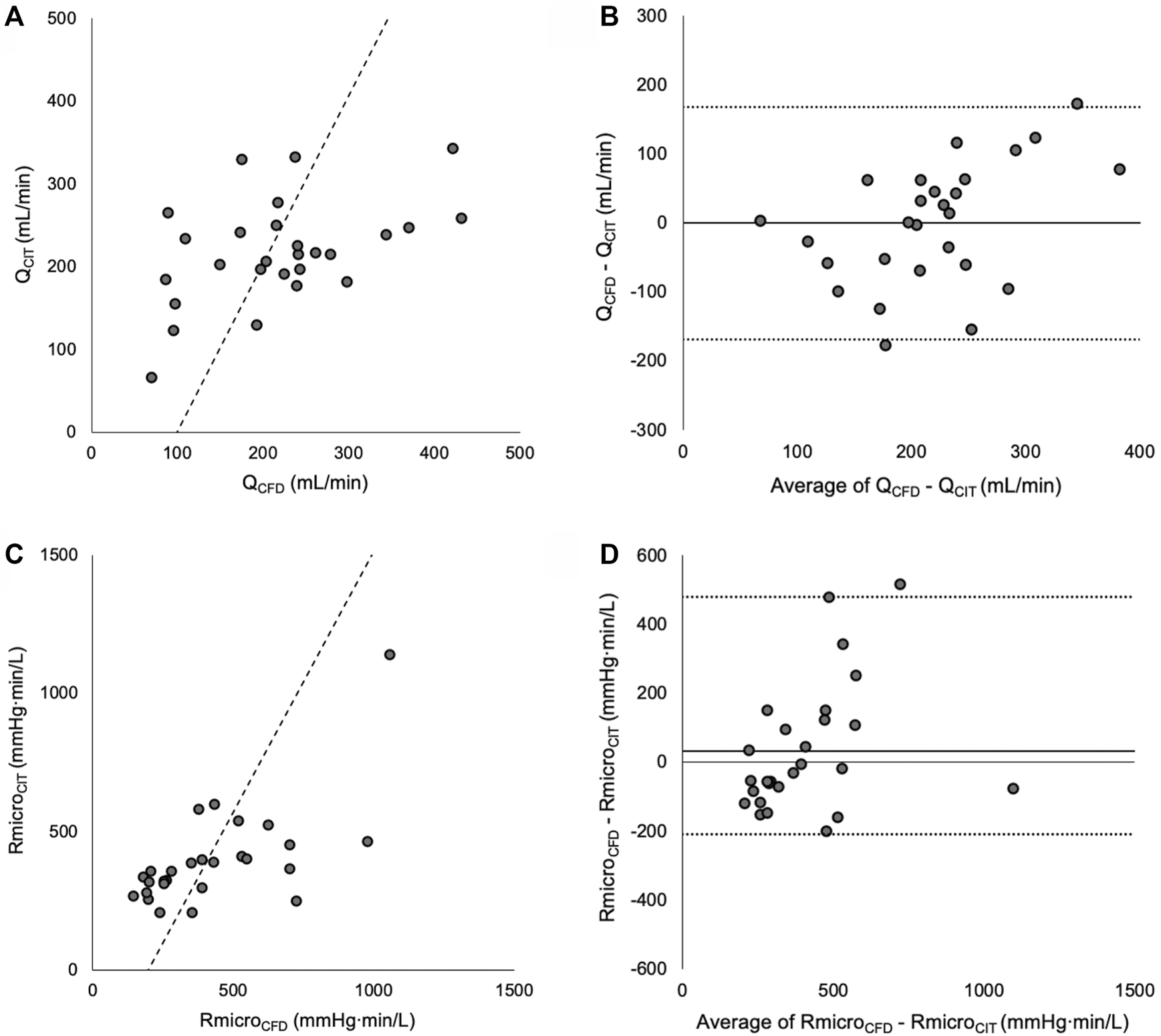
We evaluated inlet Q and Rmicro in 27 branched coronary arteries, taken from 20 patients, using a novel computational fluid dynamics (CFD) model which reconstructs 3D coronary anatomy from angiography and uses pressure-wire measurements to compute Q and Rmicro distribution in the main- and side-branches. Outputs were validated against invasive measurements using a Rayflow™ catheter. A Murray’s power law exponent of 2.15 produced the strongest correlation and closest agreement with inlet Q (zero bias, r=0.47, P=0.006) and an exponent of 2.38 produced the strongest correlation and closest agreement with Rmicro (zero bias, r=0.66, P=0.0001).
Conclusions
The optimal power law exponents for Q and Rmicro were not 3.0, as dictated by Murray’s Law, but 2.15 and 2.38 respectively. These data will be useful in assessing patient-specific coronary physiology and tailoring revascularisation decisions.