As city populations have increased, densification has often been seen as a solution to urban challenges such as sprawl, housing, and amenity provision. A compact city usually stands as the representation of improved land use (Breheny, 1996) and enhanced urban sustainability (Dempsey et al., 2012). Density, however, can also create or exacerbate urban issues, for example relating to conservation and cultural heritage (Gassner, 2019), or widening the negative impacts of property-led (re)development (Tallon 2013) including gentrification, social injustice, and housing inequalities (Immergluck & Balan, 2018). This research topic invited contributions which explore the nexus between density, sustainability, and the governance of urban futures in global cities. Each contribution reflects on questions relating to how the potential conflicts and consequences emerging from densification are being addressed (or not), across our urban environments. Through considered governance, planning and urban design agendas, which respond to specific contexts (local through to global), cities are evolving towards the apparent creation of successful and resilient urban futuresbut what will such cities look like, and how are these agendas being operationalised and experienced today?In this issue of Frontiers in Sustainable Cities, our topic includes five papers, which reflect on the complex and nuanced interpretations of density, as are explored through different types of contributions. The papers range from perspectives (Bunce) and conceptual analysis (Cipkar) on Canadian experiences, to a mini review (Livingstone et al.) and original research articles (Mellen & Short; Matillana & Livingstone) which unpack density in the UK through both London specific experiences, and broader analyses of English planning mechanisms.The two Canadian based papers each explore housing intensification as an aspect of 'gentle' densification, but from different perspectives and positions. Cipkar's conceptual analysis uses Fainstein's (2010) Just City model to consider the potential social benefits that could be achieved through the effective regulation, and encouragement of, constructing 'additional dwelling units' (ADUs), to successfully create a more spatially just and affordable housing market. ADUs are additional dwellings built on existing single-family plots by the property owners. These ADUs are usually offered for rental, augmenting supply in typically low-density neighbourhoods, and Cipkar queries whether they are ultimately producing more equitable housing outcomes, or perpetuating the 'urban sociospatial polarization in Canada' at the local level (Bourne & Hulchanski, 2020: 6). Cipkar concludes that although ADUs are not a 'silver bullet' to Canada's housing challenges, they suggest that more equitable outcomes could be achieved through varied innovative approaches and the systematic regulation of ADUs.Bunce's perspective piece examines the growth of a specific type of ADU, the garden suite (or more informally, 'beds in sheds'), and suggests that there is a 'yes in my backyard' (YIMBY) movement embracing this sort of neighbourhood intensification and apparent 'sustainable urbanism' across Toronto. The article unpacks the contradictions inherent within perspectives and policies following the recent introduction of a Garden Suite by-law and concludes that through the cultivation of YIMBYist discourses in Toronto intensification 'retains its long-standing and problematic connection with market-led, pro-growth urban development'.Three other articles contribute perspectives on density, sustainability, and urban governance in the United Kingdom. The two original research papers by Matillana & Livingstone, and Mellen & Short, specifically examine urban design agendas in London, the former in relation to conflictive policy discourses and the latter in relation to outcomes for housing across this global city.Matillana & Livingstone considers how policies relating to densification have evolved to the current 'design-led approach' and analyse the strategic and local conflicts of governance resulting from responses to planning applications which have been considered under the increasingly discretionary system within the UK. They conclude that as multiple readings of density are possible, conflictive interpretations are inevitably going to be a cause of tension across local authorities, and that outcomes are inherently connected to political will.Mellen & Short examine the specific outcomes of the delivery of high-density housing through case studies in London, querying whether policies could be better designed to improve social interactions and sustainability within such developments. They use three case studies and examine to what extent social contact and interactions were influential in the design for each development. Mellen & Short concluded generally that effectively designed developments contributed to positive social interactions and activities, although across case studies the governance mechanisms adopted by tenants and owners varied and was socio-economically and culturally specific.Livingstone, Fiorentino & Short explore a broader perspective on density, and examine its interpretation through the lens of purpose-built student accommodation (PBSA), connecting relevant policies from the national to the local, across England in key university cities. The PBSA market has been growing consistently across England in recent decades, and due to the interpretative nature of the discretionary planning system, local authorities have adopted myriad responses to policies, which reflect both similarities and differences, and vary depending on the concertedness of efforts to account for PBSA related policies in relevant plans. In conclusion, the authors suggest that there has been a somewhat delayed response to densification through PBSA policies, and that both universities and local authorities should better identify the possible locations for PBSA growth via effective policy making to create sustainable university cities.Each of the articles in this Research Topic critically reflect on possible best practices, policy making and regulatory processes, and consider approaches towards urban design and real estate development within diverse built environments. The collection of pieces in this issue ultimately observes that the different nuances and challenges offered by density in global cities are created by the variegated interests at stake within our diverse and dynamic housing markets in urban areas. The articles within this topic prompt further questions, and present thoughtful and suggestive provocations as to how we can successfully create sustainable and resilient cities of the future, through better accounting for appropriate and context specific densification.
Editorial25 August 2023
Editorial: Density, sustainability and the governance of urban futuresThis mini review explores perspectives on density and discretionary planning policy in relation to the emergent landscapes of purpose-built student accommodation (PBSA) across selected English university cities. It examines the nexus between density in planning policies and transformations in student accommodation, presenting a research gap requiring further investigation. Our research builds upon limited literature on UK PBSA within which there has been inadequate interrogation of policy impacts on the substantial growth of this now mature market sector. By better understanding the relations between national planning policies and their local interpretations regarding PBSA, we can move towards improving understandings for urban futures.The intersectionality between the evolution of the PBSA sector and the planning system are currently underexplored. The paper highlights the proliferation, densification, and concentration patterns of PBSAs and their connections to the surrounding planning system. The emergence of privately developed PBSA in the UK is typically characterised by medium to high rise, and medium to high density development. Higher density PBSA has created a dynamic spectrum of impacts reflecting subjective perceptions of their emergence in university cities. Our mini review illustrates the growth trajectory and direction of the PBSA sector. We conclude with a reflection on the discretionary nature of planning policies for density that often create regulatory loopholes allowing PBSA to thrive as a niche real estate asset class but not necessarily as a local and social collective asset.
3,683 views
2 citations
Toronto’s official intensification policy has directed increased density primarily through residential development over the last 20 years. Recently, new intensification efforts have focused on increasing density in existing residential neighbourhoods through so-called ‘gentle density’ and ‘missing middle’ built form, as a new ‘frontier’ of intensification. These efforts have included a focus on the production of garden suites on residential properties. In this short intervention, I suggest that Yes-In-My-Backyard narratives, which celebrate intensification, raise problematic arguments under the guise of sustainable urbanism and liberal progressive politics that foreclose important critiques of intensification. I argue that increased YIMBYism and new intensification efforts in Toronto are entwined with homeownership wealth-building and market-oriented property development.
2,969 views
2 citations
ORIGINAL RESEARCH
30 January 2023
1 Abstract
Over the past two decades, the Greater London Authority (GLA) has pursued the delivery of high-density development in London in order to respond to population growth whilst protecting the green belt. Though high-density places have been associated with sustainable outcomes, it is well documented that residents interact less frequently and build fewer relationships in these environments. This can be particularly detrimental since social contact is fundamental for our general well-being and happiness.
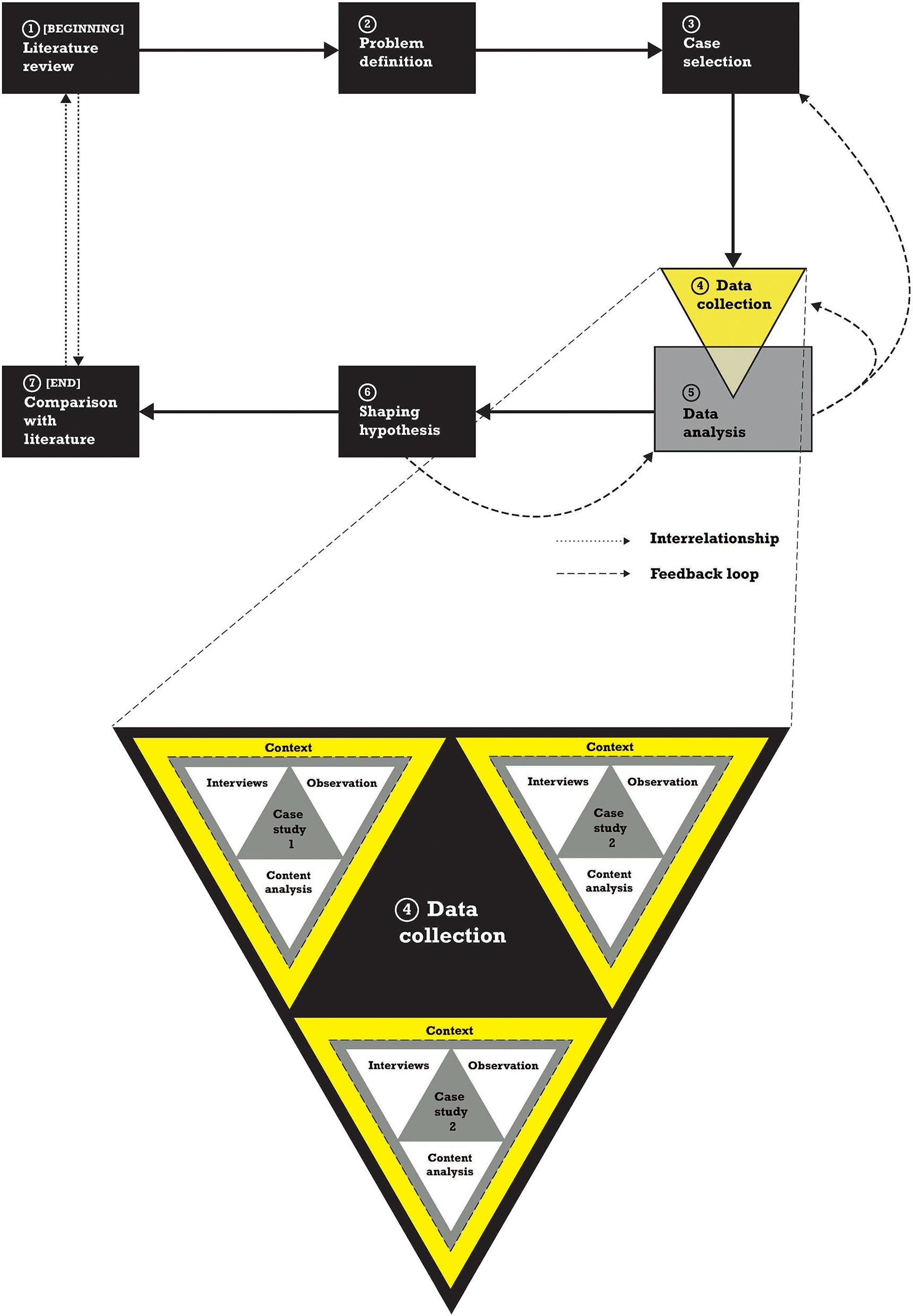
In response to this problematic, this study explored if and how we can design for social interaction in high-density housing. To do so, it adopted the process of inducting theory from case studies. Firstly, three case studies of recently completed developments were undertaken to determine whether social interaction was a driving factor in the design process, the type and location of social interactions, and clarify the influence of physical design on social contact in comparison to other factors. Three research methods were used to find answers to these questions including interviews with the residents and architects of the schemes, participant observation, and content analysis. These design-led schemes were chosen for investigation as award-winning developments which had received commendation for creating the foundations for a strong community. Next, a cross-case comparison was undertaken to identify hypotheses that addressed the research question and objectives.
Providing support for existing literature in the context of high-density housing, it was discovered that limiting the number of apartments to a building allows for collective stewardship, and that communal areas shared by smaller groups are used more intensively. Moreover, combining shared paths and communal areas was observed to support fleeting interactions and helped to nurture a local sense of community. New findings included that externalising the circulation spaces of multi-storey apartment blocks can facilitate conversations between neighbours, and that bike stores can represent an epicentre for contact if internalised and co-located with shared paths. Notably, the impact of physical design factors was not deterministic.
Using the model of a Just City (Fainstein, 2010) the goal of this paper is to contribute to the discussion of additional dwelling units (ADUs) by connecting disparate literature on ADUs in North America to the body of spatial justice and posit a way forward that recognizes the drawbacks of a system of individual property ownership, while hypothesizing that more equitable outcomes could be achieved through the inclusion of ADUs within the private market system through government regulation. This paper argues that through the lens of equity, democracy, and diversity, ADUs have the potential to lead to more just outcomes within a privatized market housing system, where homeownership is both the dominant tenure and ideology. Accounting for the inequities of informal ADUs and the contradictions within a capitalist, financialised housing system, new pathways are conceived to both encourage and regulate the ADUs to ensure security of tenure and protection against market pressures.
4,895 views
3 citations