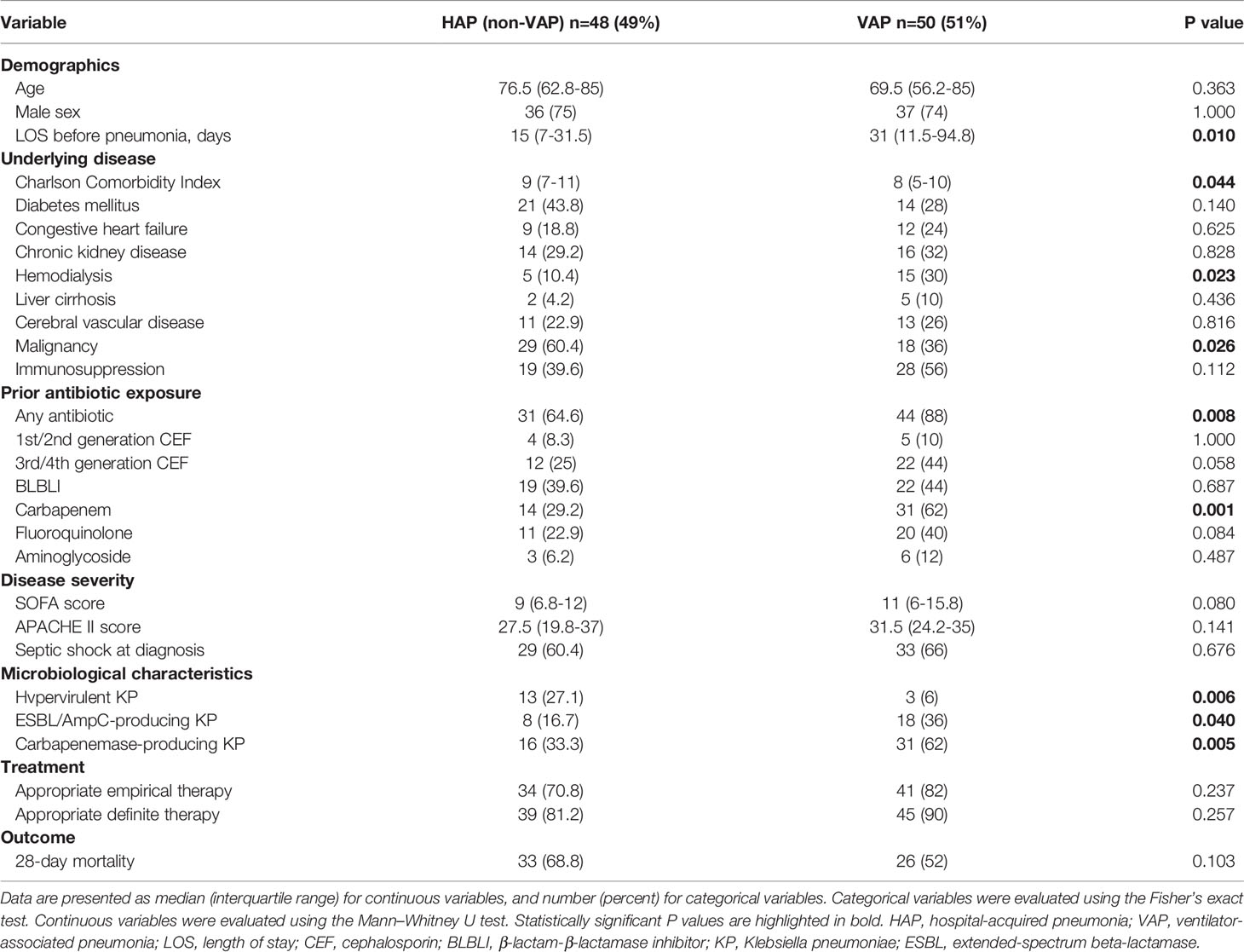
Pathogen Interaction, Molecular epidemiology, Genomic analysis Klebsiella pneumoniae is a member of the ESKAPE organisms which include 6 well-known highly virulent and antimicrobial-resistant clinical pathogens (Dong et al., 2022). K.pneumoniae has gained the ability to acquire external genetic materials that enable it to undergo constant evolution (Russo and Marr, 2019). The pathotypes reported to be associated with infections included classical (cKP) and hypervirulent K. pneumoniae (hvKP), with the former known for the capacity to acquire resistance to a wide range of antibiotics and the latter exhibiting high pathogenicity and leading to high mortality in otherwise immunocompromised hosts (Paczosa and Mecsas, 2016). To date, more than 100 distinct acquired antimicrobial resistance genes have been identified in K. pneumoniae (Wyres and Holt, 2016). Furthermore, apart from the well-established factors that help K. pneumoniae escape the innate immune mechanisms of the host, new virulence factors have been discovered (Walker et al., 2019;Walker et al., 2020;Gomes et al., 2021). Continuous effort is necessary to better understand this 'superbug' and help design feasible approaches to eradicate or halt its further evolution. As a step towards countering the threat of K. pneumoniae, our research topic brings a collection of seven selected articles exploring its molecular epidemiology, antimicrobial resistance, and pathogenesis. K. pneumoniae is a common pathogen of community-acquired pneumonia (CAP) in Asian countries (Song et al., 2008). Chen et al. revisited the burden of K. pneumoniae bacteremic pneumonia (KPBP) and determined the risk factors associated with 28-day mortality by analyzing data from 150 patients with KPBP in Taiwan from 2014-2020. A remarkably high 28-day mortality was observed in all patients. hvKP was more prevalent in CAP than in nosocomial pneumonia, yet carbapenem-resistant K. pneumoniae (CRKP) was more prevalent in nosocomial pneumonia than in CAP. Nosocomial pneumonia, Severe Organ Failure Assessment core, and lack of appropriate definitive treatment were positive predictors for 28day mortality among patients with KPBP. The results suggested host factors, disease severity, and timely effective therapy could affect the treatment outcomes of patients with KPBP.Information regarding hvKp infections in pediatric patients remains limited. Du et al. characterized K. pneumoniae strains from a children's hospital in Shanghai during 2019-2020.They found KPC-2-producing KL47-ST11 hypervirulence genes-positive (hgKp) increased dramatically from 5.3% in 2019 to 67.6% in 2020, suggesting genetic convergence of virulence and carbapenem-resistance in K. pneumoniae is increasing among children. hgKp could be classified into hvKP (32.5%) and hgKp-low virulence strains (67.5%). hvKp infections in children were mostly hospital-associated and commonly involved severe pneumonia. In hvKp, diverse genetic clones were observed and K1-ST23 and K2-ST25 were the dominant clones.These findings suggested the dramatic spread of hvKP in children. Gastrointestinal carriage is a major reservoir of K. pneumoniae infection (Gorrie et al., 2017). Migliorini et al. investigated the mechanisms associated with the transition from carriage to infection by K. pneumoniae isolates carrying blaKPC by characterizing KPC-producing strains isolated within a 10-year period. They showed the presence of resistance and virulence mechanisms were not associated with progression from colonization to infection, while intestinal colonization by carbapenem-resistant Enterobacteriaceae and, more specifically, the load of gastrointestinal carriage emerged as an important determinant of infection.ST11 is reported to be the dominant CRKP clone in China (Qi et al., 2011). TMexCD1-TOprJ1 is the first plasmid-borne RND-type tigecycline resistance determinant reported recently (Lv et al., 2020). Li et al. (2022b) The Klebsiella genus comprises a wide diversity of species apart from K. pneumoniae (Dong et al., 2022). Drug-resistant K. michiganensis strains have been increasingly reported recently. Li et al. (2022a) reported the first clinical multidrug-resistant K. michiganensis strain coharboring two blaSIM-1, one mcr-9.2, and 23 other resistance genes. They further comprehensively investigated the population structure and antibiotic-resistance genes of K. michiganensis by studying 275 publicly available genomes. Two major clades were identified, with the most popular sequence type ST29 being located in Clade 1, while other common STs (such as ST50, ST27, and ST43) in Clade 2. 25.5% K. michiganensis harbored at least one carbapenemase gene. ST27 isolates possess the most drug-resistance gene number among all the STs. The results of this study improved the understanding of K. michiganensis.Infection caused by cKP represents a significant challenge due to its rising antibiotic resistance. Mackel et al. dissected the adaptive immune responses elicited by live cKp infection and investigated how these responses protected the host from reinfection by using a lung inoculation plus challenge model. They found circulating antibody responses alone were not sufficient to mediate protection against cKP, yet either of the major T cell subsets alone (γδ or αβ) was sufficient to mediate protection; also, the circulating T cell pool was not required for the protective phenotype. These findings altogether demonstrated the imperative contribution of T cells to protective immunity against cKP which would guide further inquiries into host effector responses required to control cKP infection.The articles presented in this collection provide a valuable addition to the understanding of the notorious pathogen, K. pneumoniae. We hope these contributions will help investigators in their continuous scientific pursuit to tackle issues around the antimicrobial resistance and hypervirulence of this superbug. Related fields such as accurate and rapid pathogen detection and the design of optimal treatment regimens warrant further attention.
14 Authors
- DB
Dafne Bongiorno
Microbiology Section, Dept of Biomedical and Biotechnological Science, University of Catania, Italy
- DA
Dalida A. Bivona
Microbiology Section, Dept of Biomedical and Biotechnological Science, University of Catania, Italy
- CC
Claudia Cicino
Unit of Clinical Microbiology, Department of Health Sciences, “Magna Graecia” University, Italy
- EM
Enrico M. Trecarichi
Unit of Infectious and Tropical Diseases, Department of Medical and Surgical Sciences, “Magna Graecia” University, Italy
- AR
Alessandro Russo
Unit of Infectious and Tropical Diseases, Department of Medical and Surgical Sciences, “Magna Graecia” University, Italy
- NM
Nadia Marascio
Unit of Clinical Microbiology, Department of Health Sciences, “Magna Graecia” University, Italy
- ML
Maria Lina Mezzatesta
Microbiology Section, Dept of Biomedical and Biotechnological Science, University of Catania, Italy
- NM
Nicolò Musso
Microbiology Section, Dept of Biomedical and Biotechnological Science, University of Catania, Italy
- GF
Grete F. Privitera
Microbiology Section, Dept of Biomedical and Biotechnological Science, University of Catania, Italy
- AQ
Angela Quirino
Unit of Clinical Microbiology, Department of Health Sciences, “Magna Graecia” University, Italy
- GG
Giuseppe G. M. Scarlata
Unit of Clinical Microbiology, Department of Health Sciences, “Magna Graecia” University, Italy
- GM
Giovanni Matera
Unit of Clinical Microbiology, Department of Health Sciences, “Magna Graecia” University, Italy
- CT
Carlo Torti
Unit of Infectious and Tropical Diseases, Department of Medical and Surgical Sciences, “Magna Graecia” University, Italy
- SS
Stefania Stefani
Microbiology Section, Dept of Biomedical and Biotechnological Science, University of Catania, Italy
4,186 views
24 citations
11 Authors
- LB
Letícia Busato Migliorini
Albert Einstein Research and Education Institute, Hospital Israelita Albert Einstein, Brazil
- LL
Laura Leaden
Albert Einstein Research and Education Institute, Hospital Israelita Albert Einstein, Brazil
- RO
Romário Oliveira de Sales
Albert Einstein Research and Education Institute, Hospital Israelita Albert Einstein, Brazil
- NP
Nathalia Pellegrini Correa
Albert Einstein Research and Education Institute, Hospital Israelita Albert Einstein, Brazil
- MM
Maryana Mara Marins
Albert Einstein Research and Education Institute, Hospital Israelita Albert Einstein, Brazil
- PC
Paula Célia Mariko Koga
Laboratório Clínico, Hospital Israelita Albert Einstein, Brazil
- AD
Alexandra do Rosario Toniolo
Serviço de Controle de Infecção Hospitalar, Hospital Israelita Albert Einstein, Brazil
- FG
Fernando Gatti de Menezes
Serviço de Controle de Infecção Hospitalar, Hospital Israelita Albert Einstein, Brazil
- MD
Marines Dalla Valle Martino
Laboratório Clínico, Hospital Israelita Albert Einstein, Brazil
- JM
Jesús Mingorance
Servicio de Microbiología, Hospital Universitario La Paz, IdiPAZ, Spain
- PS
Patricia Severino
Albert Einstein Research and Education Institute, Hospital Israelita Albert Einstein, Brazil
4,311 views
20 citations
5 Authors
- JJ
Joseph J. Mackel
Department of Pediatrics, Division of Infectious Diseases, Washington University School of Medicine, United States
- CM
Catherine Morffy Smith
Department of Pediatrics, Division of Infectious Diseases, Washington University School of Medicine, United States
- RK
Rachel K. Wasbotten
Department of Pediatrics, Division of Infectious Diseases, Washington University School of Medicine, United States
- JT
Joy Twentyman
Department of Pediatrics, Division of Infectious Diseases, Washington University School of Medicine, United States
- DA
David A. Rosen
Department of Pediatrics, Division of Infectious Diseases, Washington University School of Medicine, United States
3,818 views
16 citations
15 Authors
- SL
Shuangshuang Li
Chinese Academy of Sciences (CAS) Key Laboratory of Genome Sciences and Information, Beijing Institute of Genomics, Chinese Academy of Sciences and China National Center for Bioinformation, China
- XJ
Xiaoyuan Jiang
Chinese Academy of Sciences (CAS) Key Laboratory of Genome Sciences and Information, Beijing Institute of Genomics, Chinese Academy of Sciences and China National Center for Bioinformation, China
- CL
Cuidan Li
Chinese Academy of Sciences (CAS) Key Laboratory of Genome Sciences and Information, Beijing Institute of Genomics, Chinese Academy of Sciences and China National Center for Bioinformation, China
- YJ
Yingjiao Ju
Chinese Academy of Sciences (CAS) Key Laboratory of Genome Sciences and Information, Beijing Institute of Genomics, Chinese Academy of Sciences and China National Center for Bioinformation, China
- LY
Liya Yue
Chinese Academy of Sciences (CAS) Key Laboratory of Genome Sciences and Information, Beijing Institute of Genomics, Chinese Academy of Sciences and China National Center for Bioinformation, China
- FC
Fangzhou Chen
State Key Laboratory of Pathogen and Biosecurity, Beijing Institute of Microbiology and Epidemiology, China
- LH
Lingfei Hu
State Key Laboratory of Pathogen and Biosecurity, Beijing Institute of Microbiology and Epidemiology, China
- JW
Jing Wang
State Key Laboratory of Pathogenesis, Prevention and Treatment of High Incidence Diseases in Central Asia, Department of Respiratory Medicine, First Affiliated Hospital of Xinjiang Medical University, China
- XH
Xin Hu
State Key Laboratory of Pathogenesis, Prevention and Treatment of High Incidence Diseases in Central Asia, Department of Respiratory Medicine, First Affiliated Hospital of Xinjiang Medical University, China
- BT
Bahetibieke Tuohetaerbaike
State Key Laboratory of Pathogenesis, Prevention and Treatment of High Incidence Diseases in Central Asia, Department of Respiratory Medicine, First Affiliated Hospital of Xinjiang Medical University, China
- HW
Hao Wen
State Key Laboratory of Pathogenesis, Prevention and Treatment of High Incidence Diseases in Central Asia, Department of Respiratory Medicine, First Affiliated Hospital of Xinjiang Medical University, China
- WZ
Wenbao Zhang
State Key Laboratory of Pathogenesis, Prevention and Treatment of High Incidence Diseases in Central Asia, Department of Respiratory Medicine, First Affiliated Hospital of Xinjiang Medical University, China
- DZ
Dongsheng Zhou
State Key Laboratory of Pathogen and Biosecurity, Beijing Institute of Microbiology and Epidemiology, China
- ZY
Zhe Yin
State Key Laboratory of Pathogen and Biosecurity, Beijing Institute of Microbiology and Epidemiology, China
- FC
Fei Chen
Chinese Academy of Sciences (CAS) Key Laboratory of Genome Sciences and Information, Beijing Institute of Genomics, Chinese Academy of Sciences and China National Center for Bioinformation, China
3,814 views
10 citations