Emerging Approaches for Typing, Detection, Characterization, and Traceback of Escherichia coli

198kviews

3,253 views

6 citations

ORIGINAL RESEARCH
4 July 2016
Surveillance of Extended-Spectrum Beta-Lactamase-Producing Escherichia coli in Dairy Cattle Farms in the Nile Delta, Egypt
Sascha D. Braun, 6 more and Ralf Ehricht

8,439 views

78 citations

ORIGINAL RESEARCH
30 June 2016
Whole Genome Sequencing for Genomics-Guided Investigations of Escherichia coli O157:H7 Outbreaks
Brigida Rusconi, 4 more and Mark Eppinger

11,323 views

56 citations

MINI REVIEW
20 May 2016
Rapid, Multiplexed Characterization of Shiga Toxin-Producing Escherichia coli (STEC) Isolates Using Suspension Array Technology
John M. Carter, 2 more and Matthew Lesho

15,492 views

8 citations

ORIGINAL RESEARCH
20 May 2016
Six Novel O Genotypes from Shiga Toxin-Producing Escherichia coli
Atsushi Iguchi, 6 more and Tetsuya Hayashi

5,299 views

26 citations

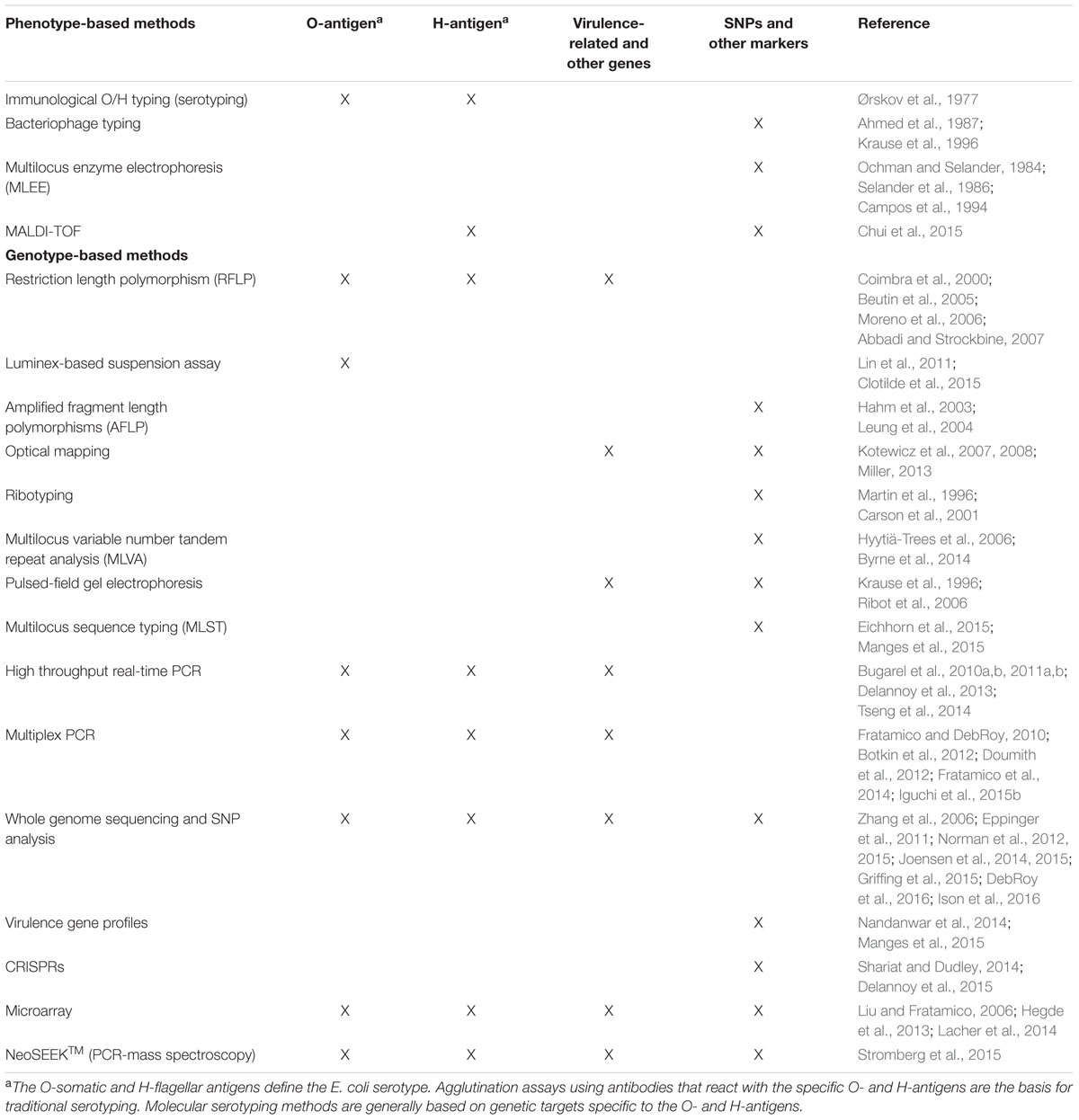
E. coli plays an important role as a member of the gut microbiota; however, pathogenic strains also exist, including various diarrheagenic E. coli pathotypes and extraintestinal pathogenic E. coli that cause illness outside of the GI-tract. E. coli have traditionally been serotyped using antisera against the ca. 186 O-antigens and 53 H-flagellar antigens. Phenotypic methods, including bacteriophage typing and O- and H- serotyping for differentiating and characterizing E. coli have been used for many years; however, these methods are generally time consuming and not always accurate. Advances in next generation sequencing technologies have made it possible to develop genetic-based subtyping and molecular serotyping methods for E. coli, which are more discriminatory compared to phenotypic typing methods. Furthermore, whole genome sequencing (WGS) of E. coli is replacing established subtyping methods such as pulsed-field gel electrophoresis (PFGE), providing a major advancement in the ability to investigate food-borne disease outbreaks and for trace-back to sources. A variety of sequence analysis tools and bioinformatic pipelines are being developed to analyze the vast amount of data generated by WGS and to obtain specific information such as O- and H-group determination and the presence of virulence genes and other genetic markers.

45,937 views

164 citations

METHODS
3 March 2016
Whole Genome Sequencing for Public Health Surveillance of Shiga Toxin-Producing Escherichia coli Other than Serogroup O157
Marie A. Chattaway, 6 more and Claire Jenkins
Shiga toxin-producing Escherichia coli (STEC) are considered to be a significant threat to public health due to the severity of gastrointestinal symptoms associated with human infection. In England STEC O157 is the most commonly detected STEC serogroup, however, the implementation of PCR at local hospital laboartories has resulted in an increase in the detection of STEC other than serogroup O157 (non-O157 STEC). The aim of this study was to evaluate the use of whole genome sequencing (WGS) for routine public health surveillance of non-O157 STEC by comparing this approach to phenotypic serotyping and PCR for subtyping the stx-encoding genes. Of the 102 isolates where phenotypic and genotypic serotyping could be compared, 98 gave fully concordant results. The most common non-O157 STEC serogroups detected were O146 (22) and O26 (18). All but one of the 38 isolates that could not be phenotypically serotyped (designated O unidentifiable or O rough) were serotyped using the WGS data. Of the 73 isolates where a flagella type was available by traditional phenotypic typing, all results matched the H-type derived from the WGS data. Of the 140 sequenced non-O157 isolates, 52 (37.1%) harboured stx1 only, 42 (30.0%) had stx2 only, 46 (32.9%) carried stx1 and stx2. Of these, stx subtyping PCR results were available for 131 isolates and 121 of these had concordant results with the stx subtype derived from the WGS data. Non-specific primer binding during PCR amplification, due to the similarity of the stx2 subtype gene sequences was the most likely cause. The results of this study showed WGS provided a reliable and robust one-step process for characterisation of STEC. Deriving the full serotype from WGS data in real time has enabled us to report a higher level of strain discrimination while stx subtyping provides data on the pathogenic potential of each isolate, enabling us to predict clinical outcome of each case and to monitor the emergence of hyper-virulent strains.

6,922 views

72 citations

ORIGINAL RESEARCH
8 February 2016
From Farm to Table: Follow-Up of Shiga Toxin-Producing Escherichia coli Throughout the Pork Production Chain in Argentina
Rocío Colello, 4 more and Nora L. Padola

6,401 views

51 citations

5,001 views

9 citations

ORIGINAL RESEARCH
22 January 2016
Revisiting the STEC Testing Approach: Using espK and espV to Make Enterohemorrhagic Escherichia coli (EHEC) Detection More Reliable in Beef
Sabine Delannoy, 6 more and Patrick Fach

9,561 views

179 citations