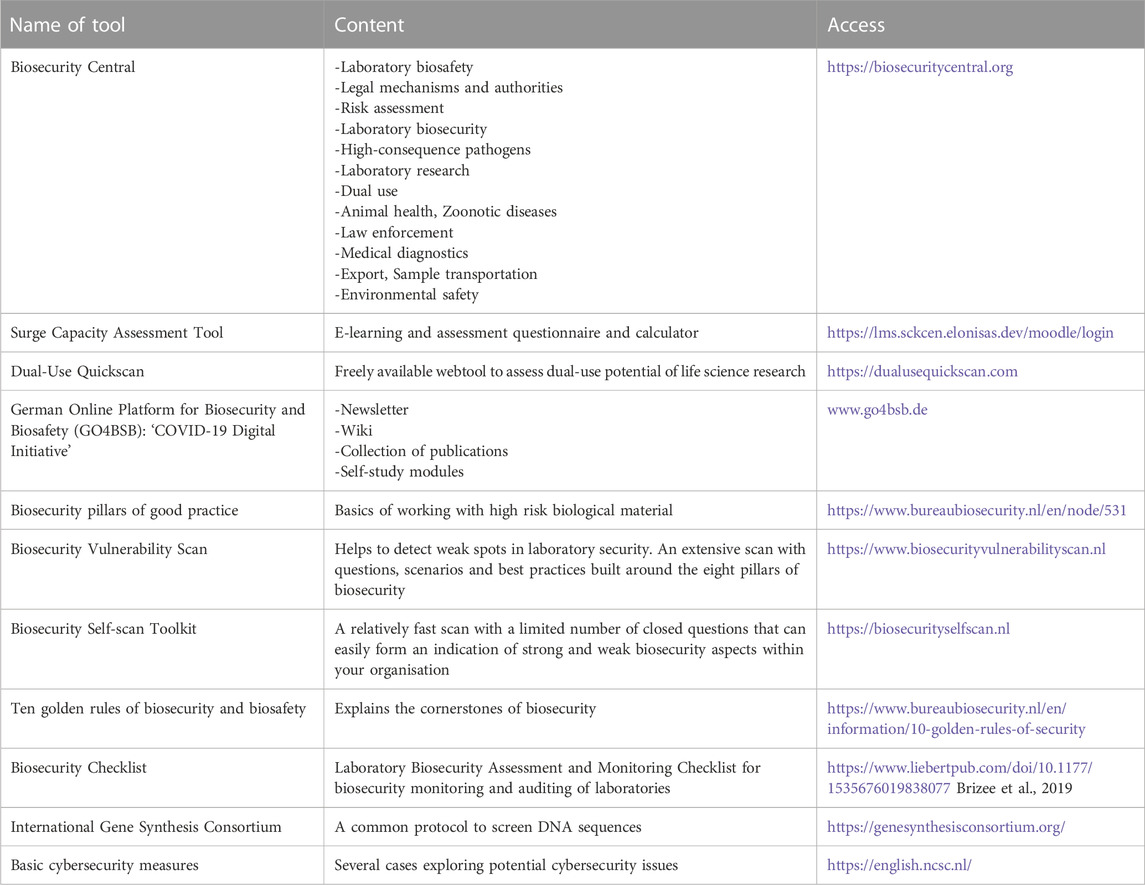
Engineering controls are one of the key measures to ensure the safety and health of the laboratorians. Kurth et al. discussed a previously unrecognized contradic�on in the design of BSL-4 laboratories. For decades, it was suggested that both direc�onal airflow and pressure differen�als were essen�al safety measures to prevent the release of pathogens into the environment and to avoid cross-contamina�on between laboratory rooms. Despite the lack of an evidencebased risk analysis demonstra�ng increased safety by direc�onal airflow and pressure differen�als in BSL-4 laboratories, they were codified in various na�onal regula�ons. The authors provided a detailed risk assessment by calcula�ng pathogen mi�ga�on in maximum contamina�on scenarios. Their results indicated that both direc�onal airflow or a differen�al pressure gradient in air�ght rooms within a secondary BSL-4 containment did not increase biosafety and were not necessary. Instead, they suggested that a reduc�on of pressure zones from the outside into secondary containment may provide sufficient environmental protec�on.High-containment laboratories (HCLs) conduct cri�cal research on highconsequence pathogens and provide diagnos�c services for the diseases they cause. Moderniza�on of HCLs has led to an increasingly cyber-connected laboratory infrastructure. Crawford et al. discussed the cybersecurity concerns specific to these HCLs to raise awareness among laboratory decision-makers and offer poten�al risk mi�ga�on strategies. Rutjes et al. observed that during the Covid-19 pandemic, the surge in demand for diagnos�c tests had a substan�al impact on biosafety and biosecurity. To prepare for the next pandemic, par�cularly in low-and middle-income countries, the authors have provided lessons learned, tools, and recommenda�ons to improve biosafety and biosecurity prac�ces to protect the front-line workers.Ou and Guo provide an overview of current research on the applica�on of synthe�c biology in biomedicine and analyze the safety risks associated with this field. Based on their analysis, they propose fundamental principles for addressing these issues and offer prac�cal recommenda�ons for ethical governance, promo�ng the development and implementa�on of relevant policies, improving legal safeguards, and enhancing biocontainment.Holub and Agena discussed biofoundries, which are highly automated facili�es for processing biological specimens, and that have a major role in accelera�ng innova�on and product development by bringing public and private stakeholders together to share resources and develop collabora�ons on na�onal and interna�onal levels. The authors present an argument for expanding the scope for biofoundries to include roles in biosurveillance and biosecurity. Sabra et al. analyzed the poten�al bioterrorism threat from Bacillus anthracis resul�ng from advances in synthe�c biology, genome edi�ng, informa�on availability, and other emerging and enabling technologies. They concluded that rapid advances and availability of technologies has led to an evergrowing number and types of actors who could poten�ally weaponize B. anthracis.Zimny proposed a reform of the European Union (EU) regulatory system for New Genomic Techniques (NGT) products to avoid placing EU researchers and investors at a disadvantage when compared to countries such as Argen�na, Brazil, Canada, United Kingdom, and the United States.
for the accountability and control of high consequence pathogens and toxins that can have a significant impact on the economy as well as the health of agricultural animals and plants. In two contribu�ons, Pillai et al 1 & 2. described a process using Mul�-criteria Decision Analysis and Decision Support Framework logic tree approaches for evalua�ng: i) agricultural animal pathogens, and ii) plant pathogens to either support their inclusion on or exclusion from the list of agents for oversight and control. In contrast to lists of human pathogens where the impact on public health and safety were the primary factors for inclusion, nonbiological criteria, i.e., economic consequences and impact on interna�onal trade agreements, were of paramount importance in these studies.The need for enhanced biosafety and biosecurity prac�ces con�nue to grow as we con�nue to discover new pathogens with high transmissibility, which can cause major outbreaks or the next epidemic or pandemic. This necessitates that scien�sts around the world conduct appropriate risk assessments and implement risk mi�ga�on procedures to ensure the safety and health of the laboratorians, their family members, and the surrounding community. As we con�nue to