
The concept of social evolution is fundamental to understanding how social changes, based on the above elements just described, have shaped the current structures of our societies. The idea of social evanescence (Marx, M. Berman), which refers to the ephemeral and fragile nature of current social structures, presents a significant challenge to the concept of social evolution. In a global world marked by crises the question arises as to whether we can create mechanisms or strategies that promote social sustainability. Let's see how the articles in this monographic issue of Frontiers have done so, which we have structured into the following thematic blocks.(1) Beriain et al. takes a sociological look at the concept of evolution in social analysis, understood in a non-teleological way, and challenges the traditional ideas of thinkers such as Comte, Spencer and Parsons, who defended a linear and progressive view of social development. The authors stress that contemporary perspectives find in the processes of cultural transmission and in the tensions between different forms of social change a more faithful understanding of social phenomena. They examine how Weber introduces a conception of modernity characterized by the tension between disenchantment and reenchantment of the world, which breaks with the notion of a unidirectional advance towards science and progress. The article suggests that we should understand social evolution as a multiple, plural and constantly tense process.(2) Labora and Fernandez-Vilas delves into how the COVID-19 pandemic has radically changed our social, cultural, economic and political life around the world. In this regard, the authors argue that we should view the pandemic as a "total social fact," a term introduced by Marcel Mauss and continued by Durkheim, meaning that complex social phenomena impact all aspects of people's lives in a given society. Indeed, COVID-19 has left traces in health, economics, politics, culture, social interrelationships and social cohesion, suggesting that society, as a whole, could be affected in the future by significant transformation. COVID-19 is not only a biological challenge, as it has also highlighted and exacerbated existing social inequalities and disproportionately affected the most vulnerable communities and individuals.(3) Maya Aguiluz's text explores the semantic origin of the transformations that the relationship between Nature and Culture has undergone. In some contexts, this relationship is presented as a continuum, while in others it is shown as a well-defined duality between the two spheres. The condition that makes this argument possible is analyzed on the basis of a narrative that begins to objectify nature" within the new modern cosmology that emerged in the seventeenth century, influenced by the contributions of Galileo and Descartes. Sociological evidence is presented that challenges the validity of this separation between Nature and Culture. The resurgence of the natureculture continuum is examined in the context of a new late modern cosmology.(4) Fan's article delves into the theoretical approaches of multiculturalism, social capital and sustainability by exploring social sustainability in contexts where cultural diversity is key. To do so, he used a two-stage methodological design: in the first, a systematic review of 210 academic publications was conducted, from which conceptual elements were extracted to help define new constructs at the micro level: individual social inclusion, individual social capital and individual social sustainability. In the second phase, he conducted a textual analysis of 130 short interviews (with a total of 173 participants). This study also provides an innovative perspective by highlighting the role of micro social inclusion and individual social capital in everyday life as essential drivers of social sustainability.(5) Buribayev et al. explores how values have changed in Kazakh society, focusing on youth and their connection to past generations. An interesting duality is highlighted: young people still value family and community, but, at the same time, they are increasingly inclined toward individualism, self-expression, and personal success. Indeed, the findings demonstrate that while the majority of young people consider family to be their most important value, there is a notable decline in the relevance they ascribe to other traditional values, such as work commitment and religion. The study reveals that Kazakh youth are experiencing an increase in personal well-being and satisfaction with life, even though the importance of friendships and religion has declined.(6) Nasri and Souid explores how Physical Education teachers play a crucial role in the socialization of students in schools and how this discipline not only focuses on the development of physical skills, but also promotes the acquisition of verbal, relational and emotional competencies, which are key to social integration. It also mentions that socialization through physical education can positively influence how students view themselves and others, helping them face challenges such as respect for diversity and inclusion. The article highlights that Physical Education teachers, being role models, have a great responsibility in transmitting values and encouraging positive behaviors, which contributes to social cohesion and the comprehensive development of adolescents.(7) Francisco Carrera's article delves into the fascinating connection between Transhumanism, Education and Hermeneutics. He proposes an approach that seeks to balance technological advancement with the preservation of essential human values. Carrera argues that today's education needs to adapt to the speed of knowledge in this digital age, without forgetting the achievements of the past. The author suggests that education should be an interpretive process in which educators act as guides who help students navigate between traditional knowledge and the new realities that are emerging.(8) Gómez-Redondo and Obregón focuses on the need for a more flexible and adapted pedagogy that fosters social and educational sustainability in different contexts. Based on the notion of authors such as Van Mannen (or, further back in time, Herbart), they propose "pedagogical tact" (the ability of educators to adjust to changing classroom situations) and "edusemiotics" (the study of signs and meanings in education) as fundamental tools for promoting sustainable education. This perspective requires teacher training that values the interpretation and adaptation of educational cues, as well as a deep understanding of socio-cultural contexts.This monographic issue has emphasized the social and educational changes experienced by contemporary societies in specific countries of the world, although its approach can be assumed to be general and universal. By focusing on structural variations, it has made it possible to confirm not only the validity and importance of the social evolutionary approach, but also its multidimensional character.The editors Juan R. Coca (University of Valladolid, Spain), Susana Gómez-Redondo (University of Valladolid, Spain) and Juan A. Roche Cárcel (University of Alicante, Spain).
Editorial27 June 2025
Editorial: The evolution and sustainability of societal systemsIn this article, I analyze the semantic genesis of the mutations experienced by the nature–culture binomial, which, in some cases, tends to be a continuum and in others, tends to the dualization of both domains. I begin with a brief analysis of the transcendence of the classical reflection on Nature from the phenomenology of Maurice Merleau-Ponty to stop my attention on the marked nature–culture duality in the no less classical formulations from specific works of Sigmund Freud and Claude Lévi-Strauss, even when this dualism is enriched by the conceptual variation in the work of each one. In the second part, I analyze the condition of possibility on which the above argumentation rests on the basis of a preparatory narrative that proceeds to objectify “nature” in the new modern cosmology that emerges in the seventeenth century with the stamp of Galileo and Descartes. In the third part, I analyze a whole set of sociological evidence that questions the plausibility of this separating duality between nature and culture. In the fourth part, I analyze the return of the nature–culture continuum that emerges at the hands of a new cosmology in late modernity that receives the stamp of James Lovelock and Bruno Latour.
3,055 views
1 citations
These pages provide a theoretical approach to the notion of pedagogical tact and its relation to a sustainable and transformative school from an edusemiotic approach. Pedagogical tact can be translated as the ability to generate a certain atmosphere in educational interaction. This requires sensitivity and interpretative skills. We associate the notion of tact and care with current proposals for sustainability as attention to the development of the present without compromising the needs of future generations. We propose an itinerary for educational and learning theories based on the semiotics of Charles S. Peirce and his idea of human experience as a sign to be interpreted. All this implies a relational use of the sign based on the interaction between people and their environment from positions of sustainable development. In other words, the new agenda is based on relational, integrative, empathetic, anticipatory, and systematic reflection of schools according to UNESCO.
2,027 views
1 citations
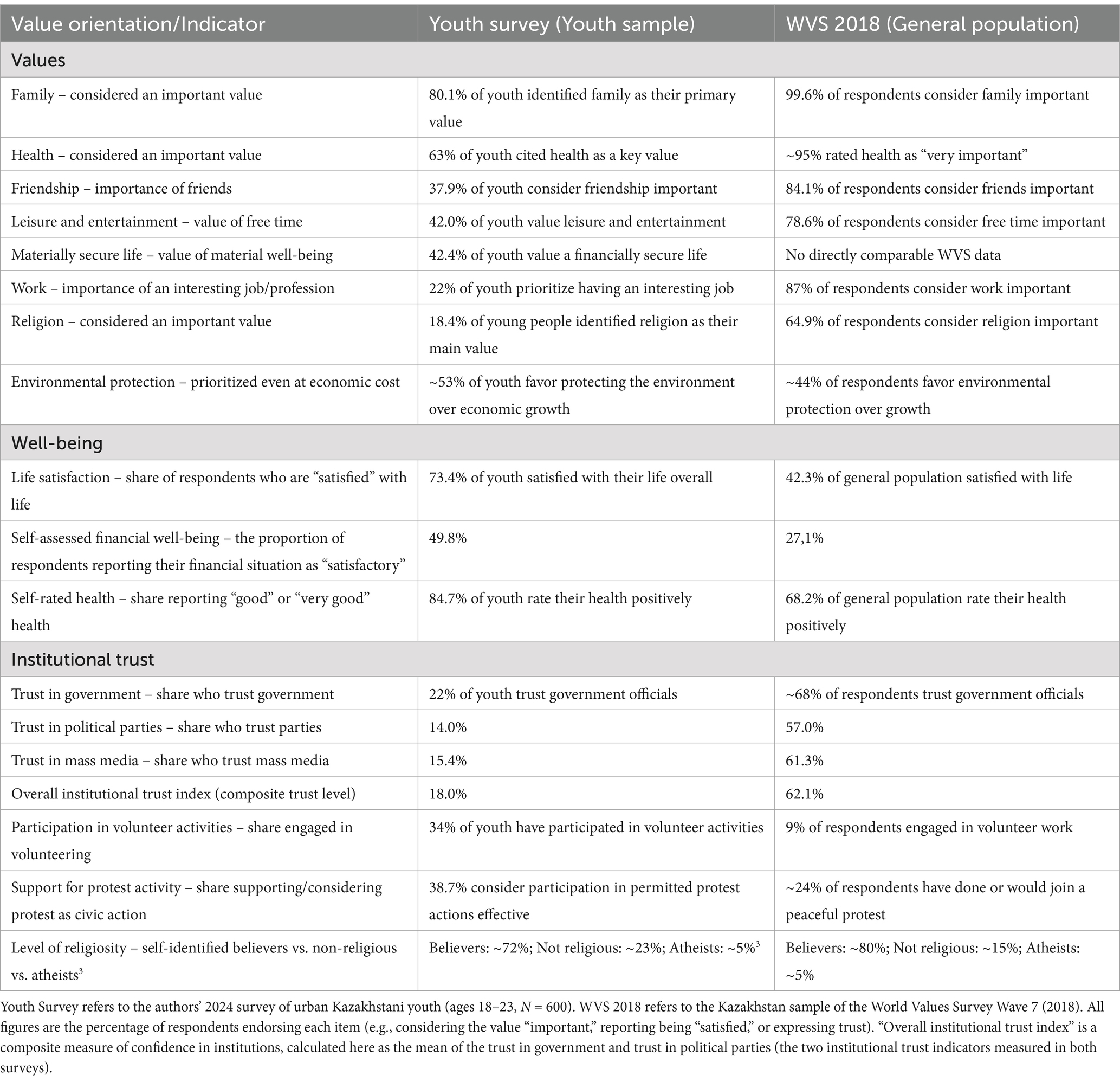
IntroductionIn this manuscript, a study of the social values of Kazakhstani youth is presented in the context of the new social reality of independent Kazakhstan. The purpose of this work is to identify the similarities and differences in the value priorities of youth compared to national trends, as well as to determine the factors influencing the formation of values in modern Kazakhstani society.MethodsThe methodological basis of the study is a sociological survey conducted among Kazakhstani youth, whose results were compared with the 2018 World Values Survey (WVS) data. Such a comparative analysis enables a deeper understanding of the specific characteristics of the value orientations of the younger generation.ResultsThe value orientations of Kazakhstani youth were analyzed and compared with the results of the 2018 WVS conducted in Kazakhstan. The identified trends reflect the influence of globalization and socio-economic changes on the value priorities of youth.DiscussionThe findings have practical significance for the development of effective youth policies that take into account the specific value orientations and needs of the younger generation. This approach contributes to their social integration and supports the sustainable development of Kazakhstan.
The COVID-19 pandemic was an unprecedented global event in recent history. Beginning with an initial outbreak in Wuhan, China, in December 2019, the virus spread rapidly across the globe, causing millions of deaths and triggering an unprecedented health, economic, and social crisis. The initial response to the outbreak in many countries was the implementation of social distancing measures, including the closure of schools and businesses, the cancellation of mass events, and the banning of travel. These measures were aimed at reducing the virus' spread and preventing health systems from being overwhelmed by the numerous severe COVID-19 cases. However, these measures also had a devastating economic impact, especially on precarious workers and freelancers, as well as those who were unable to work from home. As the pandemic (also considered a syndemic or synergistic epidemic) dragged on, countries adopted more flexible approaches to dealing with the virus, adopting mitigation measures rather than social distancing measures. These included the use of masks, testing and contact tracing, and the opening of businesses and schools with the implementation of additional safety measures. This paper highlights the social consequences of the pandemic, ultimately arguing that it is a total social fact (from the French fait social total), based on Marcel Mauss' categorization, since it encompassed and impacted all facets of human life.
10,825 views
8 citations
The aim of this paper is to carry out a sociological-conceptual genealogy of the evolutionist perspective -non-teleological-of approaching social reality. While during the first phases of modernity a teleological and progressive conception of evolution was imposed, clearly manifested in the proposals of Auguste Comte or Herbert Spencer, in the last decades important bifurcations, processes and developments have emerged that question the linearity and the finalist character of these positions. We believe consider that these approaches are closer to the nature of change and social phenomena, so it seems important to us to analyze some of the most outstanding contributions -in the form of sociological genealogy, as we have already mentioned -that have developed this perspective. In order to carry out our task we have organized four sections: In the first, we make a critique of the sociological evolutionism represented by Comte, Spencer and Parsons, focusing on the limits of their proposals and the blind spots associated with them. Secondly, we will analyze the anti-teleological cognitive approaches of Donald and Tomasello, and the importance they attach to cultural transmission as a key element for understanding the evolution of both cognition and human societies. In a third moment, we will analyze the coexistence in Weber's work between dynamics of 'disenchantment' and 'reenchantment' of the world in modern societies, understood as the two sides of the same coin that are in constant dynamic tension, and that break with the evolutionary vision that goes from magic through religion to science, or from belief to knowledge. In a fourth moment we analyze the relevance of approaches focused on what we have called 'multiple evolutions' (plural) that collide with each other -the conflicting simultaneity of the non-simultaneous-, of their rhythms and directions, inspired by works of Knöbl, Koselleck, Luhmann, Rosa, Eisenstadt, Abbott and Zerubavel, which pave the way for the construction of a non-teleological approach to evolution.
6,240 views
4 citations
OPINION
10 April 2024
Bechir Nasriand Ines Souid
2 Authors
- BN
Bechir Nasri
Higher Institute of Sport and Physical Education of Kef, University of Jendouba, Tunisia
- IS
Ines Souid
University of Lyon, France
3,827 views
HYPOTHESIS AND THEORY
10 May 2024
Francisco José Francisco Carrera
2,846 views