
operative period. The extrapolated results confirm the absence of correlation between the application of the WIC and the development of infections and secondary complications. Based on this, the authors encourage further scientific research on the topic as it could represent a valid tool for the management of pain induced by spinal surgery in equine species. A study on the application of loco-regional analgesia in large animals was also carried out by Interlandi et al., who evaluated the efficacy of the local application of butorphanol alone and in association with lidocaine in calves undergoing umbilical hernia repair. The study demonstrated that both protocols are safe and valid in ensuring good intra-and post-operative analgesia in this species, reducing pain and stress, and increasing animal welfare. Pain treatments in dogs are largely studied, especially in the field of orthopedic pain. Galosi et al., evaluated the synergistic efficacy of Magnesium Sulphate (MgSO4) and Ketamine in dogs undergoing TPLO. The aim was to evaluate whether MgSO4, acting in potentiating synergism with Ketamine, could provide better perioperative analgesia. The results showed that the ketamine/MgSO4 association resulted in a lower rescue analgesia request and opioid consumption. This protocol could represent a useful analgesic support in dogs affected by orthopedic acute pain. Instead, regarding the management of chronic pain from orthopedic pathology, such as osteoarthritis, different analgesic protocols have been studied in dogs. A valid example is the study conducted by Enomoto et al., who evaluated the efficacy of the association grapiprant/fish oil/exercise in young dogs affected by OA, for a period of 4 months, demonstrating that the multimodal treatment guaranteed a significant clinical benefit to the treated subjects. Similarly, Naurepon et al., compared the efficacy of green-lipped mussel/krill oil, meloxicam, Biota orientalis extracts and a placebo (sunflower oil) for 6 weeks in young dogs affected by OA. Results showed a significant clinical benefit in patients that received the anti-inflammatory or the green-lipped mussel/krill oil compared to the other two groups. Data obtained could be significant in defining a suitable multimodal therapy that includes the synergism between multiple molecules. In conclusion, the results of studies and reviews mentioned include interesting findings on diagnosis and treatment of pain in small and large animals, that contribute to a constant improvement in our clinical and experimental activity.
Editorial17 January 2025
Editorial: Pain assessment and management in veterinary medicine
IntroductionWith little to no regulation of the supplement markets and a paucity of quality information regarding clinical utility of individual marketed supplements, it is difficult for veterinarians to provide any evidence-based recommendations to owners. The current study aimed to provide clinically useful comparative efficacy data on certain marketed supplements.MethodsUsing a prospective, block-randomized, double-blinded, placebo-controlled design, one hundred and one pet dogs with clinical hip OA-associated pain with one side worse than the other (index limb) were randomly assigned to one of four treatment groups: Green lipped Mussel plus Krill oil extracts (Antinol® Rapid, EAB-277); Biota orientalis extracts (4CYTE™ Epiitalis® Forte); an NSAID (meloxicam); or placebo (sunflower oil). Peak vertical force (PVF, expressed as a percentage of bodyweight) of the index limb, orthopedic assessment score (OAS) and hematology and blood chemistry values were evaluated before treatment (week 0), at 2, 4 and 6 weeks during treatment.ResultsAt 6 weeks, the changes from baseline in PVF of the index limb in the EAB-277 and meloxicam groups were significantly greater than the change in the placebo and 4CYTE™ groups, and the placebo and 4CYTE groups were not different from each other. At 6 weeks, there were significant differences between the groups for overall OAS scores with the lowest scores (least impairment) in the EAB-277 and meloxicam groups, followed by the 4CYTE group and then the placebo group.DiscussionResults of this study indicate that meloxicam and EAB-277 have significant objectively measured benefits in managing OA-related pain in dogs compared to placebo, but 4CYTE does not differ from placebo.
REVIEW
17 July 2024
Ludovica Chiavaccini, 1 more and Guido Chiavaccini
3 Authors
- LC
Ludovica Chiavaccini
Department of Comparative, Diagnostic, and Population Medicine, College of Veterinary Medicine, University of Florida, United States
- AG
Anjali Gupta
Department of Comparative, Diagnostic, and Population Medicine, College of Veterinary Medicine, University of Florida, United States
- GC
Guido Chiavaccini
Independent Researcher, Italy
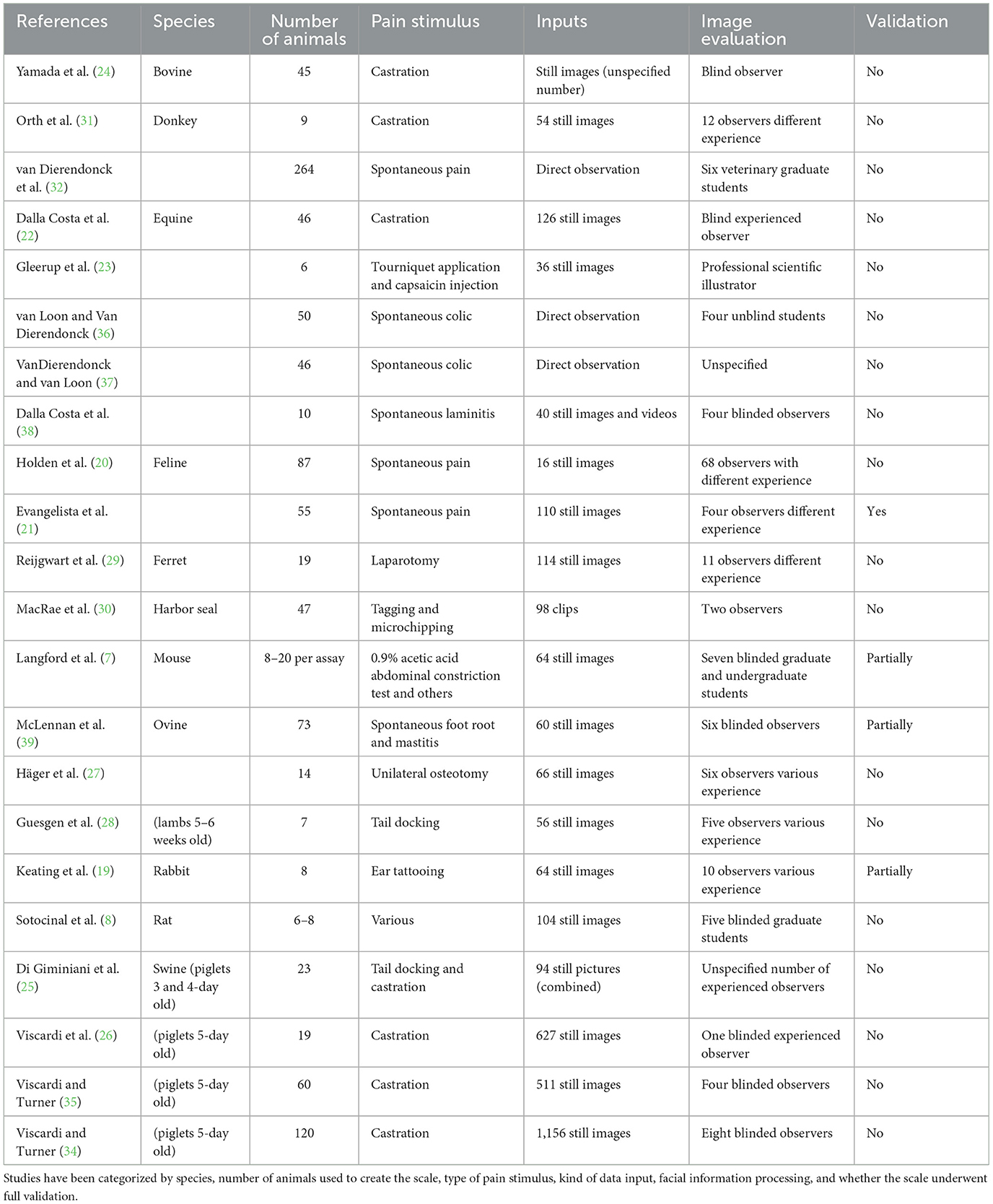
Facial expressions are essential for communication and emotional expression across species. Despite the improvements brought by tools like the Horse Grimace Scale (HGS) in pain recognition in horses, their reliance on human identification of characteristic traits presents drawbacks such as subjectivity, training requirements, costs, and potential bias. Despite these challenges, the development of facial expression pain scales for animals has been making strides. To address these limitations, Automated Pain Recognition (APR) powered by Artificial Intelligence (AI) offers a promising advancement. Notably, computer vision and machine learning have revolutionized our approach to identifying and addressing pain in non-verbal patients, including animals, with profound implications for both veterinary medicine and animal welfare. By leveraging the capabilities of AI algorithms, we can construct sophisticated models capable of analyzing diverse data inputs, encompassing not only facial expressions but also body language, vocalizations, and physiological signals, to provide precise and objective evaluations of an animal's pain levels. While the advancement of APR holds great promise for improving animal welfare by enabling better pain management, it also brings forth the need to overcome data limitations, ensure ethical practices, and develop robust ground truth measures. This narrative review aimed to provide a comprehensive overview, tracing the journey from the initial application of facial expression recognition for the development of pain scales in animals to the recent application, evolution, and limitations of APR, thereby contributing to understanding this rapidly evolving field.

ORIGINAL RESEARCH
20 February 2024
María Olcoz, 1 more and Ignacio A. Gómez de Segura
3,479 views
3 citations
ORIGINAL RESEARCH
4 July 2024
Carlota Emilia Mascaró Triedo, 2 more and Karine Portier
4 Authors
- CE
Carlota Emilia Mascaró Triedo
VetAgro Sup, CREFAC, Université de Lyon, France
- SK
Sahra Karar
VetAgro Sup, CREFAC, Université de Lyon, France
- MA
Maha Abunemeh
VetAgro Sup, CREFAC, Université de Lyon, France
- KP
Karine Portier
VetAgro Sup, CREFAC, Université de Lyon, France
2,658 views
2 citations