Nuclear Thermal Hydraulic and Two-Phase Flow

Cover image for Research Topic "Nuclear Thermal Hydraulic and Two-Phase Flow"
101kviews
Editorial10 August 2018
Editorial: Nuclear Thermal Hydraulic and Two-Phase Flow

Nuclear Thermal hydraulic and two phases flow research is always a typical component in nuclear engineering research from 1960s. In American Nuclear Society (ANS) annual meeting, thermal hydraulic and two phases flow is always the largest branch. International meeting on nuclear reactor thermal hydraulic (NURETH) starts at 1980s, provides the communication platform for all the scientists in this region. As the first research topic in Frontiers in Energy Research, Nuclear Section, this topic is with great expectation. I highly appreciate the opportunity to work with Prof. Shi, Prof. Meng, and Prof. Revankar.

Along with the development of computer technology, more modern simulation tools are involved, together with experiments, make contributions to the thermal hydraulic and two phases flow research. This technology is more about the highly geometry-dependent transient phenomena, provide structure design and safety optimization of nuclear power plants. The existing research regions mainly include: general thermal hydraulic, thermal hydraulic experiment, two phases flow modeling, boiling and condensation, safety analysis of current reactors and Gen IV reactors, computation fluid dynamics simulation, system code development and validation, critical heat flux (CHF), core thermal hydraulic and subchannel analysis, severe accident and so on.

Experiment is still the most important part of basic thermal hydraulic. Mechanism study of steam condensation with air in an imaged reactor component vertical tube experimental facility is conducted by Ms. Wang (Wang, et al., 2018). Some basic thermal hydraulic is studied by self-developed code. A one-dimension gas turbine system transient code is developed for compressible flow simulation based on hybrid semi-implicit method by another Wang. (Wang, et al., 2018).

Thermal hydraulic modelling can now be studied by computation fluid dynamics simulation. Subcooled boiling, which may appear in the vertical pipe of a reactor system, is studied by Mr. Zhang (Zhang, et al., 2018). The uncertainties from the software Fluent is also considered in Zhang’s work. Another simulation work to study the flow distribution in reactor system heat exchangers is done by Zhou (Zhou, et al., 2018), who aims to reduce this situation to avoid system risk. Luchao studies the single-phase nanomaterial flow of CuO-water by looking into the hydromechanics and heat transfer mechanics. (She, et al., 2018). In the reactor, grids will affect the coolant flow, and bring in turbulence which may affect heat transfer. Mr. Dong builds a model to study this situation by predicting the critical heat flux.

Thermal hydraulic is always coupled with neutronics, to provide highly accurate simulation of the core performance. For example, a theoretical Ultra-high temperature fuel is designed by Mr. Song (Song, et al., 2018) based on neutronics and thermal hydraulic analysis, which could provide capacity for the nuclear electric propulsion system. Core thermal hydraulic improves the primary use efficiency of nuclear power, and also gives the core safety performance analysis. Mr. Sun works on this region, and also provide a core thermal hydraulic design to for a micro nuclear system. (Sun, et al., 2018).

Severe accident turns to be one of the popular topics after Fukushima Daiichi nuclear disaster. Dr. Wang made a review work on severe accident history and core degradation mechanics during his time at Xi’an Jiaotong University supervised by Prof. Guanghui Su. (Wang, et al., 2018). Ms. Yin uses MELCOR, which is developed by Sandia National Laboratory, conducting a whole small modular reactor severe accident analysis to study its response during a station blackout. (Yin, et al., 2018). Containment is the final safety protective screen in nuclear power plants. Wen tries to find a way to help keeping containment integrity by testing surface tension of a kind of coolant material. (Wen, et al., 2018).

Future thermal hydraulic research will have various difference. Multi-physical coupled code including neutronic, fuel, mechanics and thermal hydraulic development is taking more important position. Meanwhile, more core thermal hydraulic experimental data are still required, especially for the critical heat flux, and accident tolerant fuels. Computation fluid dynamics technology is still developing, and it should be better for two phases flow simulation. Severe accident and accident tolerant fuels thermal hydraulic are still important parts.

2,962 views

Numerical Investigation of the Effect of Grids and Turbulence Models on Critical Heat Flux in a Vertical Pipe
ORIGINAL RESEARCH
3 July 2018
Numerical Investigation of the Effect of Grids and Turbulence Models on Critical Heat Flux in a Vertical Pipe
Xiaomeng Dong, 3 more and Guangliang Chen

4,321 views

25 citations

ORIGINAL RESEARCH
24 July 2018
Effect of the Wick and the Working Medium on the Thermal Resistance of FPHP
Bin Sun, 2 more and Hongwei Li

6,059 views

10 citations

ORIGINAL RESEARCH
7 June 2018
Reducing the Flow Distribution in Central-Type Compact Parallel Flow Heat Exchangers Having Optimized Tube Structure
Jian Zhou, 3 more and Zhongning Sun

5,178 views

2 citations

ORIGINAL RESEARCH
28 May 2018
Experimental Study on the Condensation of Steam With Air Out of the Vertical Tube Bundles
Lu Wang, 5 more and Zhaoming Meng

5,587 views

12 citations

ORIGINAL RESEARCH
25 May 2018
A Hybrid Semi-implicit Method of 1D Transient Compressible Flow for Thermal-Hydraulic Analysis of (V)HTR Gas Turbine Systems
Jie Wang, 3 more and Ming Ding

2,850 views

6 citations

ORIGINAL RESEARCH
22 May 2018
Accident Process and Core Thermal Response During a Station Blackout Initiated Study for Small Modular Reactor
Shasha Yin, 5 more and Zhihui Chen

3,168 views

8 citations

ORIGINAL RESEARCH
16 April 2018
Neutronics and Thermal Hydraulics Analysis of a Conceptual Ultra-High Temperature MHD Cermet Fuel Core for Nuclear Electric Propulsion
Jian Song, 2 more and Wenxi Tian

4,953 views

8 citations

Reactor Core Design and Analysis for a Micronuclear Power Source
ORIGINAL RESEARCH
22 March 2018
Reactor Core Design and Analysis for a Micronuclear Power Source
Hao Sun, 4 more and Guanghui Su
Underwater Vehicle is designed to ensure the security of country sea boundary, providing harsh requirements for its power system design. Conventional power sources, such as battery and Stirling engine, are featured with low power and short lifetime. Micro nuclear reactor power source featured with higher power density and longer lifetime would strongly meet the demands of unmanned underwater vehicle (UUV) power system. In this paper, a 2.4MWt lithium heat pipe cooled reactor coreis designed for micro nuclear power source, which can be applied for underwater vehicles. The core features with small volume, high power density, long lifetime, and low noise level. Uranium nitride fuel with 70% enrichment and lithium heat pipes are adopted in the core. The reactivity is controlled by 6 control drums with B4C neutron absorber. Monte Carlo code MCNP is used for calculating the power distribution, characteristics of reactivity feedback and core criticality safety. A code MCORE coupling MCNP5 and ORIGEN2 is used to analysis the burnup characteristics of the designed core. The results show that the core life is 14 years, and the core parameters satisfy the safety requirements. This work provides reference to the design and application of the micro nuclear power source.

9,828 views

12 citations

ORIGINAL RESEARCH
11 April 2018
Investigation on the Subcooled Boiling in Vertical Pipe With Uncertainties From Boundary Conditions by Using FLUENT
Xiang Zhang, 2 more and Tenglong Cong

3,506 views

4 citations

ORIGINAL RESEARCH
12 March 2018
Measurement for Surface Tension of Aqueous Inorganic Salt
Jiming Wen, 3 more and Haifeng Gu
Measurement for Surface Tension of Aqueous Inorganic Salt
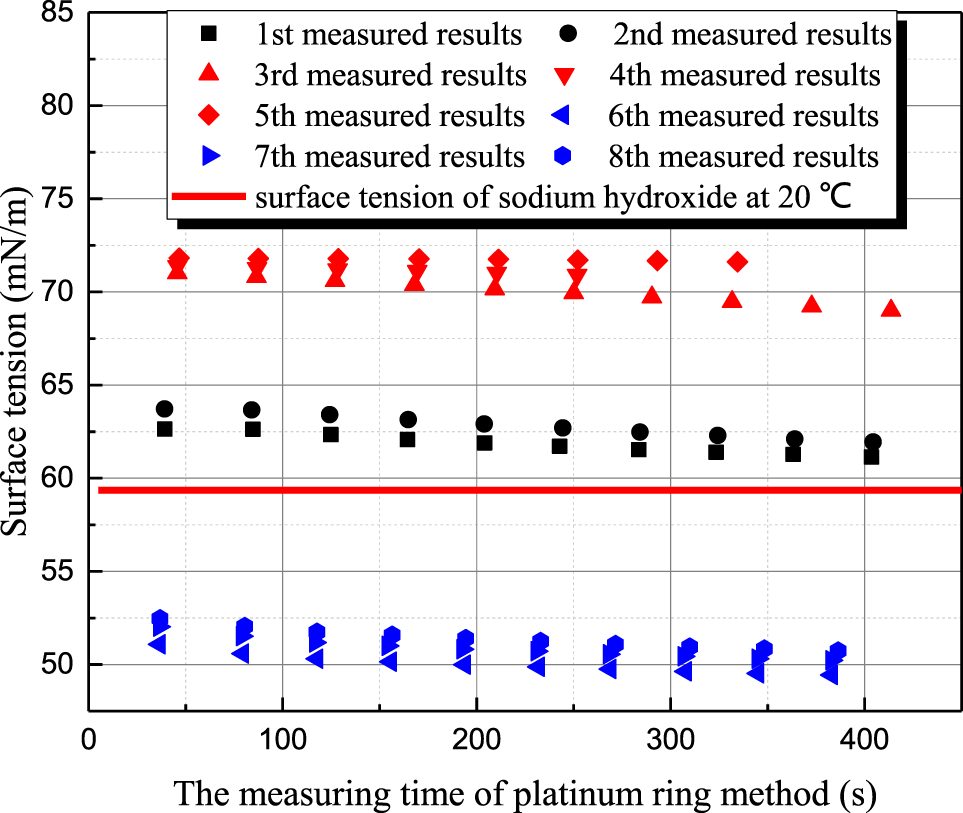
Bubble columns are effective means of filtration in filtered containment venting systems. Here, the surface tension has a significant influence on bubble size distribution and bubble deformation, which have a strong impact on the behavior of the bubble column. The influence of aqueous inorganic compounds on the surface tension depends on the electrolytic activity, Debye length, entropy of ion hydration and surface deficiencies or excess. In this work the surface tensions of same specific aqueous solutions have been measured by different methods including platinum plate method, platinum ring method and maximum bubble pressure method. The measured surface tensions of both sodium hydroxide and sodium thiosulfate are less than that of water. As solution temperature ranges from 20 ℃ to 75 ℃, the surface tension of 0.5 mol/L sodium hydroxide solution decreases from 71 to 55 mN/m while that of 1 mol/L solution decreases from 60 to 45 mN/m. Similarly during the same temperature range, the surface tension of 0.5 mol/L sodium thiosulfate decreases from 70 to 38 mN/m and that of 1 mol/L sodium thiosulfate is between 68 and 36 mN/m. The analysis for the influence mechanism of aqueous inorganic on surface tension is provided. In addition, experimental results show that the surface tension of solid aerosol suspension liquid has no obvious difference from that of distilled water.

19,828 views

23 citations