ORIGINAL RESEARCH
17 April 2020
HpaR, the Repressor of Aromatic Compound Metabolism, Positively Regulates the Expression of T6SS4 to Resist Oxidative Stress in Yersinia pseudotuberculosis
Zhuo Wang, 10 more and Xihui Shen

5,840 views

18 citations

ORIGINAL RESEARCH
17 December 2019
The Campylobacter jejuni Type VI Secretion System Enhances the Oxidative Stress Response and Host Colonization
Janie Liaw, 11 more and Nick Dorrell

10,301 views

54 citations

ORIGINAL RESEARCH
30 October 2019
Identification of a Contact-Dependent Growth Inhibition (CDI) System That Reduces Biofilm Formation and Host Cell Adhesion of Acinetobacter baumannii DSM30011 Strain
Morgane Roussin, 5 more and Sarah Bigot

8,487 views

31 citations

ORIGINAL RESEARCH
13 September 2019
Life After Secretion—Yersinia enterocolitica Rapidly Toggles Effector Secretion and Can Resume Cell Division in Response to Changing External Conditions
Bailey Milne-Davies, 4 more and Andreas Diepold

6,699 views

35 citations

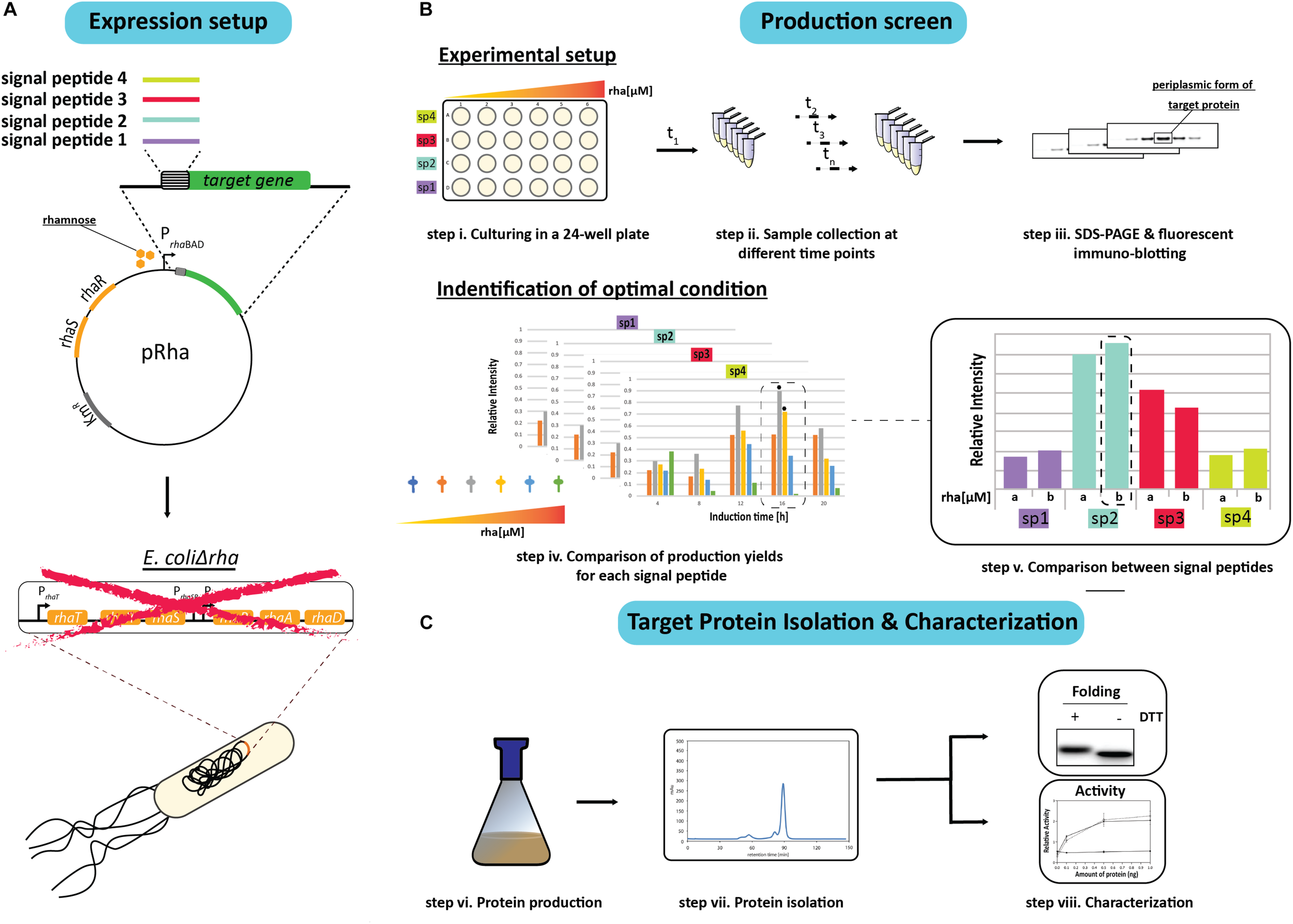
Proteins that contain disulfide bonds mainly mature in the oxidative environment of the eukaryotic endoplasmic reticulum or the periplasm of Gram-negative bacteria. In E. coli, disulfide bond containing recombinant proteins are often targeted to the periplasm by an N-terminal signal peptide that is removed once it passes through the Sec-translocon in the cytoplasmic membrane. Despite their conserved targeting function, signal peptides can impact recombinant protein production yields in the periplasm, as can the production rate. Here, we present a combined screen involving different signal peptides and varying production rates that enabled the identification of more optimal conditions for periplasmic production of recombinant proteins with disulfide bonds. The data was generated from two targets, a single chain antibody fragment (BL1) and human growth hormone (hGH), with four different signal peptides and a titratable rhamnose promoter-based system that enables the tuning of protein production rates. Across the screen conditions, the yields for both targets significantly varied, and the optimal signal peptide and rhamnose concentration differed for each protein. Under the optimal conditions, the periplasmic BL1 and hGH were properly folded and active. Our study underpins the importance of combinatorial screening approaches for addressing the requirements associated with the production of a recombinant protein in the periplasm.

44,501 views

62 citations

ORIGINAL RESEARCH
11 July 2019
A Potential Late Stage Intermediate of Twin-Arginine Dependent Protein Translocation in Escherichia coli
Hendrik Geise, 3 more and Thomas Brüser

3,177 views

6 citations

Bacteria secrete proteins for different purposes such as communication, virulence functions, adhesion to surfaces, nutrient acquisition or growth inhibition of competing bacteria. For secretion of proteins, Gram-negative bacteria have evolved different secretion systems, classified as secretion systems I through IX to date. While some of these systems consist of multiple proteins building a complex spanning the cell envelope, the type V secretion system, the subject of this review, is rather minimal. Proteins of the Type V secretion system are often called autotransporters. In the simplest case, a type V secretion system consists of only one polypeptide chain with a β-barrel translocator domain in the membrane, and an extracellular passenger or effector region. Depending on the exact domain architecture of the protein, type V secretion systems can be further separated into sub-groups termed type Va through e, and possibly another recently identified subtype termed Vf. While this classification works well when it comes to the architecture of the proteins, this is not the case for the function(s) of the secreted passenger. In this review, we will give an overview of the functions of the passengers of the different autotransporter classes, shedding more light on the variety of functions carried out by type V secretion systems.

40,559 views

188 citations

ORIGINAL RESEARCH
5 June 2019
A Type VI Secretion System Trans-Kingdom Effector Is Required for the Delivery of a Novel Antibacterial Toxin in Pseudomonas aeruginosa
Benjamin Berni, 3 more and Sophie Bleves

9,574 views

75 citations

Bacteria-Killing Type IV Secretion Systems
Bacteria have been constantly competing for nutrients and space for billions of years. During this time, they have evolved many different molecular mechanisms by which to secrete proteinaceous effectors in order to manipulate and often kill rival bacterial and eukaryotic cells. These processes often employ large multimeric transmembrane nanomachines that have been classified as type I to IX secretion systems. One of the most evolutionarily versatile are the Type IV secretion systems (T4SSs), which have been shown to be able to secrete macromolecules directly into both eukaryotic and prokaryotic cells. Until recently, examples of T4SS-mediated macromolecule transfer from one bacterium to another was restricted to protein-DNA complexes during bacterial conjugation. This view changed when it was shown by our group that many Xanthomonas species carry a T4SS that is specialized to transfer toxic bacterial effectors into rival bacterial cells, resulting in cell death. This review will focus on this special subtype of T4SS by describing its distinguishing features, similar systems in other proteobacterial genomes, and the nature of the effectors secreted by these systems and their cognate inhibitors.

36,673 views

157 citations