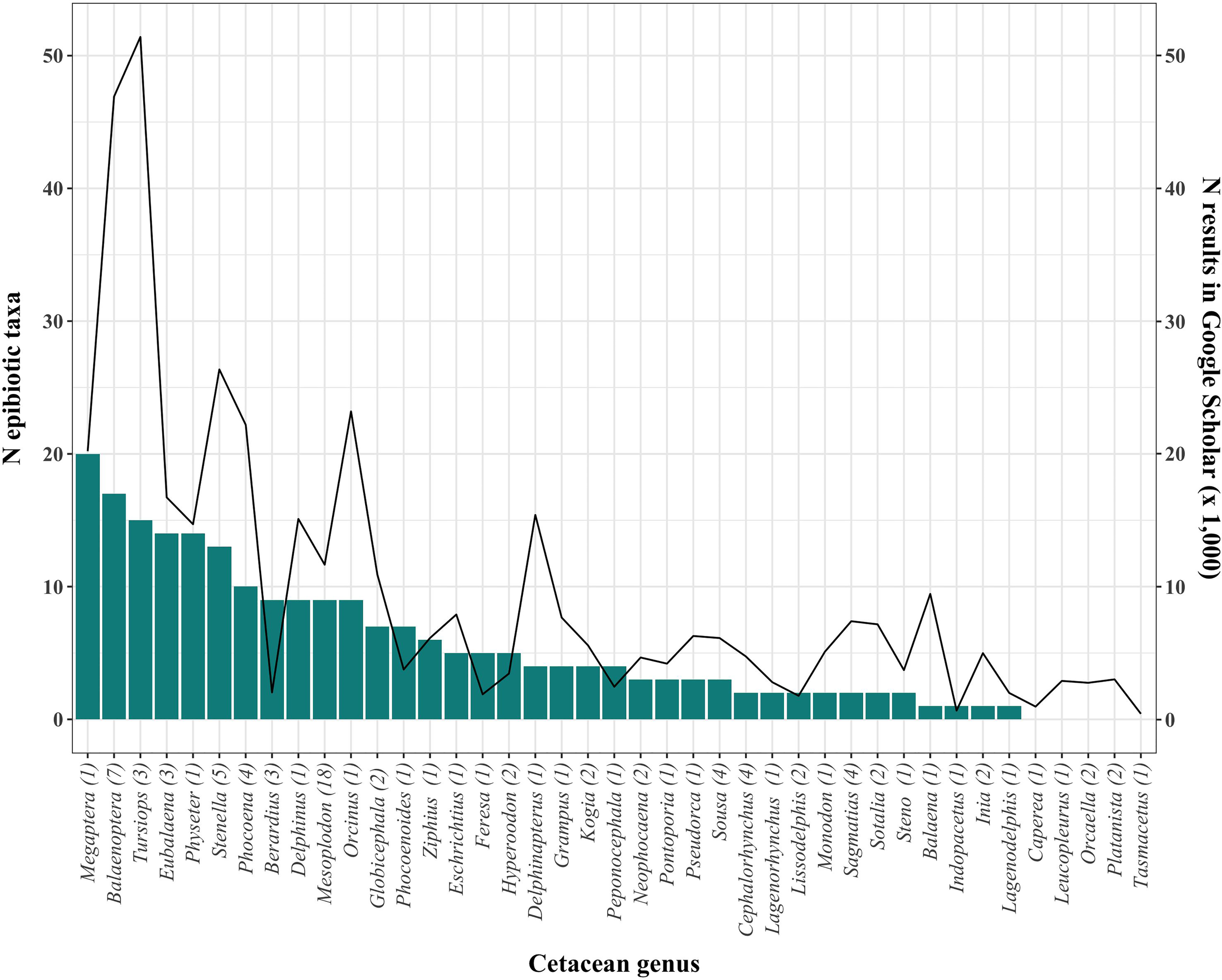
The marine domain is often divided into two broad zones: benthic and pelagic. The former consists of habitats and organisms related to the oceanic bottom, whereas the latter refers to the water column and its free-living inhabitants. However, this classification largely overlooks many surface-associated forms that are not necessarily linked to either the bottom or the water column but, rather, utilise any available hard-surfaced substrata. The various properties of water, especially seawater, as a medium favour sessility even in animals. While the availability of hard substrata is high at the ocean floor, the high ratio of the ocean volume to the surface area of its bottom might suggest that much of this environment is, to a great extent, inaccessible to sessile organisms due to a lack of attachment points. However, very often, especially in the open ocean, hard surfaces can be provided by larger organisms, which has encouraged the evolution of a unique lifestyle -epibiosis (Fig. 1).Although the meaning of the term "epibiosis" continues to develop alongside the field of marine biology, most existing definitions describe this phenomenon as the spatial association between a basibiont (substratum organism) and an epibiont (an organism attached to the basibiont's outer surface). Some definitions highlight the lack of trophic dependency of the involved organisms, while others exclude negative interactions such as parasitism. However, recent evidence suggests that the relationships between epi-and basibionts may be more complex and intimate than previously thought. This is especially true for many microepibionts that are only now receiving more research attention. For example, the ability of epibionts to access food will often depend on basibiont behaviour and physiology (Wahl et al. 2012). Therefore, the perceived lack of a direct or indirect trophic relationship, or the direction of interactions between epibiont and basibiont, may insufficiently define the true nature of epibiosis. Here, we define epibionts as life forms that live on the external body surfaces of a basibiont, regardless of their trophic relationship with that host organism. Such associations may have beneficial, deleterious, or neutral outcomes for both the epi-and the basibiont.Any physiological cost of evolutionary adaptation to life on the surface of other organisms may be outweighed by the benefits derived from access to a substratum unavailable to less-specialised organisms. Thus, in the oceanic realm, epibioses are omnipresent, with many marine organisms having both a free-living and an epibiotic stage during their life cycles. Nevertheless, despite our increasingly refined understanding of the relationships between epi-and basibionts, numerous areas of this topic are yet to be identified and explored. For example, questions concerning the consequences of the various types of epibioses on biodiversity, food web dynamics, and biotic responses of the marine systems to environmental changes and disturbance are rarely raised and addressed. Therefore, this Research Topic highlights some of the most recent observations and discoveries in this broad and seemingly simple but poorly understood field.Sea turtles are one of the most iconic marine basibionts, whose carapaces and skin are almost universally colonised by both macro-and microepibionts. In recent decades, there has been a steadily growing interest in sea turtle epibioses. Numerous studies have shown that the composition of epibiotic communities may give clues about the spatial ecology, behaviour, and health of their hosts, thus highlighting the relevance and importance of sea turtle epibiosis research for marine megafauna and habitat conservation (Pinou et al. 2018). Robinson and Pfaller summarise the current knowledge on animal macroepibionts (>1 mm) on sea turtles. They provide an exhaustive list of taxa recorded on sea turtles to identify knowledge gaps and assess biases in the current literature. Even though macroepibionts have long been reported from sea turtles, not all sea turtle species, populations, life stages, geographic regions, and habitats are equally well-researched, and new epibionts will likely be identified with increased and more carefully planned sampling and diagnostic efforts. Longhmannia et al. provide information on epibiont communities from a relatively poorly investigated population of hawksbill turtles nesting in the Persian Gulf. They conclude that epibiont communities, especially at the micro-level, may differ between geographically close nesting beaches due to local environmental conditions. Similar conclusions are drawn by Silver-Gorges et al., who sampled loggerhead turtles nesting in the northern Gulf of Mexico. They used information derived from both stable isotope analysis of sea turtle tissues and the taxonomic composition of the epibiont community to identify animal-associated taxa that could be used as indicators of their hosts' ecology and foraging areas. They observed that smaller meiofaunal taxa were generally more discriminative indicators of sea turtle foraging ecology than larger macroepibionts. This may be related to the fact that some common sea turtle-associated macroepibionts (e.g. barnacles) exhibit host selectivity (Zardus 2021). Therefore, their presence or absence may be controlled by biological (host species) rather than environmental factors. Boyd et al. show that hawksbill and green turtles with overlapping geographic ranges in the Indian (Madagascar) and Atlantic Oceans (Florida) were each colonised by a single species of Chelonibia barnacles. Specifically, C. testudinaria colonised only green turtles, whereas C. carretta was exclusive to hawksbills. These observations support the previously formulated hypothesis that the larvae of epibiotic barnacles select their host differentially from a shared pool of available species. However, comparably detailed information from many lessresearched geographical regions is still required. Kim et al. propose that information derived from the analysis of diversity and abundance of epibionts collected from stranded sea turtle carcasses can serve as a practical alternative when long-term datasets on sea turtle health and physiology are not available. Hayashi, in turn, highlights the potential of Japanese historical monographs (Honzou Gaku) to elucidate life histories and past biogeography of both sea turtles and their macroepibionts. Sea turtles are not the only marine megafauna members to host diverse and abundant epibiotic communities. Palomba et al. provide novel ecological and molecular data on several species of parasitic copepods associated with pelagic sharks in the Mediterranean region, and Ten et al. present a comprehensive list of epibiotic fauna found on cetaceans worldwide. The latter authors supplement this inventory with comments about the indicator potential of each epibiotic taxon and encourage marine biologists to record and report on epibionts (or their lack) observed during routine research activities. One of the major gaps in our current knowledge about marine epibioses is the need for more information on the ecosystem-and community-level impacts of invasive, non-native basibionts.In their snapshot study from the Damariscotta Estuary (Gulf of Maine, USA), Lazzeri and Auker attempt to evaluate whether non-native basibionts facilitate invasions through epibiosis. Although they conclude that extensive, long-term surveys from diverse regions are necessary to shed light on these complex relationships, it is clear that non-native basibionts do affect the community structure of the local epibionts.Finally, microepibionts, which also play an essential role in conditioning the living substratum for larger organisms, have only recently started to receive increased research attention. Thus, unsurprisingly, new studies investigating microbial biofilms on marine animals, plants, and algae often reveal unexpected diversity and ecological roles. In one of the first such surveys, Kanjer et al. explore microbiota on the surface of Mediterranean loggerhead turtles. They report a great variety of both bacterial and eukaryotic microbes whose presence and abundance seem to be affected by not only the sea turtle anatomy and substratum tissue type (skin vs carapace), but also environmental factors linked to the sampling locations. Microbial mats may be considered a special case of epibiosis in which entire communities of microorganisms become both basi-and epibionts to other microbes. Although these ecosystems are amongst the oldest on the planet, their taxonomic and metabolic characteristics are often poorly understood. Walter et al. use metagenomic approaches to characterise microbial mats of the hypersaline lagoon system of Araruama (Brazil). Their results reveal a diversity of cooperative niches linked and controlled by microbial interactions that create a habitable environment within an otherwise extreme setting. However, the high metabolic activity of an epibiont may also be a nuisance to its host and sometimes the entire habitat. Zou et al. describe the spatio-temporal distribution of the alga Prorocentrum concavum in the tropical coastal lagoon of Xincun Bay (China) and identify the environmental factors linked to its blooms. The new information suggests that seagrass beds, rather than other benthic substrata, constitute important reservoirs of Prorocentrum cells that, under suitable environmental conditions, can seed the harmful algal blooms in the region.The collection of articles in this Research Topic provides a glimpse into the fascinating research on marine organisms associated with living surfaces, and we hope the next edition of this series will allow readers to stay abreast of this rapidly developing field.