
New treatment perspectives in autism spectrum disorders

340kviews
Editorial18 March 2015
New Treatment Perspectives in Autism Spectrum Disorders

In the past ten years, research on autism spectrum disorders (ASD) has made a considerable

progress, leading to the identification of a number of genes and signaling pathways associated to

ASD pathogenesis. Nevertheless, our understanding of the complexity of these disorders remains

elusive, and effective treatments are still lacking [1]. In this e-book, we present 16 articles addressing

several different aspects of both clinical and basic research on ASD. A particular emphasis is put on

the efforts that are currently made to identify reliable diagnostic markers and novel therapeutic

strategies, as well as on the progress of ongoing clinical trials.

Though ASD are recognized as cross-cultural disorders, discrepancies in early diagnosis and

interventions are present in western countries. Genetic testing procedures in Europe and USA are

still discordant; these issues are addressed by Amiet and coworkers [2]. New ASD treatments are emerging and deserve to be mentioned. A number of novel medications have been used off-label in various studies, including drugs approved for Alzheimer’s disease, as reviewed by Rossignol and Frye [3]. Among these, it has to be outlined that in a large multisite controlled study memantine was not shown to improve core and associated symptoms in ASD and the open phase of the trial was in fact suspended. Similarly, cholinesterase inhibitors did not show substantial modifications in ASD core symptoms and their use is still not warranted. Drugs commonly used to treat mitochondrial diseases such as L-carnitine, complex B vitamins, antioxidants etc., have been found to improve ASD symptoms in some studies, but results are still conflicting and more research is needed. As a whole, the field is active and in progress but reports are discordant and do not yet allow us to draw firm conclusions regarding safety and efficacy. Further, research is needed to define subgroups of children with ASD in which these treatments may be most effective [4]. ASD children treated with a ketogenic diet (KGD) showed decreased seizure frequencies and improved learning abilities and social skills, as proposed by Napoli and coworkers [5], however replications of this investigation are urgently awaited to have of a clearer picture of KGD role in ASD. Excitation and inhibition (E/I) imbalance in ASD has been demonstrated in preclinical models and targeted treatments directed either to reduce excessive glutamatergic transmission or increase inhibition through stimulation of GABAergic signaling have been introduced with promising preliminary results. The implication of oxytocin in social development and affiliative behaviors has been ascertained and findings from clinical trials in children with ASD showed encouraging results especially in social cognition. Stimulation of excitatory synapses and neuronal density has been achieved with insulin-like growth factor 1 (IGF-1) administration and it has been positively tested in two single gene disorders associated with ASD, Rett syndrome and Phelan-McDermid syndrome. These preliminary clinical trials point to additional research in larger samples. Notably, modifications of neural pathways of ASD have been observed after behavioral developmental interventions through the evaluation by functional neuroimaging and electroencephalography, providing evidence of a dynamic neural substrate susceptible of functional changes. This new conceptualization paves the way to a modern treatment approach to this group of disorders once thought as hard wired and not amenable of changing, as discussed in the papers by Pini and colleagues [6] and Canitano [7].

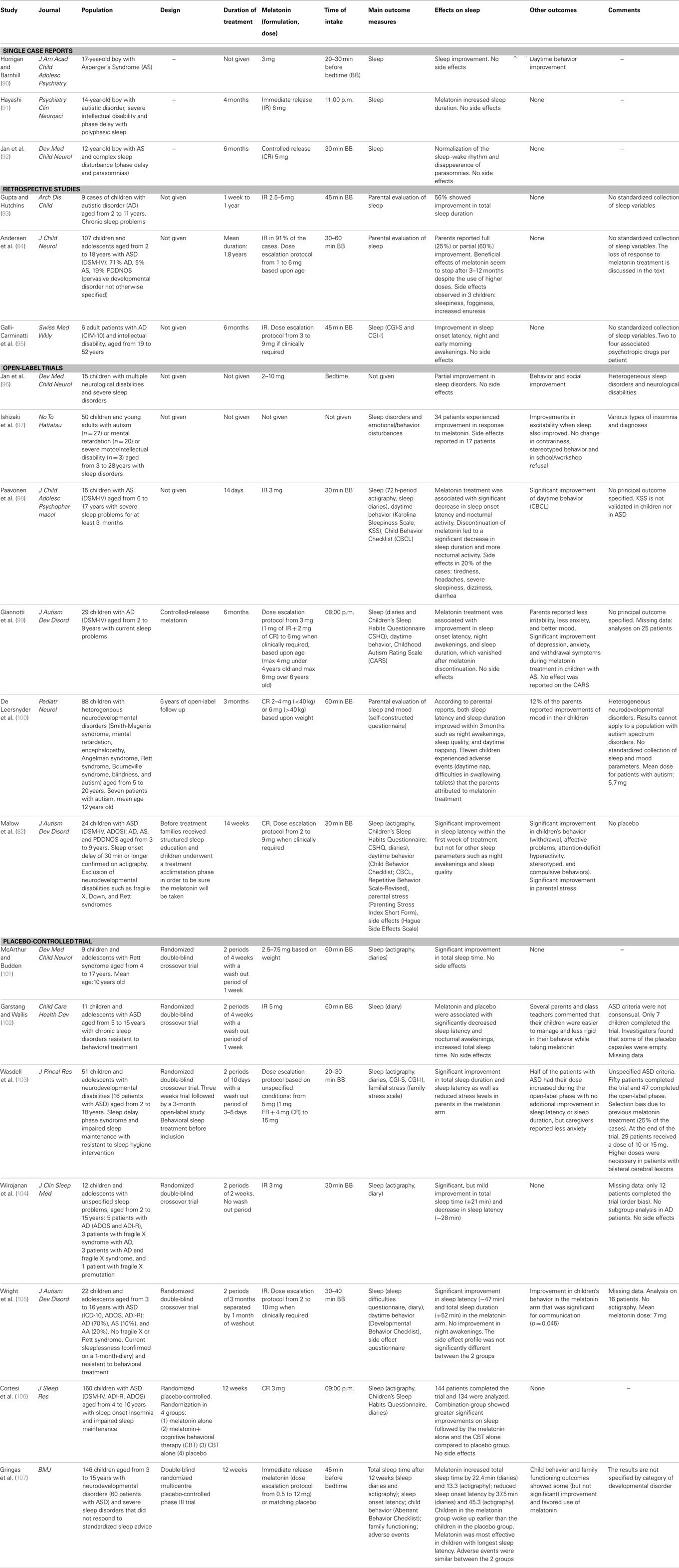
The role of melatonin in the establishment of circadian rhythms and the synchronization of

peripheral oscillators is probably linked to the synchrony of motor, emotional and social rhythms

that are altered in ASD. Potential therapeutic benefits of melatonin in the recovery of circadian

rhythms has been demonstrated in a growing number of studies in ASD. Developmental behavioral

interventions that emphasize synchrony (in some cases combined with melatonin) seem to provide

substantial improvement in ASD, as reviewed by Tordjman [8] and reported by Fulton [9]. Research on

outcome of interventions is currently an active field of investigation though data available do not

allowto answer the question of “what works for whom” in ASD. This is critical to delineate the

guidelines for behavioral interventions, as reviewed by Vivanti and colleagues [10]. Among the

bothersome ASD symptoms that need to be addressed, auditory hypersensitivities may be tackled

by means of novel techniques such as the listening protocol projects, as proposed by Porges [11]. Poor

reciprocal social communication is a hallmark characteristic of ASD and is under intense

investigation for treatment; Corbett and colleagues report a novel theatre intervention that combines

interaction of trained peers with patients to facilitate the performance-based theatrical treatment [12].

The last part of the book is dedicated to basic studies highlighting the importance of

investigating mouse models to unravel the molecular mechanisms underlying ASD pathogenesis.

Two review articles, respectively by Cellot and Cherubini [13] and Giovedì and coworkers [14], address

the role of GABAergic neurotransmission and synaptic vesicle proteins in the pathogenesis of ASD,

strengthening the notion of ASD as a “synaptic neuropathology”. Finally, three original research

articles investigate novel pathological aspects in three different ASD mouse models. Provenzano

and colleagues show growth hormone and IGF-1 signaling deficits in Engrailed-2 mouse mutants [15];

Gigliucci et al. demonstrate oxytocin signaling alterations in mice lacking opioid receptors [16], and

Michetti and coworkers identify a series of pathological features (including defects in glutamatergic

neurotransmission) in reeler mice [17]. Taken together, these mouse studies confirm the importance of

IGF-1, oxytocin and glutamate signaling in the pathogenesis of ASD, as extensively described in

several clinical studies presented in this e-book.
9,309 views

4 citations

Autism as a Disorder of Biological and Behavioral Rhythms: Toward New Therapeutic Perspectives
REVIEW
23 February 2015
Autism as a Disorder of Biological and Behavioral Rhythms: Toward New Therapeutic Perspectives
Sylvie Tordjman, 17 more and Geraldine Dawson
There is a growing interest in the role of biological and behavioral rhythms in typical and atypical development. Recent studies in cognitive and developmental psychology have highlighted the importance of rhythmicity and synchrony of motor, emotional and relational rhythms in early development of social communication. The synchronization of rhythms allows tuning and adaptation to the external environment. The role of melatonin in the ontogenetic establishment of circadian rhythms and the synchronization of peripheral oscillators suggests that this hormone might be also involved in the synchrony of motor, emotional and relational rhythms. Autism provides a challenging model of physiological and behavioral rhythm disturbances and their possible effects on the development of social communication impairments and repetitive behaviors or interests. This article situates autism as a disorder of biological and behavioral rhythms and reviews the recent literature on the role of rhythmicity and synchrony of rhythms in child development. Finally, the hypothesis is developed that an integrated approach focusing on biological, motor, emotional and relational rhythms may open interesting therapeutic perspectives for children with autism. More specifically, promising avenues are discussed for potential therapeutic benefits in autism spectrum disorder of melatonin combined with developmental behavioral interventions that emphasize synchrony such as the Early Start Denver Model (ESDM).

34,966 views

106 citations

The hallmark characteristic of autism spectrum disorder (ASD) is poor reciprocal social communication. Interventions designed to improve this core deficit are critically needed. Social skills interventions such as direct training, peer mediation, and video modeling have contributed to improvements in various social skills in children with ASD. This paper reviews existing social competence interventions available for children with ASD while highlighting hypothesized critical components for advancing, maintaining and generalizing skills, which include 1) peer mediation, 2) active learning, and 3) implementation in supportive, natural contexts. As a framework for these approaches, this conceptual paper describes SENSE Theatre, a novel intervention that combines trained peers that facilitate the performance-based theatrical treatment delivered in a supportive, community-based environment. A review of previous research shows early feasibility, setting the stage for more rigorous studies to aid in developing a standardized intervention package.

17,228 views

26 citations

ORIGINAL RESEARCH
1 September 2014
Region Specific Up-Regulation of Oxytocin Receptors in the Opioid Oprm1−/− Mouse Model of Autism
Valentina Gigliucci, 5 more and Bice Chini

9,832 views

58 citations

The Use of Medications Approved for Alzheimer’s Disease in Autism Spectrum Disorder: A Systematic Review
Autism spectrum disorder (ASD) is a neurodevelopmental disorder that affects 1 in 68 children in the United States. Even though it is a common disorder, only two medications (Risperidone and Aripiprazole) are approved by the U.S. Food and Drug Administration (FDA) to treat symptoms associated with ASD. However these medications are approved to treat irritability, which is not a core symptom of ASD. A number of novel medications which have not been approved by the FDA to treat ASD have been used off-label in some studies to treat ASD symptoms, including medications approved for Alzheimer’s disease. Interestingly, some of these studies are high quality, double-blind, placebo-controlled (DBPC) studies. This article systematically reviews studies published through April, 2014 which examined the use of Alzheimer’s medications in ASD, including donepezil (7 studies, 2 were DBPC, 5/7 reported improvements), galantamine (4 studies, 2 were DBPC, all reported improvements), rivastigmine (1 study reporting improvements), tacrine (1 study reporting improvements) and memantine (9 studies, 1 was DBPC, 8 reported improvements). An evidence-based scale was used to rank each medication. Collectively, these studies reported improvements in expressive language and communication, receptive language, social interaction, irritability, hyperactivity, attention, eye contact, emotional lability, repetitive or self-stimulatory behaviors, motor planning, disruptive behaviors, obsessive-compulsive symptoms, lethargy, overall ASD behaviors and increased REM sleep. Reported side effects are reviewed and include irritability, gastrointestinal problems, verbal or behavioral regression, headaches, irritability, rash, tremor, sedation, vomiting, and speech problems. Both galantamine and memantine had sufficient evidence ranking for improving both core and associated symptoms of ASD. Given the lack of medications approved to treat ASD, further studies on novel medications, including Alzheim

37,374 views

80 citations

ORIGINAL RESEARCH
1 September 2014
GH Dysfunction in Engrailed-2 Knockout Mice, a Model for Autism Spectrum Disorders
Giovanni Provenzano, 5 more and Yuri Bozzi

5,591 views

7 citations

Reducing Auditory Hypersensitivities in Autistic Spectrum Disorder: Preliminary Findings Evaluating the Listening Project Protocol
ORIGINAL RESEARCH
1 August 2014
Reducing Auditory Hypersensitivities in Autistic Spectrum Disorder: Preliminary Findings Evaluating the Listening Project Protocol
Stephen W. Porges, 6 more and Gregory F. Lewis

45,128 views

47 citations

REVIEW
20 June 2014
Predictors of Outcomes in Autism Early Intervention: Why Don’t We Know More?
Giacomo Vivanti, 2 more and Cheryl Dissanayake

54,729 views

222 citations

Current therapeutics in Autism Spectrum Disorders (ASD) only treat the associated symptoms, without addressing core social dysfunctions. A paradigm shift in research of the pathogenesis of ASD, its synaptic abnormalities and altered signaling in multiple dynamic systems, have led to new experimental treatments for treating the core social abnormalities of ASD. NMDA antagonists, especially memantine, have been introduced in clinical trials addressing glutamatergic transmission in children and adolescents with ASD. GABAergic signaling has been targeted in trials using the GABAB receptor agonist arbaclofen for ASD patients with promising results. Oxytocin has been recognized as implicated in social development and affiliative behaviours. Preliminary findings from clinical trials using oxytocin in children with ASD show encouraging improvements in social cognition, but larger studies are needed. In two of the single gene disorders associated with ASD, Insulin Growth Factor (IGF-1) is a new treatment that has been tested in Rett Syndrome and Phelan-McDermid Syndrome (Chromosome 22 deletion syndrome). IGF-1 has been demonstrated to reverse the reduction in the number of excitatory synapses and the density of neurons that characterize these conditions in animal studies and it is being introduced as an experimental treatment..As a novel approach to verify treatment efficacy,neural processing modifications were recently evaluated by fMRI after a Pivotal Response Training (PRT) intervention. Another study of neural changes in response to treatment examined variations in EEG signaling in patientsafter an Early Start Denver Model (ESDM) intervention.

12,028 views

37 citations

CLINICAL CASE STUDY
3 June 2014
Repeated Insulin-Like Growth Factor 1 Treatment in a Patient with Rett Syndrome: A Single Case Study
Giorgio Pini, 12 more and Daniela Tropea

7,846 views

32 citations