This editorial summarizes the contributions to the research topic "Applications of Artificial Intelligence in the Oil and Gas Industry", established under the Environmental Informatics and Remote Sensing section and appearing under the Frontiers in Earth Science.With the breakthrough of deep learning over the past few decades, artificial intelligence (AI) and big data surprise us in many fields. Applications of AI in oil and gas development have received growing attention. AI-based techniques have been applied successfully in solving a wide range of problems such as understanding reservoir, extracting information and insights from data, obtaining flow mechanisms, and solving partial differential equations. It is therefore of high interest to continue in this effect to maximize the impact of these new techniques in oil and gas industry. This research topic aims to explore recent developments in this area with a focus on:(1) Data mining, analytics and interpretation in the well logging data, fracturing data, production data and others; (2) Well Testing, formation evaluation, reservoir property estimation; (3) Fracturing effect estimation during fracturing, flowback, and production for tight oil/gas and shale oil/gas; (4) The discovery or solution of PDE in porous media, mathematical modeling, proxy models, history matching; (5) Theories, methods, technology, and design for complex reservoir development, such as reservoir percolation theory and application technology, field development theories and methods and technology for enhancing recovery efficiency; (6) The production optimization, well placement and well pattern optimization; (7) Techniques and technologies for oil and gas drilling and production; (8) Well logging, rock mechanics, digital rock.One study, Liu et al., explored a novel approach for flow field description and simplification based on principal component analysis downscaling and clustering algorithms. In this paper, PCA is used to reduce the dimension of streamline features, which achieves an accurate representation of streamlines without losing many features. Based on the streamline features from the dimension reduction, the clustering method is applied to simplify the flow field. The streamlines with different characteristics in the flow field are divided, and the main streamlines are selected among the injection-production units. The visualization of the streamline field is greatly improved and the interference phenomenon of the complicated streamlines is relieved.A second study, Liu and Liu, focused on recognition and classification for inter-well nonlinear permeability configuration in low permeability reservoirs utilizing machine learning methods. To recognize and classify the nonlinear permeability configuration between injection and production wells in the low-permeability reservoir, neural networks, support vector machine and decision tree are used to train the dynamic data with the influence of nonlinear permeability configuration in low permeability reservoirs as the training model. The results show that compared with the neural networks and the decision tree, the support vector machine represents the optimum performance in the accuracy of verification.Another study, Tan et al., focused on multi-scale normalization method combined with a deep convolutional neural network diagnosis model of dynamometer card in sucker rod pumping well. The authors propose a new data preprocessing method of dynamometer card and give its workflow, using multiple normalized dynamometer cards of the original dynamometer card data as the model input can introduce more feature information and efficiently enhance the class separability of the data. In various working condition diagnosis tasks, convolutional neural network is better than support vector machine.Another study, Dong et al., presented works on balance and correlation analysis of oilfield injection-production system based on data mining. The study determines the best-connected injection-production wells through the dynamic correlation between oil and water wells, by investigating water injection volume as the influencing factor for oil production efficiency, conducting water injection prediction research, and proposing a model for water injection prediction. Hence, the work provides the basis for the design of adjustment measures in the block to slow down the rise of water content, maintain the stability of production, and improve the efficiency of the mechanical production system.Another study, Wang et al., presented a reservoir parameter prediction approach based on the neural random forest model. In this study, a novel hybrid model combining the neural network and random forest is proposed for predicting the porosity and saturation based on well logging of the shale gas reservoir. The ability of the proposed model to forecast porosity and saturation is discussed. Meanwhile, the proposed model is also compared with the baseline methods, e.g., neural networks and random forest.Another study, Liu et al., analyzed the XGBoost formation thickness identification based on logging data. They found that, in the identification of formation thickness and reservoirs, a total of 12 response features selected from field logging data can effectively identify reactive rock and reservoir layers intelligently by their location in the ground. Through a comprehensive comparison of the five discriminatory methods, the study shows that the XGBoost algorithm is the most effective for rock and reservoir layer identification, with an average accuracy of more than 95%.Another study, Zhang et al., discussed simultaneous prediction of multiple physical parameters including porosity, water saturation and shale content, by gated recurrent neural network, using longitudinal wave velocity, shear wave velocity and density. The Pearson product moment correlation coefficients of the elastic parameters and physical parameters used in the model are calculated, and the results show that the correlation between the elastic parameters and the physical parameters is not high. Nonetheless, the models can still fit their nonlinear relationship in high dimensions, and can also predict and reconstruct the missing sections of the log.The last study, Mahmoud et al., evaluated the dynamic Young's modulus for composite formations in real-time based on the drilling parameters using different machine learning algorithms. Three machine learning models, namely, random forest, adaptive neuro-fuzzy inference system with subtractive clustering, and support vector regression, are optimized for real-time assessment of the dynamic Young's modulus from the available drilling parameters. The results show the high precision of the optimized machine learning models in estimating the dynamic Young's modulus from the surface measurable drilling parameters.
Editorial09 March 2023
Editorial: Applications of artificial intelligence in the oil and gas industry
ORIGINAL RESEARCH
24 August 2022
Reservoir parameter prediction is of significant value to oil and gas exploration and development. Artificial intelligence models are developing rapidly in reservoir parameter prediction. Unfortunately, current research has focused on multi-input single-output prediction models. Meaning, these models use a large amount of logging or seismic data to predict the petrophysical properties of a single reservoir. Another prominent problem is that most mechanistic learning studies have focused on using logging data (e.g., gamma ray and resistivity) to make predictions of reservoir parameters. Although these studies have yielded promising accuracy, a great shortcoming is the inability to obtain such data in logs by seismic inversion. The value of our research work is to achieve a complete description of the reservoir using the elastic parameters from the seismic inversion. We developed a deep learning method based on gated recurrent neural network (GRNN) suitable for simultaneous prediction of porosity, saturation and shale content in the reservoir. We used two wells each as a training well and a test well. 20% of the data in the training wells were used as the validation set. During the training phase, the model hyperparameters were optimized based on the mean absolute error (MAE) box plots of the validation set. Experiments on the test data show that the model has superior robustness and accuracy compared to the conventional recurrent neural network (RNN). In the GRNN prediction results of the test set, the MAE is 0.4889 and the mean squared error (MSE) is 0.5283. Due to the difference in input parameters, our prediction is weaker than the research method using logging data. However, our proposed method has higher practical value in exploration work.

ORIGINAL RESEARCH
13 May 2022
Mingchuan Wang, 2 more and Jiwei Wang
4 Authors
- MW
Mingchuan Wang
SINOPEC Petroleum Exploration and Production Research Institute, China
- DF
Dongjun Feng
SINOPEC Petroleum Exploration and Production Research Institute, China
- DL
Donghui Li
SINOPEC Petroleum Exploration and Production Research Institute, China
- JW
Jiwei Wang
SINOPEC Petroleum Exploration and Production Research Institute, China
Porosity and saturation are the basis for describing reservoir properties and formation characteristics. The traditional empirical and formulaic methods are unable to accurately capture the non-linear mapping relationship between log data and reservoir physical parameters. To solve this problem, in this study, a novel hybrid model (NRF) combining neural network (NN) and random forest (RF) was proposed based on well logging data to predict the porosity and saturation of shale gas reservoirs. The database includes 6 horizontal wells and the input logs were depth, borehole diameter, neutron, density, gamma-ray and acoustic. The porosity and saturation were chosen as output. The NRF model with independent and joint training was designed to extract key features from well logs data and physical parameters. It provides a promising method for forecasting the porosity and saturation with R2 above 0.93 and 0.77 separately. Compared with baseline models (NN and RF), the NRF model with joint training obtains the unsurpassed performance to predict porosity with R2 above 0.94, which is 1.3% higher than the NRF model with independent training, 4.2% higher than RF, and superior greatly than NN. For the prediction of saturation, the NRF model with joint training still superior to other algorithms with R2 above 0.82, which is 4.7% higher than the NRF model with independent training, 7.4% higher than RF. Furthermore, the NRF model has a similar data distribution with measured porosity and saturation which demonstrates the NRF model can achieve greater stability. It proved that the proposed NRF model can capture the complex relationship of the logging data and physical parameters more accurately and can serve as an economical and reliable alternative tool to give a reliable prediction.

In order to solve the complicated problem of flow field results in commercial numerical simulators, a method to describe and simplify flow field by using descending and clustering algorithms is proposed in this paper. At present, due to the serious heterogeneity of most water drive reservoirs, the streamline numerical simulation generated by the streamline distribution is complex. The streamlines in the three-dimensional streamline field interfere with each other and the connectivity between each well is not clear. Therefore, the advantages of streamline field are not obvious, which restricts the effective application of streamline numerical simulation. In order to improve the visualization degree of flow field and realize effective description of flow field, streamline field needs to be simplified. In this paper, on the basis of the extraction of streamline attributes, PCA dimension reduction algorithm is used to carry out characteristic dimension reduction for streamline attributes. Utilizing the principal component obtained after dimension reduction, the streamline field is analyzed by clustering. Based on the streamline characteristics, the streamline field is classified by clustering, and the mainstream line in the flow field is selected according to the clustering center obtained by clustering. The difficulty of describing and characterizing the flow field in detail by using streamline method is solved.
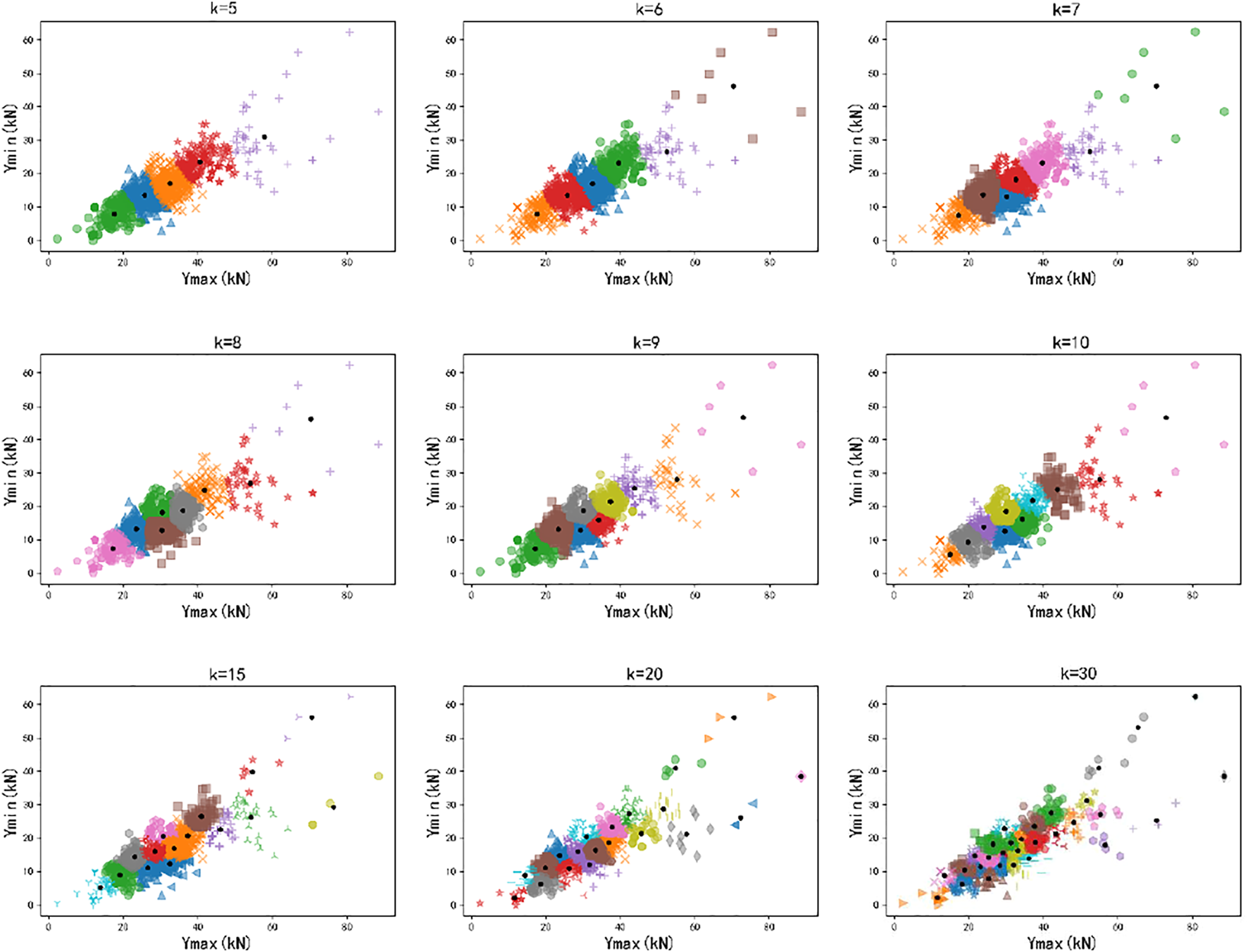
There are more than 20 types of dynamometer card measured of sucker rod pumping (SRP) wells in oil field, and some working conditions are very complicated. The common diagnosis model of SRP well based on dynamometer card recognition has low accuracy and recall rate of complicated working conditions. In order to improve the accuracy and recall rate of multi-condition diagnosis of SRP well, and solve the problem of inseparable data attributes caused by traditional dynamometer card normalization methods, a new dynamometer card preprocessing method is proposed, which uses a clustering analysis algorithm to obtain multiple normalized dynamometer cards of the original dynamometer card, and at the same time adds a set of time-series dynamometer cards to enhance the separability of data. The dynamometer card preprocessing method combined with 4 deep convolutional neural networks are used to build diagnosis model. Experiments are conducted under 24 different working conditions, the accuracy of our method is up to 95.8%, and the average recall rate of complicated working conditions is up to 93.1%, which is 13.6% and 35.3% higher than the model(AlexNet) built by the traditional preprocessing method. In addition, the preprocessing method of dynamometer card proposed is applicable to all deep learning models and machine learning models. Field applications show that our method is very effective for recalling abnormal working conditions, which is of great significance to the real demand for intelligent diagnosis of SRP well.