
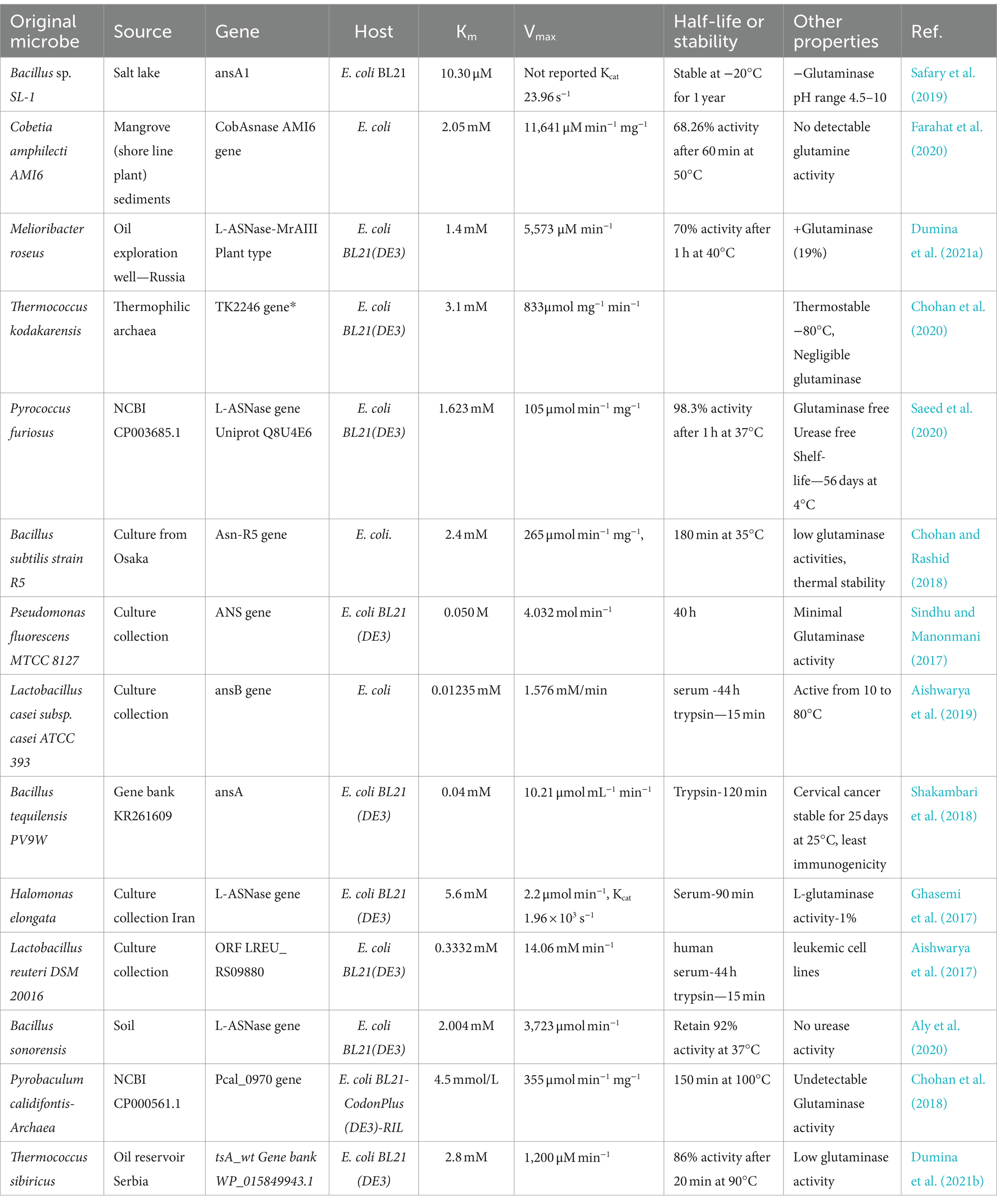
production of metabolites, health, and medicine was published in this research topic and is summarized in this editorial.The production of microbial derived molecules such as exosomes and L-asparaginase and their applications in biomedicine and health such as immunomodulation, gut health, drug delivery, and cancer treatment was reviewed (Tsegaye et al. 2024;Liu et al. 2024). The reviews emphasized on the design of efficient isolation and purification strategies as well as engineering methods for enhanced functionalities of these molecules for biomedical applications. Development and use of in-silico methods for rapid screening of effective variants, techniques to assess in-vivo distribution and long-term safety was also highlighted considering their applications for human health.Bacillus licheniformis ALSZ2 has been reported (Amin et al, 2023) for lactase production having commercial potential for having lactose intolerant people. Statistical design of media optimization was performed to choose out of 100 strains in the soil polluted with dairy products for isolation of most potent microbial lactase producer with unique lactase capacities.Two level Plackett-Burman design was used for weighing fifteen variables using three factors, lactase activity was enhanced 4 times and 13 U/ml enzyme was achieved.Genetic engineering strategies for enhanced and tailored production of prodniginines and rhamnolipids has been reported (Kossman et al, 2023) as biocontrol agents effective against plant nematodes. Bacterial secondary metabolites from genetically engineeredPseudomonas putida are of particular interest due to good plant compatibility and low toxicity. Lactic acid bacteria (LAB) (Vasundaradevi et al, 2023) was reported as biocontrol agent to be effective against phytopathogenic fungus. Seven isolates were shown to inhibit its growth, out of which only two obtained from fruits Ficus and Tinospora exhibited promising antifungal properties against Alternaria alternata. Molecular identification technique was used for identifying strains showing higher adaptability to a wide temperature range and salt tolerance of up to 7%. Cell free supernatant (CFS) inhibition was quite high as even 5% crude CFS reduced the fungal growth by >70% while a complete inhibition was reported at 10%.Inhibition was against mycelial growth and conidial germination and it was effective even after long periods of cold storage of CFS.Human health promoting bioactive compounds were reported from various parts of the medicinal mushroom Ganoderma lucidum (Tajik et al, 2024) which include peptides, fatty acids, polysaccharides and triterpenoids. Extracts of isolated compounds from G lucidum has been found to be have carcinostatic effects on cancer cell lines like lung, pancreas, breast, skin etc, and triterpenoids have been reported to be the most important bioactive compounds with such effects. Glucose as carbon and corn steep liquor (CSL) as nitrogen source was found to be the best for stimulating the production of a triterpenoid called ganoderic acid based on optimization studies. This was secreted from stem and shell of mushroom and showed substantial anti-microbial and anti-cancer activity in in-vitro conditions.Industrial uses of microbes and ultra-sensitive detection has been revolutionised in the recent times. This is of great importance in the case of anti-microbial resistance.Pseudomonas aeruginosa, a principal pathogen responsible for urinary tract infections has been known as difficult to eradicate and has evolved as the main candidate for drug resistance due to the indiscriminate uses of antibiotics. Rapid and efficient detection of microbes as well as their drug resistance genes is desirable for early clinical diagnosis and proper treatment.Recombinant polymerase amplification clustered regularly interspaced short palindromic repeats associated with protein 13a to establish one tube and two step reaction systems for detecting the mexX drug resistance gene in Pseudomonas was developed (Zhu et al, 2023).This method outperformed the traditional PCR and qRT-PCR (quantitative Real-time polymerase chain reaction) and limit of detection was as low as 10 aM and 1 aM respectively Primer was specifically designed for drug resistance mexX gene. Method was verified with industrial samples and commercial lateral flow dipstick with LoD of 10Fm and showed great accuracy.Design of robust microbial systems as a source of metabolites having commercial value and/or catering to low volume high value products using novel strategies has attracted attention under the sustainable circular economy concept. Ultrasensitive microbial detection in clinical/ environmental samples in the areas of health and medicine are of special importance. This research topic intends to motivate upcoming researchers to work in these areas which will lead to new innovations and applications in the areas of health, medicine, and industrial (bio)production.


3 Authors
- AA
Alaa A. Amin
Botany and Microbiology Department, Faculty of Science, Alexandria University, Egypt
- ZA
Zakia A. Olama
Botany and Microbiology Department, Faculty of Science, Alexandria University, Egypt
- SM
Safaa M. Ali
Nucleic Acid Research Department, Genetic Engineering and Biotechnology Research Institute, the City of Scientific Research and Technological Applications, Egypt
7 Authors
- YL
Yuan Lin
State Key Laboratory of Conservation and Utilization of Bio-Resources in Yunnan, The Key Laboratory of Medicinal Plant Biology of Yunnan Province, National and Local Joint Engineering Research Center on Germplasms Innovation and Utilization of Chinese Medicinal Materials in Southwest China, Yunnan Agricultural University, China
- YN
Yi Na Wang
State Key Laboratory of Conservation and Utilization of Bio-Resources in Yunnan, The Key Laboratory of Medicinal Plant Biology of Yunnan Province, National and Local Joint Engineering Research Center on Germplasms Innovation and Utilization of Chinese Medicinal Materials in Southwest China, Yunnan Agricultural University, China
- GH
Guang Hui Zhang
State Key Laboratory of Conservation and Utilization of Bio-Resources in Yunnan, The Key Laboratory of Medicinal Plant Biology of Yunnan Province, National and Local Joint Engineering Research Center on Germplasms Innovation and Utilization of Chinese Medicinal Materials in Southwest China, Yunnan Agricultural University, China
- GC
Geng Chen
State Key Laboratory of Conservation and Utilization of Bio-Resources in Yunnan, The Key Laboratory of Medicinal Plant Biology of Yunnan Province, National and Local Joint Engineering Research Center on Germplasms Innovation and Utilization of Chinese Medicinal Materials in Southwest China, Yunnan Agricultural University, China
- QH
Qing Hui Yang
College of Agronomy and Biotechnology, Yunnan Agricultural University, China
- BH
Bing Hao
State Key Laboratory of Conservation and Utilization of Bio-Resources in Yunnan, The Key Laboratory of Medicinal Plant Biology of Yunnan Province, National and Local Joint Engineering Research Center on Germplasms Innovation and Utilization of Chinese Medicinal Materials in Southwest China, Yunnan Agricultural University, China
- SC
Sheng Chao Yang
State Key Laboratory of Conservation and Utilization of Bio-Resources in Yunnan, The Key Laboratory of Medicinal Plant Biology of Yunnan Province, National and Local Joint Engineering Research Center on Germplasms Innovation and Utilization of Chinese Medicinal Materials in Southwest China, Yunnan Agricultural University, China
4,766 views
14 citations
20 Authors
- DF
D. F. Kossmann
Institute of Bio- and Geosciences (IBG-1): Biotechnology, Forschungszentrum Jülich GmbH, Germany
- MH
M. Huang
INRES, Molecular Phytomedicine, University of Bonn, Germany
- RW
R. Weihmann
Institute of Molecular Enzyme Technology, Forschungszentrum Jülich, Heinrich Heine University Düsseldorf, Germany
- XX
X. Xiao
INRES, Molecular Phytomedicine, University of Bonn, Germany
- FG
F. Gätgens
Institute of Molecular Enzyme Technology, Forschungszentrum Jülich, Heinrich Heine University Düsseldorf, Germany
- TM
T. M. Weber
Institute of Bioorganic Chemistry, Forschungszentrum Jülich, Heinrich Heine University Düsseldorf, Germany
- HU
H. U. C. Brass
Institute of Bioorganic Chemistry, Forschungszentrum Jülich, Heinrich Heine University Düsseldorf, Germany
- NL
N. L. Bitzenhofer
Institute of Molecular Enzyme Technology, Forschungszentrum Jülich, Heinrich Heine University Düsseldorf, Germany
- SI
S. Ibrahim
Institute of Molecular Enzyme Technology, Forschungszentrum Jülich, Heinrich Heine University Düsseldorf, Germany
- KB
K. Bangert
Institute of Molecular Enzyme Technology, Forschungszentrum Jülich, Heinrich Heine University Düsseldorf, Germany
- LR
L. Rehling
INRES, Molecular Phytomedicine, University of Bonn, Germany
- CM
C. Mueller
iAMB—Institute of Applied Microbiology, ABBt—Aachen Biology and Biotechnology, RWTH Aachen University, Germany
- TT
T. Tiso
iAMB—Institute of Applied Microbiology, ABBt—Aachen Biology and Biotechnology, RWTH Aachen University, Germany
- LM
L. M. Blank
iAMB—Institute of Applied Microbiology, ABBt—Aachen Biology and Biotechnology, RWTH Aachen University, Germany
- TD
T. Drepper
Institute of Molecular Enzyme Technology, Forschungszentrum Jülich, Heinrich Heine University Düsseldorf, Germany
- KJ
K.-E. Jaeger
Institute of Bio- and Geosciences (IBG-1): Biotechnology, Forschungszentrum Jülich GmbH, Germany
- FM
F. M. W. Grundler
INRES, Molecular Phytomedicine, University of Bonn, Germany
- JP
J. Pietruszka
Institute of Bio- and Geosciences (IBG-1): Biotechnology, Forschungszentrum Jülich GmbH, Germany
- AS
A. S. S. Schleker
INRES, Molecular Phytomedicine, University of Bonn, Germany
- AL
A. Loeschcke
Institute of Molecular Enzyme Technology, Forschungszentrum Jülich, Heinrich Heine University Düsseldorf, Germany
3,479 views
7 citations