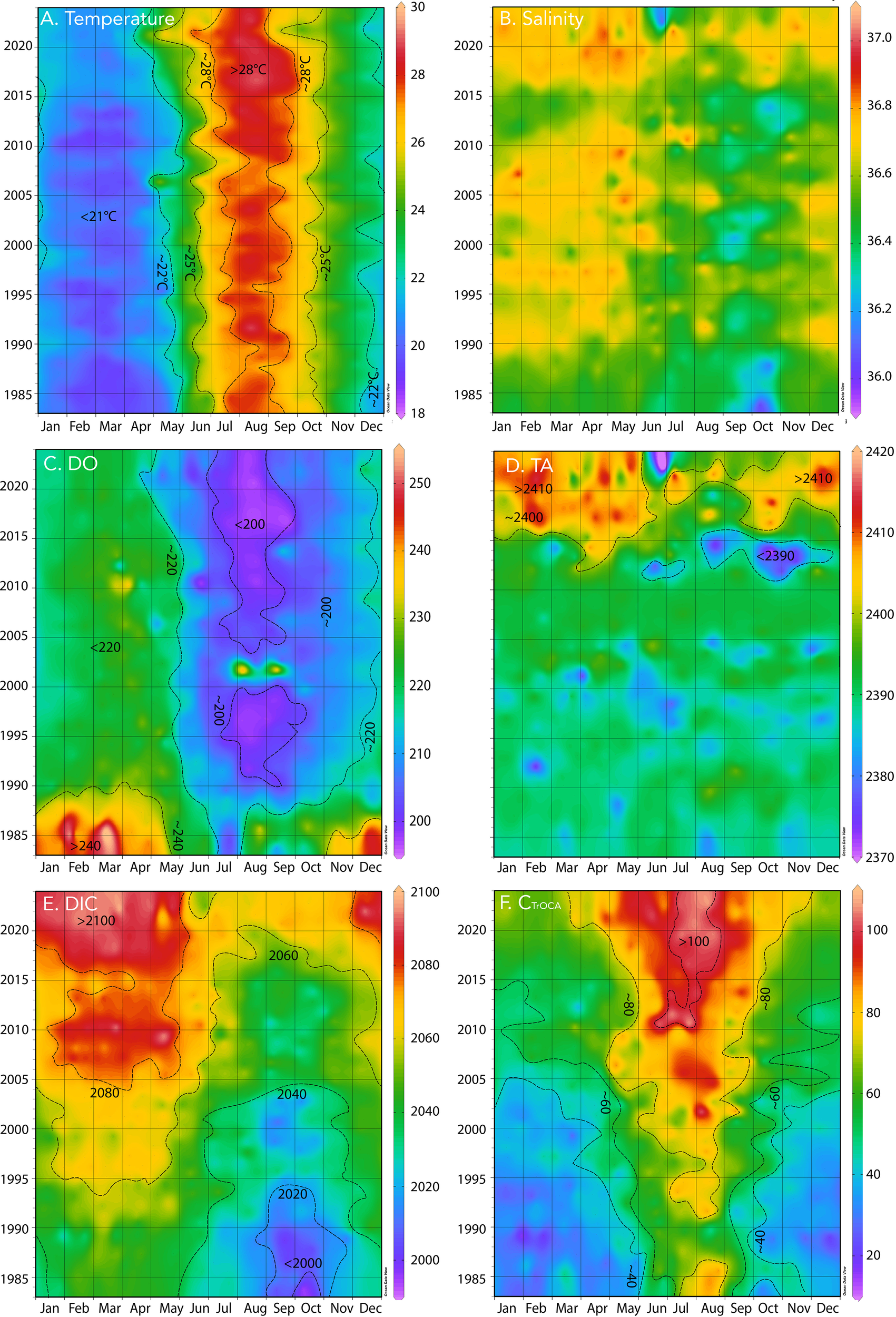
Ocean acidification (OA) is a pressing global issue characterized by fundamental changes in ocean chemistry, including the reduction of pH levels, due to the absorption of increased atmospheric CO₂. This phenomenon poses significant threats to marine ecosystems, affecting biodiversity, food security, and coastal economies. Time-series observations remain indispensable for documenting these changes, offering insights into the drivers and consequences of OA over temporal and spatial scales. This editorial summarizes the 17 studies in this special issue, highlighting the advancements in understanding OA dynamics and their broader implications.Several studies in this issue provide comprehensive analyses of long-term OA trends and add to the existing evidence of its ongoing process. Bates and Johnson (2023) report on four decades of data from Bermuda's Atlantic Time-series Study (BATS) and Hydrostation S, revealing continuous ocean warming, salinification, and CO₂carbonate shifts. These findings emphasize the region's persistent acidification trends. Similarly, González-Dávila and Santana-Casiano (2023) 2024) analyze the Munida Time Series off New Zealand, finding decadal pCO₂ (partial pressure of CO2) increases driven by regional circulation changes and anthropogenic CO₂ invasion.Understanding the interplay between chemical changes associated with OA and biology is vital for the understanding of present and future changes in marine biodiversity and ecosystem services. For Coastal Ecosystems, George et al. ( 2024) study the Tanga-Pemba Seascape, suggesting an interplay between upwelling-driven OA and oxygen depletion, with consequences to the vulnerability of resident organisms; additionally, they suggest an important role of seagrass meadows in mitigating OA. Hall et al. ( 2024) connect harmful algal blooms (HABs) in Florida estuaries with changes in carbonate chemistry, showing how these blooms exacerbate acidification. In offshore waters of Columbia, Ricaurte-Villota et al. ( 2025) find that significant seasonal variability of the carbonate system is influenced by annual changes in coastal upwelling, rainfall, and river runoff. Vance et al. ( 2024) describe seasonal DIC patterns across a coastal margin of the Subantarctic Zone, linking them to mixed-layer processes and community production, which maintain the region's status as a net CO sink. Furthermore, studies in the Eastern Mediterranean highlight the unique carbonate system dynamics (Frangoulis et al., 2024), emphasizing the need for sustained observations to assess the impacts of rapid warming and acidification on marine organisms. In Coral Reefs, Knor et al. (2024) assess coastal reefs in Honolulu, revealing how freshwater runoff and biological processes buffer OA effects, with implications for coral health.Long-term, ship-based time-series are now joined by new autonomous observing tools with the capability to constrain a broader suite of temporal scales of OA in its impacts. The utilization of time-series data by statistical and predictive models enhances our ability to fill observing gaps and forecast future OA scenarios. By bridging observational data with modeling efforts, researchers can develop more accurate projections of OA progression and its potential impacts on marine ecosystems, thereby informing policy decisions and management strategies. García-Ibáñez et al. (2024) showcase new Mediterranean time-series stations for high-resolution CO₂ observations. Tsiaras et al. ( 2024) use sensitivity simulations to identify biological, hydrodynamic, and atmospheric controls on the Mediterranean carbonate system. For long-term data applications, Lefèvre et al. (2024) utilized the PIRATA network for tropical Atlantic monitoring, providing crucial insights into regional OA variability. While Wimart-Rousseau et al. (2023) highlight the value of sustained multi-decadal data for disentangling natural variability from anthropogenic trends.The contributions to this Research Topic emphasize the pivotal role of time-series observations in advancing our understanding of OA. These studies highlight the urgent need for sustained monitoring efforts, the development of standardized methodologies, and the integration of multidisciplinary data to effectively document and address the challenges posed by OA in a rapidly changing global environment. The research presented also underscores the critical importance of interdisciplinary approaches to understand and mitigate OA's impacts, particularly that many of the studies showed the importance of various natural and/or anthropogonic drivers in contributing to OA variability at local and regional scales. High-frequency monitoring, robust modeling frameworks, and collaborative international efforts are essential to deepening our knowledge of OA dynamics and its far-reaching implications for marine ecosystems.By providing a comprehensive perspective on OA research across diverse ecosystems and timescales, this Research Topic reaffirms the necessity of sustained observations and innovative methodologies in tackling the pressing challenges of a changing ocean. Moving forward, it is imperative to strengthen global cooperation and advance scientific tools to better predict, monitor, and mitigate the impacts of ocean acidification on marine life and human communities.
4 Authors
- LA
Lucie A. C. M. Knor
Department of Oceanography, University of Hawai’i at Mānoa, United States
- MM
Melissa Meléndez
Department of Oceanography, University of Hawai’i at Mānoa, United States
- CL
Christopher L. Sabine
Department of Oceanography, University of Hawai’i at Mānoa, United States
- AJ
Adrienne J. Sutton
NOAA Pacific Marine Environmental Laboratory, United States
3,597 views
4 citations
2,980 views
4 citations
5 Authors
- ER
Emily R. Hall
Mote Marine Laboratory, United States
- KK
Kimberly K. Yates
U.S. Geological Survey, St. Petersburg Coastal and Marine Science Center, United States
- KA
Katherine A. Hubbard
Florida Fish and Wildlife Conservation Commission – Fish and Wildlife Research Institute, United States
- MJ
Matthew J. Garrett
Florida Fish and Wildlife Conservation Commission – Fish and Wildlife Research Institute, United States
- JD
Jessica D. Frankle
Mote Marine Laboratory, United States
4,063 views
5 citations
3 Authors
- NL
Nathalie Lefèvre
Laboratoire d'Océanographie et du Climat: Expérimentations et Approches Numériques/Institut Pierre Simon Laplace (LOCEAN/IPSL), Institut de Recherche pour le Développement (IRD), Sorbonne Université, Centre National de la Recherche Scientifique-Muséum National d'Histoire Naturelle (CNRS-MNHN), France
- DV
Doris Veleda
Laboratório de Oceanografia Física Estuarina e Costeira (LOFEC), Federal University of Pernambuco, Department of Oceanography, Brazil
- LB
Laurence Beaumont
Division Technique, Institut National des Sciences de l'Univers (INSU), France
3,114 views
4 citations