Magnetic resonance-guided focused ultrasound (MRgFUS)

Cover image for Research Topic "Magnetic resonance-guided focused ultrasound (MRgFUS)"
79kviews
Editorial12 August 2025
Editorial: Magnetic Resonance-guided Focused Ultrasound (MRgFUS)

validated as a viable alternative, particularly for patients ineligible for implants. Cesarano et al.further support MRgFUS's potential through a systematic review of staged bilateral treatments in both ET and PD, demonstrating encouraging safety and efficacy profiles. Finally, Rinaldo et al. outlie a structured diagnostic-therapeutic pathway (DTP) for integrating MRgFUS into clinical workflows. Their experience with over 600 cases offers a practical and scalable model for institutions aiming to adopt or expand MRgFUS programs. In conclusion, MRgFUS is maturing into a safe, effective, and patient-centered modality for the treatment of movement disorders. The contributions in this Research Topic highlight both technological progress and humanistic insight, reaffirming the growing role of MRgFUS in modern functional neurosurgery.

1,914 views

REVIEW
30 April 2025
Ameliorating motor performance and quality of life in Parkinson’s disease: a comparison of deep brain stimulation and focused ultrasound surgery
Mingqian Liang, 2 more and Shengyong Bao
Ameliorating motor performance and quality of life in Parkinson’s disease: a comparison of deep brain stimulation and focused ultrasound surgery
IntroductionDeep brain stimulation (DBS) and magnetic resonance-guided focused ultrasound surgery (MRgFUS) have emerged as valuable treatment options for Parkinson’s disease (PD) with drug-resistant symptoms. However, comparative studies of various DBS targets and MRgFUS are still limited.MethodsWe reviewed three databases for trials on the effects of DBS or MRgFUS on PD patients, focusing on motor performance and quality of life (QoL). A frequentist network meta-analysis was conducted to estimate the treatment effects.ResultsThere were 39 trials in this study, comprising 3,002 patients. In the off-phase, subthalamic nucleus_DBS (STN_DBS [SMD, −0.94; 95%CI, −1.40 to −0.48]) significantly improved the UPDRS-III Total score compared to medication treatment alone (MT). In the on-phase, STN_DBS (SMD, −0.83; 95%CI, −1.13 to −0.53), internal globus pallidus_DBS (GPi_DBS [SMD, −0.80; 95%CI, −1.20 to −0.40]), and STN_Focused Ultrasound (STN_FUS [SMD, −1.83; 95%CI, −2.97 to −0.68]) significantly improved the UPDRS-III Total score. Regarding QoL, STN_DBS (SMD, −0.75; 95% CI, −1.46 to −0.05) and GPi_DBS (SMD, −0.58; 95% CI, −0.96 to −0.21) demonstrated better outcomes compared to MT. The SUCRA plot indicated that the top three treatments for UPDRS-III Total score in the off-phase were STN_FUS (79.6%), STN-GPi_DBS (73.7%), and STN_DBS (69.1%). In the on-phase, the top three treatments were STN_FUS (95.7%), STN_DBS (69.6%), and GPi_DBS (66.9%). Regarding QoL, GPi_DBS (77.2%) ranks first, followed by STN_DBS (67.3%), STN_FUS (56.9%) ranks third.ConclusionSTN_DBS, GPi_DBS, and STN_FUS have exhibited efficacy in ameliorating motor performance and enhancing QoL in PD patients. Nevertheless, as a potential alternative to STN_DBS with comparable efficacy, STN-FUS may serve as another treatment option.

5,616 views

11 citations

Staged magnetic resonance-guided focused ultrasound thalamotomy for the treatment of bilateral essential tremor and Parkinson’s disease related tremor: a systematic review and critical appraisal of current knowledge
SYSTEMATIC REVIEW
20 June 2024
Staged magnetic resonance-guided focused ultrasound thalamotomy for the treatment of bilateral essential tremor and Parkinson’s disease related tremor: a systematic review and critical appraisal of current knowledge
Simone Cesarano, 9 more and Francesca Pistoia
Introduc.on: Essen'al Tremor (ET) and Parkinson's Disease (PD) are debilita'ng neurodegenera've disorders characterized by tremor as a predominant symptom, significantly impac'ng pa'ents' quality of life. Magne'c Resonance-guided Focused Ultrasound (MRgFUS) Thalamotomy is an innova've therapeu'c op'on for the treatment of unilateral medically refractory tremor with fewer adverse effects compared to tradi'onal surgical interven'ons. A recent CE approval allows appropriate pa'ents to have their second side treated.The objec've of this systema'c review was to analyze available current knowledge about the use of MRgFUS for the treatment of bilateral ET and PD related tremor, to iden'fy the effec'veness and the risks associated with bilateral treatment.Methods: Eligible studies were iden'fied by searching published studies in PubMed and Scopus databases from May 2014 to January 2024 and by iden'fying ongoing studies registered on the clinicaltrials.gov website. Data were summarized by considering the following informa'on topics: the number of pa'ents involved, the selected lesion target, the assessment tool used to evaluate clinical changes, the observed improvement, the reported side effects, and the 'me interval between the two treatments. The study was registered in PROSPERO (ID: CRD42024513178) Results: Nine studies were eligible for this review, 7 for ET and 2 for PD. The involved popula'on included a variable number of pa'ents, ranging from 1 to 11 subjects for ET and from 10 to 15 subjects for PD. The main lesional targets were the ventral intermediate nucleus of the thalamus, the pallido-thalamic tract and the cerebello-thalamic tract bilaterally. All studies inves'gated the tremor relief through the Clinical Ra'ng Scale for Tremor (CRST) in pa'ents with ET, and through the Unified Parkinson's Disease Ra'ng Scale (UPDRS) in pa'ents with PD. A variable degree of improvement was observed, with all pa'ents expressing overall sa'sfac'on with the bilateral treatment. Adverse events were mild and transient, primarily involving gait disturbances, dysarthria, and ataxia. A standardized protocol for administering the two consecu've treatments was not iden'fiable; typically, the 'ming of the second treatment was delayed by at least six months.Available evidence supports the effec'veness and safety of staged bilateral MRgFUS treatments for ET and PD-related tremor.

5,720 views

13 citations

ORIGINAL RESEARCH
17 June 2024
Cognitive safety of focused ultrasound thalamotomy for tremor: 1-year follow-up results of the COGNIFUS part 2 study
Gennaro Saporito, 11 more and Francesca Pistoia

3,359 views

14 citations

Early re-emerging tremor after MRgFUS thalamotomy: case–control analysis of procedural and imaging features
ORIGINAL RESEARCH
6 June 2024
Early re-emerging tremor after MRgFUS thalamotomy: case–control analysis of procedural and imaging features
Federico Bruno, 9 more and Alessandra Splendiani

4,508 views

17 citations

BRIEF RESEARCH REPORT
26 April 2024
Magnetic resonance-guided focused ultrasound unilateral thalamotomy for medically refractory essential tremor: 3-year follow-up data
Stefano Tamburin, 17 more and Giuseppe Kenneth Ricciardi

4,566 views

10 citations

The evolution of ventral intermediate nucleus targeting in MRI-guided focused ultrasound thalamotomy for essential tremor: an international multi-center evaluation
ORIGINAL RESEARCH
26 March 2024
The evolution of ventral intermediate nucleus targeting in MRI-guided focused ultrasound thalamotomy for essential tremor: an international multi-center evaluation
Ayesha Jameel, 6 more and Wladyslaw Gedroyc
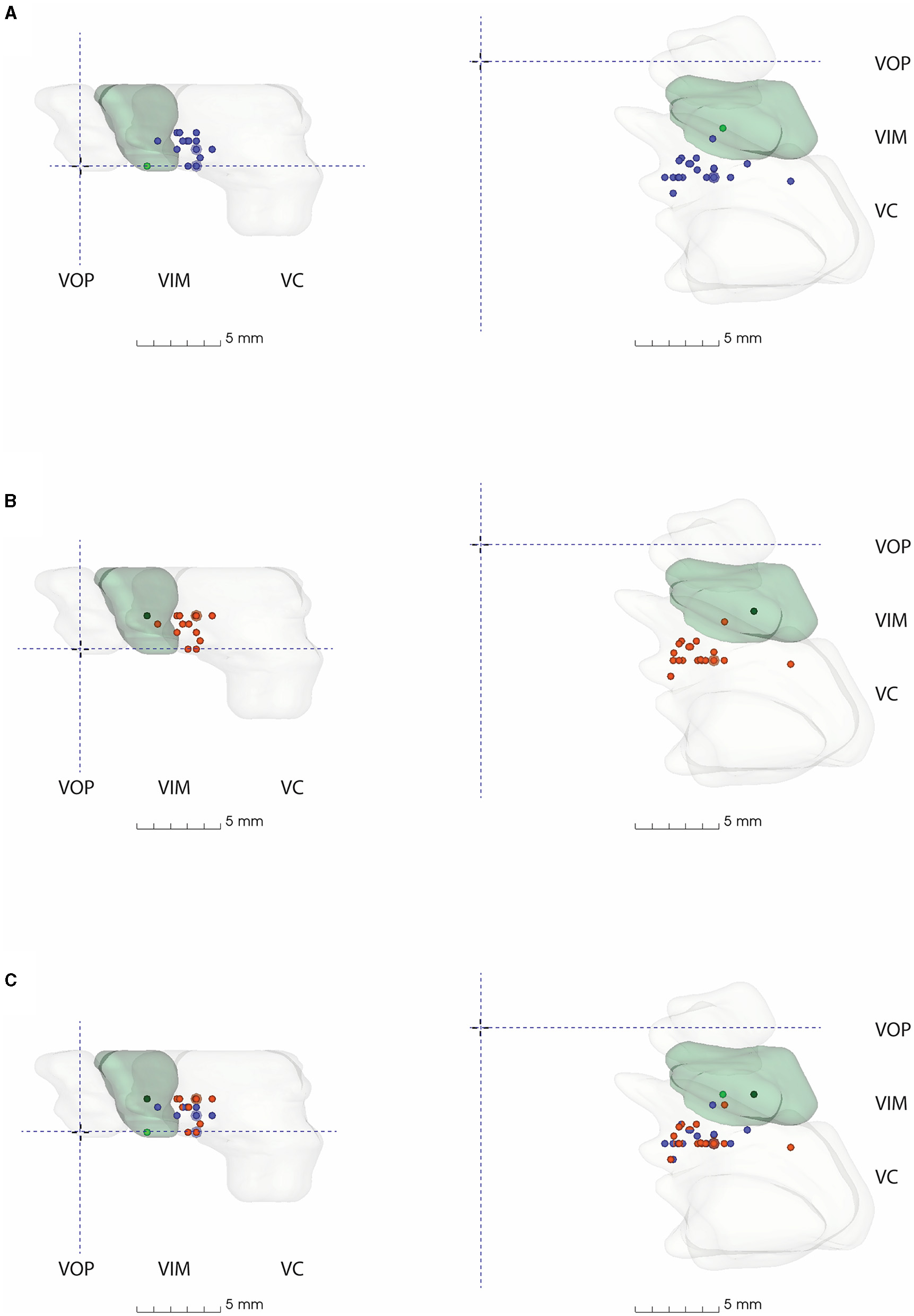
Background: The Ventral intermediate nucleus (VIM) is the premiere target in Magnetic Resonance Guided Focused Ultrasound (MRgFUS) thalamotomy for tremor; however, there is no consensus on the optimal coordinates for ablation. This study aims to ascertain the various international VIM targeting approaches (VIM-TA) and any evolution in practice. Methods: International MRgFUS centres were invited to share VIM-TAs in 2019 and 2021. Analysis of anatomical landmarks and/or tractography used, and any change in practice was conducted. Each VIM-TA was mapped in relation to the mid-commissural point onto a 3D thalamic nucleus model created from Schaltenbrand-Wahren Atlas. Results: Of 39 centres invited, 30 participated across the study period; providing VIM-TAs from 26 centres in 2019 and 23 in 2021. Results are reported as percentages of the number of participating centres in that year. In 2019, 96.2% centres (n=25) and in 2021, 95.7% centres (n=22) based targeting on anatomical landmarks rather than tractography. Increased adoption of tractography in clinical practice and/or for research was noted, 34.6% to 78.3%. There was a statistically significant change in VIM-TAs in the superior-inferior plane across the study period; VIM-TAs 2mm above the intercommisural-line (ICL) increased from 16.0% in 2019 to 40.9% in 2021 (WRST, p<0.05). This position is mapped at the centre of VIM on the 3D thalamic model created based on the Schaltenbrand-Wahren Atlas. In contrast, the VIM-TA medial-lateral and anterior-posterior positions remained stable. In 2022, 63.3% of participating centres provided the rationale for their VIM-TAs and key demographics. Centres were more likely to target 2mm above ICL, with increased experience (more than 100 treatments) and/or if they were North American. Conclusions: Across the study period, FUS centres have evolved their VIM targeting superiorly to target the centre of the VIM (2mm above ICL) and increased the adoption of tractography to aid VIM localisation. This phenomenon is seen across autonomous international centres, suggesting it is a more optimal site for FUS thalamotomy in tremor.

8,024 views

19 citations

ORIGINAL RESEARCH
26 February 2024
Focused ultrasound therapy in movement disorders: management roadmap toward optimal pathway organization
Sara Rinaldo, 27 more and Roberto Eleopra

4,050 views

2 citations

ORIGINAL RESEARCH
8 February 2024
‘Am I fixed, am I better now?’: undergoing MR-guided focused ultrasound for essential tremor: an interpretative phenomenological analysis
Tsvetina Stoycheva, 6 more and Jaqualyn Moore

3,169 views

2 citations

Efficacy and safety of magnetic resonance-guided focused ultrasound for Parkinson’s disease: a systematic review and meta-analysis
OBJECTIVE: Magnetic resonance imaging-guided focused ultrasound (MRgFUS) is a novel noninvasive treatment for drug-resistant Parkinson's disease (PD) related tremor. This study aims to evaluate MRgFUS's efficacy and safety in PD through a systematic review and meta-analysis, examining pre-and post-treatment MDS-UPDRSIII and/or CRST scores and associated adverse events. MATERIALS AND METHODS: We conducted an extensive literature search across PubMed, Embase, Web of Science, and Cochrane Library databases, screening studies based on set criteria and analyzing MDS-UPDRSIII, CRST, and adverse events pre-and post-MRgFUS treatment. RESULTS: Out of 468 retrieved articles, 20 studies involving 258 patients, spanning 2014-2023, were included.17 studies indicated significant MDS-UPDRSIII score reductions post-MRgFUS treatment, while 3 showed significant CRST score declines. In the "on" medication state, pooled MDS-UPDRSIII scores at 1, 3, 6, and 12 months were 12.18 (95%

7,959 views

30 citations