
Oral Health Care for Vulnerable and Underserved Populations

Cover image for Research Topic "Oral Health Care for Vulnerable and Underserved Populations"
46kviews
Editorial: Oral health care for vulnerable and underserved populations
Editorial06 August 2025
Editorial: Oral health care for vulnerable and underserved populations

Among indigenous communities, researchers examining the Irula tribes of Tamil Nadu, India, are conducting a cross-sectional study of 880 individuals aged 60 and above to quantify tooth morbidity while identifying risk factors and assessing oral hygiene practices. The study highlights how geographic isolation compounds vulnerability, with remote locations severely limiting access to fundamental healthcare services. Sukumar, Peter, Joseph, 2024 https://doi.org/10.3389/fdmed.2024.1427597 For socially marginalized youth, a comprehensive review spanning four countries identified three major obstacle categories: financial constraints, structural challenges, and psychological barriers. These impediments contribute to alarming rates of unmet dental needs. Disturbingly, after screening 484 studies, researchers found only seven relevant publications, underscoring a critical research gap. Vaishampayan et al, 2025 https://doi.org/10.3389/froh.2025.1521753 Even populations with presumed advantages face challenges. International post-secondary students consistently experience poorer oral health outcomes compared to domestic peersexhibiting knowledge gaps, less favorable hygiene behaviors, and lower utilization of routine dental care. This vulnerability stems from multiple factors including acculturation stress, financial constraints, and dietary changes. Yassin et al, 2025 https://doi.org/10.3389/froh.2025.1555165 Research examining oral health in opioid-addicted patients reveals profound disparities. The University of Regensburg study documented significantly poorer oral health indicatorsincluding dramatically higher DMFT scores (median 21 vs. 10 in controls), greater periodontal treatment needs, and lower salivary pH levels among opioid users. These findings highlight the complex interrelationship between substance use disorders and oral health. https://doi.org/10.3389/froh.2025.1483406Smeda et al, 2025For elderly populations, analysis of odontogenic abscesses reveals important distinctions. A seven-year study of 1,173 hospitalized patients found that elderly patients experienced longer hospital stays and higher complication rates. Chronic renal failure emerged as a significant predictor of adverse outcomes, pointing to the need for specialized approaches for geriatric dental patients. Kaercher et al, 2024 https://doi.org/10.3389/froh.2024.1486182 Recent innovations offer promisepromises for extending quality oral healthcare to vulnerable populations. A transformative study demonstrates success treating trauma-induced tooth loss using a novel 4-axial implant-based protocol. This approach achieved 100% implant retention over 48 months with minimal bone loss, potentially revolutionizing treatment for patients historically lacking access to sophisticated restorative options. https://doi.org/10.3389/froh.2024.1369494 Wang et al, 2024Beyond clinical innovations, structural approaches show promise for expanding access. Hungary's implementation of dental clusters offers insights into reorganizing primary dental care. Financial incentives and professional development opportunities motivated practitioners to join these clusters, now encompassing one-third of dental practices since 2021. Sztrilich et al, 2025While barriers exist, including information gaps and practitioner distrust, analysis suggests considerable potential for service expansion and digital health integration. Successful widespread adoption requires thoughtful policy measures addressing practitioners' implementation concerns.These studies collectively illuminate several priorities for addressing oral health disparities: First, we must expand research to address critical knowledge gaps. The lack of robust studies on marginalized populations underscores the need for more diverse investigations employing rigorous methodologies while centering perspectives of affected communities. (1,2) Second, interventions must be tailored to specific vulnerable populations. Whether addressing elderly patients with complex comorbidities, individuals with substance use disorders, indigenous populations, or international students navigating unfamiliar healthcare systems, interventions must be culturally appropriate and target specific barriers. (1)(2)(3)(4) Third, structural reforms in healthcare delivery models hold promise for expanding access. However, successful implementation requires addressing both provider concerns and patient needs through thoughtful policy design. (5) Most importantly, meaningful progress requires community engagement. Effective program design necessitates participatory research prioritizing understanding of vulnerable populations' unique perspectives and needs. (3) As dental professionals, researchers, policymakers, and advocates, we share a collective responsibility to address these persistent inequities. The research highlighted here offers both sobering evidence of challenges and inspiring examples of solutions. By combining clinical innovation with structural reform and community engagement, we can build oral healthcare systems serving all populations-particularly those most vulnerable.In conclusion, the scientific literature has a growing consensus that researchers, including health professionals and policymakers, must expand oral health research to address critical knowledge gaps affecting marginalized populations. Multiple reviews highlight the lack of robust, methodologically diverse studies focusing on socially and structurally disadvantaged groups, including Indigenous communities, migrants, elderly, and individuals facing severe and multiple disadvantages. These gaps limit our understanding of the unique barriers these populations face and hinder the development of effective, equitable interventions. To advance oral health equity, it must prioritize inclusive designs, involve larger and more representative samples, and adopt community-centered approaches that elevate the voices and lived experiences of those most affected. Embracing rigorous methodologies and culturally responsive frameworks is essential to produce evidence that informs meaningful, systemic change. Achieving oral health equity is not merely a technical challenge but a moral imperative. Access to quality oral healthcare is a fundamental component of human dignity that cannot remain a privilege for some but must become a reality for all.

2,949 views

Unmet oral health needs and barriers to dental services among socially marginalized youth: a scoping review
SYSTEMATIC REVIEW
12 March 2025
Unmet oral health needs and barriers to dental services among socially marginalized youth: a scoping review
Pranav Vaishampayan, 3 more and Abbas Jessani
ObjectivesBarriers limiting access to oral health significantly impact dental service utilization among socially marginalized youth, often resulting in unmet needs and poor oral health outcomes. Identifying and understanding these barriers is critical to inform the development of strategies to enhance oral healthcare access for this vulnerable population. This review examines the barriers restricting access to oral healthcare and unmet dental needs among socially marginalized youth worldwide, offering insight to guide the development of targeted interventions.MethodsA comprehensive search was performed across electronic databases, including Embase, MEDLINE (Ovid), Scopus, and the Cochrane Library. Two independent reviewers screened all primary studies, irrespective of publication year, to identify relevant research on barriers to care and unmet oral health needs among socially marginalized youth. Primary studies addressing barriers to oral healthcare access and unmet needs were included, with no restrictions on publication date. Studies published in languages other than English were excluded. Any discrepancies identified during the screening process were resolved through consensus. The CLARITY tool was utilized to evaluate the risk of bias in the included studies.ResultsOf the 484 studies identified, six quantitative and one qualitative study met the inclusion criteria. The review identified multiple barriers such as financial constraints, structural impediments, and psychological factors that inhibit access to dental care facilities among socially marginalized youth. Three studies were conducted in the United States, two in Australia, and one each in the United Kingdom and Kenya. Among the identified barriers, four studies reported financial constraints and structural and logistical challenges, respectively while one study reported psychological barriers to dental care. A high prevalence of unmet needs such as dental caries and periodontal diseases, was observed within this demographic. The unmet dental needs identified in the included studies encompassed dental caries (n = 3), missing teeth (n = 2), periodontal diseases (n = 1), tooth pain (n = 1), and dental infections (n = 1). However, small sample sizes and lacking in robust study design limit the findings' generalizability, emphasizing the need for more diverse studies on oral health outcomes in socially marginalized youth.ConclusionThis scoping review identified critical research gaps in regards to access to oral health and dental service utilization among socially marginalized youth. Oral health initiatives are warranted to reduce oral health inequalities among socially marginalized youth.Systematic Review Registrationhttps://doi.org/10.17605/OSF.IO/T82D3.

8,731 views

16 citations

3,936 views

4 citations

Impact of opioid abuse on oral health: a retrospective cohort study
ORIGINAL RESEARCH
21 February 2025
Impact of opioid abuse on oral health: a retrospective cohort study
Martyna Smeda, 7 more and Matthias Widbiller
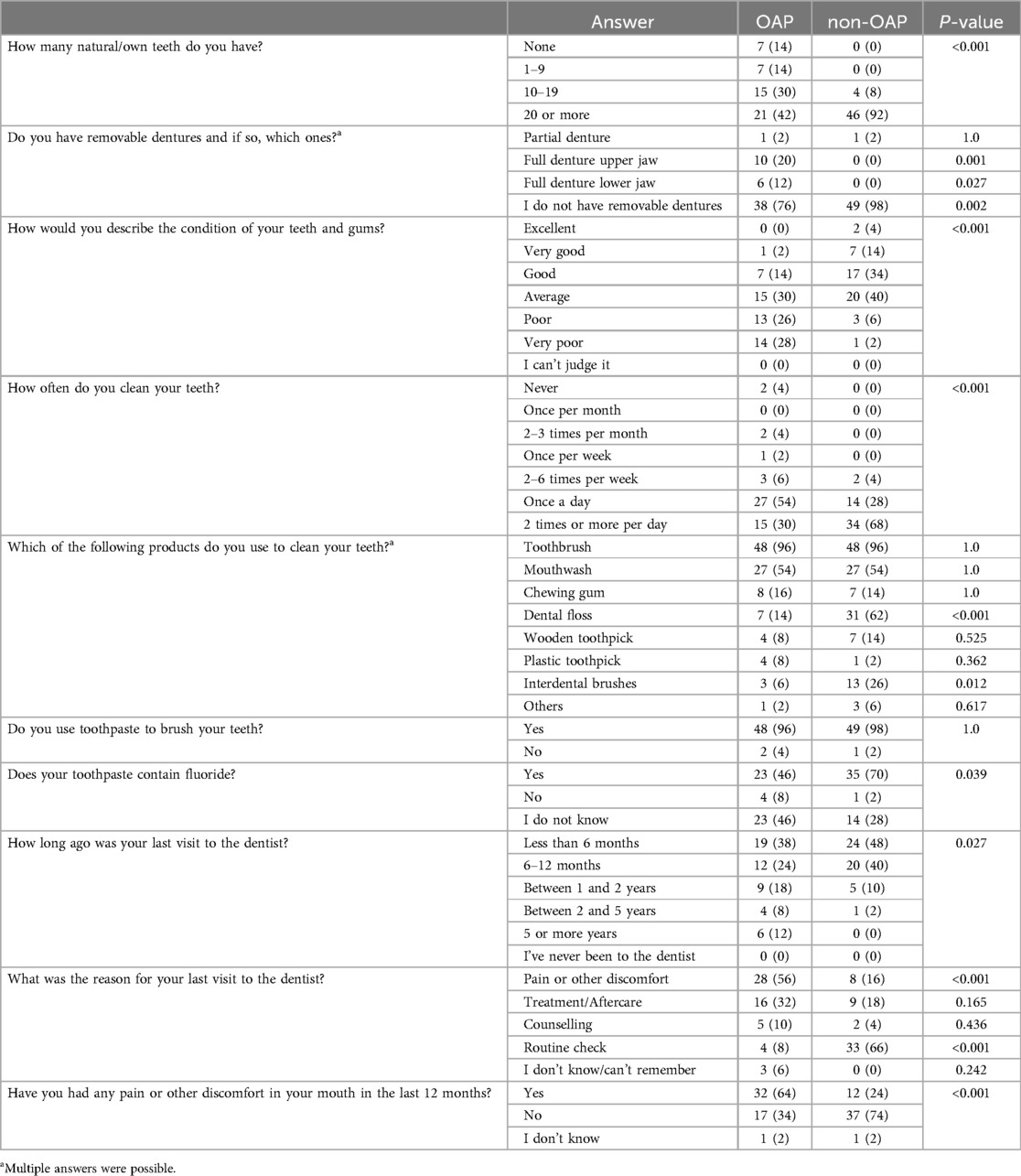
ObjectivesOpioid use has significantly increased in Germany in recent years. This study aimed to evaluate and compare the oral health, dental hygiene, self-perceived pain, and functional limitations of opioid-addicted patients with a healthy control group.Materials and methods50 opioid-addicted patients (OAP) attending substitution treatment at the Centre for Addiction Medicine of the Department of Psychiatry and Psychotherapy at the University of Regensburg were enrolled and interviewed about their drug use history. A control group was matched for age and sex. The oral health status of patients in both groups was documented using a record of decayed, missing and filled teeth (DMFT), Periodontal Screening Index (PSI), Silness and Loe Plaque Index (PI), stimulated salivary flow rate, buffer capacity and pH. Patients also completed a questionnaire on oral hygiene, functional limitations, dietary habits and other topics. Statistical analysis was performed using non-parametric tests (α = 0.05).ResultsMore men (74%) than women (26%) participated in the study with an age range of 19–64 years. According to the inclusion criteria, all OAP had a history of heroin use, followed by cannabinoids (90%) and cocaine (82%). The median DMFT of the OAP was 21 (IQR = 12–28) and was significantly higher (P < 0.001) than in the control group (median = 10, IQR = 5–16). In addition, the OAP had a significantly higher proportion of periodontal treatment needs (P < 0.001). The PI of the OAP was also significantly worse (P = 0.012). The pH of stimulated saliva from the OAP (median = 6.8, IQR = 6.4–7.2) was significantly lower (P = 0.002) compared to the control group (median = 7.2, IQR = 7.0–7.4). However, there were no significant differences in stimulated salivary flow rate and buffering capacity (P > 0.086). OAP had significantly poorer oral hygiene, with a particular lack of interdental care (P ≤ 0.0012), and a significantly higher consumption of sweets or sweetened drinks appeared to be a problem (P ≤ 0.027). Functional limitations (P < 0.001) were reported to be a burden for OAP.ConclusionOpioid addiction significantly impacts oral health, necessitating improved dental care and confidential treatment services to prevent dental and periodontal diseases and support the social integration of affected individuals.

7,567 views

6 citations

ORIGINAL RESEARCH
13 January 2025
Motivation and experiences of dentists of primary care dental clusters in Hungary: a qualitative inquiry
András Sztrilich, 3 more and István Vingender

3,733 views

2 citations

ORIGINAL RESEARCH
2 December 2024
Outcome predictors of odontogenic abscesses in the elderly
Daniel Kaercher, 3 more and Axel Hamprecht

3,893 views

5 citations

Dentistry is uniquely positioned as a healthcare profession, distinguished from allied health or paramedical fields. It operates within a university-based structure, maintaining primary care responsibilities. Oral diseases impose a substantial worldwide health and economic burden, profoundly affecting the well-being of those affected. This cross-sectional study is centered on the Irula tribes in Tamil Nadu, India. Investigating the extent of tooth morbidity and loss, identifying possible risk factors, looking at oral hygiene habits, and evaluating the oral health-associated quality of life (OHRQoL) in this population are the main goals. As this population is at high risk for dental issues, promoting good oral hygiene becomes crucial.Indigenous populations, including the Irula tribes, have been underrepresented in research studies. The vulnerability of the Irula tribes is exacerbated by their remote locations, resulting in limited access to fundamental healthcare facilities.This study employs a cluster sampling approach, aiming to include 880 individuals aged 60 and above from Kancheepuram and Chengalpattu districts. The methodology encompasses a community-based questionnaire, clinical assessments utilizing standardized indices, and the assessment of the Oral Health-Related Quality of Life (OHRQoL). The Statistical Package for Social Services, version 20, will be used to analyze all of the data that has been gathered (SPSS).Categorical variables will undergo analysis, with descriptive statistics and frequency percentages computed. CONCLUSION: This study evaluates tooth morbidity and dentistry's role in screening chronic diseases like diabetes among the Irula tribes. It explores risk factors, oral hygiene practices, treatment seeking behavior, and oral health-related quality of life to gain a comprehensive understanding.

2,584 views

1 citations

CASE REPORT
7 May 2024
Immediate loading in partially edentulous patients with fixed implant-supported restorations cases report
Shuang Wang, 3 more and Yulong Tang

3,239 views