Process Data in Educational and Psychological Measurement

299kviews
Editorial: Process Data in Educational and Psychological Measurement
Editorial03 December 2021
Editorial: Process Data in Educational and Psychological Measurement

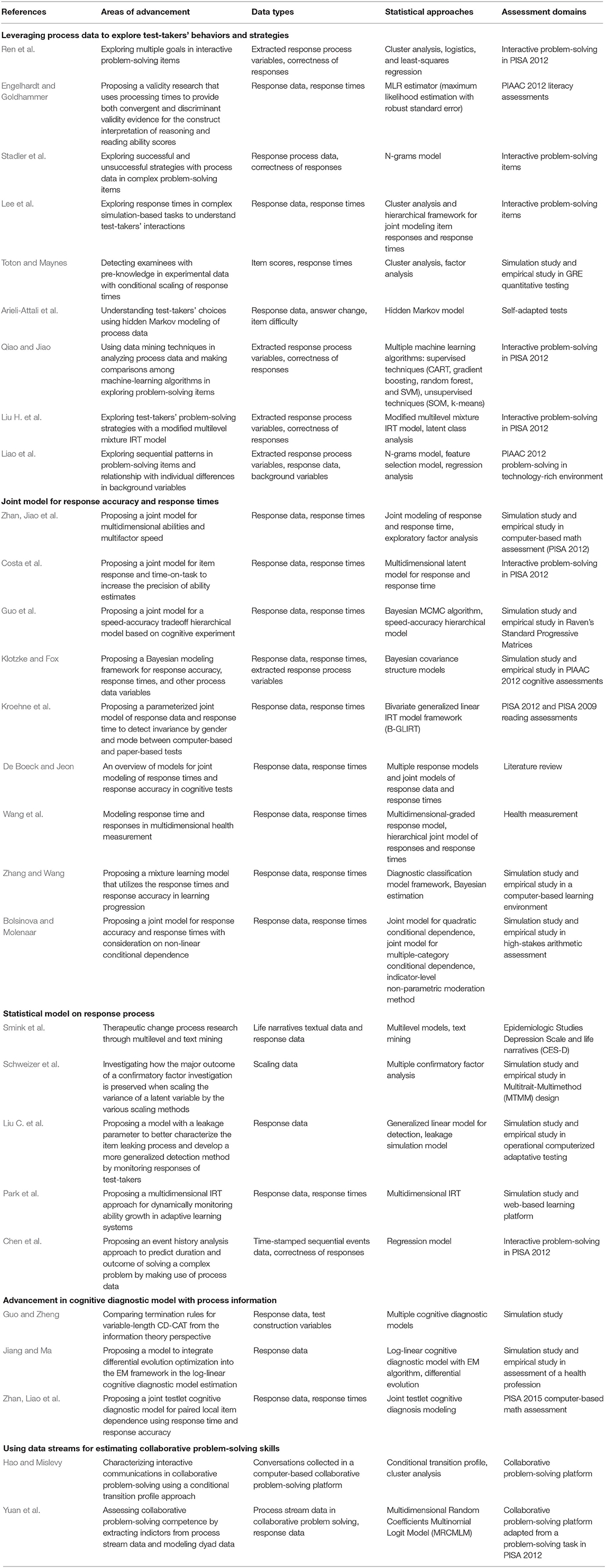
With the availability of process data in addition to response data, the measurement field is becoming increasingly interested in borrowing additional auxiliary information from responding process to serve different assessment purposes. For instance, recently researchers proposed different models for response time and the joint modeling of responses and response time (e.g., Bolsinova & Molenaar, 2018;Costa et al., 2021;Wang et al., 2019). In addition, other process data such as the path collected based on eye-tracking devices (e.g., Maddox et al., 2018;Man & Harring, 2020;Zhu & Feng, 2015), action sequences in problem solving tasks (e.g., Chen et al., 2019;He et al., 2021;Tang et al., 2020;Ulitzsch et al., 2021b), and processes in collaborative problem solving (e.g., Andrews-Todd & Kerr, 2019;de Boeck & Scalise, 2019;Graesser et al., 2018), are also worthy of exploration and integration with product data for assessment purposes. This Research Topic (formed in this edited e-book) intends to explore the forefront to respond to the needs in modeling new data sources and incorporating process data in statistical modeling of multiple possible assessment data. This edited book presents the cutting-edge research related to utilizing process data in addition to product data such as item responses in educational and psychological measurement for enhancing accuracy in ability parameter estimation (e.g., Bolsinova & Molenaar, 2018;de Boeck & Jeon, 2019;Engelhardt & Goldhammer, 2019;Klotzke &Fox, 2019;Liu et al., 2019;Park et al., 2019;Schweizer et al., 2019;Wang et al., 2019;Zhang & Wang, 2018;), facilitating cognitive diagnosis (e.g., Guo & Zheng, 2019;Guo et al., 2020;Jiang & Ma, 2018;Zhan et al., 2018;Zhan et al., 2021), and aberrant responding behavior detection (e.g., Liu et al., 2018;Toton & Maynes, 2019).Throughout the book, the methods for analyzing process data in technology-enhanced innovative items in large-scale assessment for high-stakes decisions are addressed (e.g., Lee et al., 2019;Stadler et al., 2019). Further, the methods for the extraction of useful information in process data in assessment such as serious games and simulations were also discussed (e.g., Liao et al., 2019;Kroehne et al., 2019;Ren et al., 2019;Yuan et al., 2019). The interdisciplinary studies that borrowing data-driven methods from computer science, machine learning, artificial intelligence, and natural language processing are also highlighted in this research topic (e.g., Ariel-Attali et al., 2019;Chen et al., 2019;Hao & Mislevy, 2019;Qiao & Jiao, 2018;Smink et al., 2019), which provide new perspectives in data exploration in educational and psychological measurement. Most importantly, the models presenting the integration of the process data and the product data in this book are of critical significance to link the traditional test data with the new features extracted from new data sources. Meanwhile, the papers included in the book provide an excellent source for data and coding sharing, which entails significant contributions to the applications of the innovative statistical modeling of assessment in the measurement field.The book chapters demonstrate the use of process data and the integration of process and product data (item responses) in educational and psychological measurement. The chapters address issues in adaptive testing, problem-solving strategy, validity of test score interpretation, item preknowledge detection, cognitive diagnosis, complex dependence in joint modeling of responses and response time, and multidimensional modeling of these data types. The originality of this book lies in that the statistical modeling of innovative assessment data such as log data, response time data, collaborative problem-solving tasks, dyad data, change process data, testlet data, and multidimensional data. Further, new statistical models are presented for analyzing process data in addition to response data such as transition profile analysis, the event history analysis approach, hidden Markov modeling, conditional scaling, multilevel modeling, text mining, Bayesian covariance structure modeling, mixture modeling, and multidimensional modeling. The integration of multiple data sources and the use of process data provides the measurement field with new perspectives to solve assessment issues and challenges such as problem-solving strategy, cheating detection, and cognitive diagnosis.An overview of all the papers included in this Research Topic is summarized in Table 1 with respect to their key features. The scope of the Research Topic can be classified into five major categories:(1) leveraging process data to explore test-takers' behaviors and problem-solving strategies,(2) proposing joint modeling for response accuracy and response times,(3) proposing new statistical models on analyzing response process (e.g., time-stamped sequential events),(4) advancing cognitive diagnostic models with new data source, and(5) using data stream in estimating collaborative problem-solving skills.The categorization focused on each paper's core contribution though some papers can be crossclassified. The papers' key findings and advancements impressively represent the current stateof-the-art in the field of process data analysis in educational and psychological assessments. As topic editors, we were happy to receive such a great collection of papers with various foci and make these publications right on time when digital assessments are booming. The papers collected in this Research Topic also diversify in data types, statistical approaches as well as assessment with an extensive scope in both high-stake and low-stake assessments, covering the research fields in education, psychology, health, and other applied disciplines.[Insert . This number keeps growing on the daily basis. The book readers reside all over the world throughout six continents including under representative areas in Africa and South America. The diversified demographics provide convincing evidence that the papers in this book reached the global research community, to address the critical issues of statistical modeling of multiple types of assessment data in the digital era that would need to be confronted by the whole world. This book is right in time to provide tools and methods to shape this new measurement horizon.As more and more data are being collected in computer-based testing, process data will become a very important source of information to validate and facilitate measuring the response accuracy and provide supplementary information in understanding test takers' behaviors, the reasons of missing data, and linking with motivation studies. There is no doubt for a high demand of such research in the large-scale assessment, both high-stake and low-stake, as well as in the personalized learning and assessment to tailor the best source and methods to help people learn and grow. This book is a timely addition to the current literatures in psychological and educational measurement. It is expected to be applied more extensively in educational and psychological measurement, such as in computerized adaptive testing and dynamic learning.
4,755 views

22 citations

ORIGINAL RESEARCH
4 June 2019
Detecting Examinees With Pre-knowledge in Experimental Data Using Conditional Scaling of Response Times
Sarah L. Totonand Dennis D. Maynes
Detecting Examinees With Pre-knowledge in Experimental Data Using Conditional Scaling of Response Times
The detection of examinees who have previously accessed proprietary test content is a primary concern in the context of test security. Researchers have proposed using item response times to detect examinee pre-knowledge, but progress in this area has been limited by a lack of real data containing credible information about pre-knowledge and by strict statistical assumptions. In this work, an innovative, but simple, method is proposed for detecting examinees with pre-knowledge. The proposed method represents a conditional scaling that assesses an examinee’s response time to a particular item, compared to a group of examinees who did not have pre-knowledge, conditioned on whether or not the item was answered correctly. The proposed method was investigated in empirical data from 93 undergraduate students, who were randomly assigned to have pre-knowledge or not. Participants took a computerized GRE Quantitative Reasoning test and were given no items, half the items, or half the items with correct answers to study before the test, depending on their condition. Exploratory analysis techniques were used to investigate the resulting values at both the item and person-level, including factor analyses and cluster analyses. The proposed method achieved impressive accuracy of separation between disclosed and undisclosed items and examinees with and without pre-knowledge (96% and 97% accuracy for cluster analyses, respectively), demonstrating detection power for item disclosure and examinee pre-knowledge. The methodology requires minimal assumptions about the data and can be used for a variety of modern test designs that preclude other types of data forensic analyses.

7,482 views

27 citations

Understanding Therapeutic Change Process Research Through Multilevel Modeling and Text Mining
ORIGINAL RESEARCH
29 May 2019
Understanding Therapeutic Change Process Research Through Multilevel Modeling and Text Mining
Wouter A. C. Smink, 4 more and Bernard P. Veldkamp
\noindent\textbf{Introduction} Online interventions hold great potential for Therapeutic Change Process Research (TCPR), a field that aims to relate in-therapeutic change processes to the outcomes of interventions. Online a client is treated essentially through the language their counsellor uses, therefore the verbal interaction contains many important ingredients that bring about change. TCPR faces two challenges: how to derive meaningful change processes from texts, and secondly, how to assess these complex, varied and multi-layered processes? We advocate the use text mining and multi-level models (MLMs): the former offers tools and methods to discovers patterns in texts; the latter can analyse these change processes as outcomes that vary at multiple levels. \noindent\textbf{Method} We (re-)used the data from \cite{Lamers2015} because it includes outcomes and the complete online intervention for clients with mild depressive symptoms. We used text mining to obtain basic text-variables from e-mails, that we analysed through MLMs. \noindent\textbf{Results} We found that we could relate outcomes of interventions to variables containing text-information. We conclude that we can indeed bridge text mining and MLMs for TCPR as it was possible to relate text-information (obtained through text mining) to multi-levelled TCPR outcomes (using a MLM). \noindent\textbf{Discussion} Text mining can be helpful to obtain change processes, which is also the main challenge for TCPR. We showed how MLMs and text mining can be combined, but our proposition leaves open how to obtain the most relevant textual operationalization of TCPR concepts. That requires interdisciplinary collaboration and discussion. The future does look bright: based on our proof-of-concept study we conclude that MLMs and text mining can indeed advance TCPR.

14,341 views

24 citations

A validity approach is proposed that uses processing times to collect validity evidence for the construct interpretation of test scores. The rationale of the approach is based on current research of processing times and on classical validity approaches providing validity evidence based on relationships with other variables. Within the new approach, convergent validity evidence is obtained if a component skill, that is expected to underlie the task solution process in the target construct, positively moderates the relationship between effective speed and effective ability in the corresponding target construct. Discriminant validity evidence is provided if a component skill, that is expected not to underlie the task solution process in the target construct, does indeed not moderate the speed-ability relation in this target construct. Using data from a study that follows up the German PIAAC sample, this approach was applied to reading competence assessed with PIAAC literacy items and to quantitative reasoning assessed with Number Series. As expected from theory, the effect of speed on ability in the target construct was only moderated by the respective underlying component skill, that is, word meaning activation skill as underlying component skill of reading competence and perceptual speed as underlying component skill of reasoning. Accordingly, no positive interactions were found for the component skill that should not underlie the task solution process, that is, word meaning activation for reasoning and perceptual speed for reading. Furthermore, the study shows the suitability of the proposed validation approach. The use of time information in association with task results brings construct validation closer to the actual response process than widely-used correlations of test scores.

7,895 views

24 citations

A Multidimensional IRT Approach for Dynamically Monitoring Ability Growth in Computerized Practice Environments
ORIGINAL RESEARCH
29 March 2019
A Multidimensional IRT Approach for Dynamically Monitoring Ability Growth in Computerized Practice Environments
Jung Yeon Park, 2 more and Wim Van Den Noortgate
Adaptive learning systems have received an increasing attention as they enable to provide personalized instructions tailored to the behaviors and needs of individual learners. In order to reach this goal, it is desired to have an assessment system, monitoring each learner’s ability change in real time. Elo Rating System (ERS), a popular scoring algorithm for paired competitions, has recently been considered as a fast and flexible method that can assess learning progress in online learning environments. However, it has been argued that a standard ERS may be problematic due to the multidimensional nature of the abilities embedded in learning materials. In order to handle this issue, we propose a system that incorporates a multidimensional item response theory model (MIRT) in the ERS. The basic idea is that instead of updating a single ability parameter from the Rasch model, our method allows a simultaneous update of multiple ability parameters based on a compensatory MIRT model, resulting in a multidimensional extension of the ERS (‘M-ERS’). To evaluate the approach, three simulation studies were conducted. Results suggest that the ERS that incorrectly assumes unidimensionality has a seriously lower prediction accuracy compared to the M-ERS. Accounting for both speed and accuracy in M-ERS is shown to perform better than using accuracy data only. An application further illustrates the method using real-life data from a popular educational platform for exercising math skills.

7,588 views

20 citations

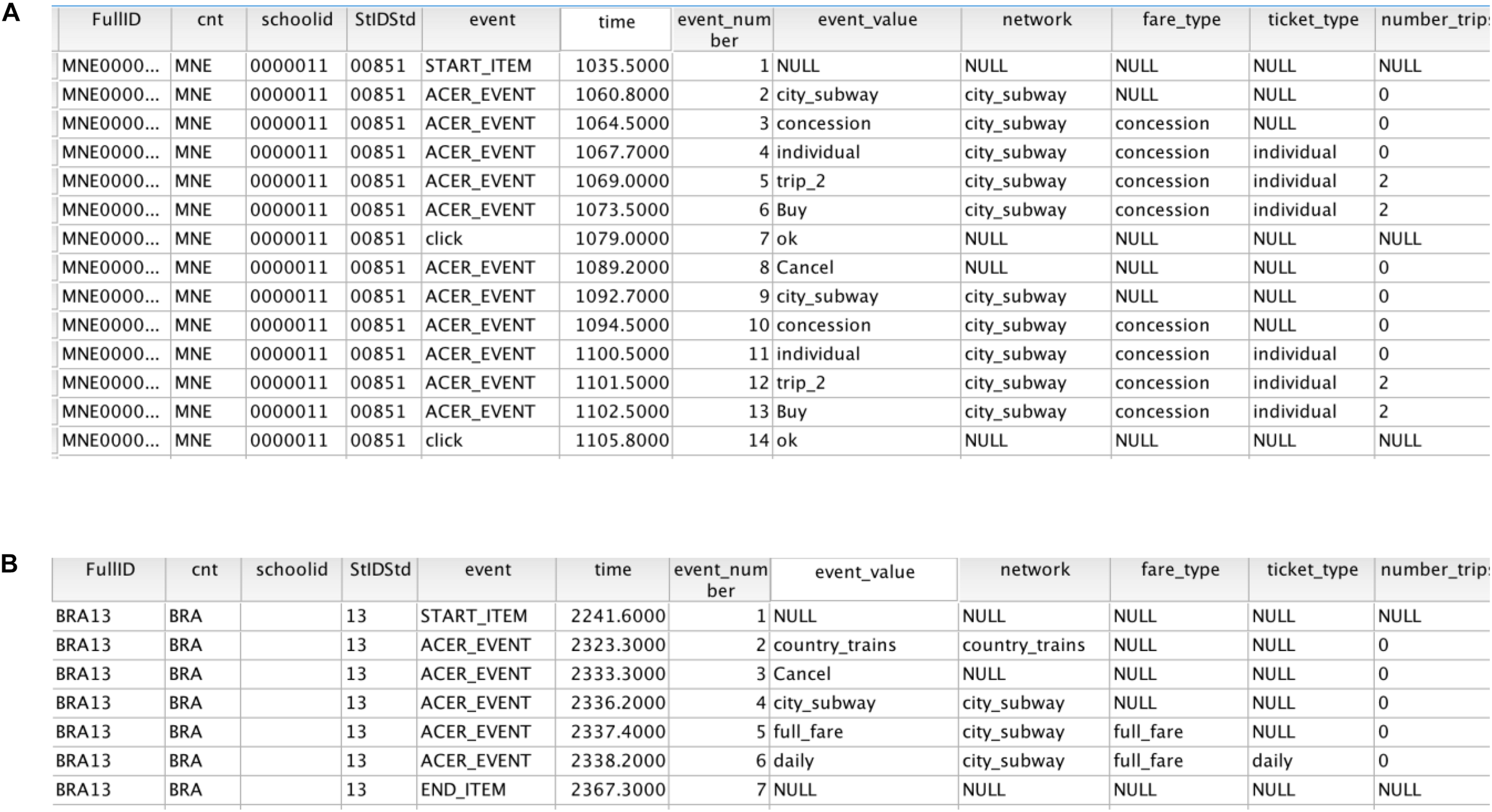
Statistical Analysis of Complex Problem-Solving Process Data: An Event History Analysis Approach
ORIGINAL RESEARCH
18 March 2019
Statistical Analysis of Complex Problem-Solving Process Data: An Event History Analysis Approach
Yunxiao Chen, 2 more and Zhiliang Ying

13,633 views

47 citations

As one of the important 21st-century skills, collaborative problem solving (CPS) has caught much attention in the assessment area. Two initiative approaches have been created: the human-to-human and human-to-agent modes. Between the two modes, the human-to-human interaction is much closer to the real-world situation and its process stream data can reveal more detailed information about the cognitive processes. In order to measure CPS ability effectively by this mode, how to extract indicators from the data and model it is crucial, while the existing methods all have some disadvantages. In the present study, we proposed a new paradigm for extracting indicators and modeling the dyad data in the human-to-human mode. Specifically, both individual and group indicators were extracted from the data stream, which served as evidence for demonstrating CPS skills. In addition, a within-item multidimensional Rasch model was used to fit the dyad data. To test the validity of the paradigm, we developed five tasks following the asymmetric mechanism and integrated them into an online testing platform. Four hundred thirty-four students from China participated in the assessment and the online platform recorded their crucial actions with time stamps. The new paradigm was used to deal with the generated process stream data. Results showed that the model fitted well. The item parameter estimates and fitting indexes were acceptable, and students were well differentiated. In general, the new paradigm of extracting indicators and modeling the dyad data is feasible for improving the human-to-human assessment of CPS. Finally, the limitations of the current study and further research directions are discussed.

8,459 views

39 citations