Biological systems such as animals and humans can be energetically autonomous for several days and
some species endure even longer. Today’s robotic systems aim to match the physical capabilities of their
biological counterparts in terms of strength, agility and dexterity, yet fail to display untethered operating
times any longer than few hours. Changing this situation is challenging and likely requires fundamental
shifts in the current paradigms for robot designs.
Today, new and promising paradigms evolve from the fact that robotics has just become a prominent
tool to validate biomechanic models and hypotheses about the causality behind observations made in
nature. The physical implementation of the biomechanic models in robotic systems allows to quantitatively
evaluate theory and compare replicated movement and force patterns to those observed in biology. Using
this technique, we have only recently fostered our understanding of nature’s principles e.g. in neural control
and actuation design for locomotion.
The new biomechancis insights are now being turned into novel mechatronic paradigms and solutions
such as dynamically and efficiently walking robots or robust and lightweight robotic prostheses and
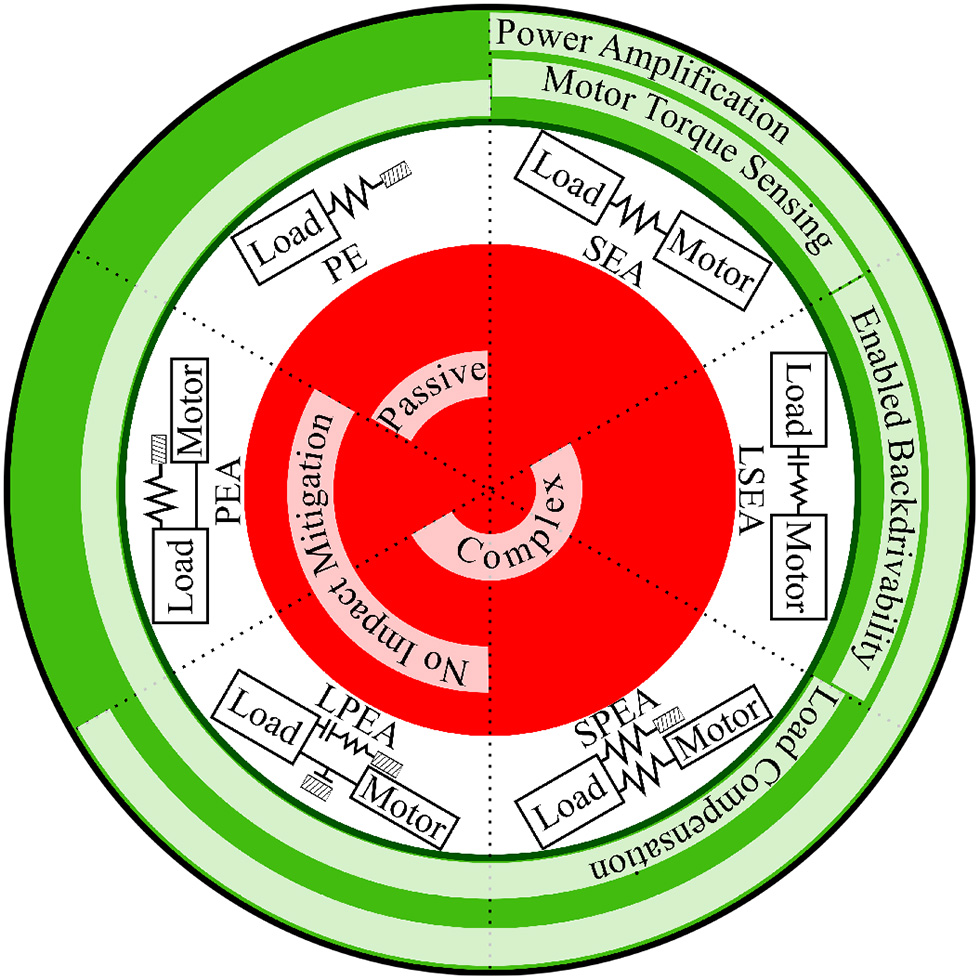
orthoses. Conventional robot designs are dominated by chains of rigid links with high transmission ratio
non-backdrivable joints. The integration of intrinsically compliant components into robot designs has been
researched for more than two decades now. However, we have only recently gained the understanding on
how to effectively exploit passive springs and intrinsically backdrivable low transmission ratio actuators
for low inertia designs, force sensing and control for efficient as well as impact resilient actuation. This is
particularly important for enduring untethered legged locomotion in unstructured environments and realistic
terrain, where impacts on the mechanism represent normal operating conditions. Further insights on neural
control in biological systems spawn new paradigms for hierarchical and hybrid local/distributed control
architectures, which can tackle the complexity we have to overcome to make robots ready and robust to
carry out real-world scenarios outside the lab space. The realm of conclusions drawn from this research
includes that not all control loops need to run at high rates ( > 1 kHz). Sometimes closing a loop with the
associated delays and efforts to ensure stability, might not be advisable at all and feedforward actions along
with carefully shaped natural dynamics can lead to simpler, more robust and efficient solutions.
The present e-book joins research efforts from the robotics, control and biodynamics communities
29 towards novel robot design and control paradigms. The joint efforts included the organization of a physical work meeting in the form of a joint workshop on the energetics economy in robotics during the International
31 Conference on Intelligent Robots and Systems (IROS) on September 24, 2017 1 .
30
Given the interdisciplinary nature of the Research Topic, it is organized under the sections “Humanoid
Robotics” and “Robotic Control Systems” within Frontiers in Robotics and AI as well as the “Bionics and
34 Biomimetics” section with Frontiers in Bioengineering and Biotechnology. The collection of articles in this
35 e-book captures a wide-angled perspective on the current state-of-the-art in robotic as well as biodynamic
36 actuation modelling, analysis, design and control towards enhanced robot energy efficiency.
32
33
37
38
39
40
41
42
43
The wide-angled perspective is initialized with an overview article by Kashiri et al. (2018) on fundamental
principles of locomotion inspired from natural biological systems, and principles for the design and control
for efficient robot locomotion. As a foundation, Lee and Harris (2018) present and discuss a framework for
quantitative evaluation of locomotion efficiency in animals and robots. The e-book further elaborates on
some of the locomotor principles outlined in the overview with dedicated articles on minimally actuated
walkers (Schroeder and Bertram, 2018) and articulated compliant parallel actuation arrangements (Roozing,
2018).
Nature demonstrates elegant solutions to minimize the inertia of moving limbs through remote tendon
driven actuation. Several articles in the e-book are devoted to the potential and the challenges encountered
46 during the technical implementation and application of such principles (Grosu et al., 2018; Wagner and
47 Emmanouil, 2018; Tian et al., 2017).
44
45
48
49
50
51
52
53
54
55
56
57
Urbina-Meléndez et al. (2018) model and study how observability and state-estimation in balancing skills
depends on the physical location of sensory organs. Nguyen et al. (2018) investigate the activation and
response behaviour of biological muscles. Engineers seeking to find suitable target functions for actuator
designs or optimal sensor placements in their robots can greatly benefit from these insights, which emerge
from millions of years of natural evolutionary design iterations.
Nature seems to effortlessly manage complexity, not only concerning growing and self-regenerating
biomechanics, but also considering efficient and effective control of millions of cells, sensors and muscle
fibres. In this e-book Groothuis et al. (2018) address this topic in the context of energy aware control across
distributed control hierarchies as observed in biology and – with the aim to manage system complexity –
also applied to technical systems (Barasuol et al., 2018).
Apart from mobile and legged robots, the direct beneficiaries of the mutual insights in biodynamics
59 and robotics engineering are humans. This e-book includes examples of robotic rehabilitation systems
60 (Ghannadi et al., 2018) as well as assistive robotic devices such as passive and active prostheses (Jeffers
61 and Grabowski, 2017; Tahir et al., 2018) to improve or recover the quality of life.
58
62
63
64
65
66
The editors hope that the results presented in this e-book will catalyse the advent of new robots and
assistive robotic devices with enduring energetic autonomy, which will help us tackle the upcoming societal
and economic challenges. At the same time the presented works report unique and invaluable experimental
data that help verifying and refining theories as well as hypotheses striving to understand the nature of the
species living on our planet (Urbina-Meléndez et al., 2018; Nguyen et al., 2018).