Methods in political science – Innovation & Developments

Cover image for Research Topic "Methods in political science – Innovation & Developments"
64kviews
ORIGINAL RESEARCH
13 October 2025
B-Call: integrating ideological position and voting cohesion in legislative behavior
Sergio Toro-Maureira, 3 more and Macarena Valenzuela

3,133 views

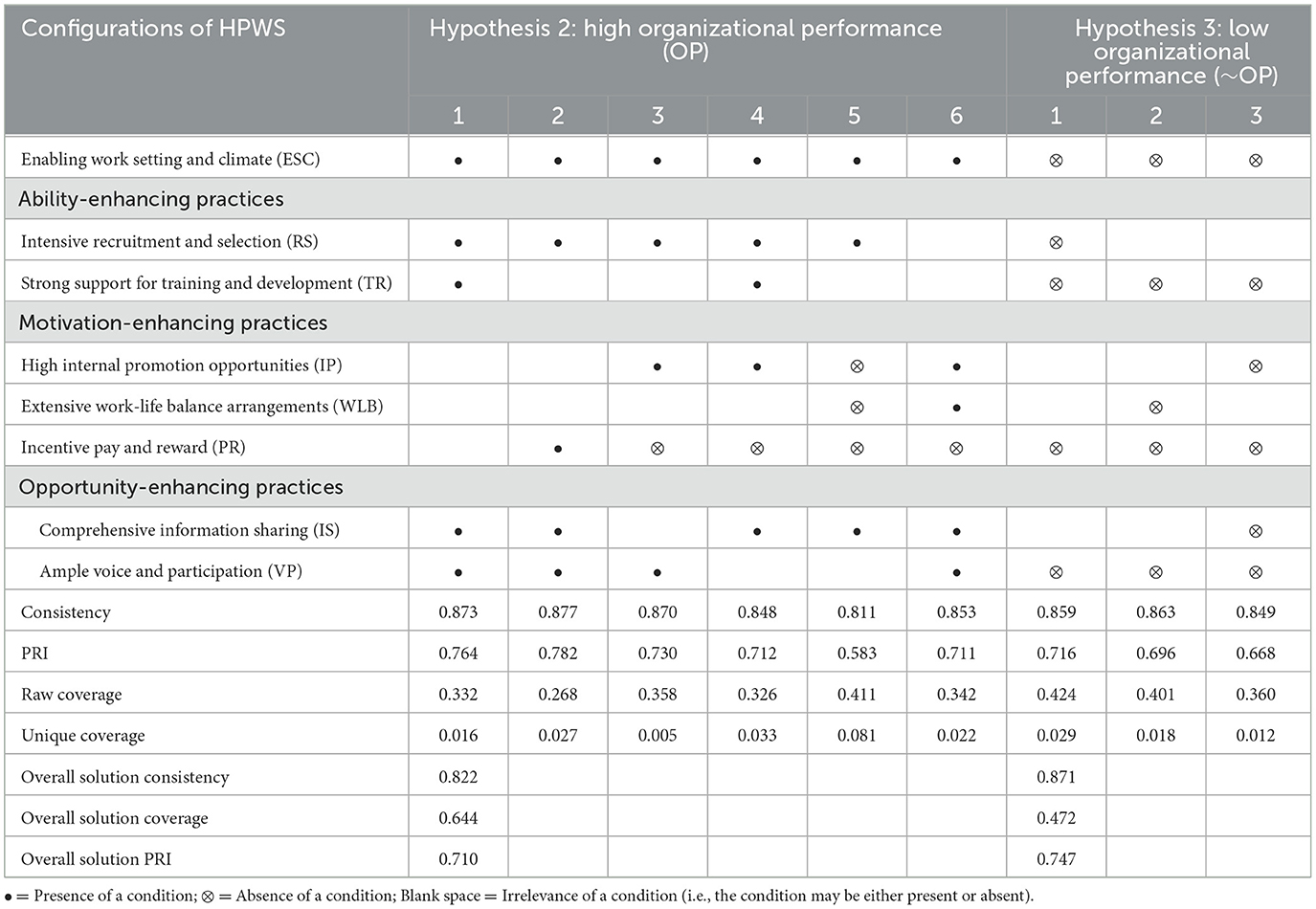
High-Performance Work Systems (HPWS) are combinations of human resource (HR) practices designed to enhance organizational performance. Although the configurational approach emphasizes aligning HR practices into coherent bundles (i.e., “best-fit” approach), empirical research has primarily focused on universalistic (i.e., “best-practices”) approaches, especially in the public sector. This study aims to identify which configurations of HPWS practices and work environments better explain the organizational performance of Swiss municipal administrations. Using a set-theoretic approach, the study analyzes data from 119 Swiss municipalities through a revised two-step Qualitative Comparative Analysis (QCA) combined with formal theory evaluation. The results identify a climate of internal trust and a strong HR system as necessary conditions for high performance. Additionally, six distinct HPWS configurations were found to be sufficient for high performance, while three explained low performance. Thus, this study offers empirical support for the configurational perspective in HRM, emphasizing the causal complexity of HPWS and their impact on organizational performance. The findings also reveal that incentive pay and rewards are either consistently avoided or combined with other motivational practices. This underscore significant challenges related to the motivational dimension of the Ability, Motivation, Opportunity (AMO) framework in the public sector, highlighting the need for future research into how motivational HPWS practices can be effectively implemented in alignment with Public Service Motivation (PSM).

4,440 views

7 citations

Ideology is a key concept in political science. In studies related to political representation, policy responsiveness, and the quality of decision-making in elections, ideology is a central concept that needs precise measurement to test related hypotheses. Despite its prominence in the political science literature, ideology is often measured differently for elites and voters with indicators that do not correlate among themselves. As a result, it is not possible to assess whether the measures of ideology and the latent dimensionality behind measures of ideology in the population and the political elites align or to what extent they differ. In this paper, I build on existing research and propose a way to measure the ideology of voters in population survey on the same space as the political elites by the same policy questions answered by political elites to voters. Furthermore, I show that researchers only need a rather limited number of questions to reach an accurate measure of ideology. Using Monte-Carlo simulations as well as real-world election data from a voting advice application (VAA) and a post-election survey in a Bayesian Item-Response Theory framework, I show that, using only a limited number of policy questions, it is possible to position voters and political elites in a similar ideological space. In sum, this paper shows that taking a handful of policy questions from elites surveys enables the operationalization of a common ideological space for political elites and citizens. This has large implications for the study of the relationship between citizens, voters, parties, and politicians.

4,728 views

4 citations

ORIGINAL RESEARCH
3 July 2024
Beyond negativity? A laboratory study on emotional responses to populist strategies on social media
Jenny Lindholm, 3 more and Sören Andersson

5,723 views

2 citations