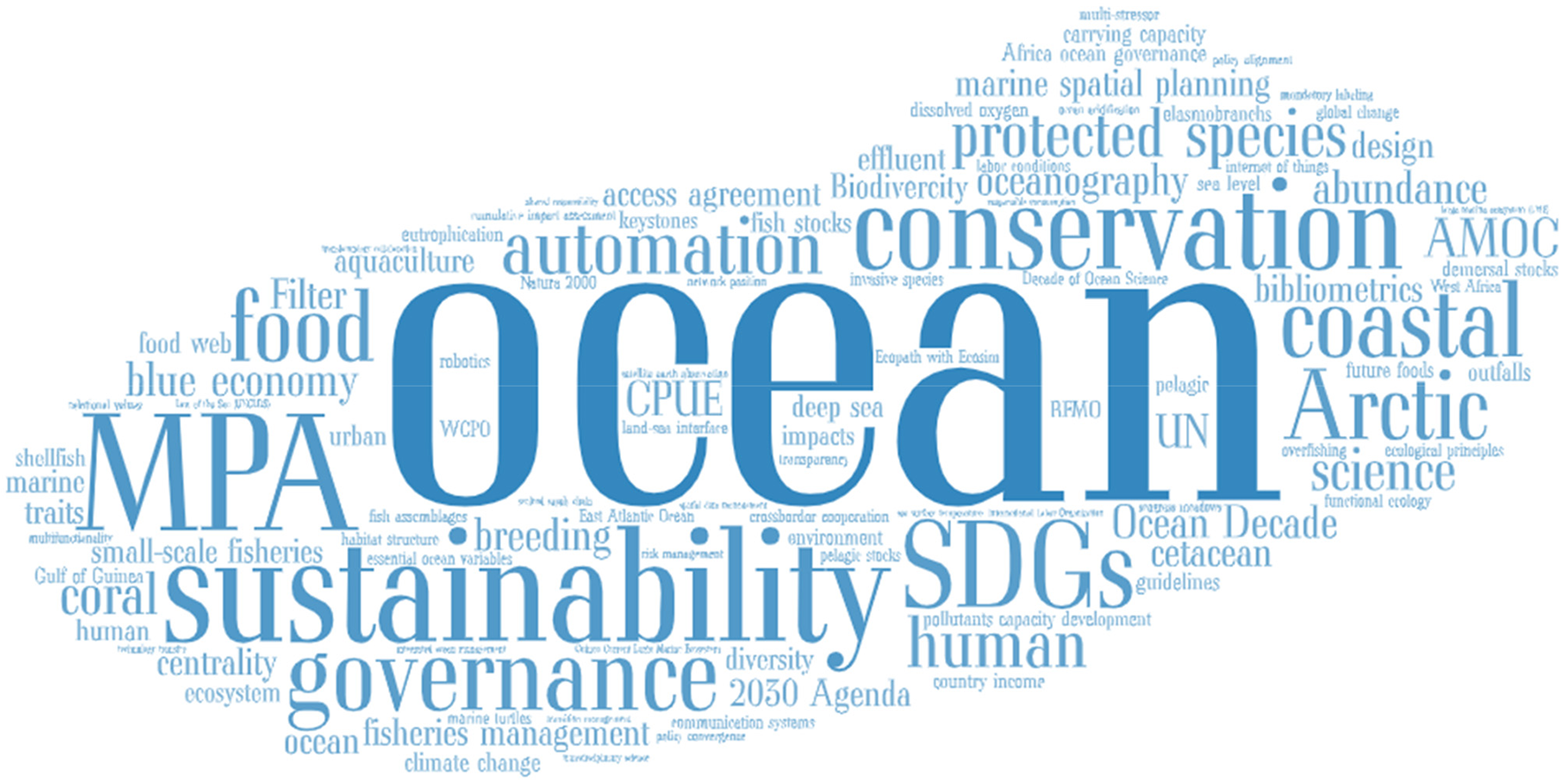
The launch of the UN Decade of Ocean Science for Sustainable Development (2021Development ( -2030 aims at catalyzing a global focus to advance SDG14 and the co-design of knowledge and actions for transformative ocean solutions to address the challenges of a growing human population and climate change. Human pressures on the Ocean are important -37% of the human population live coastally, from small villages to mega cities exceeding 10 million people (e.g., New York, Shanghai, Lagos) and use the Ocean for a huge range of inputs, outputs and services including amenity, food, transport, cooling water and waste disposal, as well as traditional and cultural uses. Many of these ecosystem services are undervalued despite being conservatively estimated at more than $3 Trillion (USD) annually and growing. This is without even considering two of the most severely undervalued services provided by the Ocean as heat and carbon sinks that have buffered many of the negative impacts of climate change. Many anthropogenic activities are leaving significant, direct and measurable global footprints in the Ocean with high profile examples including fishing (Transparency for a Sustainable Ocean | Global Fishing Watch, Sea Around Us -Fisheries, Ecosystems and Biodiversity, Global Fishing Index | Flourishing Oceans | The Minderoo Foundation), shipping lanes (Consequences of global shipping traffic for marine giants -Pirotta -2019 -Frontiers in Ecology and the Environment -Wiley Online Library, Emissions and health impacts from global shipping embodied in US-China bilateral trade | Nature Sustainability), dredging (Dredging-Science-Synthesis-Report-A-Synthesis-of- Research-2012-2018-April-2019.pdf (wamsi.org.au)), plastic pollution (Estimating quantities and sources of marine debris at a continental scale -Hardesty -2017 -Frontiers in Ecology and the Environment -Wiley Online Library, Frontiers | Microplastic Pollution in Deep-Sea Sediments From the Great Australian Bight | Marine Science (frontiersin.org)), noise pollution (Effects of marine noise pollution on Mediterranean fishes and invertebrates: A review -ScienceDirect, The soundscape of the Anthropocene ocean (science.org), Recent progress in marine noise pollution: A thorough review -ScienceDirect), and changes in Ocean chemistry (More than just temperature-climate change and ocean acidification -Curious (science.org.au)).Not only do human populations rely directly on the Ocean for food and other commercial activities, a growing body of research has identified our dependency on the Ocean for health and well-being (Frontiers | Moving Toward an Agenda on Ocean Health and Human Health in Europe | Marine Science (frontiersin.org)). Other ecosystem services provided by the Ocean are also yet to be properly considered. These include the cultural and spiritual services provided by the Ocean (de Juan, et al. https://doi.org/10.1038/s41598-021-88745-z, An empirical analysis of cultural ecosystem values in coastal landscapes -ScienceDirect), which have developed over millennia of human relationships with the Ocean, and represent knowledge and connections that extend beyond monetary value. Aiming to integrate this knowledge in scientific endeavours, many Indigenous peoples are bringing their traditional science and knowledge to partner with Western science (Western science and traditional knowledge: Despite their variations, different forms of knowledge can learn from each other (nih.gov) ) and provide a more in-depth and long-term understanding of the Ocean, especially in coastal areas ( Who is the ocean? Preface to the future seas 2030 special issue | SpringerLink).While the challenges are clear and sometimes seem overwhelming, approaches and solutions are being actively developed and tested; several of these are explored in this research topic.With more than three billion people who rely on fish for at least 20% of their daily protein, and more than 120 million directly employed in the fishing and aquaculture sectors (https://www.fao.org/inaction/eaf-nansen/news-events/detail-events/en/c/1413988/), sustainable fishing (Penca, Fiorentino and Vitale, Jaiteh et al.) and aquaculture (Nor Aza et al. ) were a natural focus of several papers. This included a call for reducing effort in mixed species fisheries, and therefore fishing mortality, to take into account the different and lower productivity of some species and the risk to their sustainability (A risk assessment and prioritisation approach to the selection of indicator species for the assessment of multi-species, multi-gear, multi-sector fishery resources -ScienceDirect) and adopt a quota system based on the "pretty good yield" (Pretty Good Yield and exploited fishes -ScienceDirect).Others emphasized the need for better conservation planning and coordination (Katsanevakis et al., Ceccarelli et al., Herrera et al.) as well as integration of their cultural and spiritual values to the wider society (Baker et al.). This included not improved spatial management and provided specific approaches to minimize human impacts and risks to charismatic megafauna, applying it to whale watching activities to support sustainable non-extractive human activities in the Ocean (Almunia et al.). The article by Adewumi et al., dealing with the Guinea Current Large Marine Ecosystem shared among Benin, Nigeria and Cameroon, highlighted the challenges of international ocean governance, a result of political characteristics, the relics of colonialism and increasing ocean use and pressure on the ecosystem. While administrative and political arrangements differ significantly among countries and complicate transnational collaboration, their review revealed varying levels of convergence at international, regional and national levels and could be a model to assist other regional fishery management organizations to support positive steps to ocean sustainability (Report card on ecosystem-based fisheries management in tuna regional fisheries management organizations -Juan-Jordá -2018 -Fish and Fisheries -Wiley Online Library). The social dimension (Haward and Haas) will also be critical as a way of valuing and engaging with direct and indirect stakeholders of the Ocean and in developing better policies for governance (Paredes-Coral et al., Polejack, Adewumi et al., Kirkfeldt and Santos, Archana and Bake, Rohmana et al.). This is especially true at the land-sea interface (Singh et al.) where human populations concentrate and the risks from a changing climate are directly evident, with projected sea level rise Sea-Level Rise and Its Impact on Coastal Zones (science.org), Global LiDAR land elevation data reveal greatest sea-level rise vulnerability in the tropics | Nature Communications), and more frequent and intense storms, (Tropical storms and mortality under climate change -ScienceDirect, Impacts of climate change on tropical cyclones and induced storm surges in the Pearl River Delta region using pseudo-global-warming method | Scientific Reports (nature.com)). It is also true for the deep ocean (Howell et al), which remains largely unexplored. The socio-ecological connections described in this issue of Frontiers in Marine Science provide frameworks and hope for a sustainable future for the coasts and ocean.While this Frontiers in Marine Science research topic does not represent all initiatives underway globally to address SDG 14, Life below Water, it provides a glimpse of some of the diverse approaches and intellectual capital invested in ocean sustainability. While SDG 14 focuses on Life Below Water, the direct links to many if not all other SDGs are obvious: without a healthy and sustainable ocean, achievement of the other SDGS is, arguably, impossible (https://link.springer.com/article/10.1007/s11160-021-09655-x).We hope that other initiatives currently underway will assist in not only highlighting the links between SDG 14 and other SDGs but will also provide a way for synergies among disparate knowledge domains to support a transdisciplinary and multi-sectoral approach for good policy development. As examples, we note the significant initiatives around the globe in areas of blue carbon and an equitable 'blue economy'. Blue carbon projects will not only protect and restore seagrass, mangrove, salt marsh and macrophytes but also support the associated biodiversity and human livelihoods that depend on these critical habitat-forming species. "Working with nature approaches" including in the restoration of corals, seagrasses, seaweeds and mangroves are underway around the globe with new methods being developed and tested (e.g. genetic techniques to identify more heat tolerant species of coral (Buerger e tal., Heat-evolved microalgal symbionts increase coral bleaching tolerance (science.org)) and other marine habitat building species (Alsuwaiyan et al., Genotypic variation in response to extreme events may facilitate kelp adaptation under future climates (int-res.com)).The efforts in these areas will be underpinned by new methods of accounting -such as blue carbon , biodiversity, ecosystem services and a framework of ocean accounting is currently being developed (The Global Ocean Accounts Partnership). This approach embraces environmental, social and cultural accounting, in addition to economic accounting to better assess and value entire marine areas and ecosystems and integrate a wide range of SDGs. Our hope is that this will support and enable clearer and better decisions by ocean and coastal management agencies, based on a number of decision support tools including management strategy evaluation approaches, scenario testing, alternatives assessment and potentially digital twins to test and explore management decisions on ocean activities, especially in coastal areas.We look forward to making the difficult possible and contributing to a vibrant, thriving future throughout the UN Decade of Ocean Science for Sustainable Development and the UN Decade of Restoration (UN Decade on Restoration) based on some of the cutting-edge approaches detailed in this Research Topic of Frontiers in Marine Science (Sustainable Development Goal 14 -Life Below Water: Towards a Sustainable Ocean | Frontiers Research Topic (frontiersin.org)). Figure 1. Word cloud generated from the key words from the SDG 14 papers contributed towards this Frontiers in Marine Science research topic [Generated through WordArt.com -Word Cloud Art Creator]. Some key words were truncated to simplify the generation of the word cloud.