Integrating Transport Infrastructures with Living Landscapes

Cover image for Research Topic "Integrating Transport Infrastructures with Living Landscapes"
185kviews
HYPOTHESIS AND THEORY
16 April 2018
Models of Coupled Settlement and Habitat Networks for Biodiversity Conservation: Conceptual Framework, Implementation and Potential Applications
Maarten J. van Strien, 6 more and Rolf Holderegger

8,465 views

13 citations

A Review of the Factors That Determine Whether Stormwater Ponds Are Ecological Traps And/or High-Quality Breeding Sites for Amphibians
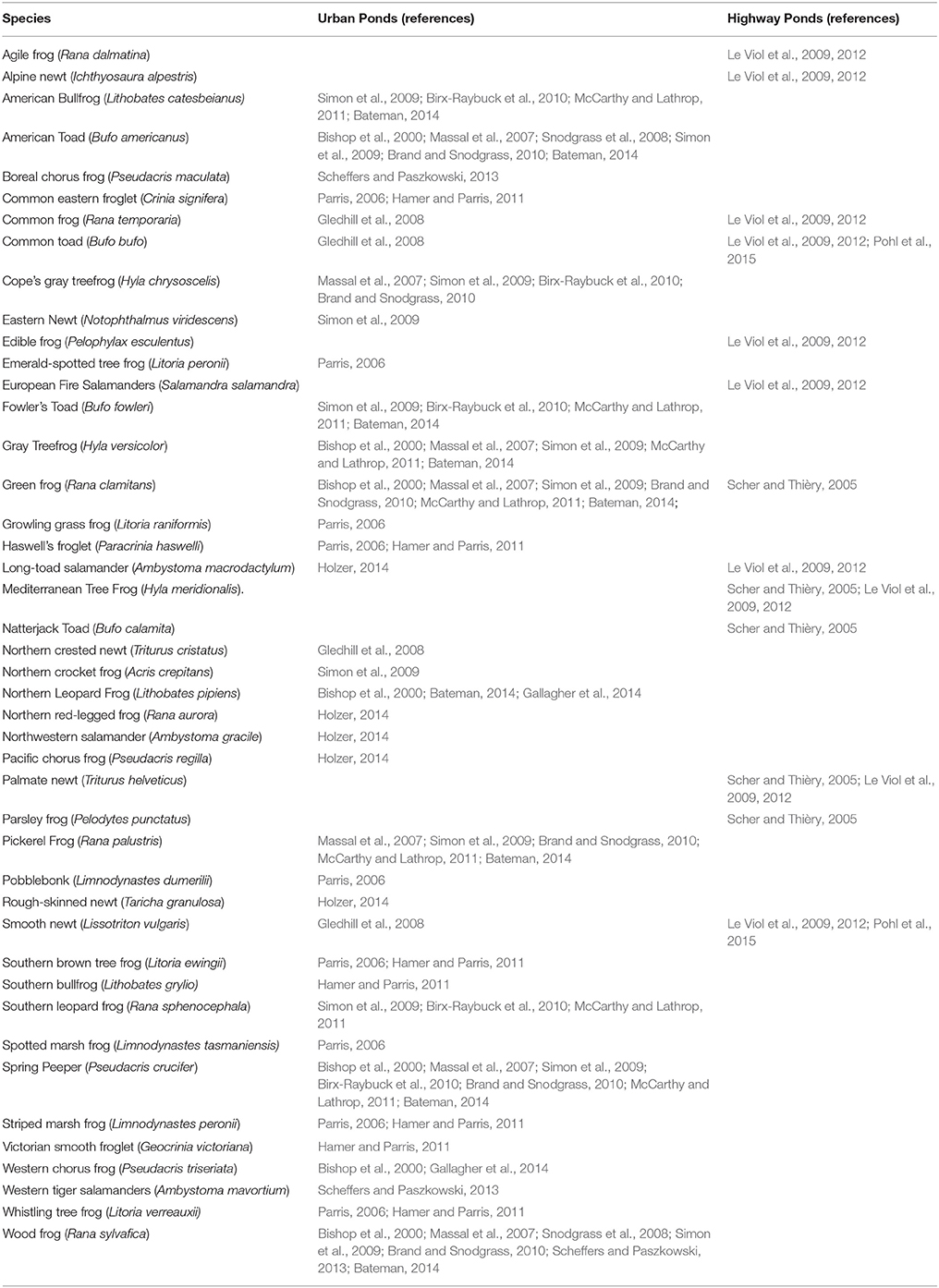
Stormwater ponds were originally constructed to control the quantity and quality of runoff on urban roads and highways before it was released to the environment. Often, stormwater ponds were designed in a technical feat of civil engineering, with no particular ecological or landscape objective in mind. Nevertheless, they are colonized spontaneously by diverse species, including amphibians. Through an initial review of the scientific literature, the objective of this study was to understand which factors determine that a pond can be considered as an ecological trap or a valuable breeding site fort amphibian. The first step was to question the role of the pond environment as a major factor in its colonization by amphibians, demonstrating that not all ponds are colonized by the same variety of species. The internal factors in the ponds that define them as ecological traps or sustainable breeding sites for amphibians was also considered. After confirming the functional and structural similarity between highway and urban stormwater ponds, 25 publications were compared, with study sites mostly located in Europe and North America, and concerning the colonization of stormwater ponds by amphibians in urban or highway areas. Several factors were identified that may affect the ecological viability of these basins: 1) the factors related to the shape of the ponds (inclination of the banks, materials used, etc.); 2) the biotic factors (aquatic vegetation, presence of predators, etc.); 3) the abiotic factors (luminosity, water level in the ponds, etc.); and 4) pollutants. The low number of publications on this subject, as well as the law variety in the location of study sites, only allows for cautious conclusions be drawn. In particular, stormwater ponds located in highly anthropogenic landscapes can be both ecological traps and suitable habitats for amphibian breeding. This depends on the species that colonize each pond, many internal factors, and the environmental context in which it is embedded. Additional research is therefore needed in other parts of the world - particularly in amphibian biodiversity hotspots - as well as other impact factors such as the effects of different maintenance practices.

10,562 views

54 citations

ORIGINAL RESEARCH
19 February 2018
Roads impact wildlife through a range of mechanisms from habitat loss and decreased landscape connectivity to direct mortality through wildlife-vehicle collisions (roadkill). These collisions have been rated amongst the highest modern risks to wildlife. With the development of ‘citizen science’ projects, in which members of the public participate in data collection, it is now possible to monitor the impacts of roads over scales far beyond the limit of traditional studies. However, the reliability of data provided by citizen scientists for roadkill studies remains largely untested. This study used a dataset of 2 666 roadkill reports on national and regional roads in South Africa (total length ~170 000 km) over three years. We first compared roadkill data collected from trained road patrols operating on a major highway with data submitted by citizen scientists on the same road section (431 km). We found that despite minor differences, the broad spatial and taxonomic patterns were similar between trained reporters and untrained citizen scientists. We then compared data provided by two groups of citizen scientists across South Africa: 1) those working in the zoology/conservation sector (that we have termed ‘regular observers’, whose reports were considered to be more accurate due to their knowledge and experience), and 2) occasional observers, whose reports required verification by an expert. Again, there were few differences between the type of roadkill report provided by regular and occasional reporters; both types identified the same area (or cluster) where roadkill was reported most frequently. However, occasional observers tended to report charismatic and easily identifiable species more often than road patrols or regular observers. We conclude that citizen scientists can provide reliable data for roadkill studies when it comes to identifying general patterns and high-risk areas. Thus, citizen science has the potential to be a valuable tool for identifying potential roadkill hotspots and at-risk species across large spatial and temporal scales that are otherwise impractical and expensive when using standard data collection methodologies. This tool allows researchers to extract data and focus their efforts on potential areas and species of concern, with the ultimate goal of implementing effective roadkill-reduction measures.
Testing the Value of Citizen Science for Roadkill Studies: A Case Study from South Africa

10,928 views

69 citations

7,731 views

17 citations

PERSPECTIVE
4 September 2017
Spillage of Viable Seeds of Oilseed Rape along Transportation Routes: Ecological Risk Assessment and Perspectives on Management Efforts
Kathrin Pascher, 2 more and Gerald M. Schneeweiss

6,296 views

15 citations

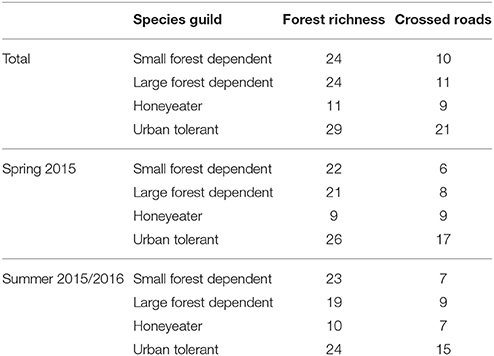
Roads provide humans with a means of mobility between destinations, be it for transportation of goods and services or as a means of connecting with others. However, roads are also known to contribute towards a number of deleterious landscape processes, such as habitat destruction and fragmentation, pollution (e.g. chemical, noise and light) and animal mortality. Few studies however have investigated their effects on avifauna. We investigated the influence of road width on movements of nearby bird assemblages in Australia by comparing crossing counts of four species guilds and sizes over roads of varying widths in Southern Brisbane. In addition, we also sought to determine the association of seasonality with species crossing richness and abundance. Species guild affiliations were based on definitions from previous literature: small forest dependent, large forest dependent, honeyeater and urban tolerant; whereas body size classifications were arbitrarily defined: small (<20cm), medium (20-29cm) and large (>30cm). Road sites were selected based on their vegetation likeness, both within and between sites, and this was assessed using the Specht classification system. We detected strong, negative correlations between road width and forest species richness, crossing species richness and species crossing abundance. In particular, analysis of species guild classifications revealed species richness and crossing likelihoods of the small forest dependent guild to be consistently lower than those of large forest dependent, honeyeater and urban tolerant guilds. Analysis of species by body size classification yielded similar outcomes: small birds were consistently less likely to be present nearby and cross over roads of all widths compared to medium and large birds. We believe gap permeability, particularly changes in vegetation structure and complexity that may restrict a species ability to access to the gap, as well as competition and predation, play an important role in determining species presence and crossing likelihood. Dense vegetation is known to benefit smaller species due to the provision of foraging resources and shelter from larger, more aggressive species.

10,338 views

39 citations