 Tianyu Zhao1,2*
 Joachim Heinrich1,2,3
- 1Institute and Clinic for Occupational, Social and Environmental Medicine, University Hospital, LMU Munich, Munich, Germany
- 2Comprehensive Pneumology Center Munich (CPC-M), German Center for Lung Research (DZL), Munich, Germany
- 3Allergy and Lung Health Unit, Melbourne School of Population and Global Health, The University of Melbourne, Melbourne, VIC, Australia
1 Introduction
Air pollution has long been a significant environmental and public health concern in China, driven by rapid industrialization, poor emission control, urbanization, and heavy reliance on fossil fuels (1). However, the country has made remarkable progress in combating air pollution through various policies and initiatives in recent years (2). Among those initiatives the promotion of new energy vehicles (NEVs), particularly electric vehicles, might hold promise for additional reducing emissions and improving air quality in China. Nevertheless, the potential impact of the introduction of NEVs on air pollution remains unclear (3, 4). In addition, the rise in NEVs may introduce potentially even new health concerns, revealing a complex and multifaceted impact on public health.
2 China's endeavors to reduce air pollution
Over the past decade, China has implemented a series of actions aimed at curbing air pollution and enhancing environmental quality. For instance, the Air Pollution Prevention and Control Action Plan, launched in 2013, set targets for reducing key pollutants, including particulate matter (PM2.5 and PM10). Through stringent regulations, industrial upgrades, and the promotion of cleaner energy sources, significant reductions in emissions of air pollutants have been achieved (1). A similar pollution control effect was observed with the implementation of the Atmospheric Environmental Policy for Autumn and Winter, first implemented in 2017 (5). Notably, the introduction of China's Policies and Actions on Carbon Peaking and Carbon Neutrality in 2020 further contributes to the improvement of air quality and mitigation of adverse impacts of pollution on public health in the country (6, 7). Data from monitoring stations across the country indicate a reduction in annual PM2.5 levels in many regions, reflecting the effectiveness of pollution control measures (http://www.allaboutair.cn/a/reports/2023/1027/684.html). The effects of these measures in protecting public and individual health has been observed as well (8, 9). However, challenges remain, particularly in addressing ozone pollution, which has shown a relatively unchanged trend despite the efforts to reduce precursor emissions (10). These trends are illustrated in Figure 1 as well, showcasing four cities with equivalent gross domestic product (GDP) in 2023 as examples. These cities’ GDPs ranged from Suzhou's 2.47 trillion Chinese Yuan to Wuhan's 2.00 trillion Chinese Yuan (0.34 trillion to 0.28 trillion United States dollar), according to the governmental statistics (https://data.stats.gov.cn/english/index.htm).
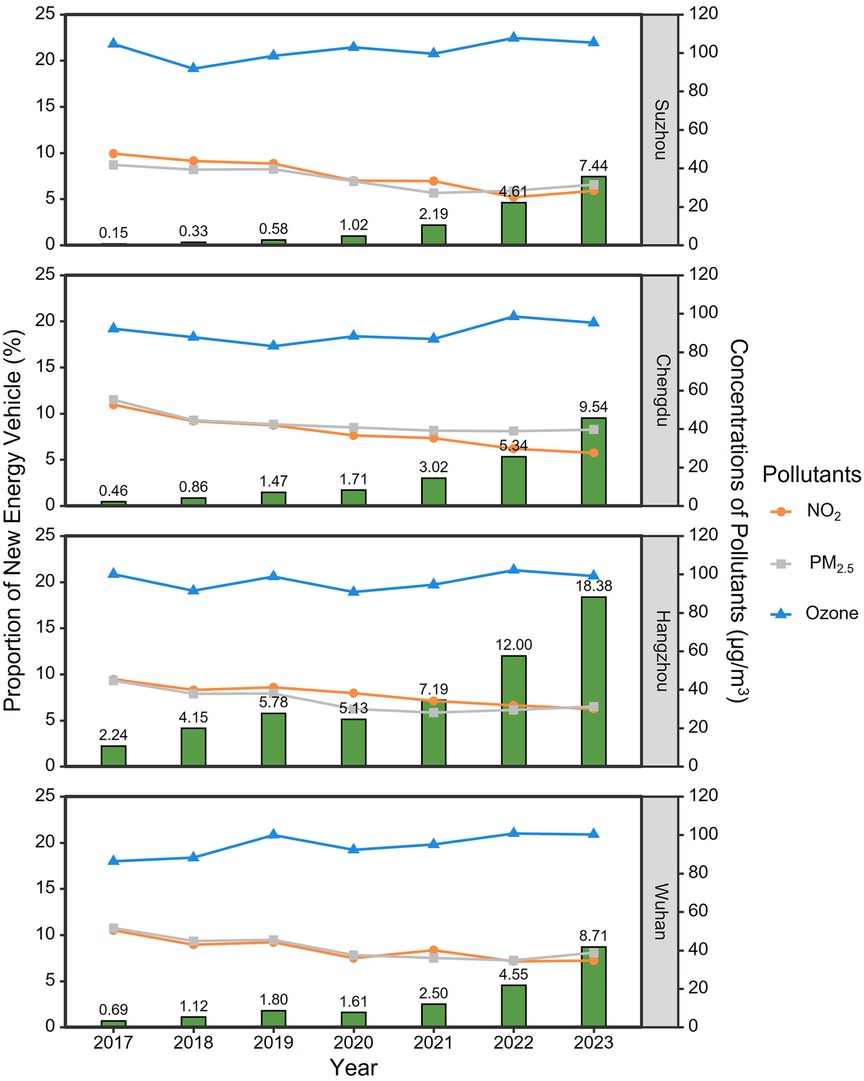
Figure 1. PM2.5, NO2, and ozone concentrations and changes in new energy vehicle (NEV) proportions from 2017 to 2023 in four cities. Annual average pollutant concentrations were adopted from monitoring stations, and the proportion of NEVs was extracted using information released by the China Ministry of Public Security Traffic Management Bureau (https://gab.122.gov.cn/m/index/).
3 Potential impact of NEVs on air pollution in China
In parallel with the endeavors to improve air quality, China has prioritized the development and promotion of NEVs as a key strategy to transition towards a low-carbon and pollution-reducing transportation system (11, 12). Consequently, China has emerged as a vast NEV market globally: In 2023, the total number of NEVs in Suzhou, Chengdu, Hangzhou, and Wuhan was around 0.390, 0.621, 0.748, and 0.388 million, respectively. Figure 1 also highlights the growing proportion of all types of NEVs in the four representative cities, with Hangzhou leading at 18% by 2023.
Theoretically, the introduction of NEVs may lead to reductions in traditional traffic-related air pollutants, such as PM and nitrogen oxides (NOx), as combustion engine vehicles are gradually phased out. However, the real-world relationship between NEV adoption and air quality is complex and still difficult to evaluate fully at this moment. Some studies have reported that the increased numbers of NEVs might contribute to lower PM2.5 and NO2 concentrations (4, 13–16), while others present different views (3, 17). Recent comprehensive studies considering “well-to-wheel” air pollutant emissions highlighted that only NEV adoption combined with cleaner or renewable energy sources could significantly reduce air pollution and yield health benefits (3, 18).
While traditional pollutants, particularly PM, have gained strong research attention during China's transition to NEVs, the potential changes in ambient ozone levels remain under investigation. As a secondary pollutant, ozone is highly sensitive to the balance of NOx and volatile organic compounds, whereas the increase in NEVs can further complicate ozone concentrations by affecting traffic-related pollutants like NOx (18–20). Moreover, ozone pollution in China is also driven by climate change and other meteorological influences (10). Overall, the potential interactions regarding NEVs, climate, and ozone are unclear.
Overall, given China's pivotal role as the largest domestic NEV market and its persistent air pollution challenges, understanding the implications of the NEV transition on air quality and health is imperative, and this chance is unique. Insights gleaned from China are invaluable for informing global policymakers and stakeholders, especially as NEV strategies face potential deceleration worldwide. For example, Europe's largest party might be prepping to delay the EU's internal combustion engine ban in January 2024 (https://www.motor1.com/news/705837/eep-leaked-election-manifesto-ice-ban/), and meanwhile, the American tech company Apple has decided to scrap plans to enter the automotive industry in February 2024 (https://www.theguardian.com/technology/2024/feb/27/apple-cancels-electric-car-layoffs).
4 Potential adverse impacts of NEVs on health
While NEVs might offer promising environmental benefits, especially in carbon neutrality and pollution reduction, addressing potentially associated health-related challenges and concerns is crucial for sustainable development. First of all, currently available studies cannot definitively testify to the role of NEVs in reducing air pollution concentration. Although some local or temporal decreases in common traffic-related pollutants could be attributed to NEVs (21), the increased electricity demand could lead to even higher emissions of fossil fuels if not met with clean or renewable energy sources. Thus, the potential environmental and health benefits of NEVs need to be carefully evaluated with a comprehensive view of the current energy supply infrastructure (3, 17). Moreover, the relationship between the increase in NEVs and ambient ozone is still less-investigated and unclear. Although the health effects of ozone are not fully understood (22), elevated ozone levels are already a major air quality concern in China (10). Therefore, prioritizing studies on ozone can be crucial in this new era of NEV adoption.
Additionally, NEVs, e.g., electric vehicles, may adopt regenerative braking systems that contribute to reducing the formation of brake wear particles (23); however, electric vehicles are structurally heavier because of their battery system and may increase the non-exhaust emissions from tires and roads (24). These issues warrant further comprehensive research together with advanced monitoring and mitigation strategies.
Without combustion engines, NEVs help reduce traffic noise (25), thus additionally mitigating noise-related adverse health effects. However, researchers also indicated that the quietness of electric motors may lead to increased risk to road users because the vehicles per se do not provide enough acoustic warnings (26). Injury epidemiological studies on this point are currently lacking, but health education on road traffic safety to the users, along with improvements in traffic infrastructure, legal frameworks, and post-crash pre-hospital care (27), could help mitigate the side effects of NEVs’ quietness before the introduction of engineering measures on NEVs.
Furthermore, some studies have explored the electromagnetic fields (EMF) generated by electric vehicles (28–30). Although current EMF exposure levels meet safety standards, researchers highlight potential long-term exposure risks (29) and the possibility of increased exposure following vehicles’ major repairs or accidents (30). Additionally, the production and disposal of lithium-ion batteries have long raised concerns about resource depletion, environmental pollution, and health risks (31, 32). The positive aspect is that increasing studies focus on the reuse of these retired batteries (33). For example, a recent study from China proposed reusing retired batteries for rural electrification, a relatively novel solution with substantial economic, environmental, and health gains (34).
5 Conclusions
China's efforts to combat air pollution and promote NEVs represent a significant step towards environmental sustainability and public health improvement. While progress may be achieved in reducing conventional pollutants, challenges remain, particularly regarding emerging issues like ozone pollution. In addition, the potential environmental and health impacts associated with NEVs require greater attention. A holistic approach that integrates NEVs with renewable energy deployment, urban planning, comprehensive emissions reduction measures, and health education to raise awareness about the safe use of NEVs shall be essential to navigate the complex nexus of pollution and health in the new era. Additionally, further research should be conducted to fully understand the long-term health implications and develop guidelines for NEV usage. Leveraging China's experiences and insights would be instrumental in paving a path towards cleaner, healthier environments worldwide.
Author contributions
TZ: Conceptualization, Data curation, Investigation, Methodology, Software, Visualization, Writing – original draft, Writing – review & editing. JH: Conceptualization, Methodology, Writing – review & editing.
Funding
The author(s) declare financial support was received for the research, authorship, and/or publication of this article. This study was supported by the German Research Foundation (GZ: KA 4737/2–1 | NO 262/13–1 | HE 3294/12–1) and the Comprehensive Pneumology Center Munich (CPC-M), German Center for Lung Research (DZL), Munich, Germany.
Acknowledgments
One preprint version of this paper is online at http://dx.doi.org/10.13140/RG.2.2.16273.03680. The authors modified it for this submission.
Conflict of interest
The authors declare that the research was conducted in the absence of any commercial or financial relationships that could be construed as a potential conflict of interest.
Publisher's note
All claims expressed in this article are solely those of the authors and do not necessarily represent those of their affiliated organizations, or those of the publisher, the editors and the reviewers. Any product that may be evaluated in this article, or claim that may be made by its manufacturer, is not guaranteed or endorsed by the publisher.
References
1. Yu Y, Dai C, Wei Y, Ren H, Zhou J. Air pollution prevention and control action plan substantially reduced PM2.5 concentration in China. Energy Economics. (2022) 113:106206. doi: 10.1016/j.eneco.2022.106206
2. Wang P. China’s air pollution policies: progress and challenges. Curr Opin Environ Sci Health. (2021) 19:100227. doi: 10.1016/j.coesh.2020.100227
3. Li X, Yan X. Fast penetration of electric vehicles in China cannot achieve steep cuts in air emissions from road transport without synchronized renewable electricity expansion. Energy. (2024) 301:131737. doi: 10.1016/j.energy.2024.131737
4. Wang L, Chen X, Zhang Y, Li M, Li P, Jiang L, et al. Switching to electric vehicles can lead to significant reductions of PM2.5 and NO2 across China. One Earth. (2021) 4(7):1037–48. doi: 10.1016/j.oneear.2021.06.008
5. Zhang Z, Shang Y, Zhang G, Shao S, Fang J, Li P, et al. The pollution control effect of the atmospheric environmental policy in autumn and winter: evidence from the daily data of Chinese cities. J Environ Manag. (2023) 343:118164. doi: 10.1016/j.jenvman.2023.118164
6. Liu L, Wang X, Wang Z. Recent progress and emerging strategies for carbon peak and carbon neutrality in China. Greenhouse Gases: Science and Technology. (2023) 13(5):732–59. doi: 10.1002/ghg.2235
7. Wang Y, Guo C-H, Chen X-J, Jia L-Q, Guo X-N, Chen R-S, et al. Carbon peak and carbon neutrality in China: goals, implementation path and prospects. China Geology. (2021) 4(4):720–46. doi: 10.31035/cg2021083
8. Zhang Q, Meng X, Shi S, Kan L, Chen R, Kan H. Overview of particulate air pollution and human health in China: evidence, challenges, and opportunities. The Innovation. (2022) 3(6):100312. doi: 10.1016/j.xinn.2022.100312
9. Zhang Z, Zhang G, Su B. The spatial impacts of air pollution and socio-economic status on public health: empirical evidence from China. Socioecon Plann Sci. (2022) 83:101167. doi: 10.1016/j.seps.2021.101167
10. Yan D, Jin Z, Zhou Y, Li M, Zhang Z, Wang T, et al. Anthropogenically and meteorologically modulated summertime ozone trends and their health implications since China’s clean air actions. Environ Pollut. (2024) 343:123234. doi: 10.1016/j.envpol.2023.123234
11. Jiang Z, Xu C. Policy incentives, government subsidies, and technological innovation in new energy vehicle enterprises: evidence from China. Energy Policy. (2023) 177:113527. doi: 10.1016/j.enpol.2023.113527
12. Zhang L, Qin Q. China’s new energy vehicle policies: evolution, comparison and recommendation. Transp Res A: Policy Pract. (2018) 110:57–72. doi: 10.1016/j.tra.2018.02.012
13. Li P, Zhang Z. The effects of new energy vehicle subsidies on air quality: evidence from China. Energy Econ. (2023) 120:106624. doi: 10.1016/j.eneco.2023.106624
14. Wang Q-S, Su C-W, Hua Y-F, Umar M. How can new energy vehicles affect air quality in China? — from the perspective of crude oil price. Energy Environ. (2022) 33(8):1524–44. doi: 10.1177/0958305X211044388
15. Xie Y, Wu D, Zhu S. Can new energy vehicles subsidy curb the urban air pollution? Empirical evidence from pilot cities in China. Sci Total Environ. (2021) 754:142232. doi: 10.1016/j.scitotenv.2020.142232
16. Liang X, Zhang S, Wu Y, Xing J, He X, Zhang KM, et al. Air quality and health benefits from fleet electrification in China. Nat Sustain. (2019) 2(10):962–71. doi: 10.1038/s41893-019-0398-8
17. Su C-W, Yuan X, Tao R, Umar M. Can new energy vehicles help to achieve carbon neutrality targets? J Environ Manag. (2021) 297:113348. doi: 10.1016/j.jenvman.2021.113348
18. Hsieh IYL, Chossière GP, Gençer E, Chen H, Barrett S, Green WH. An integrated assessment of emissions, air quality, and public health impacts of China’s transition to electric vehicles. Environ Sci Technol. (2022) 56(11):6836–46. doi: 10.1021/acs.est.1c06148
19. Kayaba S, Kajino M. Potential impact of battery electric vehicle penetration and changes in upstream process emissions assuming night-charging on summer O3 concentrations in Japan. J Geophys Res. (2023) 128(11):e2022JD037578. doi: 10.1029/2022JD037578
20. Brinkman GL, Denholm P, Hannigan MP, Milford JB. Effects of plug-in hybrid electric vehicles on ozone concentrations in Colorado. Environ Sci Technol. (2010) 44(16):6256–62. doi: 10.1021/es101076c
21. Lyu W, Hu Y, Liu J, Chen K, Liu P, Deng J, et al. Impact of battery electric vehicle usage on air quality in three Chinese first-tier cities. Sci Rep. (2024) 14(1):21. doi: 10.1038/s41598-023-50745-6
22. Zhao T, Markevych I, Janßen C, Nowak D, Steckling-Muschack N, Heinrich J. Ozone exposure and health effects: a protocol for an umbrella review and effect-specific systematic maps. BMJ Open. (2020) 10(8):e034854. doi: 10.1136/bmjopen-2019-034854
23. Zhang Q, Yin J, Fang T, Guo Q, Sun J, Peng J, et al. Regenerative braking system effectively reduces the formation of brake wear particles. J Hazard Mater. (2024) 465:133350. doi: 10.1016/j.jhazmat.2023.133350
24. Fussell JC, Franklin M, Green DC, Gustafsson M, Harrison RM, Hicks W, et al. A review of road traffic-derived non-exhaust particles: emissions, physicochemical characteristics, health risks, and mitigation measures. Environ Sci Technol. (2022) 56(11):6813–35. doi: 10.1021/acs.est.2c01072
25. Cesbron J, Bianchetti S, Pallas M-A, Bellec AL, Gary V, Klein P. Road surface influence on electric vehicle noise emission at urban speed. Noise Mapping. (2021) 8(1):217–27. doi: 10.1515/noise-2021-0017
26. Pardo-Ferreira MC, Torrecilla-García JA, de las Heras-Rosas C, Rubio-Romero JC. New risk situations related to low noise from electric vehicles: perception of workers as pedestrians and other vehicle drivers. Int J Environ Res Public Health. (2020) 17(18):6701. doi: 10.3390/ijerph17186701
27. Goel R, Tiwari G, Varghese M, Bhalla K, Agrawal G, Saini G, et al. Effectiveness of road safety interventions: an evidence and gap map. Campbell Syst Rev. (2024) 20(1):e1367. doi: 10.1002/cl2.1367
28. Dong X, Gao Y, Lu M. The electromagnetic exposure level of a pure electric vehicle inverter based on a real human body. Appl Sci. (2024) 14(1):32. doi: 10.3390/app14010032
29. Gryz K, Karpowicz J, Zradziński P. Complex electromagnetic issues associated with the use of electric vehicles in urban transportation. Sensors. (2022) 22(5). doi: 10.3390/s22051719
30. Yang L, Lu M, Lin J, Li C, Zhang C, Lai Z, et al. Long-term monitoring of extremely low frequency magnetic fields in electric vehicles. Int J Environ Res Public Health. (2019) 16(19). doi: 10.3390/ijerph16193765
31. Christensen PA, Anderson PA, Harper GDJ, Lambert SM, Mrozik W, Rajaeifar MA, et al. Risk management over the life cycle of lithium-ion batteries in electric vehicles. Renewable Sustainable Energy Rev. (2021) 148:111240. doi: 10.1016/j.rser.2021.111240
32. Sakunai T, Ito L, Tokai A. Environmental impact assessment on production and material supply stages of lithium-ion batteries with increasing demands for electric vehicles. Journal of Material Cycles and Waste Management. (2021) 23(2):470–9. doi: 10.1007/s10163-020-01166-4
33. Hua Y, Liu X, Zhou S, Huang Y, Ling H, Yang S. Toward sustainable reuse of retired lithium-ion batteries from electric vehicles. Resources, Conservation and Recycling. (2021) 168:105249. doi: 10.1016/j.resconrec.2020.105249
Keywords: air pollution, new energy vehicle, environmental policy, environmental sustainability, public health
Citation: Zhao T and Heinrich J (2024) Air pollution, health impacts, and new energy vehicles in China. Front. Environ. Health 3:1477209. doi: 10.3389/fenvh.2024.1477209
Received: 7 August 2024; Accepted: 23 October 2024;
Published: 5 November 2024.
Edited by:
Sourangsu Chowdhury, Centre for International Climate and Environmental Research (CICERO), NorwayReviewed by:
Valentin Marian Antohi, Dunarea de Jos University, RomaniaSaid Brika, University of Bisha, Saudi Arabia
Zhenhua Zhang, Lanzhou University, China
Copyright: © 2024 Zhao and Heinrich. This is an open-access article distributed under the terms of the Creative Commons Attribution License (CC BY). The use, distribution or reproduction in other forums is permitted, provided the original author(s) and the copyright owner(s) are credited and that the original publication in this journal is cited, in accordance with accepted academic practice. No use, distribution or reproduction is permitted which does not comply with these terms.
*Correspondence: Tianyu Zhao, VGlhbnl1LlpoYW9AbWVkLnVuaS1tdWVuY2hlbi5kZQ==