LF
lei fan
University of New South Wales
Kensington, Australia
100
Total downloads
2,749
Total views and downloads
Submit your idea
You will be redirected to our submission process.
Manuscript Submission Deadline 23 March 2026
This Research Topic is currently accepting articles.
The evolution of AI in radiology has progressed from rule-based methods to deep learning models and foundation models. Recent breakthroughs in LLMs, particularly transformer-based architectures like GPT-4 and specialized medical LLMs, have demonstrated remarkable capabilities in medical text processing, report generation, and clinical reasoning. Concurrently, agentic AI has emerged as a paradigm where AI systems exhibit autonomous behavior, goal-directed planning, and tool usage capabilities. Early investigations, such as multi-agent frameworks for radiology imaging, suggest that current LLMs show promise as agent cores but face challenges in complex task understanding and tool coordination. The intersection of multimodal LLMs with agent-based architectures presents unprecedented opportunities for creating autonomous radiology assistants that can process imaging data, integrate clinical information, and support complex diagnostic workflows while maintaining human oversight and clinical safety standards.
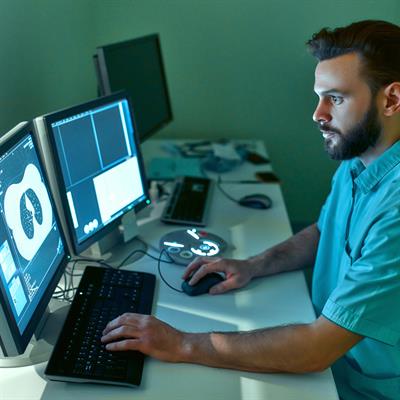
This Research Topic aims to explore the potential of agentic AI and large language models (LLMs) in improving the radiology practice. Unlike traditional AI methods that perform single tasks, agentic AI frameworks can independently execute complex multi-step workflows, coordinate multiple specialized agents, and adapt their strategies based on clinical context. Our objective is to explore how these AI agents can enhance diagnostic accuracy, streamline clinical workflows, and improve patient care across the entire radiology pipeline—from imaging protocol selection and quality assurance to report generation and clinical decision support. We seek to understand how LLMs can serve as intelligent orchestrators (interface) in radiology environments, managing tool coordination, reasoning through complex diagnostic scenarios, and facilitating human-AI collaboration.
This Research Topic welcomes original research, comprehensive reviews, and perspective articles addressing agentic AI and LLM applications in radiology. We are particularly interested in contributions, but not limited:
1. Multi-agent frameworks for radiology workflows, including specialized agents for image analysis, report generation, quality assurance, and clinical decision support;
2. LLM-based autonomous agents for imaging protocol optimization, study prioritization, and workflow orchestration;
3. Multimodal integration approaches combining vision-language models with clinical data for comprehensive diagnostic support;
4. Human-AI collaboration frameworks ensuring radiologist oversight while leveraging autonomous capabilities;
5. Validation methodologies and benchmarking methods for evaluating agentic AI performance in clinical environments;
6. Safety mechanisms, explainability, and trust considerations for autonomous radiology analysis.
This Research Topic accepts the following article types, unless otherwise specified in the Research Topic description:
Articles that are accepted for publication by our external editors following rigorous peer review incur a publishing fee charged to Authors, institutions, or funders.
Keywords: Large Language Model, Multimodal Large Languge Model, Agentic AI, Multi-Agent, Agent for Radiology
Important note: All contributions to this Research Topic must be within the scope of the section and journal to which they are submitted, as defined in their mission statements. Frontiers reserves the right to guide an out-of-scope manuscript to a more suitable section or journal at any stage of peer review.
Manuscripts can be submitted to this Research Topic via the main journal or any other participating journal.
Submit your idea
You will be redirected to our submission process.