Abstract
The capital of Saudi Arabia is evolving into one of the most attractive cities in the Middle East due to various ambitious expansion projects aligned with Vision 2030. This urban development strategy requires researchers to adopt evaluation approaches based on comprehensive sustainability criteria, including environmental and cultural sustainability, community involvement, and economic feasibility. This study utilizes the Delphi methodology to define evaluation criteria and their importance, employing the Delphi technique to gather insights from a group of experts through three rounds of questionnaires. The responses were analyzed using the Top-of-Priority Similarity to Ideal Solution (TOPSIS) technique to develop an integrated evaluation model, which assessed architectural practices in Riyadh through three key projects: The King Fahad National Library, Qasr Al-Hokm, and Saudi Arabia's Digital City. Data sources included extensive site visits, project documentation, and expert evaluations. The evaluation model demonstrated varying levels of sustainability across the projects. The King Fahad National Library and Qasr Al-Hokm showed high scores in sustainability practices, while Digital City lagged behind in several areas, highlighting the need for improvement. This research enhances the understanding of how globalization influences urban renewal in Riyadh and emphasizes the importance of developing effective evaluation models that address the multifaceted nature of sustainability. The findings underscore the need for continuous reassessment of architectural initiatives in the city to align with both international standards and local cultural contexts. The proposed evaluation model successfully tests sustainability frameworks at the local level, indicating areas for future enhancements and contributing valuable insights toward achieving sustainable urban development in Saudi Arabia.
1 Introduction
Urban development processes reflect the progress of social development and their impact on people’s quality of life (Chaskin and Joseph, 2011). It serves as an indicator of the overall economic performance of both developed and developing nations, making significant contributions to their GDPs. The primary products of this industry are “buildings,” which are essential to daily life (Sun et al., 2024). he rapid urban expansion seen in Riyadh offers a unique and illustrative example for exploring global urban development issues (Jarrar and Al-Homoud, 2024).
Today, contemporary architecture is confronted with the challenges of spatial globalization. In rapidly developing regions, construction processes may result in a situation where the distinctions between one place and another become irrelevant, leading to cities that are imitations of other cities. Buildings are moved from one context to another without considering their impact or adopting a sustainable approach to design (Bowring et al., 2009). A recent literature review by on “urban development” points to shifts towards sustainability adoption and an increasing focus on the urban context and examination of different dynamics in sustainability transitio (Frantzeskaki et al., 2017) Cities have increasingly been identified as particularly important places for sustainability transitions and related system innovations to emerge and unfold (Fuenfschilling et al., 2018). Sustainability assessment has been identified as one of the beneficial tools that exist and can be used in order to foster the sustainable development, ranging from the design, construction, right through to management stages (Ameen and Mourshed, 2019; Bai and Guo, 2021).
Nowadays, many countries or researchers have developed related indicator frameworks to evaluate an individual building or entire cities (Yang et al., 2015), involving Leadership in Energy and Environmental Design (LEED) from the United States (Hopkins, 2015). Exam current architectural landscape in Riyadh through the lens of globalization reveals a number of complexities. Over the past few decades, various architectural trends have emerged that, despite being labeled differently and having overlapping elements, ultimately converge toward the same goal of modernity across various domains, including architecture. In most cases, they have focused on incorporating the principles, characteristics and elements of sustainable design but have suffered from a gap in the comprehensive evaluation approach (Akadiri et al., 2012).
While the application of global technologies and sustainability practices may be entirely beneficial, the overuse of architectural materials and features that are incompatible with the local context is becoming increasingly worrisome. This is an ongoing discourse that emphasizes the balance between global influence and local reality (Sassen and Wills, 2004), thus placing at its heart the fundamental challenge of architecture is what works and what does not (Punter, 2016). Indeed, the emerging focus on global architectural trends has led critics to assert that expansionist projects such as these have grossly neglected contextual issues of a local nature. This adoption of global architectural models reflects the quest for modernity in architecture, but when replicated on a large scale in many countries, it has led to this research interest in a comprehensive understanding of the contemporary architectural landscape in Riyadh in light of globalization from a sustainable perspective (Naim, 2013).
There is a lack of research on measuring the sustainability of urban development at the community level. This is generally done in a subjective and one-sided manner when it comes to selecting and weighting indicators. Most studies on sustainability assessment take the perspective of consistency with certification bodies such as LEED or others that deal only with energy consumption, ignoring the economic and cultural dimensions of sustainability. (Ding, 2005; Dziekan, 2012).
Numerous studies (Michalina et al., 2021) argue that some community-level indicator frameworks for measuring sustainable urban devlopment, such as LEED-ND and BREEAM-Communities, also neglect to comprehensively analyze the social, economic and environmental aspects of sustainability. They exhibit ambiguity and shortcomings in weighting, scoring, or ranking systems. Furthermore, The number and type of indicators also differ significantly among these proposed indicator frameworks.
Too many indicators make data collection and assessment cumbersome (Ghosh et al., 2006), while a few indicators cannot provide full insight into any assessment. The continual conversation about the equilibrium between global influences and cultural authenticity highlights the fundamental challenge within the architectural domain of discerning what is suitable and what is not. It is crucial to acknowledge that, although there is an increasing emphasis on global architectural trends and expansion initiatives, concerns have been voiced about the oversight of local contextual matters (Mba et al., 2024; Selim, 2018). From this standpoint, the importance and methods of assessing the sustainability of buildings (BSAM) are established to enable project stakeholders to understand the expected and actual sustainability performance of their buildings (Thomson and El-Haram, 2018), but they are often applied in a technical and quantitative manner without considering other sustainability measures. Hence, the idea of research in an attempt to propose an integrated assessment model.
2 Method
Initially, based on the literature review, this study aims to identify sustainability indicators that are considered important worldwide. By improving the integration of these indicators, redundancy will be removed, thus arriving at a model that includes all environmental, cultural and social criteria. It consists of basic and sub-criteria under which the indicators fall. The present study utilized the expert judgment method to assess the proposed model and allocate weights to each indicator. This is a well-acknowledged and valid strategy, particularly when empirical data is scarce or challenging to obtain. Instances of expert evaluations, including weights, were collected from 13 out of 19 experts contacted in the fields of architecture and sustainability, urban renewal and construction project management and officials of some major projects in Riyadh. The study favored participants who possess extensive experience in sustainable architecture and urban development, particularly those who have worked in Riyadh or in comparable contexts. Research highlights the importance of having an expert background as a key method for obtaining reliable data on the fundamental aspects of the subject (Olander and Landin, 2005). In fact, the expert judgment framework builds on the sound foundations established by the literature by emphasizing the fact that expert judgment, where there is a lack of quantitative data, will yield crucial insights (Cashmore et al., 2004). This research adopts the ETE methodology to determine the evaluation criteria and their weights, which is an interactive method of prediction based on the opinion of a group of experts, or what is known as the Delphi method. Experts answered questionnaires to determine the weights of the criteria in three rounds where they received an anonymous summary of the experts’ predictions from the previous round along with the reasons they provided for their judgments. Several studies have shown that 10–12 expert respondents are sufficient to confirm the validity of the results, as these types of studies do not rely on statistical inference. The optimal weights for the main items derived from the survey data were then estimated using the best and worst case TOPSIS method. The results were reviewed with the expert respondents again in order to confirm the final weights (Wergin et al., 2018). Then,the study will examine leading architectural practices in Riyadh by evaluating a model that analyzes three major projects: the King Abdullah Petroleum Studies and Research Center, the King Abdullah Financial District, and the King Abdullah Financial District Metro Station. Data sources will include comprehensive site visits and detailed project documentation. These projects will be subjected to a comprehensive analysis according to the model that will be reached. See Figure 1.
FIGURE 1

Study method and procedures.
3 Literature review
Sustainability in building construction can be defined as those practices and strategies that avoid harming the environment to the minimum and at the same time maximize resources utilization efficiency for occupants’ health improvement and that of society in general. It is holistic because buildings are not only physical but an integral part of ecological and social systems where they sit. The concept of sustainability leads to healthier living spaces, strength in a community, and proper use of natural resources. Decisions made by people towards sustainable building practices are valued according to the long-term return associated with construction, thus balancing the current needs against the future environmental and social outcome. This eventually offers a more sustainable and just built environment both for the present and for future generations. Applying sustainable construction methodologies, the industry is in an excellent position to make valuable contributions to reducing carbon emissions, preserving natural resources, and improving the quality of life for individuals and communities (
Moshood et al., 2024). The following key features summarize the most important aspects of Green and Sustainable Building Construction:
• Community Participation and Certification: Local participation in some form of the planning process ensures that buildings efficiently meet the requirements and appeal of the intended occupants or users. Early involvement of stakeholders provides an open forum for debate and shared decision-making that may result in unique design solutions reflective of community perceptions. Perhaps more importantly, compliance with recognized sustainability standards and certifications, such as LEED and BREEAM, provides a roadmap not just for best practices but also for encouraging transparency and accountability in efforts toward sustainable building (Hamdan et al., 2021). These can create a benchmark against which the project can gain greater appeal in the market to environmentally conscious consumers and investors. Ultimately, community feedback serves to strengthen social bonds within the community and aligns the built environment with the aspirations of its residents.
• Resource Efficiency and Energy Management: Resource efficiency is a cornerstone of sustainable building construction, taking into account the impacts associated with the sourcing and utilization of materials (Aloshan, 2024). This could involve the use of renewable, recycled, and regionally sourced materials that reduce the carbon footprint from transportation and manufacturing intrinsic to the industry. Energy-efficient systems can be implemented to drastically reduce energy consumption while maintaining optimal efficiency, such as LED lighting, highly efficient HVAC systems, and smart technologies for energy monitoring (Khan et al., 2022). Integrating renewable energy sources, like solar panels and wind turbines, provides a greener and more stable energy supply for buildings. From a holistic perspective, managing energy at all levels helps to conserve resources and ensures economic viability, enabling local economies to thrive and boosting innovation related to sustainability in the building industry.
• Indoor Environmental Quality and Health: Indoor environmental quality is perhaps one of the most critical factors in maintaining the health and wellbeing of building occupants. Adequate ventilation, combined with the use of non-toxic and low-emitting materials, significantly improves indoor air quality, reducing respiratory illnesses and health complications. Additionally, maximizing natural lighting through proper window placement and skylights further enhances the atmosphere, contributing to a pleasant and productive environment. Incorporating biophilic design elements, including indoor plants and green walls, can enhance occupants’ feelings of connection with nature, thereby promoting mental wellbeing and overall satisfaction (Zhong et al., 2022). Creating spaces that prioritize comfort, health, and productivity adds value to individuals’ quality of life and positively impacts absenteeism and performance for organizations that own the buildings.
• Water Conservation and Waste Management: In regions where water supply is particularly scarce, water conservation is a significant aspect of sustainable construction. This can be achieved through the installation of rainwater collection systems and greywater recycling, leading to a substantial reduction in reliance on municipal water supplies. Additionally, low-flow fixtures and smart irrigation systems optimize every drop of water for practical use. Alongside these measures, holistic waste management strategies should be implemented during construction to minimize adverse impacts on the environment (Mohsen and Matarneh, 2023). This involves minimizing waste during construction by paying close attention to planning details and using recycled materials whenever possible. The concept of a circular economy, where discarded materials are reprocessed and reused, supports sustainability goals and fosters an environmentally ethical culture in the building industry.
• Site Selection and Environmental Integration: The choice of site is a vital aspect of sustainable building, where locations should be selected to minimize disturbances to existing ecosystems. Prioritizing sites that facilitate access to public transportation not only enhances a building’s sustainability but also supports environmentally friendly commuting options for residents. Furthermore, design strategies that preserve existing vegetation and wildlife habitats yield significant benefits for biodiversity and carbon sequestration, among other ecological advantages. Thoughtful integration of buildings into their natural surroundings promotes harmony between the built environment and the ecosystem, creating spaces that benefit both residents and local wildlife. In the end, sustainable site development is a crucial component of a broader process: crafting stronger, more resilient communities in harmony with their environments.
• Lifecycle Assessment and Resilience: A lifecycle assessment (LCA) of a building analyzes its environmental impact from construction through eventual demolition. This comprehensive analysis considers the ecological footprint of materials, energy use during operation, and possible end-of-life scenarios, enabling architects and builders to make informed decisions that mitigate harmful effects (Huang et al., 2020). Designing for resilience ensures that buildings can withstand the impacts of extreme weather events due to climate change and adapt to future needs or changes in use. Examples of resilient design principles include flood-resistant foundations, energy-efficient windows, and modular designs that allow for easy expansion or modification (Tagg et al., 2016). Investing in resiliency and adaptability ensures that buildings continue to contribute to long-term community sustainability while safeguarding occupants and the environment for years to come. Urban communities are the basic structures in the life of cities. They possess considerable resources, but at the same time are massive consumers of energy (Mohammed Abdullah Eben Saleh, 1998; Elsheshtawy, 2008). With applying a sustainable development approach, the urban community will be able to overcome problems such as over-imitation of modernist forms of architecture and/or excessive energy consumption. Evaluation methods have great potential to promote sustainable development in urban areas (Mashary Alnaim and Bay, 2023; Lak et al., 2021) if they are seen as a supportive tool for urban growth rather than a criticism tool. However, urban growth in new urban communities requires certain conditions: to achieve comprehensive gains in sustainable development, a balance must be struck in progress across societal, environmental and economic dimensions. This balance will bear fruit through an ecologically healthy environment, harmonious social coexistence and long-term economic growth (Ali et al., 2019).
Previous research on the issue of sustainable urban development in urban communities includes disciplines related to the evaluation of community conservation initiatives and case studies of sustainable communities (Fouseki and Nicolau, 2018). Until recently, this movement started to take hold in developed countries such as the United Kingdom, the United States, and Japan (Russell and Redmond, 2009).
Further, the New European Bauhaus initiative (Alvelos and Barreto, 2022), introduced in 2020 by the European Union, aims at accelerating the green transition across sectors of the economy, society, and everyday life. The solutions being put across entail rebuilding the cities, retrofit buildings to put in consideration affordable housing and construction in line with carbon neutrality (Karlsson Hjorth et al., 2021). Unlike previously similar projects which focused mainly on enhancement of physical setting, these new projects incorporate social, economic and environmental considerations into the development of a sustainable community.
Appropriate indicators can be applied, above all, within a comprehensive framework which allows for the evaluation of sustainable practices (Gao et al., 2020). The DSR model, proposed by UNCED, chose 58 indicators that evaluate 22 countries and regions (Goswami et al., 2017). Case studies regarding Vietnam, Mexico City, and a host of projects dealing with community level urban development projects such as Masdar Eco-City in UAE also show that the assessment toolsets utilized within a specific economic, social, and cultural background would greatly enhance development functions in terms of sustainability (United Nations, 2007). However, comprehensive assessment for most of these projects is missing in many aspects, with lots of details on location. For instance, Egyptian projects of urban development illustrate that developments can place pressures on surrounding older cities due to a lack of facilities and services (Selim et al., 2024). Even in some European cities with the successes of a sustained approach to urban development, there is quite a marked disparity between concept and reality (Shamaee et al., 2024). Quite an evident separation exists between theory and reality in the indicator frameworks for the holistic process of identifying issues and implementing a response against environmental degradation, in being able to measure social and cultural performance, and in communicating effectively through research and among stakeholders and decision-makers.
4 Building the proposed sustainability model
4.1 Classifying the most important sustainability indicators globally
Several major bodies play a significant role in advocating for environmental standards and certifications in sustainable architecture and building practices. Energy Star and the International Energy Agency, in particular, are vital in measuring energy efficiency based on the amount of energy used per square foot. (Jiang et al., 2019). The World Carbon Project or World Resources Institute is involved in measuring greenhouse gas emissions from buildings (Friedlingstein et al., 2019). The AWS Water Stewardship Alliance and the Global Water Partnership provide guidelines for efficient water use to address water conservation (Alodah, 2023). In indoor air quality, the WELL Building Standard and the WELL International Building Institute review indoor pollutant levels such as volatile organic compounds and carbon dioxide (Persily and Emmerich, 2011). These sustainable materials have ratings from entities such as LEED for the use of recycled or sustainably sourced materials and Cradle to Cradle Certified. Similarly, waste management practices are supported by LEED and ZWIA (Zero Waste Europe, 2020). Biodiversity in Good Company and the International Union for Conservation of Nature monitor biodiversity impacts (Marselle et al., 2021). The RE100 initiative and the World Renewable Energy Council call for a commitment to 100% renewable electricity among participating companies (The Climate Group, 2014). Finally, site sustainability and urban development impact can be assessed through certifications such as LEED-ND and BREEAM Communities (Adewumi et al., 2024).
ASHRAE (ASHRAE, 2020) standards address thermal comfort, while ISO 14040/14044 guides building lifecycle assessments. Similarly, the USGBC regulates the LEED (U.S. Green Building Council, 2024), certification process, which has 60 credit points on different sustainability measures. The criteria provided assess buildings on natural light and acoustic performance, with LEED credit awarded for daylight access and sound insulation. ILFI (International Living Future Institute, 2024) also sets very stringent standards through its Living Building Challenge; under the LBC, buildings must meet 20 indictors to achieve certification. For example, the CASBEE framework–particularly its city-focused iteration–allows for urban sustainability assessments, while BREEAM for Communities sets sustainability standards for community development. The German Urban Building Association evaluates new urban areas, including the DGNB (Weise Frank et al., 2022),valuates new urban districts, including the DGNB-NS certification. Additionally, the Assessment Standard of Green Eco-district (ASGE) (Khan et al., 2022) facilitates local eco-district evaluations (Adamu Salihi et al., 2024) For example, UN-Habitat (Burton, 2003), defines social indicators such as social equality in housing. In contrast, community participation is promoted through local development organizations. Health and safety compliance in building design is regulated by the Occupational Safety and Health Administration in cooperation with ISO 45001 (Minor, 2024). The economic impacts of the Global Reporting Initiative for construction projects under the Global Reporting Initiative are aligned with the targets set by the UN Sustainable Development Goals (Dubravská et al., 2020). The International Labor Organization reports on indicators related to job creation. It also allows for the preservation of community culture through local organizations and a way to ensure access to cultural facilities through local government agencies. IDEA (Chen et al., 2023) also advocates for civic engagement in governance issues to ensure that communities are involved and well informed about sustainable development practices. See Table 1.
TABLE 1
| Indicator | What It Measures | Certification/Global Entity | Number of Indicators |
|---|---|---|---|
| Energy Efficiency | Amount of energy consumed per square foot | Energy Star, International Energy Agency (IEA) | Varies by building type and rating |
| Greenhouse Gas Emissions | Total carbon emissions produced by the building | Global Carbon Project, World Resources Institute (WRI) | Varies; can use specific carbon calculators |
| Water Use and Conservation | Total water consumption and efficiency of water use | Alliance for Water Stewardship (AWS), Global Water Partnership | Varies; often project-specific |
| Indoor Air Quality (IAQ) | Levels of indoor air pollutants like VOCs and CO2 | WELL Building Standard, International WELL Building Institute | 12 features under the WELL standard |
| Sustainable Materials | Use of recycled, renewable, or sustainably sourced materials | LEED (Leadership in Energy and Environmental Design), Cradle to Cradle Certified | 14 credits in LEED |
| Waste Management and Diversion | Percentage of construction and demolition waste diverted from landfills | Zero Waste International Alliance (ZWIA), LEED | 2 credits in LEED |
| Biodiversity Impact | Impact of building on local flora and fauna | Biodiversity in Good Company, IUCN (International Union for Conservation of Nature) | Varies; often project-specific |
| Renewable Energy Use | Percentage of energy derived from renewable sources | RE100, Global Renewable Energy Council | Commitment to 100% renewable electricity by participants; no fixed number of indicators |
| Site Sustainability | Impact of development on surrounding ecosystems | LEED, BREEAM (Building Research Establishment Environmental Assessment Method), LEED-ND, BREEAM Communities | 10 credits in LEED for Site Selection |
| Thermal Comfort | Indoor temperature ranges and occupant comfort levels | ASHRAE Standards, WELL Building Standard | ASHRAE has multiple standards; WELL has specific features |
| Building Lifecycle Assessment | Environmental impact across the building’s entire lifecycle | ISO 14040/14044 (Life Cycle Assessment Standards) | No fixed number; project-specific |
| LEED Certification | Overall sustainability performance of the building | U.S. Green Building Council (USGBC) | 63 credits in LEED v4 |
| Natural Lighting | Amount and quality of natural light in the building | LEED, WELL Building Standard | 2 credits in LEED for Daylight |
| Acoustic Performance | Sound insulation and overall acoustic comfort | ISO 16283 (Acoustics in Buildings), LEED | 2 credits in LEED for Acoustic Performance |
| Living Building Challenge (LBC) | Certification for buildings that are self-sufficient and sustainable | International Living Future Institute (ILFI) | 20 performance standards in the LBC |
| CASBEE for Cities (CASBEE-City) | Comprehensive assessment of urban sustainability | CASBEE (Construction and Sustainability for Environmentally Efficient Buildings) | Varies; typically has multiple criteria |
| BREEAM for Communities | Sustainable planning and development for communities | BREEAM | Varies; sets out key objectives and criteria |
| (DGNB-NS) | Evaluation of new urban districts for sustainability | Deutsche Gesellschaft für Nachhaltiges Bauen (DGNB) | Varies; typically includes several assessment criteria |
| Assessment Standard of Green Eco-district (ASGE) | Framework for evaluating eco-districts | Various local authorities and organizations | Varies; specific to local implementations |
| Social Equity in Housing | Accessibility and affordability of housing options | UN-Habitat | Varies; often project-specific |
| Community Engagement | Involvement of residents in development decisions | Community development organizations (no specific global entity) | No fixed number; project-specific |
| Health and Safety Standards | Compliance with health and safety regulations | OSHA (Occupational Safety and Health Administration), ISO 45001 | No fixed number; compliance with specific regulations |
| Economic Impact | Impact of the building on local economies and job creation | Global Reporting Initiative (GRI), UN Sustainable Development Goals (SDGs) | Varies; project-specific |
| Job Creation | Number of jobs created through construction and operation | International Labour Organization (ILO) | No fixed number; project-specific |
| Community Culture Preservation | Maintenance and promotion of local cultural practices | Local community organizations (no specific global entity) | No fixed number; project-specific |
| Access to Cultural Amenities | Availability of arts, entertainment, and recreational facilities | Local government agencies (no specific global entity) | No fixed number; project-specific |
| Civic Participation | Level of public participation in governance | International Institute for Democracy and Electoral Assistance (IDEA) | No fixed number; project-specific |
Overview of sustainability indicators for architecture and building practices.
While the above sustainability indicators available so far in architecture and construction practices provide constructive assessments, most fall short of representing a comprehensive assessment model for the environmental, economic, social, and cultural dimensions. Inclusion of other meaningful indicators of economic viability, such as return on investment and long-term cost savings, would also add more insight into financial sustainability. Social equity, access, and community wellbeing dimensions would have to be incorporated if the process is meaningfully to contribute to benefit all residents. Community engagement in cultural sustainability indicators would also ensure the preservation of local heritage and cultural identities. Only by applying all of those indicators within one assessment model will stakeholders understand what sustainability truly means and make better decisions to accomplish high-quality buildings that serve current and future generations as well.
4.1.1 Process of selecting suitable indicators for the local context
The Delphi method (Goktas and Yumusak, 2024), was thereafter used in collaboration with a multidisciplinary team of experts-in particular, 11 expert team members in the field of sustainable design and urban studies, besides experts working on key projects in Riyadh-to build and enhance these indicators. We commenced by defining the purpose of our research and its importance in terms of architectural sustainability in all of its comprehensive dimensions through in-person meetings and using Zoom technologies. A set of questions straightforward and concise were constructed in order to gauge the opinions of the experts on the various indications of sustainability. In the first round, comments with regards to the relevance and feasibility of the indicators were to be made by the experts. The responses were then analyzed to identify recurring and converging themes and contradictions using the Technique for Order of Preference by Similarity to Ideal Solution (TOPSIS) (Hwang and Yoon, 1981). After two rounds, The development of the assessment criteria has been done to provide an orderly procedure toward effective and efficient impacts that different projects have, considering multidimensional criterion varying by their subcriteria and weight. This comprehensive framework evaluates architectural contributions in key areas of high importance: sustainability (Kibert, 2012a), economic integration, cultural value, community integration, and urban connectivity. We applied these filtered indicators to the three most prominent projects in Riyadh and followed the impact that these would have on sustainability outcomes across time. In this way, the Delphi method and TOPSIS technique has allowed structured and meaningful collaboration, with useful insight into the advance of sustainability in its comprehensive meaning. Accordingly, there were comments on the evaluation model according to sets of basic criteria. See Figure 2 the main criterion of fnvironmental; the most pertinent topic involves Sustainable Design (Fioretti et al., 2020), whereby aspects are included in the various stages of architectural projects by pointing out the adoption of the structures to meet the requirements for LEED certification, verification of efficiency for advanced technologies, and design feature assessment that would tackle environmental criterion (Federal Ministry for the Environment et al., 2016). LEED compliance review upholds the importance of recognized standards for sustainability and therefore reflects a project’s commitment to energy efficiency and care for the environment.
FIGURE 2

The primary criteria and sets of indicators following their integration and refinement.
Critical evaluation of advanced technologies is important, since high scores under this category reveal their relevance to enhancing the sustainability of the built environment. Besides that, creative solutions for energy consumption reduction and prioritizing sustainability give full support to the concept of great contribution to achieve sustainability goals in an architectural design. However, the sub-criterion was low in the selection of materials, which might imply difficulties in quantifying sustainability in material selections or a tendency towards greater prioritization in operational aspects over the consideration of materials. The additionally emphasizes the strategy of conserving water and enhancing indoor environmental quality. This reflects a comprehensive approach that takes into account both indoor and outdoor environmental effects (Kibert, 2012b). Another important certification is the Urban Heat Island Effect, which considers architectural strategies to limit temperature retention within the built-up environment. In this regard, improved urban climatic conditions stand to benefit from this factor.
An average score arises for the implementation of cool roofs and pavements; such cool surfaces are underlined as being important for managing surface temperatures while proposing a wider adoption across projects. The shading structure with greenery is more integrated, showing high contribution to the reduction of solar heat gain and increasing comfort in urban areas. Urban layout for maximizing natural ventilation has a relatively lower score, which shows that there is some improvement to be made in the strategy in order to enhance airflow effectively. The use of heat-resistant materials demonstrates awareness of their role in minimizing heat absorption, while the use of water features and thermal mass for cooling is functional and aesthetic. With respect to the exacerbation of urban heating, Beatley (2011) (Vanolo, 2015), supports such a stance by reviewing some of the benefits of biophilic design approaches in dealing with such urban challenges.
The third major criterion in envronmental facotor, Smart Building Technology, assesses advanced technologies intended for enhancement of energy efficiency and occupant comfort in modern architectural practice.
This includes assessment on energy-saving HVAC systems in relation to total energy consumption-a reinforcement in operation efficiency so key to sustainable design. The optimization of the use of energy through smart building technologies underlines their crucial role in energy management. In contrast, under sub-criterion IV, which represents the advanced lighting system, no score was obtained; this shows an important omission in stating the crucial role that lighting plays toward total sustainability and comfort of occupants. Building Automation Systems, BAS, have been evaluated to effectively manage building operations, an important aspect in smart architecture.
This work, in a nutshell, explains that the integration of renewable energies involving solar panels and wind turbines has an integral role to play in the sustainability attainment goals and, consequently, the demand reduction in general, which perfectly supports Lehmann (2011), who expressed that all the renewable technologies have transformed urban sustainability. The second most important factor is the Technological and economic Factor, because it expresses how collaboration with international firms influences design innovation and the introduction of sophisticated technologies. Laying an emphasis on a design innovation process in respect to collaboration assumes that partnerships with international experts might bring substantial added value to project quality, creativity, and sustainability, which corroborates insights by Fischer and Mone (2002) (Mach et al., 2017) concerning the use of expert panels in solving complex interdisciplinary problems.
The latter assessment also considers how international partnerships facilitate the incorporation of advanced systems and sustainable technologies, further underlining the benefits of global knowledge sharing in enhancing local ventures. The Role as Economic Hub criterion evaluates the contribution that a project brings out in developing Riyadh’s standing in the world economic arenaThis will involve its ability to attract international businesses, cross-border investment, and enhance the international standing of Riyadh (Scott, 2012). These kinds of evaluations bring out the correlation between architectural excellence and economic development, something considered of utmost importance in the task of long-term sustainability, as expressed by Vanolo (2015) (Stachura and Kuligowska, 2021). Who argue about the role that urban environment plays in the development of an economy.
Thirdly, cultural criterion assess the level of integration of the buildings under study with Saudi culture and respect for architectural heritage within the project. They also reflect a commitment to preserving local cultural identity, which has been considered vital in the case of maintaining authenticity in modern design and the desire to achieve cultural sustainability, as highlighted by Alsayyad (2001) (Moscatelli, 2022).
While a low score in promoting a sense of identity may indicate shortcomings in ensuring cultural relevance in current practices, sensitivity to local values and aesthetic preferences is very important for the sustainability of community heritage. Lastely, Community Connectivity, accounting for 10% of the evaluation, emphasizes the importance of pedestrian-friendly infrastructure and effective public transportation in promoting urban connectivity. By designing walkable environments with safe pathways and amenities, projects can enhance accessibility and encourage social interaction among residents. Additionally, well-integrated public transportation facilities facilitate seamless movement across the city, linking residents to essential services and opportunities. Lastly, interconnected public spaces create cohesive urban landscapes, fostering community engagement and enriching the urban experience. Overall, this criterion highlights the critical role of connectivity in developing vibrant and inclusive urban environments (Litman, 2021).
Table 2 include four main sections for each main criterion. After analyzing the results and extracting the weights that were done by experts to facilitate the analysis, a code was created for each sub-indicator that begins with the first letter of the main criterion, then the indicator number/indicator weight. All the numbers and values received from the experts were entered into the Excel statistics program to finally come up with a weight for each indicator. See Table 2.
TABLE 2
| 1. Environmental criterion | |||
|---|---|---|---|
| Indicators | 1.1 sub criterion - sustainable Design (Assessment includes criteria such as LEED certification, use of advanced technologies, and design features aimed at reducing environmental impact). Total score 23.62 of 100 | Total average % | Code |
| 1.1.1 | Assessment includes criteria such as LEED certification, use of advanced technologies, and design features aimed at reducing environmental impact. | 4.71% | E1.1.1/4.71 |
| 1.1.2 | Evaluation of compliance with LEED (Leadership in Energy and Environmental Design) certification standards. | 4.91% | E1.1.2/4.91 |
| 1.1.3 | Assessment of the integration and effectiveness of advanced technologies in building systems. | 4.91% | E1.1.3/4.91 |
| 1.1.4 | Review of design features aimed at reducing energy consumption and environmental impact. | 5.09% | E1.1.4/5.09 |
| 1.1.5 | Analysis of materials selection based on sustainability criteria and lifecycle assessment. | 4.00% | E1.1.5/4.0 |
| indicators | 2.1 Sub Criterion - Urban Heat Island Effect (Evaluation considers strategies to mitigate heat island effects through architectural design. (Total score 15.64of 100) | Total average % | Code |
|---|---|---|---|
| 2.1.1 | Implementation of cool roofs and pavements to reduce surface temperatures. | 3.45% | E2.1.1/3.45 |
| 2.1.2 | Integration of shade structures and vegetation to minimize solar heat gain. | 3.09% | E2.1.2/3.09 |
| 2.1.3 | Design of urban layouts to maximize natural ventilation and airflow. | 3.27% | E2.1.3/3.27 |
| 2.1.4 | Selection of heat-resistant materials and finishes to reduce heat absorption. | 3.00% | E2.1.4/3.0 |
| 2.1.5 | Use of water features and thermal mass to enhance cooling effects in the environment. | 2.82% | E2.1.5/2.82 |
| indicators | 3.1. Sub Criterion - Smart Building Technology (Includes assessment of advanced building technologies implemented to enhance energy efficiency, occupant comfort, and operational performance). Total 14.73 of 100 | Total average % | |
|---|---|---|---|
| 3.1.1 | Evaluation of energy-efficient HVAC systems and their impact on overall energy consumption. | 3.09% | E1.11/4.71 |
| 3.1.2 | Assessment of smart building technologies for optimizing energy use and enhancing operational efficiency. | 3.36% | E3.12/3.36 |
| 3.1.3 | Review of advanced lighting systems designed to reduce energy consumption while improving occupant comfort. | 2.82% | E3.13/2.82 |
| 3.1.4 | Analysis of building automation systems (BAS) and their effectiveness in managing and monitoring building operations. | 2.64% | E3.4/2.64 |
| 3.1.5 | Examination of renewable energy integration (e.g., solar panels, wind turbines) and its contribution to energy efficiency and sustainability goals. | 2.82% | E3.5/2.82 |
| 2. Technological and economic Criterion | |||
|---|---|---|---|
| indicators | 1.2 Sub Criterion - International Expertise (impact of collaborating with global architecture firms on design innovation, technological advancements, and the integration of diverse perspectives into project development) Total 12.54 of 100 | Total average % | Code |
| 1.2.1 | Assessment of design innovation fostered through collaboration, including the introduction of new architectural concepts, materials, or construction techniques. | 4.27% | T1.2.1/4.07 |
| 1.2.2 | Evaluation of technological advancements integrated into projects through collaborative efforts, such as the adoption of advanced building systems, sustainable technologies, or digital design tools. | 4.09% | T1.2./4.09 |
| 1.2.3 | Analysis of how collaboration with global firms enhances project development by integrating diverse cultural, environmental, and technical perspectives, contributing to holistic and innovative design solutions. | 4.18% | T.2.3/4.18 |
| 2.2.1 | Assessment of the project’s ability to attract international businesses and multinational corporations to establish operations or headquarters in Riyadh. | 4.09% | T2.2.1/4.09 |
| 2.2.2 | Assessment of the project’s ability to attract international businesses and multinational corporations to establish operations or headquarters in Riyadh. | 4.18% | T2.2.2/4.18 |
| 2.2.3 | Analysis of the project’s impact on enhancing Riyadh’s reputation and role as a global economic hub by promoting international trade, commerce, and investment opportunities in the region. | 3.55% | T2.2.3/3.55 |
| 3. Cultural Criterion | |||
|---|---|---|---|
| indicators | 1.3 Sub Criterion - Cultural Integration (Assessment considers the incorporation of Saudi cultural elements and architectural heritage into design concepts). Total 10.64 of 100 | Code | Code |
| 1.3.1 | Does the project integrate traditional Saudi architectural styles, motifs, or materials into its design? | 3.91% | C1.3.1/3.91 |
| 1.3.2 | encompassing the project’s sensitivity to local cultural values, customs, and aesthetic preferences? | 3.64% | C1.3.2/3.64 |
| 1.3.3 | examining how the incorporation of Saudi cultural elements enhances the project’s identity, authenticity, and sense of place within its local context | 2.91% | C1.3.3/2.91 |
| indicators | 2.3 Sub Criterion - Community Engagement (Provision of spaces for community activities, cultural exchanges, and social cohesion within the Architecture). Total 7.84 of 100 | Total average % | Code |
|---|---|---|---|
| 2.3.1 | Evaluation considers how the architectural designs provide spaces that facilitate community activities, fostering cultural exchanges and social cohesion. | 4.64% | C2.3.1/4.64 |
| 2.3.2 | Assessment examines the effectiveness of these spaces in promoting interaction, inclusivity, and community engagement within the built environment. | 4.00% | C2.3.2/4.00 |
| 4. Urban connectivity Criterion | |||
|---|---|---|---|
| indicators | 1.4 Sub-Criterion: Analysis examines how each project promotes urban connectivity through pedestrian-friendly infrastructure, public transportation facilities, and interconnected public spaces. Total 03.17 | Total average % | Code |
| 1.4.1 | Analysis examines how the project integrates pedestrian-friendly infrastructure to enhance walkability and accessibility within the urban environment. | 1.71% | U1.4.1/2.26 |
| 1.4.2 | Assessment considers the effectiveness of public transportation facilities and interconnected public spaces in facilitating convenient and seamless movement for residents and visitors alike. | 1.46% | U1.4.2/2.45 |
Weights and comprehensive criteria for the evaluation model.
The following diagrams represent the determination of ratios and weights for each of the primary and secondary criteria. Figure 3.
FIGURE 3

Diagrams represent the determination of ratios and weights for each of the primary and secondary criteria.
According to the above table and diagrams, the presence of four main criteria was confirmed:environmental (53.99%), technological and economic (24.36%), cultural (18.48%) and urban connectivity (3.17%). The environmental criterion is dominant, reflecting its decisive contribution to any form of sustainability assessment; it is supported by three sub-criteria and 15 indicators in total. The technological and economic criterion came in second place, with two sub-criteria and six indicators. The cultural criterion had two sub-criteria and six indicators with a weight of 18.48%. On the other hand, it had the least weight, which means that it could be a less important point in this context with 3.17%, and therefore one that should be given more attention in further research. See Figure 4.
FIGURE 4

Com analysis of evaluation criteria across environmental, technological, economic, cultural, and urban connectivity factors.
5 Application for case studies
All available information on the three projects was sent to the expert committee tasked with determining the weights, in addition to the researchers’ participation in the evaluation after determining the evaluation model and determining the weights see Table 3. These data collection tools included field visits to collect field observations and analytical descriptions, consultation with project stakeholders, and site photography in 2024. The case projects were selected due to their strategic importance within Riyadh, allowing the study to be more in-depth in their impacts. The three projects were also designed and implemented by international experts, which helps the research in monitoring how to deal with global trends. Given the climatic conditions in Riyadh, this study will receive another boost in environmental feasibility and special attention will be paid to how architects adapt their strategies to the prevailing environmental conditions. The next part contain short description for each project.
TABLE 3
| 1. Main criterion (assessing environmental criterion) | |||||
|---|---|---|---|---|---|
| Indicators | 1.1 sub criterion - sustainable Design (Assessment includes criteria such as LEED certification, use of advanced technologies, and design features aimed at reducing environmental impact). | Code | Achievement percentage king fahad national library’s | Achievement percentage Qasr Al-Hokm | Achievement percentage digital city |
| 1.1.1 | Assessment includes criteria such as LEED certification, use of advanced technologies, and design features aimed at reducing environmental impact. | E1.1.1/4.71 | 4.5 | 3.9 | 3.23 |
| 1.1.2 | Evaluation of compliance with LEED (Leadership in Energy and Environmental Design) certification standards. | E1.1.2/4.91 | 4.07 | 3.98 | 4.01 |
| 1.1.3 | Assessment of the integration and effectiveness of advanced technologies in building systems. | E1.1.3/4.91 | 3.9 | 4.56 | 3.98 |
| 1.1.4 | Review of design features aimed at reducing energy consumption and environmental impact. | E1.1.4/5.09 | 4.2 | 4.01 | 3.02 |
| 1.1.5 | Analysis of materials selection based on sustainability criteria and lifecycle assessment. | E1.1.5/4.0 | 3.77 | 3.12 | 2 |
| Total score 23.62 of 100 | 20.44 | 19.57 | 16.24 | ||
Table showing the results of applying the proposed model to the case study (Environmental).
The evaluation of sustainable design across the three projects reveals notable differences in achievement percentages. King Fahad National Library has performed well overall, scoring a total of 88.19%, with high marks in areas such as LEED, certification compliance at 92.06% (1.1.2) and materials selection based on sustainability criteria at 94.25% (1.1.5). Qasr Al-Hokm leads in several categories, achieving a total score of 89.59%, particularly excelling in the assessment of LEED, compliance with 98.78% (1.1.2) and the overall integration of advanced technologies at 92.87% (1.1.3). In contrast, Digital City lags significantly behind, with a total score of 68.76%, demonstrating notably lower performance in design features aimed at reducing environmental impact, scoring just 59.33% (1.1.4) and in materials selection with 50.00% (1.1.5). This assessment highlights the strengths of King Fahad National Library and Qasr Al-Hokm in sustainable design, while indicating areas for improvement for Digital City. See Figure 8.
5.1 King fahd national library
The King Fahad National Library, recognized as one of the premier cultural institutions in the Kingdom of Saudi Arabia, officially commenced operations in November 2013 (Gerber Architekten, 2024). This monumental project was brought to life by Professor Eckhard Gerber and his esteemed team at Gerber Architekten, marking a significant milestone in the urban development and cultural landscape of Riyadh. See Figure 5.
FIGURE 5
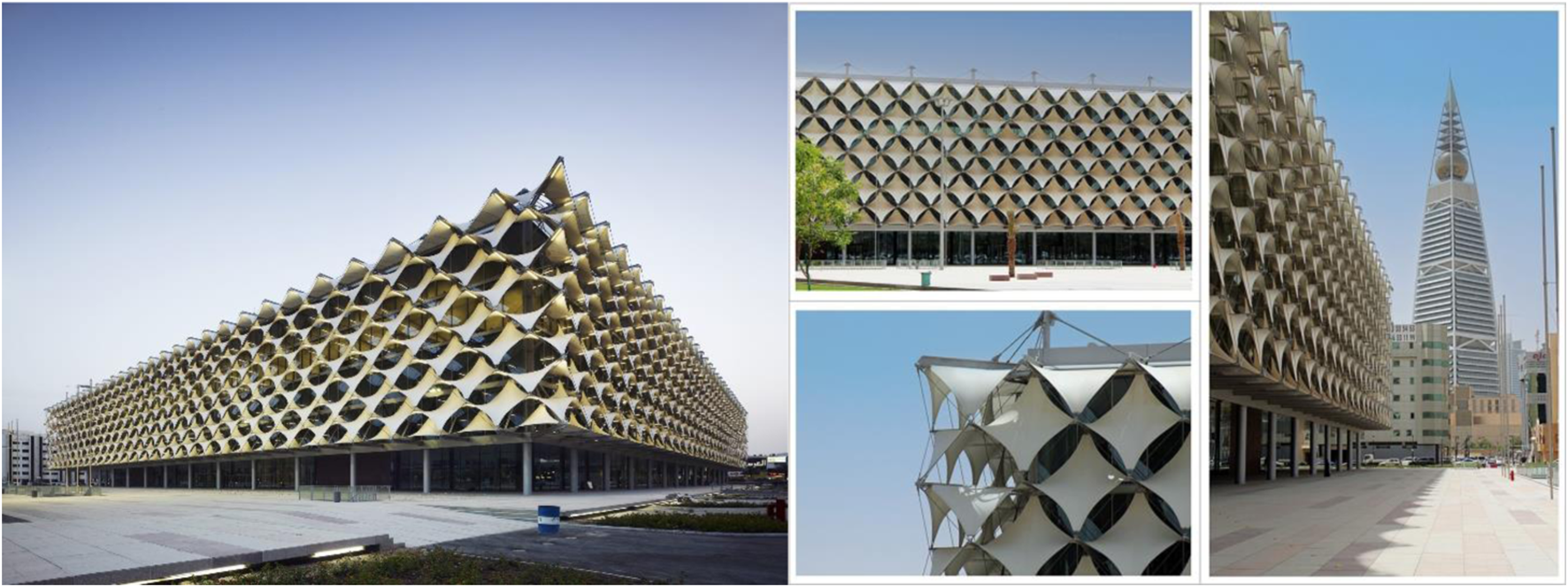
The’s design, as illustrated in Figures 5, 6, acts as a catalyst for urban transformation, thoughtfully integrating modern architectural elements with the existing urban fabric. (Authors: April 2024).
The library’s design acts as a catalyst for urban transformation, thoughtfully integrating modern architectural elements with the existing urban fabric. It embodies a harmonious blend of contemporary design and Arabian cultural heritage, reflecting the values and traditions of the region. Key features include extensive collections of manuscripts, rare books, and digital resources that aim to promote knowledge, culture, and learning for Saudi citizens and visitors alike (Saudi Press Agency, 2024). Moreover, the library serves as a pivotal institution for educational programs, exhibitions, and cultural events, bolstering its role as a community hub. The project underscores the commitment of the Saudi government to invest in cultural infrastructur e that supports both preservation and innovation (Mashary Alnaim and Bay, 2023). The library project uses advanced tent fabric to achieve three goals. First, the tent structure recalls desert tent dwellings in Arab culture. Second, the building envelope provides shade, and reducing heat. Third, it combines a new technology material and a structural composition to combine the traditional and contemporary. The innovative design enhances the aesthetic appeal of the area and encourages community engagement and interaction, fostering a deeper appreciation for literature and scholarship. Its strategic location within the capital reinforces its importance as a center for knowledge and cultural exchange (Architizer, 2023).
The architectural design of the King Fahd National Library harmoniously combines the splendor of modern aesthetics with elements of Arab cultural heritage. Advanced materials such as glass and steel allow ample natural light to penetrate the interior spaces, ensuring a highly welcoming environment for visitors. The interior design enhances functionality and accessibility, with clear designations for reading, research and community activities areas. The design also reflects environmental concerns in its use of sustainable practices that increase energy efficiency.
5.2 Qasr Al-Hokm
The Qasr Al-Hokm District and the Great Mosque project, which was successfully completed in 1992, represents a significant achievement in the revitalization of the historical center of Riyadh. This project was recognized with the prestigious Aga Khan Award for Architecture for the 1993–1995 award cycle. Commissioned by the Arriyadh Development Authority, it embodies the second phase of a comprehensive plan aimed at rejuvenating the Qasr Al-Hokm District, which is known as the old heart of Riyadh (Royal Commission for Riyadh City, 2024). See Figure 6.
FIGURE 6

The architectural style reflects classic Saudi features, characterized by columns, courtyards, and narrow corridors, creating a seamless blend of functionality and traditional aesthetics. Axon, Anthony; Hewitt, Susan (2022–03–16). Saudi Arabia 1975–2020. BRILL. ISBN 978-90-04-51249-8.
The project encompasses not only the Great Mosque of Riyadh but also includes surrounding public squares, gates, towers, remnants of the old city wall, streets, and commercial facilities (Bay et al., 2022) The design, led by architect Rasem Badran, emphasizes the dynamic interaction between people and their environment, a principle he believes promotes a sense of community and ownership among residents. Badran’s approach creatively revitalizes and transforms the local Najdi architectural tradition, with outward-facing buildings that are framed by walls, gates, and towers (Architecture and Design Commission, 2021) See Figure 9.
The architectural style reflects classic Saudi features, characterized by columns, courtyards, and narrow corridors, creating a seamless blend of functionality and traditional aesthetics. The mosque’s strat egic public location integrates it into the urban fabric, allowing it to function as a vibrant part of the city rather than merely a detached landmark. To enhance durability and maintain aesthetic harmony with the local environment, the project employs local materials, including Riyadh limestone, which offers advantages over traditional mud brick in terms of resilience while still preserving the traditional look (Al-Jazirah, 2020).
5.3 Digital city in riyadh
Located in the heart of Riyadh, Digital City is Saudi Arabia’s first mixed-use development with commercial, residential, and retail offerings. Underpinned by international-standard services and facilities, Digital City is the optimal destination for forward-thinkers and urban-living enthusiasts. See Figure 7 The development is designed to stimulate and nurture a knowledge-based economy by cultivating an innovative business environment and a dynamic workplace. Digital City feature a world-class assortment of retail selections, smarter services and technologically advanced features. It is a community that fosters inclusivity and is driven by a commitment to excellence. Digital City, initially named Al-Raidah Digital City, is a significant milestone in Saudi Arabia’s drive towards modernization and technological innovation, situated in the al-Nakheel neighborhood of Riyadh (Arab News, 2022). This mixed-use development is strategically located near King Saud University, allowing for collaborative opportunities between academia and industry. Spanning over 470 acres, it functions as an information technology park that hosts multinational companies, government ministries, and various commercial and residential facilities. The vision for Digital City was conceived in 2005 by the Saudi Public Pension Agency, positioning it as the first smart city in the Kingdom, inspired by successful international models such as Dubai Internet City. The Royal Commission for Riyadh City played a crucial role in establishing this tech hub, approving the project and overseeing its initial studies and framework.
FIGURE 7

Digital City has emerged as a focal point for various cultural events and initiatives, including an international taste festival featuring Michelin-starred restaurants and numerous community events. https://algihaz.com/news/digital-city-brilliantly-reimagine-in-riyadh/.
By 2006, project plans accelerated with a focus on creating a science park to attract both local and international technology firms, and the architectural design was a collaborative effort between Zuhair Fayez and Jurong International, blending local and modern influences in constructio (Moscatelli, 2023). Digital City enhances Riyadh’s skyline and contributes to urban planning strategies by integrating workspaces with residential and retail areas, promoting a vibrant living and working environment and fostering community engagement and economic growth. Since its opening in 2017, Digital City has emerged as a focal point for various cultural events and initiatives, including an international taste festival featuring Michelin-starred restaurants and numerous community events³, thereby promoting local culture and cuisine while attracting tourism and contributing to the economy (Al-Gihaz, 2022). As the city continues to evolve, Digital City adapts by incorporating smart technologies and innovative features that align with Saudi Vision 2030, which aims to enhance the quality of life for citizens and create a sustainable urban environment. In summary, Digital City stands as a testament to Saudi Arabia’s ambitions to become a leader in technology and innovation; by creating a vibrant, mixed-use environment that integrates various sectors, it reinforces the Kingdom’s commitment to building a knowledge-based economy, and as further developments unfold, Digital City will likely play a pivotal role in shaping the future landscape of Riyadh and beyond.
6 Implementation of the evaluation model
In the next stage of the research, the results of the analysis of the projects that were briefly explained above.
7 Discussion
-
1. The assessment of the environmental criteria across the King Fahad National Library, Qasr Al-Hokm, and Digital City reveals considerable variations in sustainable design effectiveness, strategies addressing the Urban Heat Island Effect, and the application of smart building technologies. In the domain of Sustainable Design, the King Fahad National Library emerges as a leader, achieving an impressive overall score of 88.19%—notably excelling in LEED certification compliance (92.06%) and materials selection (94.25%). These metrics reflect a robust commitment to environmental sustainability, setting a high benchmark for future developments. Qasr Al-Hokm follows closely with a total score of 89.59%, showcasing particularly strong integration of advanced technologies (92.87%) and exceptional LEED compliance (98.78%). In contrast, Digital City shows alarming deficiencies, registering an overall score of 68.76% due to poor performance in design features aimed at reducing environmental impacts, specifically in materials selection (50.00%) and energy consumption reduction (59.33%) Table 4.
TABLE 4
| 1. Main criterion (environmental) | |||||
|---|---|---|---|---|---|
| Indicators | 2.1 sub criterion - urban heat island Effect (Evaluation considers strategies to mitigate heat island effects through architectural design. | Code | Achievement percentage king fahad national library’s | Achievement percentage Qasr Al-Hokm | Achievement percentage digital city |
| 2.1.1 | Implementation of cool roofs and pavements to reduce surface temperatures. | E2.1.1/3.45 | 3.07 | 2.5 | 0.00 |
| 2.1.2 | Integration of shade structures and vegetation to minimize solar heat gain. | E2.1.2/3.09 | 2.72 | 2.14 | 0.00 |
| 2.1.3 | Design of urban layouts to maximize natural ventilation and airflow. | E2.1.3/3.27 | 2.67 | 2.3 | 0.00 |
| 2.1.4 | Selection of heat-resistant materials and finishes to reduce heat absorption. | E2.1.4/3.0 | 2.54 | 2.47 | 2.48 |
| 2.1.5 | Use of water features and thermal mass to enhance cooling effects in the environment. | E2.1.5 2.82 | 2.69 | 2.14 | 2.80 |
| Total score 15.64 | 13.69 | 11.55 | 5.28 | ||
Table showing the results of applying the proposed model to the case study (Environmental).
According to Table 4, The evaluation of strategies addressing the Urban Heat Island Effect reveals significant performance disparities among the three projects. King Fahad National Library scores an impressive total of 91.50%, demonstrating effective implementations such as cool roofs (89.57% in 2.1.1) and extensive vegetation integration (97.73% in 2.1.2). Qasr Al-Hokm also shows strong results, totaling 88.17% with high scores in shade structures (99.34% in 2.1.2) and heat-resistant materials (95.21% in 2.1.4). In stark contrast, Digital City exhibits critical deficiencies, with an overall achievement percentage of only 32.29% and no measurable implementations in several strategies, such as cool roofs and vegetation, scoring 0.00% in both 2.1.1 and 2.1.2. This assessment underscores the effective measures taken by King Fahad National Library and Qasr Al-Hokm in mitigating urban heat, while highlighting urgent areas for improvement in Digital City’s design approach. See Figure 9.
When addressing the Urban Heat Island Effect, the performance gaps are stark. The King Fahad National Library scores an impressive 91.50% through effective strategies, such as cool roofs (89.57%) and extensive vegetation integration (97.73%). Qasr Al-Hokm demonstrates strong results as well, achieving a total score of 88.17% with high ratings for shade structures (99.34%) and heat-resistant materials (95.21%). In contrast, Digital City is severely lacking, with an overall score of only 32.29%, evidencing a complete absence of effective strategies; it scores 0.00% for both cool roofs and vegetation integration. This stark comparison highlights the necessity for Digital City to implement proactive measures to mitigate urban heat and enhance overall environmental performance Table 5.
TABLE 5
| 1. Main criterion (environmental assessing) | |||||
|---|---|---|---|---|---|
| Indicators | 3.1. Sub criterion - smart building technology (Includes assessment of advanced building technologies implemented to enhance energy efficiency, occupant comfort, and operational performance). |
Code | Achievement percentage king fahad national library’s | Achievement percentage Qasr Al-Hokm | Achievement percentage digital city |
| 3.1.1 | Evaluation of energy-efficient HVAC systems and their impact on overall energy consumption. | E1.11/4.71 | 2.58 | 2.95 | 2.14 |
| 3.1.2 | Assessment of smart building technologies for optimizing energy use and enhancing operational efficiency. | E3.12/3.36 | 3.05 | 2.85 | 2.13 |
| 3.1.3 | Review of advanced lighting systems designed to reduce energy consumption while improving occupant comfort. | E3.13 /2.82 |
2.78 | 2.75 | 1.85 |
| 3.1.4 | Analysis of building automation systems (BAS) and their effectiveness in managing and monitoring building operations. | E3.4 /2.64 |
2.45 | 2.55 | 2.23 |
| 3.1.5 | Examination of renewable energy integration (e.g., solar panels, wind turbines) and its contribution to energy efficiency and sustainability goals. | E3.5 /2.82 |
1.85 | 2.01 | 1.09 |
| Total 14.73 of 100 | 12.14 | 12.47 | 12.71 | ||
Table showing the results of applying the proposed model to the case study (Environmental).
According to Table 5, The assessment of Smart Building Technology reveals varying levels of achievement in the implementation of advanced technologies across the three projects. King Fahad National Library leads with a total score of 86.29%, demonstrating strong performance particularly in advanced lighting systems (98.58% in 3.1.3) and building automation systems (92.80% in 3.1.4). Qasr Al-Hokm follows closely with a total achievement of 89.00%, excelling in energy-efficient HVAC, systems (95.47% in 3.1.1) but showing slightly lower performance in smart technologies for energy optimization (84.82% in 3.1.2). Digital City lags behind with an overall score of 64.09%, notably struggling in renewable energy integration (38.65% in 3.1.5) and overall effective use of smart technologies, as evidenced by lower scores in various categories. This evaluation highlights the strengths of King Fahad National Library and Qasr Al-Hokm in utilizing smart technologies to enhance energy efficiency and occupant comfort, while indicating significant opportunities for Digital City to enhance its technological strategies for improved performance. See Figure 10.
In the assessment of Smart Building Technology, the King Fahad National Library again leads, scoring 86.29%, largely due to outstanding performance in advanced lighting systems (98.58%) and building automation systems (92.80%). Qasr Al-Hokm closely follows with a score of 89.00%, demonstrating high efficiency in HVAC systems (95.47%). However, Digital City’s low score of 64.09%, particularly in renewable energy integration (38.65%), indicates a critical area for improvement. These findings underscore the strengths of the King Fahad National Library and Qasr Al-Hokm in implementing sustainable practices and advanced technologies, while highlighting urgent areas for improvement within Digital City’s environmental strategies. Enhancements in sustainable design, effective urban heat island mitigation strategies, and the advancement of smart building technologies are crucial for Digital City to elevate its environmental performance and contribute positively to Riyadh’s urban landscape Figures 8-10.
FIGURE 8

Results of 1.1 Sub Criterion - Sustainable Design (Assessment includes criteria such as LEED certification, use of advanced technologies, and design features aimed at reducing environmental impact).
FIGURE 9

Results of 2.1 Sub Criterion - Urban Heat Island Effect (Evaluation considers strategies to mitigate heat island effects through architectural design.
FIGURE 10

Results of 3.1. Sub Criterion - Smart Building Technology (Includes assessment of advanced building technologies implemented to enhance energy efficiency, occupant comfort, and operational performance).
2. The assessment of the Technological and Economic criterion Table 6 unveils key insights into the impact of international collaboration on design innovation and economic integration across the three projects: King Fahad National Library, Qasr Al-Hokm, and Digital City. Under the International Expertise sub-criterion, the King Fahad National Library emerges as a standout performer with a total score of 92.58%, showcasing a strong commitment to design innovation (94.38%) and the integration of diverse perspectives (96.17%). This highlights the project’s successful collaboration with global architecture firms, which enhances its overall development through innovative architectural concepts and sustainable technologies. Qasr Al-Hokm also performs well, achieving a total score of 95.55%, particularly excelling in the adoption of technological advancements (96.58%). In contrast, Digital City exhibits a concerning overall score of 66.75%, indicating significant deficiencies in fostering design innovation (58.55%) and integrating diverse perspectives (72.25%). These results emphasize the critical need for Digital City to leverage international expertise more effectively to enhance its project development and competitive edge Table 7.
TABLE 6
| Indicators | 1.2 sub criterion - international expertise (impact of collaborating with global architecture firms on design innovation, technological advancements, and the integration of diverse perspectives into project development) | Code | Achievement percentage king fahad national library’s | Achievement percentage Qasr Al-Hokm | Achievement percentage digital city |
|---|---|---|---|---|---|
| 1.2.1 | Assessment of design innovation fostered through collaboration, including the introduction of new architectural concepts, materials, or construction techniques. | T1.2.1/4.07 | 4.03 | 4.02 | 2.5 |
| 1.2.2 | Evaluation of technological advancements integrated into projects through collaborative efforts, such as the adoption of advanced building systems, sustainable technologies, or digital design tools. | T1.2./4.09 | 3.56 | 3.95 | 2.85 |
| 1.2.3 | Analysis of how collaboration with global firms enhances project development by integrating diverse cultural, environmental, and technical perspectives, contributing to holistic and innovative design solutions. | T.2.3/4.18 | 4.02 | 4.01 | 3.02 |
| Total 12.54 of 100 | 11.61 | 11.98 | 8.37 |
Assessmentof Technological and economic Criterion.
According to Table 6, The assessment of International Expertise highlights the varying impact of collaborating with global architecture firms on design innovation and technological advancements across the three projects. King Fahad National Library demonstrates a robust total achievement of 92.58%, excelling particularly in fostering design innovation (94.38% in 1.2.1) and integrating diverse perspectives to enhance project development (96.17% in 1.2.3). Qasr Al-Hokm shows strong performance with a total score of 95.55%, leading in the evaluation of technological advancements integrated through collaboration (96.58% in 1.2.2) while also maintaining high scores in design innovation and perspective integration. In contrast, Digital City lags with an overall score of 66.75%, particularly reflective of its lower achievement in fostering design innovation (58.55% in 1.2.1) and the integration of diverse perspectives (72.25% in 1.2.3). This evaluation underscores the significant benefits achieved by King Fahad National Library and Qasr Al-Hokm through international collaboration while indicating critical areas for development in Digital City to leverage global expertise effectively. See Figure 11.
TABLE 7
| Indicators | 2.2 sub criterion - role as economic hub (project contributes to economic integration by attracting international businesses, fostering cross-border investments, and enhancing local role as a global economic hub). | Code | Achievement percentage king fahad national ibrary’s | Achievement percentage Qasr Al-Hokm | Achievement percentage digital city |
|---|---|---|---|---|---|
| 2.2.1 | Assessment of the project’s ability to attract international businesses and multinational corporations to establish operations or headquarters in Riyadh. | T2.2.1/4.09 | 3.62 | 4.01 | 2.07 |
| 2.2.2 | Assessment of the project’s ability to attract international businesses and multinational corporations to establish operations or headquarters in Riyadh. | T2.2.2/4.18 | 4.02 | 4 | 2.05 |
| 2.2.3 | Analysis of the project’s impact on enhancing Riyadh’s reputation and role as a global economic hub by promoting international trade, commerce, and investment opportunities in the region. | T2.2.3/3.55 | 3.04 | 3.45 | 3.05 |
| Total 11.82 of 100 | 15.64 | 10.68 | 11.46 | 7.17 |
Assessment of Technological and economic Criterion.
According to Table 7, The evaluation of the Role as Economic Hub highlights distinctive performance levels across the three projects in promoting economic integration and attracting international business. King Fahad National Library achieves a total score of 90.36%, demonstrating effectiveness in attracting international businesses (88.51% in 2.2.1) and enhancing Riyadh’s reputation as a global economic hub (85.63% in 2.2.3). Qasr Al-Hokm excels with a total achievement of 96.95%, particularly impressive in both attracting multinational corporations (98.04% in 2.2.1) and promoting overall international trade and investment opportunities (97.18% in 2.2.3). In contrast, Digital City scores only 60.66%, with significant challenges in attracting international businesses (50.61% in 2.2.1) and below-average performance in establishing itself as an economic hub. This assessment reveals that while King Fahad National Library and Qasr Al-Hokm are making substantial contributions to Riyadh’s economic landscape, Digital City has critical opportunities for improvement to enhance its role as a global economic center. See Figure 12.
In terms of the Role as Economic Hub, King Fahad National Library scores 90.36%, effectively attracting international businesses (88.51%) and enhancing Riyadh’s economic profile (85.63%). Its ability to foster a robust economic environment is indicative of its strategic design and operational initiatives that appeal to multinational corporations. Qasr Al-Hokm excels even further with an impressive total score of 96.95%, particularly highlighting its capacity to attract corporate headquarters (98.04%) and promote international trade (97.18%). This performance not only underscores the project’s significant contributions to the local economy but also illustrates its role in positioning Riyadh as a global economic center. Conversely, Digital City’s overall score of 60.66% reveals substantial challenges in attracting international businesses (50.61%) and establishing itself as an economic hub, indicating urgent areas for improvement. Conclusively, while the King Fahad National Library and Qasr Al-Hokm demonstrate strong achievements through effective international collaboration and economic integration, Digital City must address its deficiencies in technological advancement and economic roles to enhance its contributions to Riyadh’s urban landscape. Strengthening these areas will be essential for Digital City to realize its potential as a transformational project within the region, ultimately fostering a more robust and diversified economy Figures 11, 12.
FIGURE 11

Results of 1.2 Sub Criterion - International Expertise (impact of collaborating with global architecture firms on design innovation, technological advancements, and the integration of diverse perspectives into project development).
FIGURE 12

Results of 2.2 Sub Criterion - Role as Economic Hub (Project contributes to economic integration by attracting international businesses, fostering cross-border investments, and enhancing local role as a global economic hub).
3. The assessment of the Cultural Criterion reveals significant disparities in how the three projects—King Fahad National Library, Qasr Al-Hokm, and Digital City—incorporate Saudi cultural elements and architectural heritage into their design concepts. The King Fahad National Library achieves a remarkable total score of 95.03%, indicating a strong commitment to integrating traditional Saudi architectural styles, scoring 90.79% in incorporating these elements (1.3.1) and demonstrating exceptional sensitivity to local cultural values (97.80% in 1.3.2). This high level of cultural integration not only enhances the Library’s identity and authenticity but also fosters a strong sense of place within its local context, making it a significant cultural asset for the community Table 8.
TABLE 8
| 3. Cultural criterion | |||||
|---|---|---|---|---|---|
| Indicators | 1.3 sub criterion - cultural integration (assessment considers the incorporation of saudi cultural elements and architectural heritage into design concepts). | Code | Achievement percentage king fahad national library’s | Achievement percentage Qasr Al-Hokm | Achievement percentage digital city |
| 1.3.1 | Does the project integrate traditional Saudi architectural styles, motifs, or materials into its design? | C1.3.1/3.91 | 3.45 | 4.53 | 4.2 |
| 1.3.2 | encompassing the project’s sensitivity to local cultural values, customs, and aesthetic preferences? | C1.3.2/3.64 | 3.07 | 1.85 | 3.02 |
| 1.3.3 | examining how the incorporation of Saudi cultural elements enhances the project’s identity, authenticity, and sense of place within its local context | C1.3.3 /2.91 |
2.79 | 6.38 | 1.85 |
| Total 10.64 of 100 | 9.31 | 4.53 | 4.2 | ||
Assessment of cultural criterion.
According to Table 8, The assessment of Cultural Integration reveals significant disparities in how each project incorporates Saudi cultural elements and architectural heritage into their design concepts. King Fahad National Library stands out with a total score of 95.03%, showcasing high achievements in integrating traditional Saudi styles (90.79% in 1.3.1) and demonstrating sensitivity to local cultural values (97.80% in 1.3.2). Qasr Al-Hokm also performs well with a total achievement of 88.91%, particularly strong in incorporating Saudi cultural elements (94.50% in 1.3.3) and respecting local aesthetics (91.48% in 1.3.2). In stark contrast, Digital City shows significantly lower performance, with an overall score of 30.21%, indicating challenges in integrating traditional styles (27.88% in 1.3.1) and aligning with cultural values (27.75% in 1.3.2). This evaluation highlights the successful cultural integration efforts made by King Fahad National Library and Qasr Al-Hokm, while emphasizing the urgent need for Digital City to enhance its incorporation of Saudi cultural elements in its design framework. See Figure 13.
Qasr Al-Hokm also performs admirably, achieving a total score of 88.91%. It excels particularly in incorporating Saudi cultural elements, achieving 94.50% for its efforts to reflect local aesthetics and customs. The project’s design strategies display a thoughtful incorporation of cultural heritage, contributing positively to its communal identity. Yet, while Qasr Al-Hokm shows strengths in cultural integration, its performance still trails behind that of the King Fahad National Library, suggesting additional opportunities for enhancing its cultural narrative.
In stark contrast, Digital City scores significantly lower with an overall achievement of 30.21%. This project faces notable challenges, particularly in integrating traditional styles (27.88% in 1.3.1) and aligning with cultural values (27.75% in 1.3.2). The lack of effective strategies to reflect local culture and heritage diminishes Digital City’s identity and sense of community, highlighting a critical area for development. The low performance indicates that the project has not sufficiently capitalized on the rich architectural and cultural context of Saudi Arabia, which is essential for fostering community acceptance and pride.
Additionally, when examining community engagement through the Community Engagement sub-criterion, the King Fahad National Library achieves a total score of 81.38%, indicating strong effectiveness in providing spaces for community activities (97.63% in 2.3.1). However, it falls short in promoting interaction and inclusivity, with a score of only 57.81% in 2.3.2, suggesting a gap in fully fostering community cohesion. Qasr Al-Hokm, with an overall score of 79.60%, excels in creating spaces conducive to interaction (94.38%), indicating a strong focus on community engagement, but still lacks in providing spaces specifically dedicated to activities (90.52% in 2.3.1). Digital City reflects moderate performance with a total achievement of 65.18%, showing similar effectiveness in promoting interaction (65.31% in 2.3.2) and community spaces (65.09% in 2.3.1), yet illustrating the need for more robust frameworks to enhance social cohesion Figures 13, 14.
FIGURE 13

Results of 1.3 Sub Criterion - Cultural Integration (Assessment considers the incorporation of Saudi cultural elements and architectural heritage into design concepts).
FIGURE 14

Results of 2.3 Sub Criterion - Community Engagement (Provision of spaces for community activities, cultural exchanges, and social cohesion within the Architecture).
In summary, while the King Fahad National Library and Qasr Al-Hokm effectively embody cultural integration within their designs, Digital City presents a significant opportunity for improvement. Enhancing the incorporation of Saudi cultural elements and fostering community engagement will be crucial for Digital City to connect meaningfully with local identities, thus facilitating its acceptance and success in the urban context Table 9.
TABLE 9
| 3. Cultural criterion | |||||
|---|---|---|---|---|---|
| Indicators | 2.3 sub criterion - community engagement (provision of spaces for community activities, cultural exchanges, and social cohesion within the architecture). | Code | Achievement percentage king fahad national library’s | Achievement percentage Qasr Al-Hokm | Achievement percentage digital city |
| 2.3.1 | Evaluation considers how the architectural designs provide spaces that facilitate community activities, fostering cultural exchanges and social cohesion. | C2.3.1/4.64 | 1.71 | 1.53 | 1.63 |
| 2.3.2 | Assessment examines the effectiveness of these spaces in promoting interaction, inclusivity, and community engagement within the built environment. | C2.3.2/4.00 | 1.46 | 1.33 | 1.36 |
| Total 4.71 of 100 | 3.17 | 2.86 | 2.99 | ||
Assessment of cultural criterion.
According to Table 9, The assessment of Community Engagement reflects significant differences in how the architectural designs of each project facilitate community activities and promote social cohesion. King Fahad National Library achieves a total score of 81.38%, demonstrating strong effectiveness in providing spaces for community activities (97.63% in 2.3.1), though it falls short in promoting interaction and inclusivity, scoring only 57.81% in 2.3.2. Qasr Al-Hokm, while scoring lower overall with 79.60%, excels in the effectiveness of these spaces for interaction at 94.38%, indicating a focus on community engagement, yet it still lags in the provision of spaces for activities (90.52% in 2.3.1). Digital City shows moderate performance with a total achievement of 65.18%, reflecting similar effectiveness in promoting interaction (65.31% in 2.3.2) as well as community activity spaces (65.09% in 2.3.1). This assessment highlights the strengths of the King Fahad National Library in offering community activity spaces while illustrating opportunities for improvement in fostering interaction and enhancing community engagement effectively, particularly for Digital City and Qasr Al-Hokm. see Figure 14.
4. The evaluation of Urban Connectivity across the King Fahad National Library, Qasr Al-Hokm, and Digital City reveals varying strengths in promoting pedestrian-friendly infrastructure and effective public transportation systems, which are critical for enhancing urban mobility and accessibility. The King Fahad National Library achieves a commendable total score of 90.22%, reflecting its strong commitment to integrating pedestrian-friendly infrastructure, evidenced by a score of 89.47% in this area. Additionally, its effectiveness in providing public transportation facilities is underscored by an impressive score of 91.10%, illustrating a well-developed framework that facilitates convenient movement for both residents and visitors.
Qasr Al-Hokm performs even better overall, attaining a total score of 94.32%. The project excels in its pedestrian-friendly infrastructure with a score of 95.32%, indicating a design that prioritizes walkability and encourages community interaction. Its high performance in public transportation facilities (93.15%) further showcases its role in creating an interconnected urban environment that supports seamless transportation options for users. This strong focus on connectivity not only enhances accessibility but also fosters economic activity and social engagement within the area.
In contrast, Digital City scores 86.44%, which is reflective of a relatively solid performance across both areas but still trails behind the other two projects. With scores of 88.89% for pedestrian infrastructure and 83.56% for transportation effectiveness, Digital City demonstrates commendable efforts; however, there remains an opportunity for further enhancements to reach the standards set by the King Fahad National Library and Qasr Al-Hokm. The results indicate that while Digital City is making progress in promoting walkability and accessibility, it could benefit from a more integrated approach that prioritizes public transportation and pedestrian connectivity Figure 15.
FIGURE 15

Results of 4 Sub Criterion - Community Engagement (Provision of spaces for community activities, cultural exchanges, and social cohesion within the Architecture).
Overall, the assessment underscores the strengths of Qasr Al-Hokm and the King Fahad National Library in enhancing urban connectivity. Their designs not only encourage pedestrian movement but also link seamlessly to public transportation, improving the urban experience for all. Digital City, while performing satisfactorily, must leverage opportunities for improvement in urban connectivity to enhance overall functionality and integration within Riyadh’s urban landscape. Enhanced focus on creating a more interconnected environment will be vital for fostering a sustainable and vibrant urban community in the future Table 10.
TABLE 10
| 4. Urban connectivity | |||||
|---|---|---|---|---|---|
| Indicators | 1.4 sub-criterion: Analysis examines how each project promotes urban connectivity through pedestrian-friendly infrastructure, public transportation facilities, and interconnected public spaces. | Code | Achievement percentage king fahad national library’s | Achievement percentage Qasr Al-Hokm | Achievement percentage digital city |
| 1.4.1 | Analysis examines how the project integrates pedestrian-friendly infrastructure to enhance walkability and accessibility within the urban environment. | U1.4.1/1.71 | 1.12 | 1.54 | 1.43 |
| 1.4.2 | Assessment considers the effectiveness of public transportation facilities and interconnected public spaces in facilitating convenient and seamless movement for residents and visitors alike. | U1.4.2/1.46 | 1.17 | 1.34 | 1.30 |
| Total 3.17 of 100 | 3.17 | 2.29 | 2.88 | 2.73 | |
Urban connectivity.
According to Table 10, The evaluation of Urban Connectivity reveals varying levels of performance in promoting pedestrian-friendly infrastructure and public transportation across the three projects. King Fahad National Library achieves a total score of 90.22%, demonstrating strong integration of pedestrian-friendly infrastructure with a score of 89.47% in 1.4.1 and effective public transportation facilities at 91.10% in 1.4.2. Qasr Al-Hokm performs slightly better overall with a total achievement of 94.32%, excelling in pedestrian-friendly infrastructure (95.32% in 1.4.1) and maintaining solid effectiveness in public transportation facilities (93.15% in 1.4.2). Digital City scores 86.44%, showing commendable performance in both areas with scores of 88.89% for pedestrian infrastructure and 83.56% for transportation effectiveness. This assessment highlights the strengths of Qasr Al-Hokm in enhancing urban connectivity while underscoring the good practices present in King Fahad National Library and Digital City, all of which contribute positively to walkability and accessibility in the urban environment. See Figure 15.
8 Conclusion
The comprehensive assessment of the four key criteria—Environmental, Technological and Economic, Cultural, and Urban Connectivity—across the King Fahad National Library, Qasr Al-Hokm, and Digital City reveals distinct strengths and weaknesses that shape their contributions to Riyadh’s urban development. Both the King Fahad National Library and Qasr Al-Hokm excel in sustainable design, with the Library achieving an overall score of 88.19% and notable metrics in LEED compliance and materials selection, while Qasr Al-Hokm closely follows with a score of 89.59%. In stark contrast, Digital City faces significant challenges with a score of 68.76%, highlighting deficiencies in sustainable design features aimed at environmental impact reduction. The assessment of the Technological and Economic Criterion shows King Fahad National Library leading with a score of 92.58%, particularly excelling in design innovation, while Qasr Al-Hokm achieves 95.55%, showcasing strong technological advancements; Digital City, with a score of 66.75%, underscores its need for improvement in leveraging international expertise. In the domain of Cultural integration, the King Fahad National Library stands out with a remarkable score of 95.03% for its integration of Saudi architectural styles, whereas Digital City struggles at 30.21%, indicating a significant lack in cultural relevance. Lastly, the evaluation of Urban Connectivity reveals that King Fahad National Library and Qasr Al-Hokm effectively promote pedestrian-friendly infrastructure, scoring 90.22% and 94.32% respectively, while Digital City scores 86.44%, highlighting opportunities for further enhancement. Overall, while the King Fahad National Library and Qasr Al-Hokm demonstrate exemplary performance across these criteria, Digital City must address its shortcomings in sustainable design, cultural integration, and urban connectivity to contribute more effectively to a vibrant and integrated urban ecosystem in Riyadh.
8.1 Study limitations
These are some limitations that should be taken into consideration. Focusing on three specific projects in Riyadh may present challenges in generalizing to the rest of Saudi Arabia, as different environmental, cultural, and economic contexts may lead to diverse sustainability outcomes, considering that relying on expert judgments through the Delphi method with larger numbers may be useful in ensuring the reliability of all perspectives on architecture and sustainability, and thus, the set of evaluation criteria and their weights may become more objective. Furthermore, the timing of the evaluation may not take into account future developments in sustainability best practices and supporting technologies; thus, over time, the results may be constrained by limitations. Additionally, limited access to detailed project documentation may limit the analysis to relying on qualitative judgments, which can easily introduce variance into the results. This is also because local cultural practices and their impact on sustainability may not be well captured in this research, which may lead to some important dimensions not being adequately represented.
8.2 Evaluation of methods, results, and data interpretation
Methods: The methodological approaches used in this study are objective and effectively aligned with the research objectives. The Delphi technique facilitates the systematic collection of expert opinions, while the TOPSIS framework clearly prioritizes sustainability indicators, ensuring a robust analytical process.
The results are expressed in a clear and accessible manner, offering meaningful comparisons across projects. Expanding the interpretation of these results to consider future trends or potential policy implications could provide greater relevance and utility to urban development stakeholders.
8.3 Data interpretation
Data interpretation is warranted, and a more rigorous analysis could provide deeper insights into the broader impacts and lessons learned from the evaluated projects. This would enhance understanding of sustainability practices in Saudi urban development and provide a more comprehensive view of their impact.
8.4 Knowledge contribution
From the authors’ perspective, this work is novel; it contributes significantly to sustainable urban development in Saudi Arabia by proposing an integrated assessment model that includes environmental, technological, cultural, and economic criteria to evaluate sustainability in architecture projects. This integration, using the Delphi technique along with the TOPSIS method, allows for the effective integration of qualitative and quantitative approaches to ensure comprehensive assessments based on expert judgment. The research provides valuable insights into mega projects such as the King Fahd National Library, the Government Palace, and the Digital City with best practices and areas for improvement to achieve Saudi Vision 2030. In addition, the approach emphasizes cultural integration. It emphasizes how to integrate local identity and heritage into modern design strategies. This paper concludes by recommending community engagement in sustainability assessment as part of comprehensive urban planning that is responsive to local needs. Furthermore, the assessment model provides evidence-based recommendations for policymakers and city planners regarding future regulations and investments. Thus, this study not only points to potential areas for further studies on sustainability issues, but also pledges to support sensitive architecture practices in Riyadh and even beyond.
Statements
Data availability statement
The original contributions presented in the study are included in the article/supplementary material, further inquiries can be directed to the corresponding author.
Ethics statement
Ethical review and approval was not required for the study on human participants in accordance with the local legislation and institutional requirements. Written informed consent from the [patients/ participants OR patients/participants legal guardian/next of kin] was not required to participate in this study in accordance with the national legislation and the institutional requirements.
Author contributions
HS: Conceptualization, Data curation, Formal Analysis, Funding acquisition, Investigation, Methodology, Project administration, Resources, Software, Supervision, Validation, Visualization, Writing–original draft, Writing–review and editing. AA: Conceptualization, Data curation, Formal Analysis, Funding acquisition, Investigation, Methodology, Project administration, Resources, Software, Supervision, Validation, Visualization, Writing–original draft, Writing–review and editing.
Funding
The author(s) declare that financial support was received for the research, authorship, and/or publication of this article. This work was supported and funded by the Deanship of Scientific Research at Imam Mohammad Ibn Saud Islamic University (IMSIU) (grant number IMSIU-RG23071).
Acknowledgments
The authors wish to express their heartfelt gratitude to Imam Muhammad bin Saud Islamic University for its generous financial support and assistance throughout the research process. The backing from the university was instrumental in successfully executing this study, thereby contributing to the enhancement of knowledge in the relevant field. Special thanks are extended to Rasem Baran for his valuable insights and support during the research journey. The authors also appreciate the collaborative spirit and assistance from colleagues and peers, which enriched the research experience and facilitated its completion.
Conflict of interest
The authors declare that the research was conducted in the absence of any commercial or financial relationships that could be construed as a potential conflict of interest.
Publisher’s note
All claims expressed in this article are solely those of the authors and do not necessarily represent those of their affiliated organizations, or those of the publisher, the editors and the reviewers. Any product that may be evaluated in this article, or claim that may be made by its manufacturer, is not guaranteed or endorsed by the publisher.
References
1
Adamu Salihi A. Ibrahim H. Mastura Baharudin D. (2024). Environmental governance as a driver of green innovation capacity and firm value creation. Innovation Green Dev.3 (2), 100110. 10.1016/j.igd.2023.100110
2
Adewumi A. S. Opoku A. Dangana Z. (2024). Sustainability assessment frameworks for delivering environmental, social, and governance (ESG) targets: a case of building research establishment environmental assessment method (BREEAM) UK new construction. Corp. Soc. Responsib. Environ. Manag.31, 3779–3791. 10.1002/csr.2768
3
Akadiri P. O. Chinyio E. A. Olomolaiye P. O. (2012). Design of A Sustainable building: a conceptual framework for implementing sustainability in the building sector. Buildings2, 126–152. 10.3390/buildings2020126
4
Al-Gihaz (2022). Digital city: brilliantly reimagined in Riyadh. Available at: https://algihaz.com/news/digital-city-brilliantly-reimagined-in-riyadh/ (Accessed September 25, 2022).
5
Ali H. H. Al-Betawi Y. N. Al-Qudah H. S. (2019). Effects of urban form on social sustainability – a case study of Irbid, Jordan. Int. J. Urban Sustain. Dev.11 (2), 203–222. 10.1080/19463138.2019.1590367
6
Al-Jazirah (2020) Salmaniya architecture precedes the curriculum and sustains the vision, 17565. Riyadh, Saudi: Al-Jazirah Newspaper. Available at: https://www.aljazirah.com/2020/20201211/rg1.htm (Accessed October 4, 2022).
7
Alodah A. (2023). Towards sustainable water resources management considering climate change in the case of Saudi Arabia. Sustainability15, 14674. 10.3390/su152014674
8
Aloshan M. (2024). Sustainable environmental design: evaluating the integration of sustainable knowledge in Saudi Arabian architectural programs. Discov. Sustain5, 176. 10.1007/s43621-024-00382-4
9
Alvelos H. Barreto S. (2022). Contributions towards a plurality in design narratives: addressing dynamics between global and local discourses. Des. J.25 (6), 934–954. 10.1080/14606925.2022.2125731
10
Alsayyad N. (2003). The end of tradition?. 10.4324/9780203421338
11
Ameen R. F. M. Mourshed M. (2019). Urban sustainability assessment framework development: the ranking and weighting of sustainability indicators using analytic hierarchy process. Sustain. Cities Soc.44, 356–366. 10.1016/j.scs.2018.10.020
12
Arab News (2022). The Place: Al-Raidah Digital City: boosting Saudi Arabia's IT and communication capabilities. Available at: www.arabnews.com (Accessed August 22, 2022).
13
Architecture and Design Commission (2021). King salman charter for architecture and urbanism. Riyadh, Saudi Arabia: Architecture and Design Commission.
14
Architizer (2023). King Fahad national library Riyadh. Available at: https://architizer.com/blog/projects/king-fahad-national-library-riyadh/(Accessed May 9, 2023).
15
ASHRAE (2020). ASHRAE handbook—fundamentals. Available at: https://sovathrothsama.wordpress.com/wp-content/uploads/2016/03/ashrae-hvac-2001-fundamentals-handbook.pdf.
16
Bai Y. Guo R. (2021). The construction of green infrastructure network in the perspectives of ecosystem services and ecological sensitivity: the case of Harbin, China. Glob. Ecol. Conservation27, e01534. 10.1016/j.gecco.2021.e01534
17
Bay M. A. Alnaim M. M. Albaqawy G. A. Noaime E. (2022). The heritage jewel of Saudi Arabia: a descriptive analysis of the heritage management and development activities in the at-turaif district in ad-dir’iyah, a world heritage site (WHS). Sustainability14, 10718. 10.3390/su141710718
18
Beatley T. (2011). Biophilic cities: Integrating nature into urban design and planning. 1st edition. Washington, DC: Island Press. 10.5822/978-1-59726-986-5
19
Bowring J. Egoz S. Ignatieva M. (2009). As good as the West’: two paradoxes of globalisation and landscape architecture in St. Petersburg. J. Landsc. Archit.4 (1), 6–15. 10.1080/18626033.2009.9723409
20
Burton E. (2003). Housing for an urban renaissance: implications for social equity. Hous. Stud.18 (4), 537–562. 10.1080/02673030304249
21
Cashmore M. Gwilliam R. Morgan R. Cobb D. Bond A. (2004). The interminable issue of effectiveness: substantive purposes, outcomes and research challenges in the advancement of environmental impact assessment theory. Impact Assess. Proj. Apprais.22 (4), 295–310. 10.3152/147154604781765860
22
Chaskin R. J. Joseph M. L. (2011). Social interaction in mixed-income developments: relational expectations and emerging reality. J. Urban Aff.33 (2), 209–237. 10.1111/j.1467-9906.2010.00537.x
23
Chen S. Song Y. Gao P. (2023). Environmental, social, and governance (ESG) performance and financial outcomes: analyzing the impact of ESG on financial performance. J. Environ. Manag.345, 118829. 10.1016/j.jenvman.2023.118829
24
Ding G. K. C. (2005). Developing a multicriteria approach for the measurement of sustainable performance. Build. Res. and Inf.33 (1), 3–16. 10.1080/0961321042000322618
25
Dubravská M. Marchevská M. Vašaničová P. Kotulič R. (2020). Corporate social responsibility and environmental management linkage: an empirical analysis of the Slovak republic. Sustainability12, 5431. 10.3390/su12135431
26
Dziekan K. (2012). Evaluation of measures aimed at sustainable urban mobility in European cities–case study CIVITAS MIMOSA. Procedia-Social Behav. Sci.48, 3078–3092. 10.1016/j.sbspro.2012.06.1274
27
Elsheshtawy Y. (2008). The evolving Arab city: tradition, modernity and urban development. 1st ed. (New York: Routledge).
28
Federal Ministry for the Environment, Nature Conservation, Building and Nuclear Safety (BMUB) (2016) “Guideline for sustainable building: future-proof design,” in Construction and operation of buildings. 2nd updated edition. Berlin: BMUB.
29
Fischer S. Sahay M. (2002). Modern hyper- and high inflations. J. Econo. Liter.40, 837–880. 10.1257/002205102760273805
30
Fioretti C. Pertoldi M. Busti M. Van Heerden S. (2020). Handbook of sustainable urban development strategies (EUR 29990 EN) (Luxembourg: Publications Office of the European Union).
31
Fouseki K. Nicolau M. (2018). Urban heritage dynamics in ‘heritage-led regeneration’: towards a sustainable lifestyles approach. Hist. Environ. Policy and Pract.9 (3–4), 229–248. 10.1080/17567505.2018.1539554
32
Frantzeskaki N. Coenen L. Castán Broto V. Loorbach D. (2017). Urban sustainability transitions. London: Routledge. 10.4324/9781315228389
33
Friedlingstein P. Jones M. W. O'Sullivan M. Andrew R. M. Hauck J. Peters G. P. et al (2019). Global carbon budget 2019. Earth Syst. Sci. Data11 (4), 1783–1838. 10.5194/essd-11-1783-2019
34
Fuenfschilling L. Frantzeskaki N. Coenen L. (2018). Urban experimentation and sustainability transitions. Eur. Plan. Stud.27 (2), 219–228. 10.1080/09654313.2018.1532977
35
Gao H. Medjdoub B. Luo H. Zhong H. Zhong B. Sheng D. (2020). Building evacuation time optimization using constraint-based design approach. Sustain. Cities Soc.52, 101839. 10.1016/j.scs.2019.101839
36
Gerber Architekten (2024). King Fahad national library. Available at: https://www.gerberarchitekten.de/app/uploads/2015/07/140110_en_King-Fahad-info.pdf (Accessed September 23, 2024).
37
Ghosh S. Vale R. Vale B. (2006). Indications from Sustainability Indicators: <span class=“smallcaps smallerCapital”>PRACTICE NOTE</span>. J. Urban Des.11 (2), 263–275. 10.1080/13574800600644597
38
Goktas H. O. Yumusak N. (2024). Applying the Delphi method to assess critical success factors of digitalization while sustaining lean at a lean automaker. Sustainability16, 8424. 10.3390/su16198424
39
Goswami R. Saha S. Dasgupta P. (2017). Sustainability assessment of smallholder farms in developing countries. Agroecol. Sustain. Food Syst.41 (5), 546–569. 10.1080/21683565.2017.1290730
40
Hamdan H. A. M. Andersen P. H. de Boer L. (2021). Stakeholder collaboration in sustainable neighborhood projects—a review and research agenda. Sustain. Cities Soc.68, 102776. 10.1016/j.scs.2021.102776
41
Hopkins E. A. (2015). LEED certification of campus buildings: a cost-benefit approach. J. Sustain. Real Estate7 (1), 99–111. 10.1080/10835547.2015.12091877
42
Huang B. Gao X. Xu X. Song J. Geng Y. Sarkis J. et al (2020). A life cycle thinking framework to mitigate the environmental impact of building materials. One Earth3 (5), 564–573. 10.1016/j.oneear.2020.10.010
43
Hwang C. L. Yoon K. (1981). Multiple attribute decision making: methods and applications. Springer.
44
International Living Future Institute (2024). Living Building Challenge: What if every single act of design and construction made the world a better place?Available at: https://living-future.org/lbc (Accessed March 25, 2024).
45
Jarrar O. M. Al-Homoud M. (2024). Sustainable urban development in Riyadh: a projected model for walkability. Int. J. Urban Sustain. Dev.16 (1), 398–421. 10.1080/19463138.2024.2421163
46
Jiang B. Li H. Dong L. Wang Y. Tao Y. (2019). Cradle-to-Site carbon emissions assessment of prefabricated rebar cages for high-rise buildings in China. Sustainability11, 42. 10.3390/su11010042
47
Karlsson Hjorth H.-O. Antonsson R. Liljefors L. Näslund M. Lagnerö L. Svensson E. Boverket (2021). Implementation of the EPBD: Sweden status in 2021. Boverket. Available at: https://www.ca-epbd.eu/Media/638373595736227761/Implementation-of-the-EPBD-in-Sweden.pdf
48
Khan O. Khan M. Z. Khan E. Bhatt B. K. Afzal A. Ağbulut Ü. et al (2022). An enhancement in diesel engine performance, combustion, and emission attributes fueled with Eichhornia crassipes oil and copper oxide nanoparticles at different injection pressures. Energy Sources, Part A Recovery, Util. Environ. Eff.44 (3), 6501–6522. 10.1080/15567036.2022.2100014
49
Kibert C. J. (2012a). Sustainable construction: green building design and delivery. 3rd edn. Wiley.
50
Kibert C. J. (2012b). Sustainable construction: green building design and delivery. John Wiley and Sons.
51
Lak A. Sharifi A. Khazaei M. Aghamolaei R. (2021). Towards a framework for driving sustainable urban regeneration with ecosystem services. Land Use Policy111, 105736. 10.1016/j.landusepol.2021.105736
52
Lehmann S. (2011). Transforming the city for sustainability: the principles of green urbanism. J. Green Build.6, 104–113. 10.3992/jgb.6.1.104
53
Litman T. (2021). Evaluating public transit benefits and costs. Victoria, BC: Victoria Transport Policy Institute.
54
Mach K. J. Mastrandrea M. D. Freeman P. T. Field C. B. (2017). Unleashing expert judgment in assessment. Glob. Environ. Change44, 1–14. 10.1016/j.gloenvcha.2017.02.005
55
Marselle M. R. Hartig T. Cox D. T. C. de Bell S. Knapp S. Lindley S. et al (2021). Pathways linking biodiversity to human health: a conceptual framework. Environ. Int.150, 106420. 10.1016/j.envint.2021.106420
56
Mashary Alnaim M. Bay M. A. (2023). Regionalism indicators and assessment approach of recent trends in Saudi Arabia’s architecture: the Salmaniah architectural style and the King Salman Charter initiatives as a case study. Ain Shams Eng. J.14 (10), 102144. 10.1016/j.asej.2023.102144
57
Mba E. J. Okeke F. O. Igwe A. E. Ozigbo C. A. Oforji P. I. Ozigbo I. W. (2024). Evolving trends and challenges in sustainable architectural design; a practice perspective. Heliyon10 (20), e39400. 10.1016/j.heliyon.2024.e39400
58
Michalina D. Mederly P. Diefenbacher H. Held B. (2021). Sustainable urban development: a review of urban sustainability indicator frameworks. Sustainability13, 9348. 10.3390/su13169348
59
Minor (2024). Occupational health and safety (OHS), and well-being: commitment to safe and healthy working environment. Available at: https://www.minor.com/storage/download/sustainability-report/2022/ohs-management-system-en.pdf.
60
Mohammed Abdullah Eben Saleh (1998). The integration of tradition and modernity: a search for an urban and architectural identity in Arriyadh, the capital of Saudi Arabia. Habitat Int.22 (Issue 4), 571–589. 10.1016/S01973975(98)00020-4
61
Mohsen M. S. Matarneh R. (2023). Exploring the interior designers’ attitudes toward sustainable interior design practices: the case of Jordan. Sustainability15, 14491. 10.3390/su151914491
62
Moscatelli M. (2022). Cultural identity of places through a sustainable design approach of cultural buildings. The case of Riyadh. IOP Conf. Ser. Earth Environ. Sci.1026, 012049. 10.1088/1755-1315/1026/1/012049
63
Moscatelli M. (2023). Rethinking the heritage through a modern and contemporary reinterpretation of traditional najd architecture, cultural continuity in Riyadh. Buildings13, 1471. 10.3390/buildings13061471
64
Moshood T. D. Rotimi J. O. Shahzad W. (2024). Enhancing sustainability considerations in construction industry projects. Environ. Dev. Sustain. 10.1007/s10668-024-04946-2
65
Naim M. (2013). Urban transformation in the city of Riyadh: a study of plural urban identity. Open House Int.38, 70–79. 10.1108/OHI-04-2013-B0008
66
Olander S. Landin A. (2005). Evaluation of stakeholder influence in the implementation of construction projects. Int. J. Proj. Manag.23 (5), 321–328. 10.1016/j.ijproman.2005.02.002
67
Persily A. Emmerich S. (2011). Indoor air quality in sustainable, energy efficient buildings. Hvac&r Res.18, 4–20. 10.1080/10789669.2011.592106
68
Punter J. (2016). The vancouver achievement: urban planning and design. Vancouver: UBC Press.
69
Royal Commission for Riyadh City (2024). Qasr Al-hokm district development project. Available at: https://www.rcrc.gov.sa/en/publication/qasr-al-hukm-development-program-phase-two (Accessed July 25, 2024).
70
Russell P. Redmond D. (2009). Social housing regeneration in Dublin: market-based regeneration and the creation of sustainable communities. Local Environ.14 (7), 635–650. 10.1080/13549830903089309
71
Sassen S. (2004). “Global city: introducing a concept,” in The globalization and development reader. Editor WillsJ. D. (Oxford: Wiley-Blackwell), 75–90.
72
Saudi Press Agency (2024). Launch of king Fahad national library. Available at: www.spa.gov.sa (Accessed July 25, 2024).
73
Scott A. (2012). Triumph of the city: how our greatest invention makes us richer, smarter, greener, healthier, and happier – by edward glaeser. Econ. Geogr.88, 97–100. 10.1111/j.1944-8287.2011.01134.x
74
Selim H. S. (2018). Reactions to architectural globalization in the context of contemporary cairo. Int. J. Archit. Res. Archnet-IJAR12, 307–325. 10.26687/ARCHNET-IJAR.V12I1.1571
75
Selim H. S. Mayhoub M. S. Abuzaid A. (2024). A comprehensive model to assess sustainable architecture in emerged megacities: a closer look at cairo’s new administrative capital (nac). Sustainability16, 5046. 10.3390/su16125046
76
Shamaee S. H. Yousefi H. Zahedi R. (2024). Assessing urban development indicators for environmental sustainability. Discov. Sustain5, 341. 10.1007/s43621-024-00563-1
77
Stachura P. Kuligowska K. (2021). Multi-criteria analysis of urban policy for sustainable development decision-making: a case study for Warsaw city, Poland. Procedia Comput. Sci.192, 259–269. 10.1016/j.procs.2021.08.027
78
Sun Z. Gao Y. Yang J. Chen Y. Guo B. H. W. (2024). Development of urban building energy models for Wellington city in New Zealand with detailed survey data on envelope thermal characteristics. Energy Build.321, 114647. 10.1016/j.enbuild.2024.114647
79
Tagg A. Laverty K. Escarameia M. Garvin S. Cripps A. Craig R. et al (2016). A new standard for flood resistance and resilience of buildings: new build and retrofit. E3S Web Conf.201, 13004. 10.1051/e3sconf/20160713004
80
The Climate Group (2024). RE100 - 100% renewable power. Available at: https://www.there100.org.
81
Thomson C. S. El-Haram M. A. (2018). Is the evolution of building sustainability assessment methods promoting the desired sharing of knowledge amongst project stakeholders?Constr. Manag. Econ.37 (8), 433–460. 10.1080/01446193.2018.1537502
82
United Nations (2007). Indicators of sustainable development: guidelines and methodologies. 2nd edn. New York: United Nations.
83
U.S. Green Building Council (2024). LEED certification for neighborhood development: looking beyond the scale of buildings to consider entire communities. Available at: https://www.usgbc.org/leed/rating-systems/neighborhood-development.
84
Vanolo A. (2015). The Fordist city and the creative city: evolution and resilience in Turin, Italy. City, Cult. Soc.6 (4), 69–74. 10.1016/j.ccs.2015.01.003
85
Weise Frank E. Dahy H. Sánchez Vibæk K. (2022). Challenges in creating a sustainable building certificate for single-family housing in Denmark through an Actor-Network Theory (ANT) lens. Curr. Res. Environ. Sustain.4 (2022), 100144. 10.1016/j.crsust.2022.100144
86
Wergin V. V. Zimanyi Z. Mesagno C. Beckmann J. (2018). When suddenly nothing works anymore within a team – causes of collective sport team collapse. Front. Psychol.9, 2115. 10.3389/fpsyg.2018.02115
87
Yang B. Li S. Binder C. (2015). A research frontier in landscape architecture: landscape performance and assessment of social benefits. Landsc. Res.41 (3), 314–329. 10.1080/01426397.2015.1077944
88
Zero Waste Europe (2020). Sustainable finance for a zero waste circular economy. Available at: https://zerowasteeurope.eu.
89
Zhong W. Schröder T. Bekkering J. (2022). Biophilic design in architecture and its contributions to health, well-being, and sustainability: a critical review. Front. Archit. Res.11 (Issue 1), 114–141. 10.1016/j.foar.2021.07.006
Summary
Keywords
urban renewal, environmental integrity, assessment methodologies, cultural preservation, urban integration
Citation
Selim HS and Abuzaid A (2024) Towards an integrated framework for sustainability: evaluating selected projects from Saudi Arabia. Front. Built Environ. 10:1500588. doi: 10.3389/fbuil.2024.1500588
Received
23 September 2024
Accepted
21 November 2024
Published
13 December 2024
Volume
10 - 2024
Edited by
Xianhai Meng, Queen’s University Belfast, United Kingdom
Reviewed by
Hasim Altan, Prince Mohammad bin Fahd University, Saudi Arabia
Jamal Younes Omran, Tishreen University, Syria
Updates
Copyright
© 2024 Selim and Abuzaid.
This is an open-access article distributed under the terms of the Creative Commons Attribution License (CC BY). The use, distribution or reproduction in other forums is permitted, provided the original author(s) and the copyright owner(s) are credited and that the original publication in this journal is cited, in accordance with accepted academic practice. No use, distribution or reproduction is permitted which does not comply with these terms.
*Correspondence: Haitham Sadek Selim, haitham.selim@gmail.com, hselim@oc.sdu.sa
†Architecture Department of Al Azhar university, Egypt
Disclaimer
All claims expressed in this article are solely those of the authors and do not necessarily represent those of their affiliated organizations, or those of the publisher, the editors and the reviewers. Any product that may be evaluated in this article or claim that may be made by its manufacturer is not guaranteed or endorsed by the publisher.