 Amaël Borzée1,2*
 Ariadne Angulo1Helen Meredith1,3
 Yuki Taguchi4
 Jordy Groffen5
 Dallin Bradshaw Kohler6
 John Peter Duncan Abernethy7
 Siti N. Othman2Kevin Messenger8Kyongman Heo8Le Wan2
 Tae Eun Um9Xiaoli Zhang6
 Yucheol Shin2,10Yoonhyuk Bae2Zhenqi Wang11Zhixin Qiu11
 Richard Pearce12*
- 1Amphibian Specialist Group, Species Survival Commission, International Union for the Conservation of Nature, Toronto, ON, Canada
- 2Laboratory of Animal Behavior and Conservation, College of Life Sciences, Nanjing Forestry University, Nanjing, Jiangsu, China
- 3Amphibian Survival Alliance, London, United Kingdom
- 4Asahi Hanzaki Research Association, Hiroshima, Japan
- 5College of Science and Engineering, James Cook University, Townsville, QLD, Australia
- 6Laboratory of Animal Behaviour and Conservation, College of Ecology and the Environment, Nanjing Forestry University, Nanjing, Jiangsu, China
- 7School of Biological and Environmental Sciences, Liverpool John Moores University, Liverpool, United Kingdom
- 8Herpetology and Applied Conservation Laboratory, College of Life Sciences, Nanjing Forestry University, Nanjing, Jiangsu, China
- 9Laboratory of Animal Communication, Department of EcoScience, Ewha Woman’s University, Seoul, Republic of Korea
- 10Department of Biological Sciences, College of Natural Science, Kangwon National University, Chuncheon, Republic of Korea
- 11The Co−Innovation Center for Sustainable Forestry in Southern China, College of Biology and the Environment, Nanjing Forestry University, Nanjing, China
- 12Sustainable Daisen Non-Profit Organization, Tottori, Japan
The Japanese giant salamander, Andrias japonicus, is an iconic but declining species of aquatic amphibian. A population within the Nawa River Basin of Tottori Prefecture persists but faces two significant threats. The first major threat is waterway obstructions, in the form of dams, weirs, and concrete embankments, which severely fragment and degrade the habitat. The second is water pollution, primarily caused by runoff from animal farms. Both threats to A. japonicus can be mitigated with proper actions. We provide science-based recommendations, advocating for the modification of dams and weirs by implementing ladderways to restore habitat connectivity and the provisioning of adequate breeding habitat in the form of artificial nest boxes. We also recommend the implementation of regular water quality monitoring and the enforcement of regulations regarding allowed runoff from animal farms. The Nawa River Basin could also be designated as an official sanctuary area for the Japanese Giant Salamander, lending additional formal protection and providing ecotourism opportunities for economically declining rural areas. Though the threats to A. japonicus are serious, the implementation of these mitigation measures and continual monitoring can allow this remarkable species to thrive.
1 Introduction
1.1 Species introduction
Amphibians are declining globally (Bishop et al., 2012; Wake, 2012; Green et al., 2020; Luedtke et al., 2023), with more than 41% of species now listed as threatened on the IUCN Red List of Threatened Species, mostly because of habitat loss (IUCN, 2023). Almost two-thirds of salamander species (Caudata) are under threat (57.8%; IUCN, 2023), a trend resulting principally from invasive and other problematic species, genes and diseases; agriculture and aquaculture; residential and commercial development; and biological resource use (IUCN, 2023). Threats are area- and species-specific, and the ecology of each species best predicts the threats to this species, and the steps necessary for their conservation. However, a point shared among all Giant Salamander (Cryptobranchidae) species, the Asian Giant Salamanders (Andrias spp.) and North American Hellbenders (Cryptobranchus spp.), is the population decline (Browne et al., 2020).
Japanese Giant Salamanders (Andrias japonicus) are an aquatic species of Cryptobranchid found only on three of Japan’s main islands of Honshu, Kyushu and Shikoku with the population on Honshu only in the south-west of the island and much of their habitat being highly fragmented (Browne et al., 2020). As breeding habitat, the sites where spawning nests and juveniles are most common tends to be in relatively small and lotic habitats in the upper tributaries of streams (Okada et al., 2008) these habitat are especially sensitive to change from construction and modification. The Japanese Giant Salamander is a key umbrella species currently listed as Vulnerable by the IUCN Red List of Threatened Species and the population size of the species has been declining for close to a century, with the peak in decline between the 1950s and 1970s (IUCN SCC Amphibian Specialist Group, 2022). The population density is currently estimated to be between 40 and 69 individuals per km of river length in good quality habitat with little water pollution, few or no barriers to movement and suitable banks with cavities for nests (Taguchi and Natuhara, 2009; Taguchi, 2009a). Habitat loss was the principal threat until the mid-2000s, and it remains the case for some sub-populations (Ota, 2000; Kaneko and Matsui, 2004), although hybridization with the introduced Chinese Giant Salamanders (Andrias davidianus and Andrias sligoi) is increasingly prevalent (Matsui et al., 2008; Matsui, 2017; IUCN SCC Amphibian Specialist Group, 2022; Hara et al., 2023; Nishikawa et al., 2024). Specifically, the construction of obstructions along waterways and artificial banks are the main threats (IUCN SCC Amphibian Specialist Group, 2022), resulting in habitat fragmentation and the loss of breeding habitat respectively (Wakabayashi et al., 1976; Matsui, 2000; Taguchi and Natuhara, 2009; Yamasaki et al., 2013; Matsui, 2014). Constructions, like dams and weirs, can modify in-stream habitat and flow regime, disrupt animal behavior, decrease gene flow, alter water-quality parameters, increase sediment deposition, habitat fragmentation, the loss of breeding habitat, and ultimately result in direct displacement and mortality of individuals (Cole and Landres, 1995; Watters, 1999; Matsui, 2000; Bunn and Arthington, 2002; Lessard and Hayes, 2003; Matsui, 2014). Especially, the removal of valuable refugia such as cobble shelters can greatly alter habitat characteristics required by aquatic organisms, including fish, macro-invertebrates, and aquatic (juvenile) salamanders (Kondolf, 2000; Milner and Piorkowski, 2004; Diaz et al., 2015).
Recent research shows that, against original expectations, small streams and tributaries are critical to the development of giant salamander larvae (Bjordahl et al., 2020), and conservation plans must therefore be adjusted to include small streams and tributaries. In addition, small streams and tributaries are also beneficial for the development of larvae and juveniles, two age groups hard to find, as the species takes about 15 years to reach sexual maturity (IUCN SCC Amphibian Specialist Group, 2022).
Conservation actions for the Japanese Giant Salamanders have so far included listing the species as a “Special Natural Monument” under the “Act on Protection of Cultural Properties” in Japan, resulting in Federal protection from collection and killing, and the protection of some small sections of the species’ range, including some of the breeding and non-breeding habitat (Okada et al., 2008; Saitoh et al., 2014). However, this act it is limited in that it does not request conservation actions to be taken to improve the situation for wildlife by either national or local government (Saitoh et al., 2014). Much of their habitat outside of these few reserves remains unprotected (Kobara et al., 1980; Okada et al., 2008). Japanese Giant Salamanders are also included in CITES Appendix I, and in addition collection is completely forbidden throughout the range of the species (Matsui and Hayashi, 1992), therefore collection for food, medicine and the pet trade is forbidden and it is now expected to have stopped. In addition, salamander meat is not considered a delicacy worth facing the steep punishments of a fine of up to 300,000 yen and up to 5 years in prison for killing or collecting a Natural Monument (Act on the Protection of Cultural Properties, 1950). Although the threats from collection within Japan are low, the dangers presented from hybridization with other species of Giant Salamanders originating from China are high and should the Japanese Giant Salamander be delisted and commercially traded, further pressure would be put on the few populations without hybrids. It is thus one of the key reasons that the species is listed as CITES Appendix I (CITES, 2009).
Japanese Giant Salamanders are not only a Natural Monument due to their endemicity to Japan but also their cultural significance to Japanese culture, they are inspiration for monsters both old and new and a common mascot throughout the country. The legendary Kappa, a Japanese monster or yōkai in the form of a half human half monster water demon is supposedly inspired by the Japanese Giant Salamander (Browne et al., 2020) whilst the modern-day monster, the Pokémon Quagsire is also drawing on the Japanese Giant Salamander for its appearance. Japanese Giant Salamanders are not just seen as monsters though, they are also used as symbols and mascots with Ou-Chan being a mascot in the shape of a giant salamander being used to teach people about the value of clean rivers in Toyooka City in Hyōgo Prefecture (Leveille, n.d.). In some parts of Japan, the Japanese Giant Salamanders are celebrated with a festival called the Hanzaki Matsuri held annually in the village of Yubara Onsen in Okayama Prefecture where they are venerated (Browne et al., 2020).
The species is being supported through ex situ conservation such as captive breeding (Kobara et al., 1980) with the first breeding being recorded at the Amsterdam Zoo in 1904 (Kerbert, 1904) and it has been reliably bred at the Asa Zoological Park in Japan since 1979 (Kubawara et al., 1989; Murphy and Gratwicke, 2017), although re-introductions have not yet been conducted. Current in situ support is focused on the development and installation of ladders and artificial nests to help Japanese Giant Salamander traverse dams and weirs to improve movement, connectivity and gene flow between populations (Hara, 2021; IUCN SCC Amphibian Specialist Group, 2022).
Little data are available about the population of Japanese Giant Salamanders in the Nawa River Basin area in Tottori Prefecture, but the perceived absence of Chinese Giant Salamanders, the distance from the main urban areas and the comparatively lower pressure due to a lower human density suggests a comparatively stable population. For these populations, conservation actions can have a strong benefit in terms of the number of individuals protected and the conservation of the species in the long run.
1.2 Risks resulting from obstruction of waterways
Caudata are threatened globally by obstruction to waterways such as dams and weirs (Gratwicke, 2008; Unger et al., 2017; Browne et al., 2020). These structures present obstacles to upstream or downstream movement during the life cycle of salamanders (Jackson, 2003; Taguchi, 2009a), resulting in habitat fragmentation and the loss of genetic connectivity (Blank et al., 2013). The obstruction of waterways through dam building has already contributed to the extinction of other vertebrates, such as the Chinese Paddlefish (Psephurus gladius; Scarnecchia, 2023), and these obstructions are resulting in the decline of freshwater megafauna such as the Russian sturgeon (Acipenser gueldenstaedii; Gesner et al., 2010; He et al., 2017), the Chinese sturgeon (A. sinensis; Wu et al., 2015; He et al., 2017), and the Gharial (Gavialis gangeticus; He et al., 2017; Lang et al., 2019). It is not only freshwater megafauna that are affected but potentially of greater concern is the impact these dams are having on the stocks of diadromous fish; those which require to live in both marine and freshwater habitats to complete their life histories (Tamario et al., 2019). Many of these species are of significant economic value to humans, such as salmon and shad, with the current stocks of many of these species in North America 90% below historical levels due to the loss of habitat connectivity through dam building (Limburg and Waldman, 2009).
The development of embankments, generally through concrete layering presents another threat to many freshwater vertebrates and results in the loss of habitat, prey and pollution (He et al., 2017). Giant salamanders are especially impacted by bankside damage, channelization, dams, and sedimentation (Browne et al., 2020). While some environmental damage can be mitigated, the impact of dams is generally irreversible (Liu and Lu, 2007; Dai et al., 2009; Browne et al., 2020). For Japanese Giant Salamanders, these waterway alterations have resulted in population fragmentation, followed by an increased risk of extinction because of the absence of genetic exchange (Wakabayashi et al., 1976; Matsui and Tominaga, 2007; Taguchi and Natuhara, 2009). In addition, damages of natural banks impact the breeding habitat and daytime refuge habitat of the species (Tochimoto, 1995, 1996; Takahashi et al., 2016; Browne et al., 2020).
The main threat to the Japanese Giant Salamanders in the Nawa River Basin area is related to habitat connectivity due to the numerous obstructions to the waterway (Figure 1). During the development of the region for agricultural purposes, the riverbeds were straightened so that the rice fields that flank them could be made uniform in size and shape, and to facilitate their flooding for agricultural purposes. Once canalized, the rivers needed to be slowed down and rice paddies flooded so weirs and dams were added. In places, there are as many as 15 weirs within a 1 km stretch, obstructing the migration of Japanese Giant Salamanders, their access to mates, and adequate habitat for shelter, breeding and development, as well as direct impacts on their prey (Figure 2).
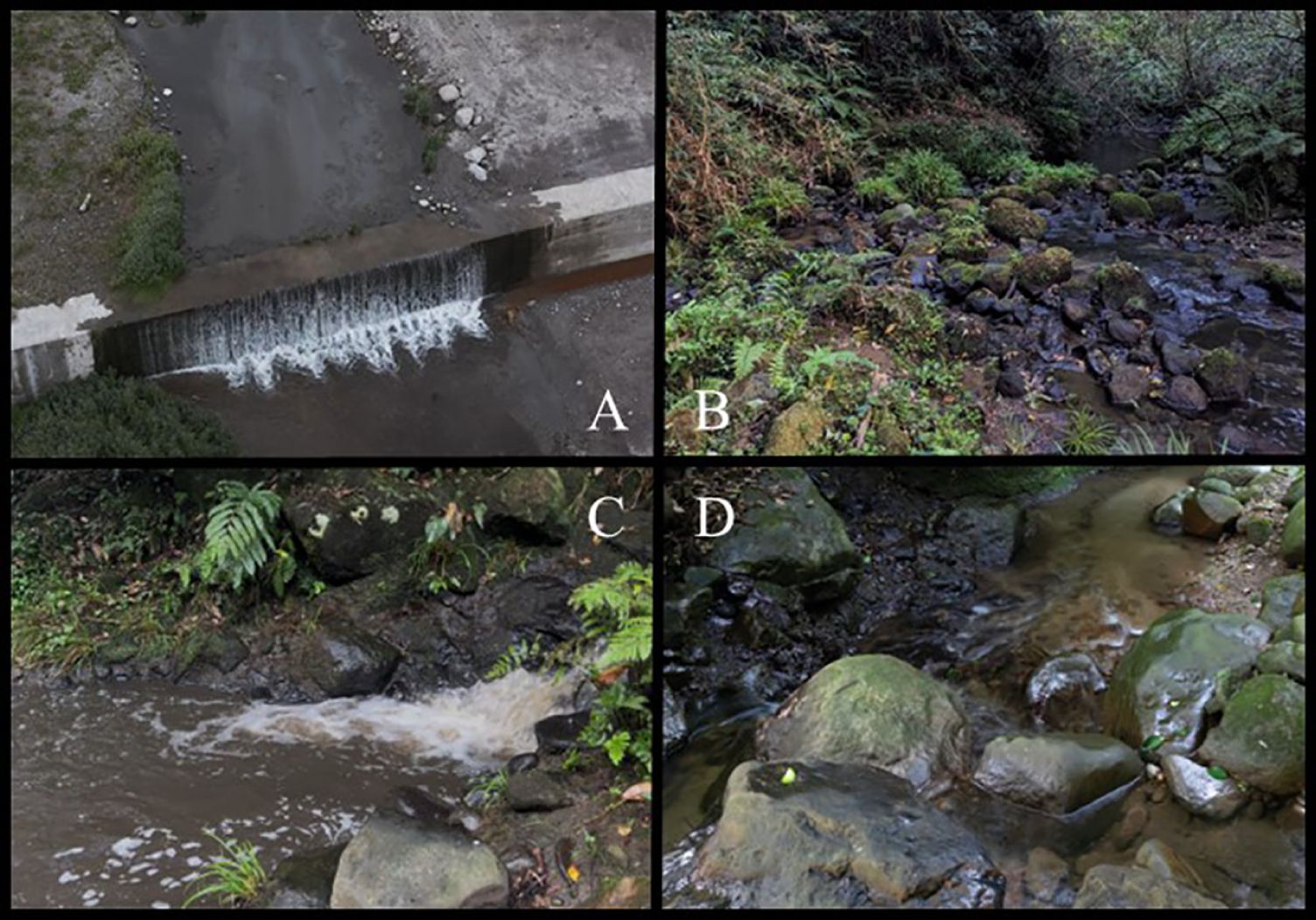
Figure 1 Visible anthropogenic impacts upon habitat and water quality within the Nawa River, Tottori Prefecture, Japan which could impact the survival of the Japanese Giant Salamander population within the river. Concrete weirs (A) form impassable barriers that severely restrict salamander movement compared to natural habitat (B). The water quality in streams impacted directly by runoff (C) compared to those not (D) is starkly different.
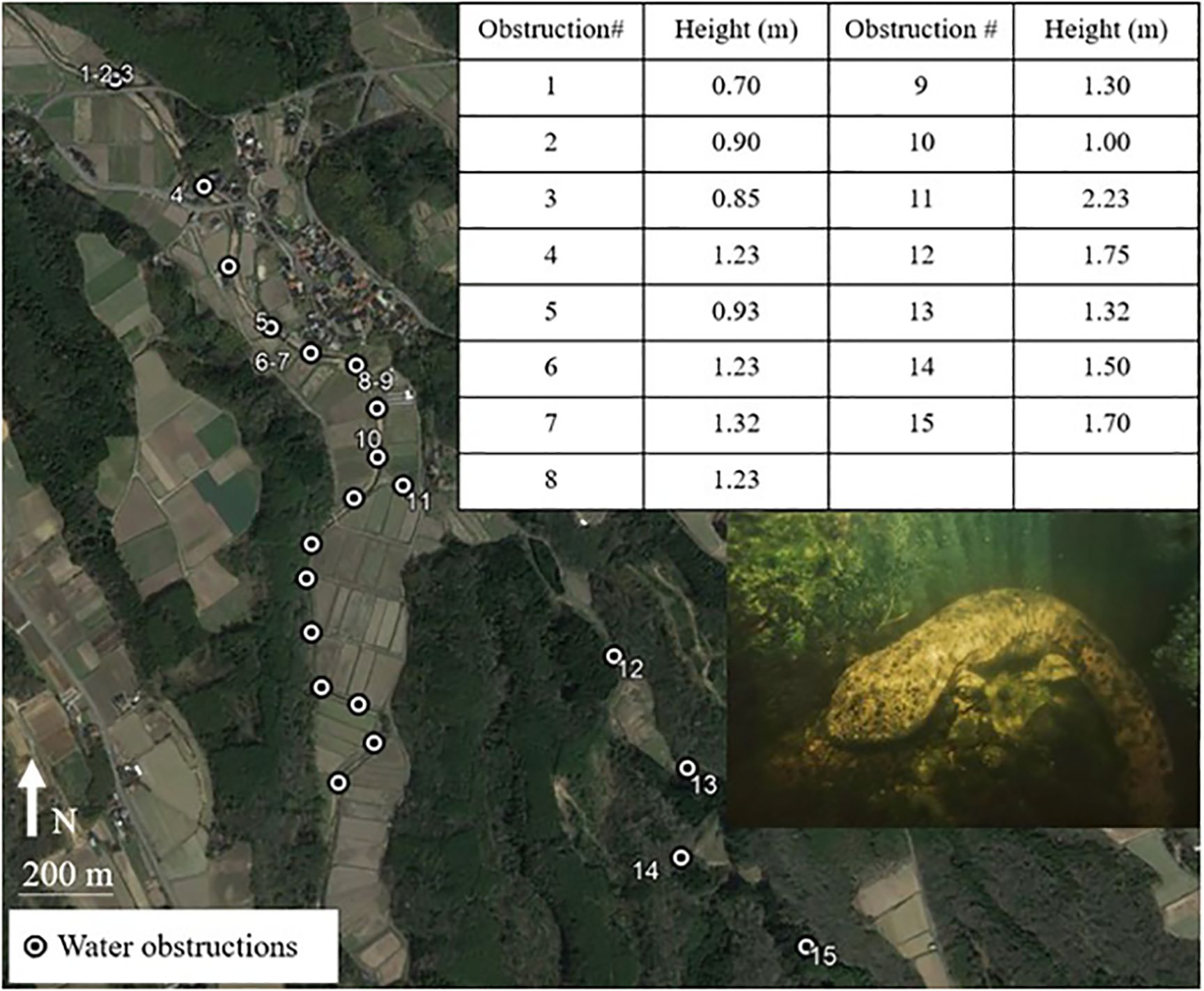
Figure 2 Local Google Earth map of the Nawa River, Tottori Prefecture, Japan (maps.google.com), with examples waterway obstructions (dam and weirs). The numbers on the map are matching the numbers in the table where the height is indicated. The height of the obstructions is important as while Andrias sp. individuals may be able to disperse over-ground in some restricted instances, most obstructions are over a meter heigh, making it impossible to climb over it for the animals. Not all obstructions have been measured, and the ones measures are the ones numbered here. The inset picture is an adult Andrius japonicus against the weir number 8, its body pushing against the concrete weir (picture by Kenneth Chin Y. A).
1.3 Risks due to pollution
Pollution is among the top five threat categories impacting amphibians (IUCN, 2023), and its impacts on populations can be critical, especially when coupled with other separate threat factors, such as habitat destruction (Perelman et al., 2021). As a result, numerous caudate species are threatened by water pollution, including the Western Chinese Mountain Salamander (Batrachuperus pinchonii) (Fei and Ye, 2004), the Chinese Warty Newt (Paramesotriton chinensis; Gu et al., 2004), and the Wanggao Warty Newt (Paramesotriton fuzhongensis; Zhao and Yuan, 2004). Pollution can have multiple origins, for example the development of land for residential, urban and agricultural use is a well-known source of pollution in the form of fine sediment which can pose major challenges to aquatic species, and have significant negative impacts on population dynamics (Sutherland et al., 2002; Li, 2004; Zhou et al., 2021). More specifically, activities related to cattle farming have a demonstrated negative impact on amphibian populations (Schmutzer et al., 2008) and their impact does not need to directly result in the reduction of water quality to levels deadly to amphibians as this pollution can act in synergy with other threats such as disease to have a greater negative impact on amphibians (Preuss et al., 2020).
The genus of Giant Salamanders (Andrias spp.), in China, is also impacted by water pollution (Shu et al., 2021). While there is little published research on the impact of pollution on Japanese Giant salamanders (A. japonicus), the ranges of the species in this genus in China have contracted in part, due to habitat loss and degradation, including water pollution and obstruction of waterways that result in changes in flow regimes and increase in turbidity along with severe overexploitation (e.g. Liang et al., 2004; Wang et al., 2004; Dai et al., 2009; Tapley et al., 2021). In addition, other pollutants yet to be investigated for the genus are expected to negatively impact the survival of individuals, for example heavy metals, phosphates, nitrates and persistent organic pollutants (Dai et al., 2009).
Among the threats to the Japanese Giant Salamanders in the Nawa River Basin, pollution is concerning. There is a large number of animal farms in the area that are positioned adjacent to waterways which could be potential sources for pollution from runoff. In particular, animal farms that are positioned next to small tributaries or near the sources of the rivers are of particular concern given that effluence can impact habitats much further down river (Figure 3).

Figure 3 Hydrological basin of the area. The Nawa River is highlighted in dark blue and the range of Andrias japonicus is indicated by the light orange shaded area on the inset map (IUCN and NatureServe, 2008). The area with the dam in the earlier section is highlighted as “focal area”. A very high number of animal farms is directly adjacent to small streams, ponds and larger rivers which could be potential sources of pollution into these streams.
The legal and illegal discarding of animal waste in fields close to waterways can results in the waste being washed into the watercourse later on, ensuing in an increase in salinity, phosphate and nitrate, and a decrease in dissolved oxygen (Table 1 with sampling details here-in) that potentially impacts Japanese Giant Salamanders, despite being below the guidelines of the Ministry of Environment of the Government of Japan for waters related to the protection of the living environment (Government Ordinance No.363, 1974; www.env.go.jp/en/water/wq/nes.html). In the Nawa River basin, we recorded such variations at several locations, with for instance an increase in salinity, conductivity, pH, phosphate, nitrate and ammonium, and a decrease in dissolved oxygen downstream of a tributary running along a pig farm; and also an increase in nitrate and ammonium, and a decrease in dissolved oxygen downstream of a tributary running along a poultry farm, in comparison with water parameters recorded from samples taken right before the tributaries (Table 1). As the successful hatching of amphibians is impacted by high values in ammonia, phosphate and biological oxygen (De Solla et al., 2002), further understanding on the impact of farming on Japanese Giant Salamanders throughout all life stages is required as the levels of nutrient and chemical pollution entering the waterway from farms may be above the threshold tolerated by the focal species and numerous other aquatic species (Muenz et al., 2006), including some present in the food chain below the Japanese Giant Salamanders and therefore directly or indirectly impacting the species. In the context of Hellbenders, the loss of forest cover upstream stands out as a significant factor. This loss often leads to changes in stream habitat, including siltation and alterations in water chemistry. For instance, increased dissolved ions can elevate conductivity and salinity, which are commonly linked to declines in Hellbender populations (Hopkins et al., 2023).
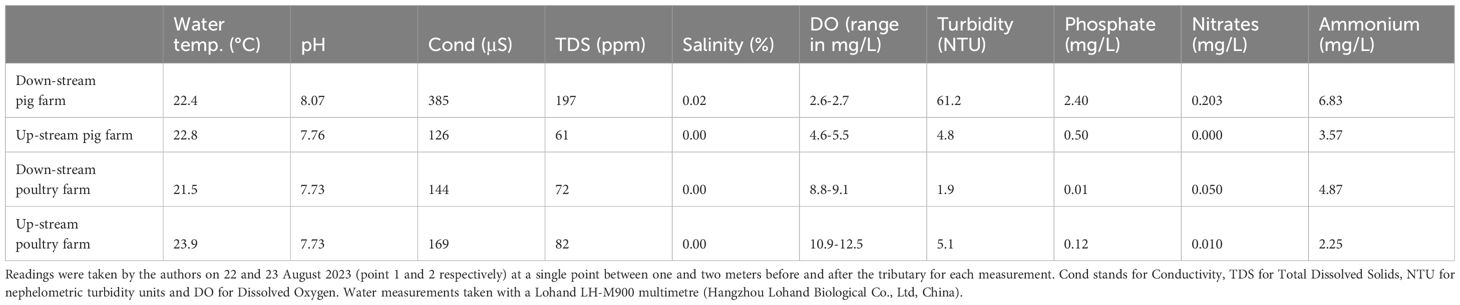
Table 1 Water quality upstream and downstream of animal farms in the Nawa River Basin, Tottori.
2 Policies and practices
While Japanese Giant Salamanders are threatened, conservation actions can have a positive outcome, on all species in the river basin. Possible interventions include the restoration of natural breeding habitat (Joly and Grolet, 1996; Kinne, 2004), the translocation of individuals under controlled conditions (Smith et al., 2020), and the provisioning of adequate artificial breeding habitat such as nest boxes (Hara, 2021; Suzuki, 1999; Kuwabara et al., 2005; Jonas et al., 2020).
The Japanese Giant Salamander urgently requires the restoration of its habitat, and the re-establishment of connectivity across stream segments, such as through the installation of ladderways (Hara, 2021; Takahashi et al., 2016; Hara, 2021). Other beneficial interventions include the creation of nesting and sheltering areas, and population supplementation in some specific areas (Browne et al., 2020). Examples of supplementary breeding habitats are available from the Intraregional Breeding Program in Asa Zoological Park (Browne et al., 2020; Hara, 2021), and several types of spawning areas are known to be successful for aiding reproduction in the species (Tochimoto, 1995, 1996).
Specific to the Nawa River Basin area, and upon confirmation of the absence of invasive Chinese Giant Salamander basin through broadly sampling methods such as eDNA analyses, the implementation of bypass slopes and fish ladders for each obstruction of the river course will help alleviate their impact and restore connectivity. Such contraptions, or small structural changes to water obstructions, are likely to have near-perfect success rates based on field observations (Taguchi, 2009b) and experiments with prototypes (Takahashi et al., 2016). Importantly, this restoration of connectivity should be conducted for all obstructions of the waterway, as dispersion must be facilitated across all habitat types for all life stages to effectively protect the species, but also in a way that enables protection of the food chain that giant salamanders rely upon at all life stages. This habitat restoration can be supplemented by the deployment of nest boxes in suitable portions of the streams. To complement these actions, surveys should be conducted to determine the need for population supplementation, and to determine the effectiveness of any interventions as soon as possible to avoid further decline. Finally, regular monitoring of water quality, especially focused on pollution originating from farming activities, at several locations along the waterway is needed, along with the enforcement of penalties when required. Once protected, the conservation action can be boosted by the establishment of official sanctuary areas recognized as important breeding areas for the Japanese Giant Salamander. This sanctuary area will need to match with some of the critical habitat for the species, such as breeding grounds, but also areas needed to maintain connectivity between breeding and non-breeding areas. In addition, the presence of such a sanctuary will provide important data on carrying capacity of the habitat. Habitat protection, monitoring and sanctuaries may provide a base for the development of conservation projects, which may be funded through ecotourism. Ecotourism is not only a source of funding for conservation but also an opportunity to revitalize the countryside of Japan, which has experienced depopulation, and ecotourism could instead bring people back to these areas. Many local and national government policies incorporate ecotourism as a tool to tackle problems facing rural communities such as those living around the Nawa basin (Sakuma, 2018).
3 Conclusion
In conclusion, while there are known threats to Japanese Giant Salamanders, a number of important details require confirmation in the Nawa River Basin area, and these can be addresses through research. However, multiple known threats can already be alleviated with adequate conservation actions, which can be implemented by the GOs and NGOs active in the regions. In addition, citizen science monitoring such as the project set-up through iNaturalist (https://www.inaturalist.org/projects/biodiversity-of-the-nawa-river-basin) could help provide the data needed to further understand the ecology of the species in the area. The primary risks are linked to habitat destruction and loss of connectivity, which can be re-established through appropriate bypass slopes. Once reconnected, populations can also be supplemented to preserve genetic diversity, and their survival supported by the management of the food chain, and provision of shelters. These actions should be implemented following science-based data. Finally, water quality monitoring and maintenance will facilitate continued protection of the species, a monitoring that can be conducted by GOs or NGOs. Although these recommendations are specific to the Japanese Giant Salamanders of the Nawa River Basin area, numerous aquatic species will be protected along this key umbrella species given appropriate interventions and subsequent monitoring, and guidelines can also be transferred to other landscapes.
Data availability statement
The original contributions presented in the study are included in the article/supplementary material. Further inquiries can be directed to the corresponding authors.
Ethics statement
Ethical approval was not required for the study involving animals in accordance with the local legislation and institutional requirements because no animals were handled or observed for this study.
Author contributions
AB: Conceptualization, Data curation, Funding acquisition, Investigation, Project administration, Resources, Validation, Visualization, Writing – original draft, Writing – review & editing. AA: Conceptualization, Validation, Writing – review & editing. HM: Conceptualization, Validation, Writing – review & editing. YT: Conceptualization, Validation, Writing – review & editing. JG: Data curation, Investigation, Validation, Writing – review & editing. DK: Data curation, Investigation, Validation, Writing – review & editing. JA: Data curation, Investigation, Validation, Writing – review & editing. SO: Data curation, Investigation, Validation, Writing – review & editing. KM: Data curation, Investigation, Validation, Writing – review & editing. KH: Data curation, Investigation, Validation, Writing – review & editing. LW: Data curation, Investigation, Project administration, Validation, Writing – review & editing. TU: Data curation, Investigation, Validation, Writing – review & editing. XZ: Data curation, Investigation, Validation, Writing – review & editing. YS: Data curation, Investigation, Validation, Writing – review & editing. YB: Data curation, Investigation, Validation, Writing – review & editing. ZW: Data curation, Investigation, Validation, Writing – review & editing. ZQ: Data curation, Investigation, Validation, Writing – review & editing. RP: Data curation, Funding acquisition, Investigation, Methodology, Project administration, Resources, Supervision, Validation, Visualization, Writing – review & editing.
Funding
The author(s) declare that no financial support was received for the research, authorship, and/or publication of this article.
Conflict of interest
The authors declare that the research was conducted in the absence of any commercial or financial relationships that could be construed as a potential conflict of interest.
Publisher’s note
All claims expressed in this article are solely those of the authors and do not necessarily represent those of their affiliated organizations, or those of the publisher, the editors and the reviewers. Any product that may be evaluated in this article, or claim that may be made by its manufacturer, is not guaranteed or endorsed by the publisher.
References
Act on the Protection of Cultural Properties (1950) (Act no.214). Available at: https://www.wipo.int/wipolex/en/text/187600.
Bishop P. J., Angulo A., Lewis J. P., Moore R. D., Rabb G. B., Garcia Moreno J. (2012). The amphibian extinction crisis-what will it take to put the action into the Amphibian Conservation Action Plan? S.A.P.I.E.N.S 5, 97–111.
Bjordahl B., Okada S., Takahashi M. K. (2020). Assessment of small tributaries as possible habitats for larvae and juveniles of Japanese giant salamanders, Andrias japonicus, by coupling environmental DNA with traditional field surveys. Salamandra 56, 148–158.
Blank L., Sinai I., Bar-David S., Peleg N., Segev O., Sadeh A., et al. (2013). Genetic population structure of the endangered fire salamander (Salamandra infraimmaculata) at the southernmost extreme of its distribution. Anim. Conserv. 16, 412–421. doi: 10.1111/acv.12009
Browne R., Wang Z., Okada S., Mcginnity D., Luo Q., Taguchi Y., et al. (2020). The sustainable management of giant salamanders (Cryptobranchoidea). Review (Belize: Sustainability America).
Bunn S. E., Arthington A. H. (2002). Basic principles and ecological consequences of altered flow regimes for aquatic biodiversity. Environ. Manage. 30, 492–507. doi: 10.1007/s00267-002-2737-0
CITES (2009) Twenty-fourth meeting of the Animals Committee: Periodic review of animal species included in the CITES Appendices. Periodic Review Of Species Selected Between Cop13 And Cop15. Available at: https://cites.org/sites/default/files/eng/com/ac/24/E24-10-02.pdf (Accessed 8 April 2024).
Cole D. N., Landres P. B. (1995). “Indirect effects of recreation on wildlife,” in ildlife and recreationists: coexistence through management and research. Eds. Knight R., Gutzwiller (Island Press, Washington, USA), 183–202.
Dai Q., Wang Y., Liang G. (2009). Conservation status of Chinese giant salamander (Andrias davidianus) (Chengdu, China: Chinese Academy of Sciences).
De Solla S. R., Pettit K. E., Bishop C. A., Cheng K. M., Elliott J. E. (2002). Effects of agricultural runoff on native amphibians in the lower Fraser River Valley, British Columbia, Canada. Environ. Toxicol. Chemistry: Int. J. 21, 353–360. doi: 10.1002/etc.5620210218
Diaz P. H., Fries J. N., Booner T. H., Alexander M. L., Nowlin W. H. (2015). Mesohabitat associations of the threatened San Marcos Salamander (Eurycea nana) across its geographic range. Aquat. Conservat: Mar. Freshw. Ecosyst. 25, 307–321. doi: 10.1002/aqc.2559
Fei L., Ye C. (2004). “Batrachuperus pinchonii,” in The IUCN red list of threatened species e.T59085A11868223. doi: 10.2305/IUCN.UK.2004.RLTS.T59085A11868223.en
Gesner J., Freyhof J., Kottelat M. (2010). “Acipenser gueldenstaedtii,” in The IUCN red list of threatened species e.T232A135063140. doi: 10.2305/IUCN.UK.2022-1.RLTS.T232A135063140.en
Gratwicke B. E. (2008). Proceedings of the appalachian salamander conservation workshop (Apple Valley, USA: IUCN/SSC Conservation Breeding Specialist Group).
Green D. M., Lannoo M. J., Lesbarrères D., Muths E. (2020). Amphibian population declines: 30 years of progress in confronting a complex problem. Herpetologica 76, 97–100. doi: 10.1655/0018-0831-76.2.97
Gu H., Geng B., Yuan Z. (2004). “Paramesotriton chinensis,” in The IUCN red list of threatened species e.T59457A11945154. doi: 10.2305/IUCN.UK.2004.RLTS.T59457A11945154.en
Hara K. (2021). “Continuous field research and conservation activities,” in ASA ZOO 50th anniversary - conservation research of Japanese giant salamanders (Nakamoto Honten Inc Press, Hiroshima, USA), 77–94.
Hara S., Nishikawa A., Matsui M., Yoshimura M. (2023). Morphological differentiation in giant salamanders, Andrias japonicus, A. davidianus, and their hybrids (Urodela, Cryptobranchidae), and its taxonomic implications. Zootaxa 5369, 42–56. doi: 10.11646/zootaxa.5369.1
He F., Zarfl C., Bremerich V., Henshaw A., Darwall W., Tockner K., et al. (2017). Disappearing giants: a review of threats to freshwater megafauna. WIREs Water 4, e1208. doi: 10.1002/wat2.1208IUCN(2023. The IUCN Red List of Threatened Species. Version 2022-2, https://www.iucnredlist.org.
Hopkins W. A., Case B. F., Groffen J., Brooks G., Jachowski C. B., Button S., et al. (2023). Filial cannibalism leads to chronic nest failure of eastern hellbender salamanders (Cryptobranchus alleganienesis). The American Naturalist 202 (1), 92–106. doi: 10.1086/724819
IUCN (2023) The IUCN red list of threatened species. Version 2022-2. Available at: https://www.iucnredlist.org (Accessed 12 December 2023).
IUCN, NatureServe (2008). “Andrias japonicus,” in The IUCN red list of threatened species. Version 2023-1. Available at: https://www.iucnredlist.org/ja/species/1273/3376261. 12 February 2024.
IUCN SCC Amphibian Specialist Group (2022). “Andrias japonicus,” in IUCN red list of threatened species e.T1273A177177761.
Jackson S. D. (2003). “Ecological considerations in the design of river and stream crossings,” in International conference on ecology and transportation, vol. 24-29. (University of Massachusetts Amherst, Amherst, USA).
Joly P., Grolet O. (1996). Colonization dynamics of new ponds, and the age structure of colonizing alpine newts, triturus alpestris. Acta oecologica (Montrouge) 17 (6), 599–608.
Jonas C. S., Timbrell L. L., Young F., Petrovan S. O., Bowkett A. E., Smith R. K. (2020). “Management of captive animals,” in What works in conservation 2020. Eds. Sutherland W. J., Dicks L. V., Petrovan S. O., Smith R. K. (Cambridge, UK: Open Book Publishers), 527–553.
Kaneko Y., Matsui M. (2004). “Andrias japonicus,” in The IUCN red list of threatened species e.T1273A3376261. doi: 10.2305/IUCN.UK.2004.RLTS.T1273A3376261.en
Kerbert C. (1904). Zur Fortpflanzung von Megalobatrachus maximus Schlegel (Cryptobranchus japonicus vd Hoeven). Naturwissenschaftliche Rundschau 19, 229–230.
Kinne O. (2004). Successful re-introduction of the newts Triturus cristatus and T. vulgaris. Endangered Species Res. 1, 25–40. doi: 10.3354/esr001025
Kobara J., Ashikaga K., Inoue T., Wakabayashi F., Kuwabara K., Suzuki N. (1980). The study on the protection of Japanese Giant Salamander Megalobatrachus j. japonicus, in Hiroshima Prefecture. The egg-Laying in aquarium. J. Japanese Gardens Aquariums 22, 67–71.
Kondolf G. M. (2000). Assessing salmonid spawning gravel quality. Trans. Am. Fisheries Soc. 129, 26–2281. doi: 10.1577/1548-8659(2000)1292.0.CO;2
Kubawara K., Suzuki N., Wakabayashi F., Ashikaga H., Inoue T., Kobara J. (1989). Breeding the Japanese giant salamander Andrias japonicus at Asa Zoological Park. Int. Zoo Yearbook 28, 22–31. doi: 10.1111/j.1748-1090.1989.tb03249.x
Kuwabara K., Ashikaga K., Minamigata N., Nakanishi M., Shimada H., Kamata H., et al. (2005). The breeding ecology and conservation of the japanese giant salamander, Andrias japonicus, at shijihara and kamiishi in tokyohira-cho, hiroshima prefecture. Na.t His.t Nishi-Chugoku Mt. 10, 101–133.
Lang J., Chowfin S., Ross J. P. (2019). “Gavialis gangeticus (errata version published in 2019),” in The IUCN red list of threatened species. e.T8966A149227430. doi: 10.2305/IUCN.UK.2019-1.RLTS.T8966A149227430.en
Lessard J. L., Hayes D. B. (2003). Effects of elevated water temperature on fish and macroinvertebrate communities below small dams. River Res. Appl. 19, 721–732. doi: 10.1002/rra.713
Leveille D. Kinosaki inspirations: meeting toyooka’s mascots, visit kinosaki. Available at: https://visitkinosaki.com/trip-ideas/meeting-toyookas-mascots/ (Accessed 8 April 2024).
Li J. L. (2004). On the biology of Onychodactylus fischeri found in Xiuyan Co., and protection of its habitat. Sichuan J. Zool 23, 169–171.
Liang G., Geng B., Zhao E. (2004). “Andrias davidianus,” in The IUCN red list of threatened species e.T1272A3375181. doi: 10.2305/IUCN.UK.2004.RLTS.T1272A3375181.en
Limburg K. E., Waldman J. R. (2009). Dramatic declines in North Atlantic diadromous fishes. Bioscience 59, 955–965. doi: 10.1525/bio.2009.59.11.7
Liu A., Lu Z. (2007). A preliminary study on the conservation and management of the giant salamander resource in Shannxi Province. Water Conservancy Fishery 27, 69–71.
Luedtke J. A., Chanson J., Neam K., Hobin L., Maciel A. O., Catenazzi A., et al. (2023). Ongoing declines for the world’s amphibians in the face of emerging threats. Nature 622, 308–314. doi: 10.1038/s41586-023-06578-4
Matsui M. (2000). “Japanese giant salamander,” in Threatened wildlife of Japan - red data book, 2nd Edition (Japan Wildlife Research Center, Environment Agency. (Tokyo, Japan).
Matsui M. (2014). ““Japanese giant salamander,” in Red Data Book 2014,” in Threatened wildlife of Japan, vol. Volume 3 . Ed. Environment M. O. (Gyosei Co, Tokyo, Japan), 130–131.
Matsui M. (2017). Effects of introduced Chinese giant salamander on native Japanese congener. Bull. Kansai Organ. Nat. Conserv. 39, 13–19.
Matsui M., Hayashi T. (1992). Genetic uniformity in the Japanese giant salamander, andrias japonicus. Copeia 1, 232–235. doi: 10.2307/1446557
Matsui M., Tominaga A. (2007). A survey by AFLP of genetic diversity in the Japanese giant salamander aiming conservation of local populations. Ecol. Civil Eng. 10, 175–184. doi: 10.3825/ece.10.175
Matsui M., Tominaga A., Liu W., Tanaka-Ueno T. (2008). Reduced genetic variation in the Japanese giant salamander, Andrias japonicus (Amphibia: Caudata). Mol. Phylogenet. Evol. 49, 318–326. doi: 10.1016/j.ympev.2008.07.020
Milner A. M., Piorkowski R. J. (2004). Macroinvertebrate assemblages in streams of interior Alaska following alluvial gold mining. River Res. Appl. 20, 719–731. doi: 10.1002/rra.786
Muenz T. K., Golladay S. W., Vellidis G., Smith L. L. (2006). Stream buffer effectiveness in an agriculturally influenced area, southwestern Georgia: responses of water quality, macroinvertebrates, and amphibians. J. Environ. Qual. 35, 1924–1938. doi: 10.2134/jeq2005.0456
Murphy J. B., Gratwicke B. (2017). History of captive management and conservation amphibian programs mostly in zoos and aquariums. Part II salamanders and caecilians. Herpetol Rev. 48, 474–486.
Nishikawa K., Matsui M., Yoshikawa N., Tominaga A., Eto K., Fukuyama I., et al. (2024). Discovery of ex situ individuals of Andrias sligoi, an extremely endangered species and one of the largest amphibians worldwide. Sci. Rep. 14, 2575. doi: 10.1038/s41598-024-52907-6
Okada S., Utsonomiya T., Okada T., Felix. Z. I., Ito F. (2008). Characteristics of Japanese Giant Salamander (Andrias japonicus) populations in two small tributary streams in Hiroshima Prefecture, Western Honshu, Japan. Herpetol Conserv. Biol. 3, 192–202.
Ota H. (2000). Current status of the threatened amphibians and reptiles of Japan. Population Ecol. 42, 5–9. doi: 10.1007/s101440050003
Perelman Z. E., Takahashi M. K., Hundermark E. L., Parenzan C. (2021). An eDNA-based assessment of the impact of a 207,000-liter gasoline spill on local populations of Eastern hellbenders (Cryptobranchus alleganiensis alleganiensis), an imperiled Giant salamander. Northeastern Nat. 28, 484–496. doi: 10.1656/045.028.0406
Preuss J. F., Greenspan S. E., Rossi E. M., Lucas Gonsales E. M., Neely W. J., Valiati V. H., et al. (2020). Widespread pig farming practice linked to shifts in skin microbiomes and disease in pond-breeding amphibians. Environ. Sci. Technol. 54, 11301–11312. doi: 10.1021/acs.est.0c03219
Saitoh T., Kaji K., Izawa M., Yamada F. (2014). Conservation and management of terrestrial mammals in Japan: its organizational system and practices. Therya 6, 139–153. doi: 10.12933/therya-15-239
Sakuma S. (2018). “Revitalizing the nation: Building resilience through ecotourism in Okinawa, Japan,” in Resilient destinations and tourism: governance strategies in the transition towards sustainability in tourism. Eds. Saarinen J., Gill A. M. (Routledge, London), 171–186.
Scarnecchia D. L. (2023). The extinction of the Chinese Paddlefish Psephurus gladius: transnationalism, technology transfer, and timescape. Rev. Fisheries Sci. Aquacul 31, 396–419. doi: 10.1080/23308249.2023.2201636
Schmutzer A. C., Gray M. J., Burton E. C., Miller D. L. (2008). Impacts of cattle on amphibian larvae and the aquatic environment. Freshw. Biol. 53, 2613–2625. doi: 10.1111/j.1365-2427.2008.02072.x
Shu G., Liu P., Zhao T., Li C., Hou Y. E. A. (2021). Disordered translocation is hastening local extinction of the chinese giant salamander. Asian Herpetol Res. 12, 271–279. doi: 10.16373/j.cnki.ahr.200080
Smith R. K., Meredith H., Sutherland W. J. (2020). “Amphibian conservation,” in What works in conservation 2020. Eds. Sutherland W. J., Dicks L. V., Petrovan S. O., Smith R. K. (Open Book Publishers, Cambridge, UK), 9–64.
Sutherland A. B., Meyer J. L., Gardiner E. P. (2002). Effects of land cover on sediment regime and fish assemblage structure in four southern Appalachian streams. Freshw. Biol. 47, 1791–1805. doi: 10.1046/j.1365-2427.2002.00927.x
Suzuki N. (1999). The breeding of japanese giant salamanders in movable artificial den. Bull. Hiroshima City Asa Zoological Park 24, 21–25.
Taguchi Y. (2009a). Seasonal movements of the Japanese giant salamander (Andrias japonicus): Evidence for possible breeding migration by this stream-dwelling amphibian. Japanese J. Ecol. 59, 117–128.
Taguchi Y. (2009b). Habitat evaluation and conservation planning of the Japanese giant salamander (Andrias japonicus) (Kyoto, Japan: Kyoto University).
Taguchi Y., Natuhara Y. (2009). Requirements for small agricultural dams to allow the Japanese giant salamander (Andrias japonicus) to move upstream. Japanese J. Conserv. Ecol. 14, 165–172.
Takahashi Y., Rashid M., Sarkar A., Asaeda T., Isono M., Omura T., et al. (2016). Use of ladderways in fragmented habitat to aid the movement of Japanese giant salamander (Andrias japonicus). Int. J. River Basin Manage. 14, 233–241. doi: 10.1080/15715124.2016.1159572
Tamario C., Calles O., Watz J., Nilsson P. A., Degerman E. (2019). Coastal river connectivity and the distribution of ascending juvenile European eel (Anguilla Anguilla L.): implications for conservation strategies regarding fish-passage solutions. Aquat. Conserv. 29, 612–622. doi: 10.1002/aqc.3064
Tapley B., Turvey S. T., Chen S., Wei G., Xie F., Yang J., et al. (2021). Range-wide decline of Chinese giant salamanders Andrias spp. from suitable habitat. Oryx 55, 373–381. doi: 10.1017/S0030605320000411
Tochimoto T. (1995). Ecological studies on the Japanese Giant Salamander, Andrias japonicus, in the Ichi River in Hyogo Prefecture. An attempt to rebuild spawning places along the river. J. Japanese Assoc. Zool Gardens Aquariums 37, 7–12.
Tochimoto T. (1996). Ecological studies on the Japanese giant salamander, Andrias japonicus, in the Ichi River in Hyogo Prefecture. J. Japanese Assoc. Zoos Aquaria 38, 33–39.
Unger S. D., Williams L. A., Groves J. D., Lawson C. R., Humphries W. J. (2017). Anthropogenic associated mortality in the Eastern hellbender (Cryptobranchus alleganiensis alleganiensis). Southeastern Nat. 16, 9–13. doi: 10.1656/058.016.0212
Wakabayashi F., Kuwabara K., Ashikaga K., Inoue T., Suzuki N., Kobara J. (1976). The study on the protection of Japanese giant salamander, Megalobatrachus j. japonicus, in Hiroshima Prefecture. The Relation between the breeding migration and the weir. J. Japanese Gardens Aquariums 18, 31–36.
Wake D. B. (2012). Facing extinction in real time. Science 335, 1052–1053. doi: 10.1126/science.1218364
Wang X., Zhang K., Wang Z., Ding Y., Wu W., Huang S. (2004). The decline of the Chinese giant salamander Andrias davidianus and implications for its conservation. Oryx 38, 197–202. doi: 10.1017/S0030605304000341
Watters G. T. (1999). Freshwater mussels and water quality: A review of the effects of hydrologic and instream habitat alterations. Proc. First Mollusk Conserv. Soc. Symposium 1999, 261–274.
Wu J. M., Wang C. Y., Zhang H., Du H., Liu Z. G., Shen L., et al. (2015). Drastic decline in spawning activity of Chinese sturgeon Acipenser sinensis Gray 1835 in the remaining spawning ground of the Yangtze River since the construction of hydrodams. J. Appl. Ichthyol 31, 839–842. doi: 10.1111/jai.12882
Yamasaki H., Shimizu N., Tsuchioka K., Ueda S., Takamatsu T., Sato K., et al. (2013). Practical study for conservation of Giant Salamander Andrias japonicus in Toyosaka, Higashi-Hiroshima, Japan. Bull. Hiroshima Univ. Museum 5, 29–38.
Zhao E., Yuan Z. (2004). “Paramesotriton fuzhongensis,” in The IUCN red list of threatened species e.T59458A11945297. doi: 10.2305/IUCN.UK.2004.RLTS.T59458A11945297.en
Keywords: Andrias, conservation needs, policy recommendation, habitat connectivity, giant salamanders, Japan, population monitoring, water pollution
Citation: Borzée A, Angulo A, Meredith H, Taguchi Y, Groffen J, Kohler DB, Abernethy JPD, Othman SN, Messenger K, Heo K, Wan L, Um TE, Zhang X, Shin Y, Bae Y, Wang Z, Qiu Z and Pearce R (2024) Protecting Japanese giant salamanders (Andrias japonicus) in the Nawa River Basin, Japan: policy recommendations addressing water pollution and waterway disruption. Front. Amphib. Reptile Sci. 2:1348251. doi: 10.3389/famrs.2024.1348251
Received: 02 December 2023; Accepted: 17 April 2024;
Published: 28 May 2024.
Edited by:
David Lesbarreres, Environment and Climate Change Canada (ECCC), CanadaReviewed by:
Sara L. Ashpole, St. Lawrence University, United StatesBenjamin Tapley, Zoological Society of London, United Kingdom
Copyright © 2024 Borzée, Angulo, Meredith, Taguchi, Groffen, Kohler, Abernethy, Othman, Messenger, Heo, Wan, Um, Zhang, Shin, Bae, Wang, Qiu and Pearce. This is an open-access article distributed under the terms of the Creative Commons Attribution License (CC BY). The use, distribution or reproduction in other forums is permitted, provided the original author(s) and the copyright owner(s) are credited and that the original publication in this journal is cited, in accordance with accepted academic practice. No use, distribution or reproduction is permitted which does not comply with these terms.
*Correspondence: Amaël Borzée, YW1hZWxib3J6ZWVAZ21haWwuY29t; Richard Pearce, cmljaGFyZEBidXNoaWRvamFwYW4uY29t