 David J. Kurz1,2,3*
 Arthur D. Middleton1
 Melissa Chapman1Bruce R. Huber4
 Alex McInturff5Jeremy Sorgen1Kyle S. Van Houtan6
 Christine E. Wilkinson1,7Lauren Withey1
 Justin S. Brashares1
- 1Department of Environmental Science, Policy, and Management, University of California, Berkeley, Berkeley, CA, United States
- 2Environmental Science Program, Trinity College, Hartford, CT, United States
- 3Environmental Studies Program, Boston College, Chestnut Hill, MA, United States
- 4Notre Dame Law School, Notre Dame, IN, United States
- 5U.S. Geological Survey Washington Cooperative Fish and Wildlife Research Unit, School of Environmental and Forest Sciences, University of Washington, Seattle, WA, United States
- 6Nicholas School of the Environment, Duke University, Durham, NC, United States
- 7California Academy of Sciences, San Francisco, CA, United States
1 Introduction
Academia, including academic conservation science, is making historic strides on diversity, equity, inclusion, and justice (DEIJ). In recent years, there have been powerful calls for promoting diversity and inclusivity in conservation science (e.g. Schell et al., 2020; Rudd et al., 2021). These calls have been accompanied by concrete signs of progress through reimagined postures and decolonial actions (Trisos et al., 2021): decolonizing the mind (e.g. through frameworks for ethical community research partnerships; Wilmer et al., 2021), knowing histories (e.g. recognizing Indigenous attachments to lands; Huntington, 2021), increasing access to scientific resources (e.g. by publishing open access; Veríssimo et al., 2020), amplifying diverse expertise (e.g. through prioritizing DEIJ in faculty hires; Cronin et al., 2021), and working in diverse teams (e.g. by including social science in conservation; Bennett et al., 2016). These and other efforts have helped generate momentum for an increasingly expanded view of DEIJ in conservation. In the U.S. context, rural attitudes and values—broadly speaking—have received relatively little research attention in the conservation literature, presenting an opportunity for more intentional inclusion of rural communities in conservation (Bonnie et al., 2020). In this paper, we propose that more fully including rural U.S. constituents and engaging with rural values can improve conservation outcomes while also adding new dimensions to ongoing DEIJ efforts in academic conservation science.
What is — and who are — considered “rural”? Characterizing rurality is elusive (Bennett et al., 2019). Defining rurality in the United States might include definitions based on “metro” or “non-metro” counties (U.S. Department of Agriculture, 2013), as well as factors spanning economic status, demographics, social networks, and acquaintanceship factors (Donnermeyer et al., 2015). In this paper, our intention is not to isolate a particular definition of rurality, but to broadly consider the people in non-metropolitan areas (U.S. Department of Agriculture, 2013) in the United States who have been, in many cases, disenfranchised from the science and process of conservation decision-making (e.g. Meltz, 1994; Gilio-Whitaker, 2019; Russell et al., 2021).
Why is rurality important to consider in conservation DEIJ discussions? A major reason is that rural communities in the United States have long experienced social and environmental injustices (e.g. Johnson, 1998; Merchant, 2003). For Black and Indigenous communities in the United States, rural experiences in fields, reservations, wilderness, or other rural areas have been linked to murders, brutality, cultural genocide, forced removal from homelands, reduced access to natural resources, rights and legal violations, slavery, and a number of other injustices (Gates, 2011; Madley, 2017; Gilio-Whitaker, 2019; Bray, 2020). For rural communities of color, historical legacies of racial injustice are compounded by injustices tied to rurality more generally, such as poverty and isolation (Davis et al., 2020a). In considering issues of justice, then, it is important to remember that distinct Rural Americas descend from distinct rural histories.
Additionally, rural communities in the U.S. experience disparities in health, education, and income (Hartley, 2004; Gabe et al., 2007; Burdick-Will and Logan, 2017). For example, many students in Rural America experience limited funding, limited access to technology, histories of racial segregation, and barriers to opportunity and cultural resources (Davis et al., 2020b). Rural students are less likely than non-rural students to attend college, four-year institutions, selective schools, and universities that confer graduate degrees (Koricich et al., 2018). An important antidote to these injustices is representation, e.g. Black school teachers in rural areas helping guide Black students (Davis et al., 2020a). In conservation, increased rural representation and inclusion could also help ease tensions between rural constituents and conservation entities in the United States that have existed for decades (Yung et al., 2003; Robbins, 2006; Messick et al., 2021).
While there have been many conservation victories and fruitful collaborations between conservation and local stakeholders in the U.S. West (e.g. Western Landowners Alliance, 2023; USDA, 2023), the West has also been a famous arena of decades-old contestations of values between them. For example, for some private landowners in the Western U.S., the Endangered Species Act of 1973 became a mechanism limiting agency over their own lands (Meltz, 1994), and a salient symbol of federal government overreach. Differing values have led to strain over environmental issues between rural, place-based ranchers and conservation advocates (Yung et al., 2003), e.g. as seen recently in controversy over a public ballot on the reintroduction of wolves to Colorado (Niemiec et al., 2022). In coalition-building that has been attempted in the U.S. West, some coalitions have bridged differences in environmental values, while others—strikingly—have not, despite highly similar views on environmental policy (Robbins, 2006).
In addition to arguments based on justice, rural inclusion in academic conservation science also provides fresh values and perspectives. For example, Indigenous land stewardship is deeply tied to rural areas and is critical for equitable energy transitions (Eisenberg and Warner, 2021) and wildlife management (Hessami et al., 2021). Inclusion of rural values also offers potential for reframing intractable policy conversations. For example, Diamond et al. (2021) reported that 78% of rural midwestern respondents found a climate policy argument convincing when it was framed in terms of benefits to farmer livelihoods. Inclusion of rural values also offers new opportunities for diverse conservation teams. Diverse teams are important for creativity, both generally (Paulus et al., 2017) and in conservation specifically (Gould et al., 2017).
A more intentional inclusion of rural U.S. communities in academic conservation science can help, alongside other values, promote justice for excluded rural communities and diversify perspectives in conservation (McInturff et al., 2021). Toward this goal, we highlight three pathways for rural inclusivity in academic conservation science: (i) emphasizing knowledge co-production through partnerships that resonate with rural lifestyles and values; (ii) proactively recruiting and training rural students in conservation science degree programs; and (iii) reshaping academic advancement criteria to incentivize rural engagement.
2 Emphasizing knowledge co-production and partnerships that resonate with rural lifestyles and values
As has been shown again and again, trust-building between scientists and local communities is facilitated by genuine academic-community partnerships (e.g. Adams et al., 2014; Volski et al., 2021). Face-to-face engagement allows an irreplaceable cultural cache to be built between researchers and stakeholders, and helps researchers develop a more intimate knowledge of the socio-cultural realities of a study context or constituency (Roux et al., 2006; Mishra et al., 2017). For example, the Western Landowners Alliance provides structure and facilitates networks for ecologically and economically sustainable conservation solutions across the U.S. West; the alliance hosts in-person and virtual events that bring together landowners, government representatives, and university scientists (Western Landowners Alliance, 2023). At present, much of the bridging work between conservation and rural partners is carried out very capably by NGOs, government agencies, extension professionals, and individual academics. Existing workshops, Tribal partnerships, demonstrations, stakeholder meetings, capacity building, and many other forms of outreach by these entities are critical and should not be replaced. However, there is a powerful opportunity for academics to more fully complement these efforts by working with locals to collaboratively identify, research, and implement locally-relevant conservation solutions (Figure 1). Indeed, Bonnie et al. (2020) found that, for a pool of rural voter respondents, university scientists and biologists were among the most trusted sources of information on conservation and environmental issues.
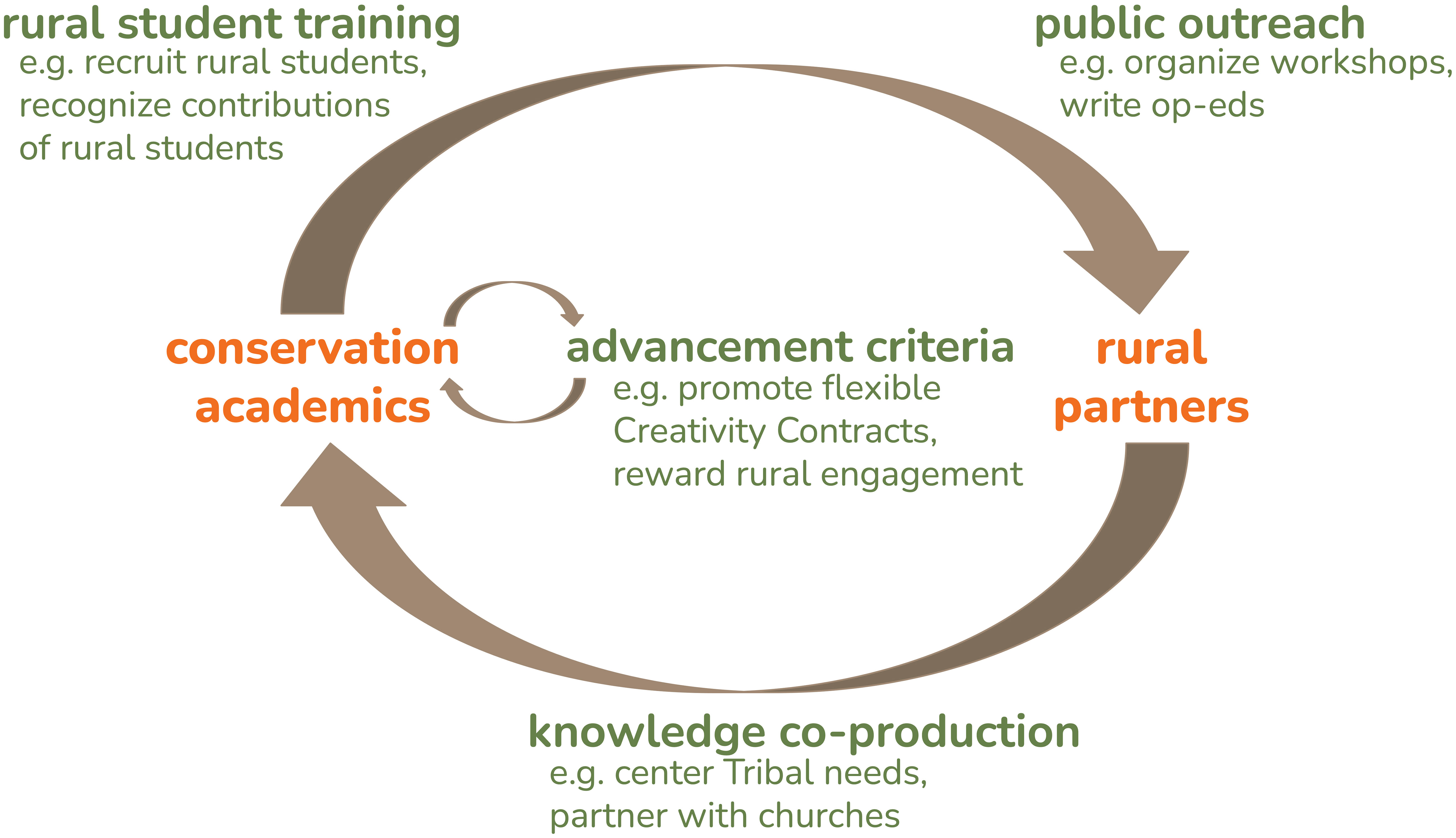
Figure 1 Potential pathways for greater inclusion of Rural America in academic conservation science: emphasizing knowledge co-production and partnerships that resonate with rural lifestyles and values, recruiting and training rural students in conservation science degree programs, and reshaping academic advancement criteria to promote rural engagement (e.g. public outreach).
Collaborations between academics and local communities provide opportunities for researchers to learn about the priorities of rural communities while supporting local initiatives and leadership (Smith et al., 2009; Rodrigues and Shepherd, 2022). Rural stakeholders are important partners who tend to bear disproportionate burdens on the front lines of environmental issues, such as climate change-related natural disasters (Lal et al., 2011) and large carnivore reintroductions (McInturff et al., 2021). Rural community members are also critically important stewards of U.S. landscapes, as Tribal representatives, farmers, ranchers, hunters, and conservation managers. Over time, academic-rural partnerships may extend beyond pragmatic partnerships to reform the value orientations, skills, and knowledge sets of all parties. Moreover, environmental policy ideas that incorporate local values and livelihoods can find support among rural stakeholders (Diamond et al., 2021). Other possible avenues for renewed academic-public partnerships could include building trust with religious communities, something for which religious scientists are well-positioned (Hanes, 2014). As part of this effort, thoughtful alignment of climate communication with religious language and values can help foster a bipartisan agenda (Wardekker et al., 2009).
3 Recruiting and training rural students in conservation science degree programs
Recruiting rural students is a promising pathway for strengthened relationships between rural and university communities (Figure 1). Rural students are not as likely as non-rural students to attend college, selective schools, and universities that confer graduate degrees (Koricich et al., 2018). More intentional recruitment of rural students could broaden conservation engagement at the undergraduate, graduate, and faculty levels. In so doing, rural students could gain access to opportunities and resources in academic conservation that may not otherwise be accessible to them (Davis et al., 2020a).
Greater inclusion of rural students in graduate and undergraduate conservation programs could offer several benefits for advancing conservation. First, rural students could help create new links between conservation and local issues in rural communities, e.g., agricultural interests. Moreover, rural students could be new messengers for climate policies in their communities, situating climate science within socio-culturally contextualized ethics that can help inspire lasting support for conservation issues (Van Houtan, 2006). Rural voters often have sophisticated environmental views, but may disagree with some environmental policies due to low trust of the federal government (Bonnie et al., 2020) or an absence of place-based values relevant to their lives and livelihoods (Yung et al., 2003; O’Neill et al., 2007). Additionally, academic engagement with rural stakeholders, which could be facilitated or accelerated with greater inclusion of rural students, can help undergraduate and graduate students confront assumptions and expand ways of knowing in the scientific process, e.g. by working with rural Indigenous communities (Mulrennan et al., 2012). Rural students, then, could be a critical link between academic and rural communities, helping build trust, increasing attention to local issues, embodying rural values, and communicating conservation science in locally relevant ways.
4 Reshaping academic advancement criteria to promote rural engagement
Another major step forward for academic-rural ties would be a reorientation of the incentive structures and norms of academia to more fully include and value public engagement (Alperin et al., 2019). To help the academic conservation science community be more available for creative forms of public engagement, the value of service could be grounded in tangible structures and incentives, especially through greater weight in academic advancement review processes (Figure 1).
A new faculty model in service of these goals will see increased effectiveness when it reframes the standards of scholarship and advancement. For example, Creativity Contracts are an approach to help encourage faculty pursuit of a wider variety of academic activities through custom-designed, malleable roles (Boyer, 1990). One study showed that 75% of governing boards, 70% of Deans, 67% of provosts, 71% of full-time non-tenure track faculty, and 50% of tenure-track faculty found this idea attractive (Kezar et al., 2015). Through Creativity Contracts, participation at a rural stakeholder workshop could carry similar weight as a presentation at an academic conference. Outreach efforts, rather than being devalued, could hold weight in evaluation and advancement (Schell et al., 2020). To help bring about this change, increased institutional support could help align the importance of outreach with tangible practice (Doberneck, 2016; Rose et al., 2020). Indeed, some universities—including some land-grant institutions—have strayed from earlier roles as reliable partners for local stakeholders such as farmers and union workers (Jamieson, 2020). While this important work continues through extension offices, NGOs, government agencies, and individual academics, academia as a whole could more fully embrace its public outreach imperative (Kezar, 2018).
What can outreach by conservation academics to rural publics look like, and why is it important? A few ideas, some of which we have implemented ourselves, include workshops, public lectures and town halls, novel conference structures, op-eds in newspapers, podcasts, museum exhibits, collaborations with religious groups, participation on local or regional boards, and art shows. Experiential engagement and demonstration of conservation actions has been shown to help achieve conservation project outcomes, according to rural and urban respondents (Stern et al., 2017). Moreover, rural engagement by academics specifically is integral to pursuing ethical research in rural areas on topics that may intersect with rural cultures, identities, and values (e.g. Adams et al., 2014). Academic-rural engagement also helps include stakeholder perspectives and needs in research design (e.g. Volski et al., 2021), fulfilling responsibilities of universities to local stakeholders. Furthermore, academic-rural partnerships could help reconceptualize and reframe discussions about conservation in the literature through inclusion of Indigenous thinking (e.g. Hessami et al., 2021; Martinez et al., 2023) and other rural values (e.g. Bonnie et al., 2020; Diamond et al., 2021). Additionally, there is a growing track record of projects by academics and rural communities, illustrating the effectiveness of these partnerships for social-ecological sustainability (e.g. Mulrennan et al., 2012; Volski et al., 2021). These types of collaborations could also include partnerships with government agencies, NGOs, or others (e.g. Western Landowners Alliance, 2023). For example, academics studying threatened species could partner on field studies with stakeholders enrolled in the Partners for Fish and Wildlife program, through which the U.S. Fish & Wildlife Service helps a range of landholders to restore wildlife habitat (U.S. Fish & Wildlife Service, 2023). Despite these numerous benefits, language on public engagement can vary widely in academic advancement policies (Doberneck, 2016).
At present, the conventions of our discipline can be self-defeating and pull us away from the very constituents we seek to serve, learn from, and engage. As criteria by which academic careers are judged, advancement standards serve a powerful role in reflecting priorities and values in conservation science.
5 Discussion
As part of the movement for advancing diversity, equity, inclusion and justice, academic conservation science is seeking to increase accessibility for underrepresented groups. However, DEIJ efforts in academia have, by and large, not prioritized rurality, despite evidence of barriers to rural individuals in STEM (O’Neal and Perkins, 2021; Morgan et al., 2022). Alongside concerns about rural representation, ongoing conservation challenges—including 30x30, state and federal climate policy, and renewable energy—need fresh approaches and ideas from constituents of different backgrounds and geographies. As part of a 'boundary science' (Cook et al., 2013), conservation academics could leverage these new perspectives to help promote conservation science and decision-making that benefits Rural America. We suggest that greater inclusivity of Rural America in academic conservation science would advance justice goals, broaden perspectives, and support pragmatic opportunities for conservation.
As conservation scientists in academia, we have a powerful opportunity to build bridges between rural communities and academia in the United States. Most of the U.S. public wants action on the environment (Pew Research Center, 2016), including climate change (Pew Research Center, 2020), and rural communities are important stakeholders in conservation solutions. However, some rural constituents feel a sense of exclusion from environmental decision making, showing that we can do more to build solutions that emphasize shared values (Bonnie et al., 2020; Diamond et al., 2021). Through co-producing knowledge, training rural students in conservation science programs, and increasing the flexibility of academic advancement standards, conservation academics can help promote justice and inclusion for rural communities and enrich conservation partnerships.
Author contributions
DK, MC, CW, LW, and JB contributed to early discussions that helped shape the paper. All authors contributed ideas and insights that strengthened the paper. All authors contributed to the article and approved the submitted version.
Funding
The authors acknowledge the following funding sources who helped support the research: the SJ Hall Fellowship, the Hannah M. and Frank Schwabacher Memorial Scholarship Fund, the Howard William Siggins Fellowship, Boston College, The Mustard Seed Foundation, the National Science Foundation Graduate Research Fellowship, the Philomathia Graduate Student Fellowship in the Environmental Sciences, the Thomas McKenna Meredith ‘48 Postdoctoral Fellowship in Environmental Science at Trinity College, and the UC Berkeley Rausser College of Natural Resources. CW was supported by a Schmidt Science Fellowship, in partnership with the Rhodes Trust.
Acknowledgments
Thank you to Claire Kremen for encouraging an early version of this work and to Matthew Potts for supporting ideas connected to this work. Thank you to the Brashares Group for comments on an early version of this work. Thank you to Matthew Williamson, Mark Schwartz, and two reviewers for helping improve an earlier version of this piece. The authors thank David Fulton and Fikirte Gebresenbet for comments that helped improve the manuscript, and Raquel De La Cruz Modino for editorial oversight. Thank you to Evelyne St-Louis for assistance with the figure and for support for this work. Thank you to Peter J. Kurz and Corriene Kurz for their support. Parts of this article were previously included in a preprint, accessible at https://ecoevorxiv.org/repository/view/4255/.
Conflict of interest
The authors declare that the research was conducted in the absence of any commercial or financial relationships that could be construed as a potential conflict of interest.
Publisher’s note
All claims expressed in this article are solely those of the authors and do not necessarily represent those of their affiliated organizations, or those of the publisher, the editors and the reviewers. Any product that may be evaluated in this article, or claim that may be made by its manufacturer, is not guaranteed or endorsed by the publisher.
References
Adams M. S., Carpenter J., Housty J. A., Neasloss D., Paquet P. C., Service C., et al. (2014). Toward increased engagement between academic and indigenous community partners in ecological research. Ecol. Soc 19, 5. doi: 10.5751/ES-06569-190305
Alperin J. P., Nieves C. M., Schimanski L. A., Fischman G. E., Niles M. T., McKiernan E. C. (2019). Meta-Research. How significant are the public dimensions of faculty work in review, promotion and tenure documents? eLife 8, e42254. doi: 10.7554/eLife.42254
Bennett K. J., Borders T. F., Holmes G. M., Kozhimannil K. B., Ziller E. (2019). What is rural? Challenges and implications of definitions that inadequately encompass rural people and places. Health Aff. 38, 1985–1992. doi: 10.1377/hlthaff.2019.00910
Bennett N. J., Roth R., Klain S. C., Chan K. M. A., Clark D. A., Cullman G., et al. (2016). Mainstreaming the social sciences in conservation. Conserv. Biol. 31, 56–66. doi: 10.1111/cobi.12788
Bonnie R., Diamond E. P., Rowe E. (2020) Understanding rural attitudes toward the environment and conservation in America. Nicholas Institute for Environmental Policy Solutions. Available at: https://nicholasinstitute.duke.edu/sites/default/files/publications/understanding-rural-attitudes-toward-environment-conservation-america.pdf.
Boyer E. L. (1990). Scholarship reconsidered: priorities of the professoriate (Lawrenceville: Princeton University Press).
Bray L. A. (2020). Settler colonialism and rural environmental injustice: water inequality on the Navajo nation. Rural Sociol. 86, 586–610. doi: 10.1111/ruso.12366
Burdick-Will J., Logan J. R. (2017). Schools at the rural-urban boundary: blurring the divide? An. Am. Acad. Pol. Soc Sci. 672, 185–201. doi: 10.1177/0002716217707176
Cook C. N., Mascia M. B., Schwartz M. W., Possingham H. P., Fuller R. A. (2013). Achieving conservation science that bridges the knowledge - action boundary. Conserv. Biol. 27, 669–678. doi: 10.1111/cobi.12050
Cronin M. R., Alonzo S. H., Adamczak S. K., Baker D. N., Beltran R. S., Borker A. L., et al. (2021). Anti-racist interventions to transform ecology, evolution, and conservation biology departments. Nat. Ecol. Evol. 5, 1213–1223. doi: 10.1038/s41559-021-01522-z
Davis J. L., Ford D. Y., Moore J. L. III, Floyd E. F. (2020a). Black and gifted in Rural America: barriers and facilitators to accessing gifts and talented education programs. TPRE 10, 85–100. doi: 10.3776/tpre.2002.v10n2p85-100
Davis J. L., Ford D. Y., Moore J. L., Floyd E. F. (2020b). “Black, gifted and living in the ‘country’: searching for equity and excellence in rural gifted education programs,” in African-American rural education: college transitions and postsecondary experiences. Eds. Cambers C. R., Crumb L. (Bingley, UK: Emerald Publishing), 39–52.
Diamond E. P., Bonnie R., Rowe E. (2021) Rural attitudes on climate change. Nicholas Institute for Environmental Policy Solutions and The University of Rhode Island [Report]. Available at: https://nicholasinstitute.duke.edu/sites/default/files/publications/Rural-Attitudes-on-Climate-Change-Midwest_1.pdf.
Doberneck D. M. (2016). Are we there yet?: Outreach and engagement in the consortium for institutional cooperation promotion and tenure policies. JCES 9, 8–18. doi: 10.54656/RNQD4308
Eisenberg A. M., Warner E. K. (2021). The precipice of justice: equity, energy, and the environment in Indian Country and rural communities. Energy Law J. 42, 281–298. Available at: https://heinonline.org/HOL/P?h=hein.journals/energy42&i=359.
Gabe T. M., Colby K., Bell K. P. (2007). Creative occupations, county-level earnings and the U.S. rural-urban wage gap. CJRS 3, 393–410. Available at: https://idjs.ca/images/rcsr/archives/V30N3-GABE.pdf.
Gates H. L. (2011). Life upon these shores: looking at African American history, 1513-2008 (New York: Alfred A. Knopf).
Gilio-Whitaker D. (2019). As long as grass grows: the Indigenous fight for environmental justice (Boston: Beacon Press).
Gould R. K., Phukan I., Mendoza M. E., Ardoin N. M., Panikkar B. (2017). Seizing opportunities to diversify conservation. Conserv. Lett. 11, e12431. doi: 10.1111/conl.12431
Hanes J. M. (2014). Science and religion: think local. Science 346, 309. doi: 10.1126/science.346.6207.309
Hartley D. (2004). Rural health disparities, population health, and rural culture. Am. J. Public Health 94, 1675–1678. doi: 10.2105/AJPH.94.10.1675
Hessami M. A., Bowles E., Popp J. N., Ford A. T. (2021). Indigenizing the north american model of wildlife conservation. FACETS 6, 1285–1306. doi: 10.1139/facets-2020-0088
Huntington H. P. (2021). What do land acknowledgments acknowledge? Environ.: Sci. Policy Sustain. Dev. 63, 31–35. doi: 10.1080/00139157.2021.1924579
Jamieson K. H. (2020). Reconceptualizing public engagement by land-grant university scientists. PNAS 117, 2734–2736. doi: 10.1073/pnas.1922395117
Johnson C. Y. (1998). A consideration of collective memory in African American attachment to wildland recreation places. Hum. Ecol. Rev. 5, 5–15. Available at: https://www.jstor.org/stable/247071.
Kezar A. (2018). A new vision for the professoriate. Change: Magazine Higher Learn. 50, 84–87. doi: 10.1080/00091383.2018.1509616
Kezar A., Maxey D., Holcombe E. (2015) The professoriate reconsidered. University of southern california [Report]. Available at: https://pullias.usc.edu/wp-content/uploads/2015/10/Professoriate-Reconsidered-final.pdf.
Koricich A., Chen X., Hughes R. P. (2018). Understanding the effects of rurality and socioeconomic status on college attendance and institutional choice in the United States. Rev. High. Ed. 41, 281–305. doi: 10.1353/rhe.2018.0004
Lal P., Alavalapati J. R. R., Mercer E. D. (2011). Socio-economic impacts of climate change on rural United States. Mitig. Adapt. Strateg. Glob. Change 16, 819–844. doi: 10.1007/s11027-011-9295-9
Madley B. (2017). An american genocide: the United States and the californian Indian catastrophe 1846-1873 (New Haven: Yale University Press).
Martinez D. J., Cannon C. E. B., McInturff A., Alagona P. S., Pellow D. N. (2023). Back to the future: Indigenous relationality, kincentricity and the North American Model of wildlife management. Environ. Sci. Policy 140, 202–207. doi: 10.1016/j.envsci.2022.12.010
McInturff A., Cannon C. E. B., Alagona P. S., Pellow D. N. (2021). Meeting at the crossroads: an environmental justice framework for large carnivore reintroductions and recoveries. Elementa 9, 172. doi: 10.1525/elementa.2020.00172
Meltz R. (1994). Where the wild things are: the Endangered Species Act and private property. Endangered Species Act at Twenty-One: ESA & Private Property. Envtl. L. 24, 369–418. Available at: https://heinonline.org/HOL/P?h=hein.journals/envlnw24&i=397.
Merchant C. (2003). Shades of darkness: race and environmental history. Environ. Hist. 8, 380–394. doi: 10.2307/3986200
Messick J. A., Serenari C., Rubino E. C. (2021). Determinants of private landowner participation in endangered species conservation: a comprehensive review and analytical framework. Soc Nat. Resour. 34, 980–998. doi: 10.1080/08941920.2020.1865495
Mishra C., Young J. C., Fiechter M., Rutherford B., Redpath S. M. (2017). Building partnerships with communities for biodiversity conservation: lessons from Asian mountains. J. Appl. Ecol. 54, 1583–1591. doi: 10.1111/1365-2664.12918
Morgan A. C., LaBerge N., Larremore D. B., Galesic M., Brand J. E., Clauset A. (2022). Socioeconomic roots of academic faculty. Nat. Hum. Behav. 6, 1625–1633. doi: 10.1038/s41562-022-01425-4
Mulrennan M. E., Mark R., Scott C. H. (2012). Revamping community-based conservation through participatory research. Can. Geogr. 56, 243–259. doi: 10.1111/j.1541-0064.2012.00415.x
Niemiec R., Berl R. E. W., Gonzalez M., Teel T., Salerno J., Breck S., et al. (2022). Rapid changes in public perception toward a conservation initiative. Conserv. Sci. Pract. 4, e12632. doi: 10.1111/csp2.12632
O’Neal L., Perkins A. (2021). Rural exclusion from science and academia. Trends Microbiol. 29, 953–955. doi: 10.1016/j.tim.2021.06.012
Paulus P. B., van der Zee K. I., Kenworthy J. (2017). “Cultural diversity and team creativity,” in The palgrave handbook of creativity and culture research. Ed. Glăveanu V. P. (London: Springer Nature).
Pew Research Center (2016) Most Americans favor stricter environmental laws and regulations [Poll]. Available at: https://www.pewresearch.org/short-reads/2016/12/14/most-americans-favor-stricter-environmental-laws-and-regulations/.
Pew Research Center (2020) Two-thirds of Americans think government should do more on climate. Available at: https://www.pewresearch.org/science/2020/06/23/two-thirds-of-americans-think-government-should-do-more-on-climate/.
Robbins P. (2006). The politics of barstool biology: environmental knowledge and power in greater Northern Yellowstone. Geoforum 37, 185–199. doi: 10.1016/j.geoforum.2004.11.011
Rodrigues R. R., Shepherd T. G. (2022). Small is beautiful: climate-change science as if people mattered. PNAS Nexus 1, 1–9. doi: 10.1093/pnasnexus/pgac009
Rose K. M., Markowitz E. M., Brossard D. (2020). Scientists’ incentives and attitudes toward public communication. PNAS 117, 1274–1276. doi: 10.1073/pnas.1916740117
Roux D. J., Rogers K. H., Biggs H. C., Ashton P. J., Sergeant A. (2006). Bridging the science-management divide: moving from unidirectional knowledge transfer to knowledge interfacing and sharing. Ecol. Soc 11, 4. Available at: https://www.jstor.org/stable/26267817.
Rudd L. F., Allred S., Ross J. G. B., Hare D., Nkomo M. N., Shanker K., et al. (2021). Overcoming racism in the twin spheres of conservation science and practice. Proc. R. Soc B 288, 1962. doi: 10.1098/rspb.2021.1871
Russell K. J., Hossfield L., Rico Mendez G. (2021). “Not a new pattern”: Black farmers’ perspectives on barriers to participating in federal farm programs. JAFSCD 10, 195–209. doi: 10.5304/jafscd.2021
Schell C. J., Guy C., Shelton D. S., Campbell-Staton S. C., Sealey B. A., Lee D. N., et al. (2020). Recreating Wakanda by promoting Black excellence in ecology and evolution. Nat. Ecol. Evol. 4, 1285–1287. doi: 10.1038/s41559-020-1266-7
Smith R. J., Veríssimo D., Leader-Williams N., Cowling R. M., Knight A. T. (2009). Let the locals lead. Nature 462, 280–281. doi: 10.1038/462280a
Stern M. J., Ardoin N. M., Powell R. B. (2017). Exploring the effectiveness of outreach strategies in conservation projects: the case of the Audubon Toyota TogetherGreen Program. Soc Nat. Resour. 30, 95–111. doi: 10.1080/08941920.2016.1164266
Trisos C. H., Auerbach J., Katti M. (2021). Decoloniality and anti-oppressive practices for a more ethical ecology. Nat. Ecol. Evol. 5, 1205–1212. doi: 10.1038/s41559-021-01460-w
U.S. Department of Agriculture (2013) 2013 rural-urban continuum codes. Available at: https://www.ers.usda.gov/data-products/rural-urban-continuum-codes/documentation/.
US Department of Agriculture Natural Resources Conservation Service (2023) Programs & Initiatives. Available at: https://www.nrcs.usda.gov/programs-initiatives.
U.S. Fish & Wildlife Service (2023) Partners for fish & Wildlife. Available at: https://www.fws.gov/program/partners-fish-and-wildlife.
Van Houtan K. S. (2006). Conservation as virtue: a scientific and social process for conservation ethics. Conserv. Biol. 20, 1367–1372. doi: 10.1111/j.1523-1739.2006.00447.x
Veríssimo D., Pienkowski T., Arias M., Cugnière L., Doughty H., Hazenbosch M., et al. (2020). Ethical publishing in biodiversity conservation science. Conserv. Soc 18, 220–225. doi: 10.4103/cs.cs_19_56
Volski L., McInturff A., Gaynor K. M., Yovovich V., Brashares J. S. (2021). Social effectiveness and human-wildlife conflict: linking the ecological effectiveness and social acceptability of livestock protection tools. Front. Conserv. Sci. 2. doi: 10.3389/fcosc.2021.682210
Wardekker J. A., Petersen A. C., van der Sluijs J. P. (2009). Ethics and public perception of climate change: exploring the Christian voices in the US public debate. Global Environ. Change 19, 512–521. doi: 10.1016/j.gloenvcha.2009.07.008
Western Landowners Alliance (2023) Western landowners alliance. Available at: https://westernlandowners.org/.
Wilmer H., Meadow A. M., Brymer A. B., Carroll S. R., Ferguson D. B., Garba I., et al. (2021). Expanded ethical principles for research partnership and transdisciplinary natural resource management science. Environ. Manage. 68, 453–467. doi: 10.1007/s00267-021-01508-4
Keywords: advancement criteria, community engagement, DEIJ, diversity, local stakeholders, public outreach, rural partnerships, rural-urban divide
Citation: Kurz DJ, Middleton AD, Chapman M, Huber BR, McInturff A, Sorgen J, Van Houtan KS, Wilkinson CE, Withey L and Brashares JS (2023) Including Rural America in academic conservation science. Front. Conserv. Sci. 4:1227227. doi: 10.3389/fcosc.2023.1227227
Received: 22 May 2023; Accepted: 05 September 2023;
Published: 20 October 2023.
Edited by:
Raquel De La Cruz Modino, University of La Laguna, SpainReviewed by:
Fikirte Gebresenbet, University of New Hampshire, United StatesCopyright © 2023 Kurz, Middleton, Chapman, Huber, McInturff, Sorgen, Van Houtan, Wilkinson, Withey and Brashares. This is an open-access article distributed under the terms of the Creative Commons Attribution License (CC BY). The use, distribution or reproduction in other forums is permitted, provided the original author(s) and the copyright owner(s) are credited and that the original publication in this journal is cited, in accordance with accepted academic practice. No use, distribution or reproduction is permitted which does not comply with these terms.
*Correspondence: David J. Kurz, ZGF2aWQua3VyekBiZXJrZWxleS5lZHU=