 Lynn Rannankari
 Rianna Burnham
 David Duffus
- Whale Research Lab, Department of Geography, University of Victoria, Victoria, BC, Canada
Pacific fin whales (Balaenoptera physalus velifera), once the most abundant cetacean species in British Columbia (BC), were also one of the most heavily targeted by commercial whaling. Much of what we know about their phenology and ecology is from catch records, but their current status has not yet been summarized in Canadian waters. Here, we collated evidence from dedicated surveys, opportunistic sightings, and passive acoustic records that had not been reported before and reviewed them in the context of past data. This was to add new findings to what is known, and to establish if the population was showing signs of recovery. This is particularly relevant considering discussions of downlisting their population status in Canada from endangered to threatened. We then asked if this rebounding was consistent with what is known about pre-whaling presence and movement patterns, or if changes in whale distribution reflected altered oceanic regimes, prey availability, or increased anthropogenic pressures. The evidence suggested that fin whale populations in the northeast Pacific Ocean are repopulating areas along the BC coast recognized as part of their historic range. However, they are recovering in a different ocean than they were removed from, which makes them increasingly vulnerable to new anthropogenic threats. The sightings data suggested that, at least for the west coast of Vancouver Island, this repopulation has occurred over a relatively short period, with fin whales still absent from regular surveys as recent as the early 2000’s. The recent acoustic recordings suggested their presence is not transitory, but that fin whales may be using locales along the BC coast for feeding and breeding activities.
1 Introduction
Large-scale industrial whaling ended in the Canadian northeast Pacific Ocean in 1967, but not before decimating cetacean populations. Once the most abundant species in this area, Pacific fin whales (Balaenoptera physalus velifera) became the most heavily hunted (Pike and MacAskie, 1969). Catch records show that more than 7,000 fin whales were killed in less than 60 years (1908–1967), more than any other species for the five whaling stations in British Columbia (BC) (Figure 1) for that period (Gregr, 2000; Nichol et al., 2002).
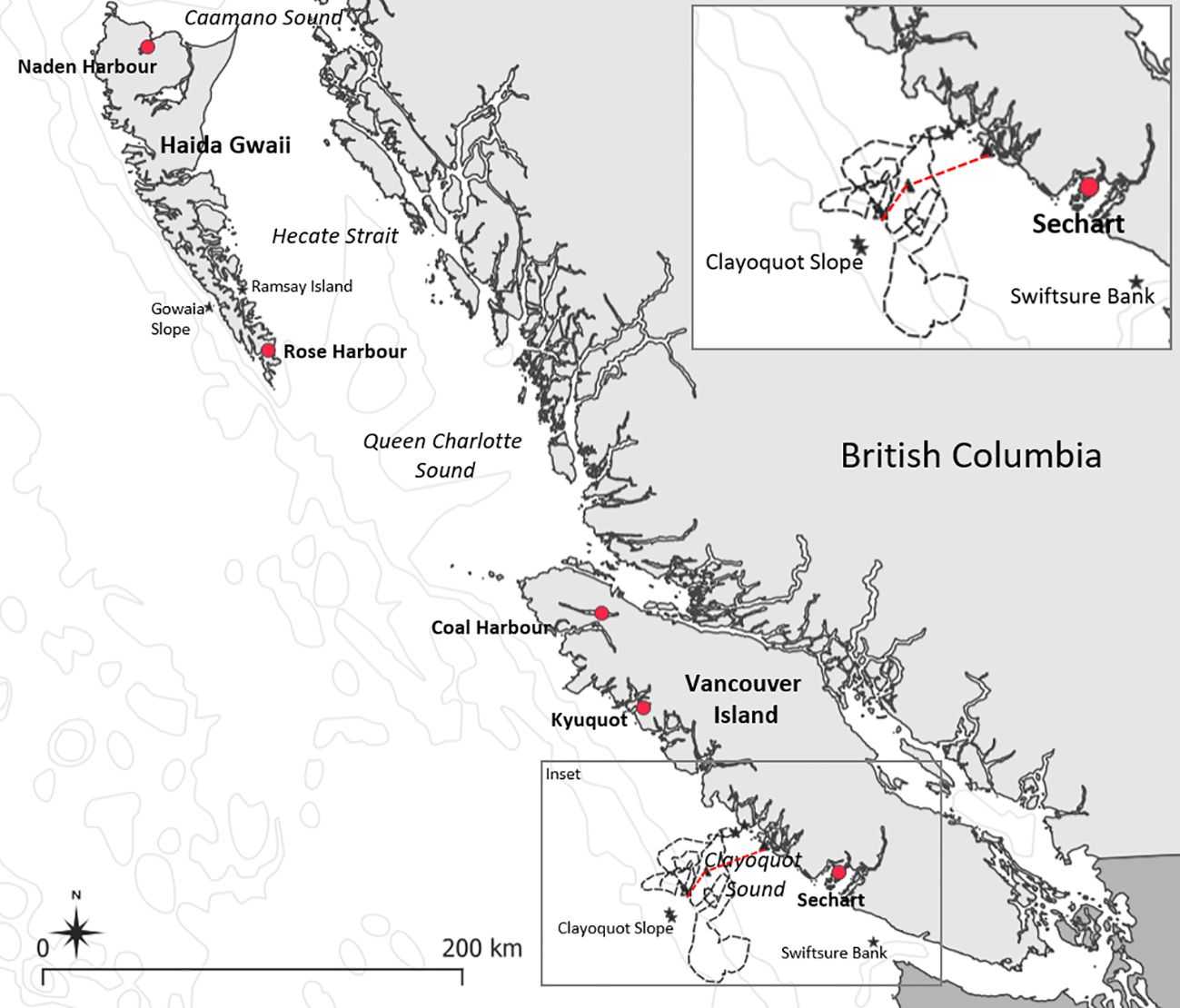
Figure 1. Map of the British Columbia coast. The five whaling stations are indicated with red circles (Naden, Rose and Coal Harbor, Kyuquot, and Sechart). The location of passive acoustic monitoring (PAM) systems discussed are shown with black stars (Gowgaia Slope and Ramsay Island (Frouin-Mouy et al., 2022); Clayoquot Slope, Clayoquot Sound, and Swiftsure Bank (Burnham, 2019). The track of mobile PAM systems is shown with black dashed lines and the bi-monthly pelagic survey off the west coast of Vancouver Island is shown with red dotted line, with starting, shelf crossing, and end locations marked by a black triangle. This is shown in greater detail in the inset.
Here, we combine insights from previously unpublished data with the existing literature from studies and catch records from along the BC coast to consider the potential recovery of fin whales since the cessation of whaling. For context from their full geographic range, data from Alaska to California was examined. Recent visual surveys and passive acoustic monitoring (PAM) data are compared as new evidence of whale presence to whaling records and works from that period to consider if the current patterns of presence and habitat use indicate a population recovery into areas where fin whales once prevailed, or if the extent of population growth and/or dynamic environmental variables have initiated a range expansion. We question whether the consistent down-listing of fin whales under the Species at Risk Act (SARA) is warranted given the evidence. Fin whale presence along the BC coast forms the foundation of this assessment, while behavioral context will be considered where possible to ascertain spatiotemporal trends.
2 Whaling
Four whaling stations operated in BC between 1905 and 1943 during the first era of whaling. These stations were located on the west coast of Vancouver Island at Sechart and Kyuquot, and on Haida Gwaii in Rose and Naden Harbors. After World War II, during the second era of whaling, a fifth station opened in Coal Harbor on northern Vancouver Island, becoming one of the most prolific stations and one of the last operational shore-based stations in North America (Figure 1).
The industry in BC targeted five whale species: blue (Balaenoptera musculus), fin, humpback (Megaptera novaeangliae), sei (B. borealis) and sperm (Physeter macrocephalus) whales. Occasionally, north Pacific right (Eubalaena glacialis), Baird’s beaked (Berardius bairdii), gray (Eschrichtius robustus) and minke (Balaenoptera acutorostrata) whales were also noted in the records (Nichol and Ford, 2018). A total of 24,427 whales were logged into catch records, of which 7,497 were fin whales (Gregr, 2000; Ford, 2014; Nichol and Ford, 2018). Despite the closure of Canadian whaling stations, between 1964 and 1974, a further 201 fin whales were taken in the Pacific by Japanese whalers, with additional removals by Soviet whalers in the offshore waters, both of which are believed to have under-reported or falsified records (Ford, 2014).
Despite overharvesting being evident in the early years of whaling, the BC industry increased production; limits on chaser boats per station were abandoned and whale processing became a 24-hour operation at the shore stations (Nichol and Ford, 2018). Initially spared from the hunt on account of their speed, strength, and use of offshore habitat, fin whales became a target species for the cull. Their predictable presence in waters close enough to shore was not great enough to warrant a stronger focus until the numbers of blue and right whales had dwindled (Drucker, 1951; Monks et al., 2001; Ford, 2014). Catch numbers of fin whales steadily decreased from a peak in 1911–1912, although they still formed a substantial part of the catch. The focus on fin whales was even greater in the second era of whaling (Gregr, 2000; Nichol and Ford, 2018). During this period fin whale catch peaked in 1958 with 573 animals, followed by another dramatic fall in catch (Gregr, 2000). The overall proportion of fin whales caught from BC waters was similar to that reported for Alaskan stations (Gregr, 2000), and a similar switch of target species was noted in whaling records for California (Clapham et al., 1997). Bonuses were paid based on the length of the whale, encouraging the take of more mature individuals. However, the take in this second era for fin whales was from a population that had already been exploited, which had altered the age and size structure. The minimum catch length for fin whales was set at less than the known average length at maturity and was lesser than that imposed for humpback and sei whales, typically smaller species (Flinn et al., 2002).
Much of what is known about fin whale ecology and habitat use has been derived from historical catch and commercial whaling records that provide details over large spatial and temporal scales. Catch dates, location, sex, length, and a variety of measures related to diet, reproductive status, and morphology were taken (Nichol and Ford, 2018). This adds to our understanding of trends on sex ratios, body lengths at maturity, pregnancy rates, and population structure. These details, along with notations of catch and whaling efforts (Pike, 1968; Gregr, 2000; Gregr et al., 2000) can be used to better understand the impacts of removals on fin whale populations.
3 Contemporary data
3.1 Visual data
Several dedicated, systematic surveys have been undertaken in BC, which aid in establishing fin whale presence, habitat use, and population abundance. However, much of the effort has been focused on the continental shelf. Vessel-based line transect surveys have estimated the fin whale population. The use of photo-identification mark-recapture methods from a dedicated research vessel helps to better estimate the number of individuals observed. However, again, much of this work to date has been limited to continental shelf waters and estimates the total population, rather than sexually mature adults. Aerial and vessel-based surveys in deeper waters have shown greater density of fin whales for the survey effort expended in areas west of Vancouver Island and Haida Gwaii, for example (Harvey et al., 2017; Figure 1), indicating there is still much to learn about fin whale presence in the offshore areas. A three-month vessel-based survey in the summer of 2018 into offshore waters extended to the limits of Canada’s Exclusive Economic Zone (EEZ), including over 350,000 km2 of survey area in offshore waters (Pacific region International Survey of Marine Megafauna (PRISMM), Wright et al., 2021) started to address the lack of data.
Additional data comes from smaller-scale vessel-based surveys. An example is from surveys undertaken between 1993 and 2007 on the west coast of Vancouver Island by a citizen science group, the Strawberry Island Marine Research and Education Society (SIMRS, Figure 1). The results of these surveys have not been previously published and were not designed to target fin whale populations specifically. The transect began at a near-shore location north of Tofino (49.1362°N, −125.9751°W) and extended to an end point 35 nm offshore (48.8450°N, −126.7192°W); 24 nm of this survey were over the continental shelf, then crossed the shelf break (48.9667°N, −126.5267°W) to continue into abyssal waters (Figure 1). This survey line crossed several bathymetric features including submarine canyons west of Clayoquot Sound. These surveys, despite noting the presence of eleven cetacean species, highlighted the absence of fin whales at that time.
Data collated from aerial or vessel-based surveys and platforms of opportunity adds to evidence of fin whale habitat use as they recover from whaling. Opportunistic data collated for the BC coast by the British Columbia Cetacean Sighting Network (BCCSN) was used to look for changes in presence in time and space, and to set the SIMRS Vancouver Island surveys in a coast-wide context. For the period of the SIMRS pelagic surveys, the total reported sightings for fin whales in the 1990’s was five, three of which were before the surveys started in 1991–1992. No sightings were reported between 2000–2009, consistent with the survey results (Figure 2). Although not effort-corrected and all observations being opportunistic, the coast-wide sighting data suggests an increasing number of fin whales in BC waters and an expanding spatial range, as represented by the geographical extent the sightings were made (Figure 2).
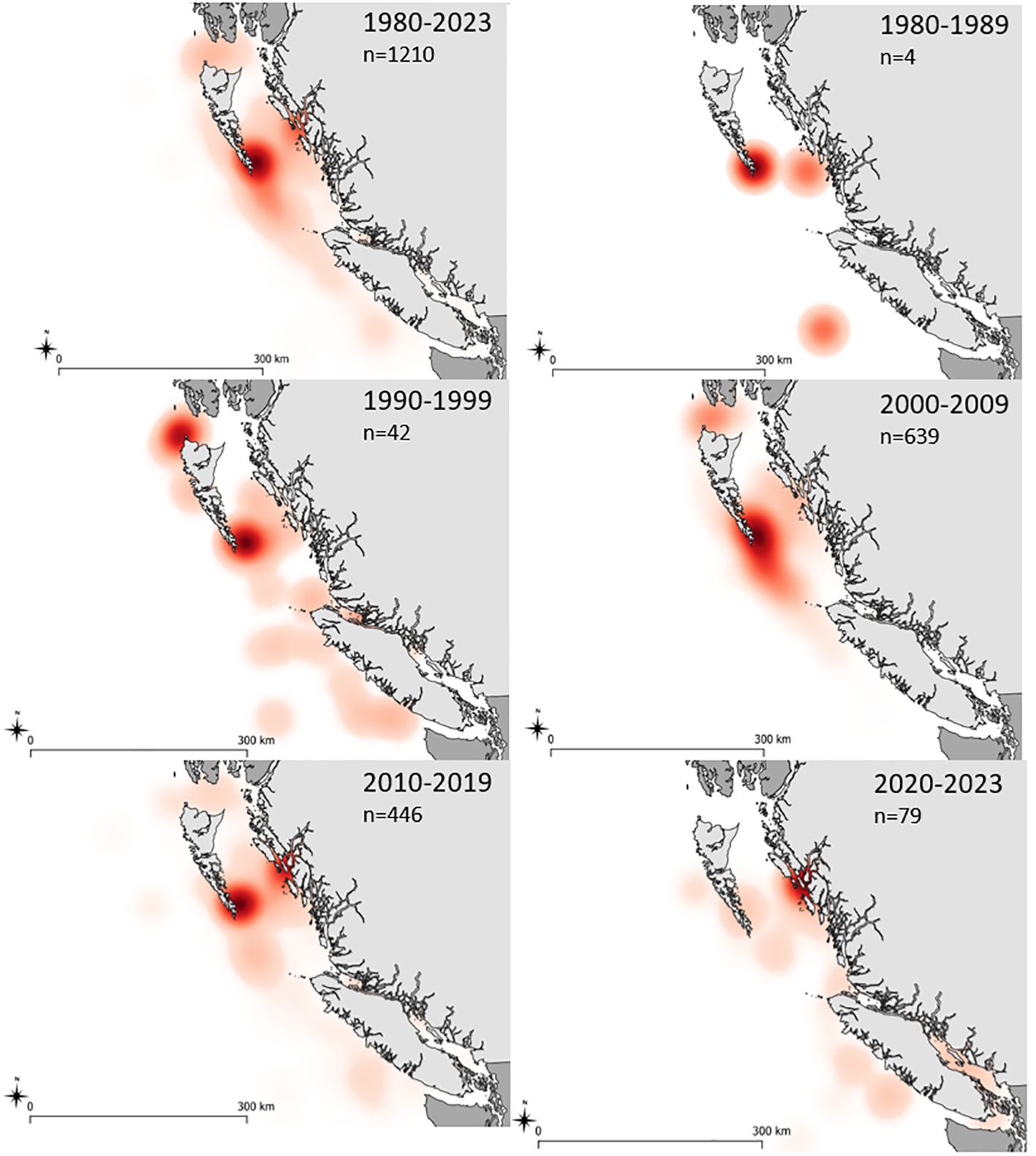
Figure 2. Sightings data of fin whales taken from the British Columbia Cetacean Sightings Network. These are opportunistic sightings, that have not been effort corrected. Heat-spotting allows hot-spots of whale presence through each decade and the full length of data (1980–2023) to be visualized spatially. The number of sightings per decade is also indicated.
3.2 Acoustic records
Data from passive acoustic monitoring (PAM) systems have also added to our knowledge base of fin whale habitat use in BC. Whale calls in the acoustic record indicate presence, but also give an idea of the whales’ behavioral state. The most commonly described fin whale call is the 20-Hz downsweep, used while traveling and socializing (Watkins et al., 1987; McDonald et al., 1995; Edds-Walton, 1997; Sirovic et al., 2013). If 20-Hz calls appear in a regular pattern in the acoustic record, with consistent inter-call intervals, it represents ‘song’ and forms part of the male reproductive display (Watkins et al., 2000; Croll et al., 2002; Sirovic et al., 2013; Koot, 2015; Burnham, 2019). Also noted in the literature is the 40-Hz call, principally used during foraging (Sirovic et al., 2013; Burnham et al., 2021; Romagosa et al., 2021).
Findings from recordings from offshore Vancouver Island by Burnham et al. (2019) were furthered here by considering an extra year of data from a bottom-mounted underwater hydrophone at Clayoquot Canyon [48.6706°N, −126.8485°W; Ocean Networks Canada (ONC) node (oceannetworks.ca); Figure 1]. This analysis was undertaken from July 2018 to July 2019 and considered here as they overlap spatially with the SIMRS vessel surveys. This analysis was a manual aural-visual review of offshore recordings (July 2018–July 2019 at 48.6706°N, −126.8485°W) that systematically analyzed every 5th day. Details from similar recordings from bottom-mounted underwater hydrophones on the eastern and western coasts of Haida Gwaii (Gowgaia Slope and Ramsay Island, Figure 1) were taken from analysis by Frouin-Mouy et al. (2022) to add to the coast-wide picture of whale presence using acoustic means. Using single hydrophone systems, it is not possible to discern the number of whales present or their location. Nor is there a way to absolutely determine the absence of whales when calls were not heard. Therefore, the calls in the acoustic data represents a minimum presence. However, call number, rate, and the presence of numerous coincident calls can all indicate the relative number of whales present, and suggest migration, breeding, and foraging behavior (Koot, 2015; Burnham, 2019; Burnham et al., 2019; Frouin-Mouy et al., 2022).
4 Population abundance and structure
Pre-exploitation estimates suggest that prior to the 1900’s, the north Pacific fin whale population was 40,000–45,000, and was reduced to 13,620–18,680 whales by the end of commercial whaling (Ohsumi and Wada, 1974). Recognition that the northeast Pacific stock was distinct in 1973 also indicated half of the existing population of fin whales were of this stock, numbering 8,520–10,970 whales (Ohsumi and Wada, 1974).
To date, an estimate of population abundance for finwhales in Canadianwaters, especially for offshore regions is lacking where fin whales are presumed to be most numerous (COSEWIC, 2019). Dedicated, systematic surveys have estimated the population in BC to be approximately 400–500 individuals (2004–2005 survey, 496 individuals (95% CI: 202–1218) Williams and Thomas, 2007; 2004–2008 survey, 446 individuals (95% CI: 263–759) Best et al., 2015). Nichol et al. (2018) confirmed this estimate from surveys conducted between 2009 and 2014 (405 individuals (95% CI: 363–469)), complemented using photo-identification to better estimate the number of individuals. These surveys highlighted whale ‘hotspots’ in Hecate Strait, and Queen Charlotte and Caamano Sounds (Harvey et al., 2017; Figure 1). Sightings interpolated using density surface modelling fromthe 2018 PRISMM survey suggested a total abundance of 2,893 (95% CI: 2171 - 3855) fin whales in BC estimated from 235 sightings across two survey strata (Wright et al., 2021). This survey found over six times as many fin whale sightings in the offshore than the north coast stratum and, overall, exceeded earlier abundance estimates (see COSEWIC, 2019).
In the context of their full range along the west coast of North America, surveys conducted in northern California, Oregon, and Washington suggest a 7.5% annual increase in numbers from the mid-1990’s to the mid-2000’s, representing an overall five-fold increase in fin whale population size (Moore and Barlow, 2011; Nadeem et al., 2016). Central and southern California estimates were stable in population estimates during this period (Nadeem et al., 2016). In their northern range extent in Alaska, annual increases were estimated to be 4.8% between 1987 to 2003 (Nadeem et al., 2016). These kinds of population trend estimates have not been possible for fin whales in Canadian waters, given the lack of baseline data especially in offshore regions. Additionally, the logistical challenges of systematically and repeatedly surveying offshore areas exacerbates the difficulty of obtaining population estimates.
5 Habitat use
Whaling catch records provide clues about the distribution, behavior, and prey of fin whales. However, they have an inherent spatial bias; whaling efforts extended approximately 200 nautical miles (nm) offshore from whaling stations (Pike and MacAskie, 1969), but approximately 80% of the catch was within 150 nm. Fin whales were caught in both coastal shelf and offshore waters, with the distance between the coastline and the capture site of whales increasing significantly over the course of the second whaling era (Gregr, 2000). Hunting efforts on the west coast of Vancouver Island and around Haida Gwaii, in Hecate Strait and Queen Charlotte Sound (see Figure 1), were primarily in exposed waters, but occasionally in protected areas along the mainland coast and Queen Charlotte Strait (Pike and MacAskie, 1969; Gregr and Trites, 2001; Ford, 2014). The catch per station along the coast was similar, suggesting approximately equal availability and ease of capture of fin whales. In general, catches increased from spring to summer, and decreased from fall to winter (Gregr, 2000; Nichol et al., 2002, Nichol and Ford, 2018). Male and female catch numbers by search distance were approximately equal, indicating little to no spatial segregation by sex. Their increased proximity to shore and presence in Hecate Strait and Queen Charlotte Sound showed a seasonal pattern, strongest in July and August, which suggests their use of more near shore waters for summer foraging (Pike and MacAskie, 1969; Gregr, 2000). Pregnant females were noted consistently from April until September within reach of the coastal stations (Gregr, 2000). Combined, this suggests that during the whaling period BC waters were important for both reproduction and foraging.
The take of smaller bodied animals, despite the incentive toward larger whales, suggests that the fin whale population may have been segregated spatially by size, with mature animals living further offshore. Analysis of body size data also suggests the existence of a local BC foraging sub-group or sub-population, of generally smaller bodied individuals (Fujino, 1964; Pike and MacAskie, 1969; Flinn et al., 2002). This was in addition to migrating animals, with age structuring in this population movement. Larger bodied fin whales arrived in BC ahead of smaller individuals for the northward migration, and the southward migration was led by pregnant females leaving in September to give birth, resulting in a notable reduction in catch number (Gregr, 2000).
The context of fin whale presence can be enhanced from patterns of prey abundance or oceanographic regimes. Spatial modeling of the catch data shows increased whale abundance with water depth (Nichol et al., 2017) and around bathymetric features (Hui, 1985; Gregr and Trites, 2001), as well as during periods of increased chlorophyll production (Smith et al., 1986), sea surface temperature (Woodley and Gaskin, 1996), and ocean circulation (Waring et al., 1993; Woodley and Gaskin, 1996). All of these speak to the tie between whales and prey abundance (e.g., Woodley and Gaskin, 1996; Fiedler et al., 1998; Gregr, 2000; Gregr et al., 2000; Gregr and Trites, 2001). Fin whale habitat from catch data was predicted to be concentrated along the continental shelf and in a large offshore area encompassing waters up to 100 nm offshore that extended from the south end of Haida Gwaii towards Vancouver Island (Pike and MacAskie, 1969; Gregr, 2000; Gregr and Trites, 2001).
Oceanographic variables dictating prey abundance and aggregation predicts whale presence (Gregr, 2000; Gregr and Trites, 2001). Convergent currents to the north of Vancouver Island, the topography, off-shelf flow, and the formation of Haida eddies, upwell nutrients in these areas and entrain zooplankton (Thomson, 1981; Allen et al., 2001; Nichol and Ford, 2018). The higher proportion of euphausiids in stomach contents from captured fin whales also suggests whales were concentrated on the shelf break and around other bathymetric features (Mackas and Galbraith, 1992). This was distinguished from greater proportions of copepods from fin whales in sub-arctic, Alaskan, and offshore waters (Mackas, 1992).
The opportunistic sighting data must be reviewed with caveats, as results may reflect increased effort, both spatially and temporally. However, similar to the whaling data, there is a spatial bias of limiting search efforts to within reach of shore stations. Consistently, most sightings per decade were reported around Rose Harbor and the southern tip of Haida Gwaii (Figure 2). The appearance of whales in near coastal or inner waterways and fjord systems has been noted by Pilkington et al. (2018) and is also reflected in the BCCSN data showing an increase from four individuals sighted on a single occasion in 1995, to a total of 163 reports from 2010 to 2023 (Figure 2). Considering notations of foraging with the sightings, foraging activity also increased (Figure 3).
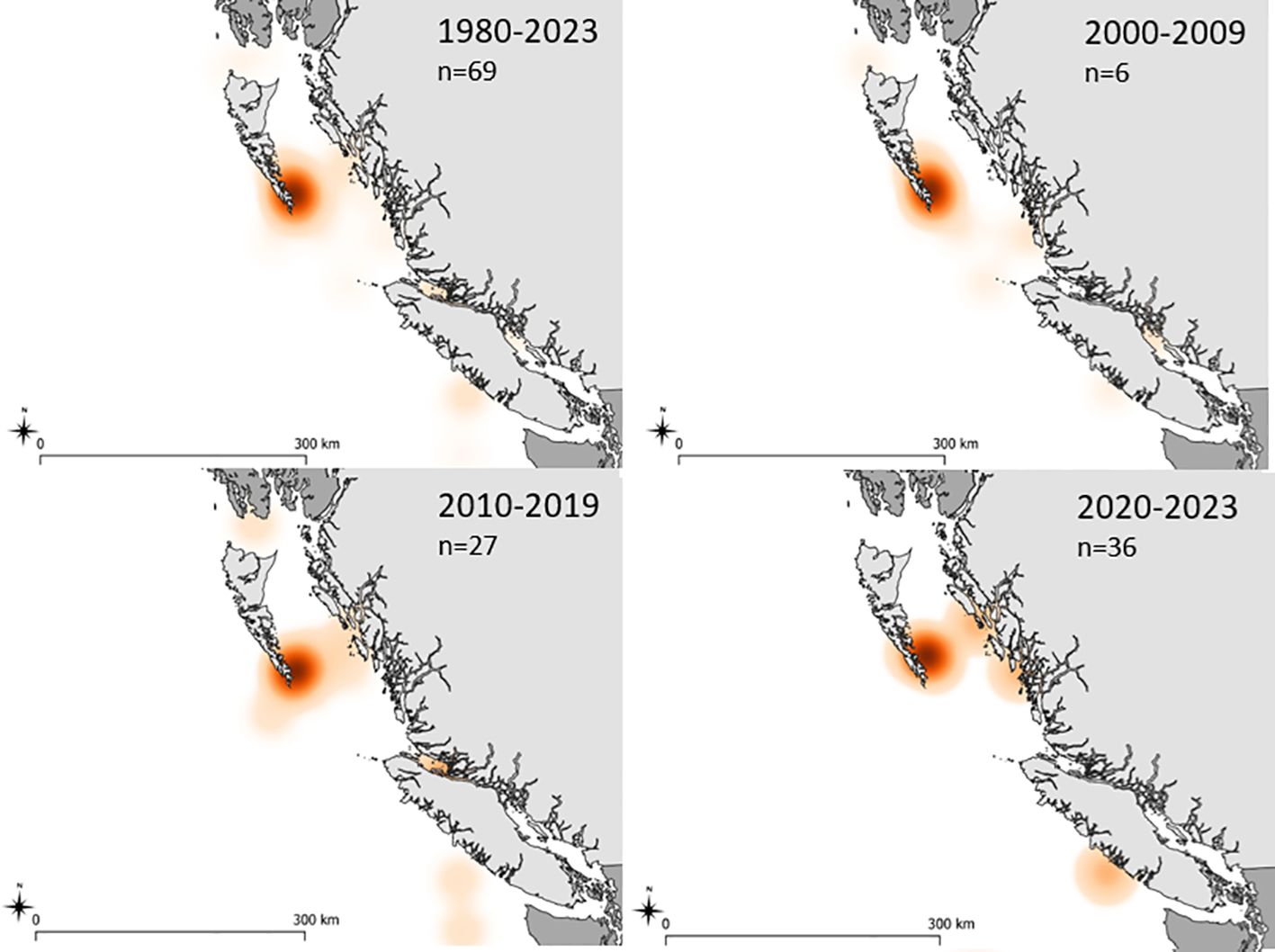
Figure 3. Sightings data taken from the British Columbia Cetacean Sightings Network, specifically noted as foraging fin whales. These are opportunistic sightings, that have not been effort corrected. Heat-spotting allows hot-spots of whale presence through each decade and the full length of data (1980–2023) to be visualized spatially. The number of sightings per decade is also indicated.
Although little effort has been dedicated to these areas, fin whales are known to use waters extending at least 200 nm offshore/1,000 m water depth (Nichol et al., 2017). This includes the deeper waters south and east of Haida Gwaii and in some more confined waterways (Gregr and Trites, 2001; Williams and Thomas, 2007; Ford et al., 2010; Nichol and Ford, 2018). Studies in California have also shown fin whale presence to be consistent year-round and with residency times of 30 days or more (Falcone and Schorr, 2014; Scales et al., 2017), contradicting the presumed north–south migration between high-latitude feeding areas and lower latitude breeding and calving regions (Mackintosh, 1972; Sergeant, 1997). As lesser numbers were noted in the catch records in BC over the winter, it could be that the general population migrates, while some individuals or sub-groups do not. These sort of breaks from the expected whale presence in time or space may represent animals of differing age, gender, reproductive status, energetic requirements/size class, predation risk, or physiological capacities.
Review of more recent PAM data has indicated the presence of fin whales year-round in recordings. The data both from Vancouver Island and Haida Gwaii indicate the presence of both the 20-Hz and 40-Hz call, further suggesting BC is important for both feeding and breeding for fin whales. Foraging calls were most prevalent in the spring and summer, following the spring bloom and upwelling along the shelf break (Burnham, 2019; Burnham et al., 2019). The presence of 20-Hz calls in BC waters, however, substantially outnumbers the 40-Hz call type in the acoustic records. This was found in the years’ worth of data analyzed from offshore Vancouver Island. As per previous studies (see Burnham, 2019), this additional PAM data showed the 20-Hz call was prevalent in January–February, when records from whaling and recent surveys or sightings are most scarce. Conception and calving are believed to occur in the winter (Mizroch et al., 1984; Folkens et al., 2002), which is when song was most frequent in the acoustic data off the west coast of Vancouver Island and further north (Frouin-Mouy et al., 2022). Births are most common between mid-October and mid-February (Lockyer, 1984; Koot, 2015), with patterning in 20-Hz calls peaking towards the latter part of this period (also see Burnham, 2019). Song patterning in the 20-Hz calls has been noted in recordings taken at Union Seamount, Nootka Sound, Barkley Sound, La Perouse Bank, and Brooks Peninsula on the west coast of Vancouver Island (Ford et al., 2010; Koot, 2015). Further, winter recordings in northern BC, the Bering Sea, and northern Gulf of Alaska to the Southern Californian Bight have also noted the presence of regularly patterned 20-Hz song (Moore et al., 2006; Stafford et al., 2007; Sirovic et al., 2013, 2015; Pilkington et al., 2018; Frouin-Mouy et al., 2022). Early notation by Burnham et al. (2019) described a doublet pattern (two tones: a backbeat and a 20-Hz note, see Burnham, 2019) that had been described in other areas of the west coast of Vancouver Island by Koot (2015), and more widely in the northeast Pacific by Sirovic et al. (2017). Song patterning is used in courtship displays but is also thought to reflect population sub-structures. The doublet structured pattern noted by Burnham (2019) and others (Ford et al., 2010; Koot, 2015) is the most prominent pattern in the north Pacific (Sirovic et al., 2017) and dominated the acoustic records from the BC offshore waters from the recorder off Vancouver Island. The presence of this song suggests a wide-ranging and highly connected population (Oleson et al., 2014; Sirovic et al., 2017). Indeed, similarity in song pattern for southern California to the southern Chukchi Sea suggests the range of this group could span the west coast of North America (Mellinger and Barlow, 2003; Sirovic et al., 2017; Burnham, 2019; Furumaki et al., 2021). The data analyzed from July 2018 to July 2019 from offshore Vancouver Island noted more than 140,000 fin whale calls in a years’ worth of data, with approximately 85% of the calls 20-Hz calls and forming song patterns that peaked from January to March. However, in considering the inter-call intervals, the analysis indicated an altered or modified form of the song pattern which may suggest song evolution, similar to that seen in humpback whales (see, e.g., Allen et al., 2018) but on longer time scales, or a progressive splintering of the population into sub-groups as their numbers recover. The whaling data already suggested a sub-group specific to foraging regions in BC; something similar might become more apparent in the data for whales undertaking courtship activities. Contrary to the catch records, which suggested whale numbers decreased from September onwards, fin whale calls were found to be most numerous in the deep coast and offshore waters on the west coast of Vancouver Island and Haida Gwaii in the winter months, determined by both bottom-stationed and mobile PAM devices (see Ford et al., 2010; Koot, 2015; Burnham, 2019; Burnham et al., 2019; Frouin-Mouy et al., 2022; Figure 1).
The collated evidence suggests fin whales are present in BC waters year-round and, while predominantly found in deeper waters past the continental shelf break, they also use areas on the shelf. Contemporary research confirms a similar habitat use pattern to pre-whaling as fin whale populations in the northeast Pacific Ocean are recovering. However, they are doing so in a different ocean than they were removed from. When a population is reduced it not only faces challenges due to small population dynamics, but the removal of individuals may, to some extent, erase knowledge of quality locations for foraging, mating, and calf rearing from the collective memory of the population. This can mean the legacy of whaling persists far beyond the cessation of removal activities. Since the cessation of whaling, fin whales are starting to return to historically important habitat as the current population builds their collective memory of areas in BC waters that support their reproductive and foraging success.
6 Challenges for recovery
As fin whales reestablish patterns of foraging and breeding, they are now faced with shifts in the marine environment that were absent prior to whaling pressures. Fin whale abundance mirrors their prey, which even the whalers were aware of (Nichol et al., 2017). Fin whale sightings were most frequent along bathymetric features that aggregate prey, particularly euphausiids, which fin whales are known to target along the west coast of North America (Flinn et al., 2002). However, changing ocean regimes and anomalies of increased water temperatures in the Pacific Ocean have altered zooplankton species composition along the BC coast (Galbraith and Young, 2020), which their proclivity for offshore waters does not exclude them from (Hourston and Thomson, 2020). With warmer ocean temperatures expected due to climate change, shifts in zooplankton timing and reduced size of prey species is expected (Richardson, 2008). Although the response from fin whale populations is so far unknown, these changes will dictate the location, abundance, and quality of their prey, which may be reflected in future fin whale presence and habitat use. Climate change also has a role in sea level rise, ocean acidification, more intense marine heatwaves and storm events, and altered nutrients cycling and sequestration. The large body size, long generation time and low reproductive rates increases fin whales’ vulnerability to climate change effects, either directly or through changes in habitat suitability of prey resources. Adaptations of habitat use may become apparent as whales try to exploit localized concentrations or prey hotspots (see Notarbartolo di Sciara et al., 2016). More ‘opportunistic nomadism’ (Jonzen et al., 2011), contractions in range, or altered or weakened migration patterns may also become apparent (Notarbartolo di Sciara et al., 2016).
The consistent signs of fin whale repopulation along the BC coast (Towers et al., 2018; Keen et al., 2021) makes them increasingly vulnerable to anthropogenic threats. Propeller driven vessels have increased remarkably in the period since whaling ceased. Marine vessel traffic in BC is concentrated around Vancouver Island, especially nearest the ports of southern BC and Washington State, but international shipping routes span much of BC waters (Erbe et al., 2014). Although all large whales are susceptible to vessel strikes, fin whales are especially vulnerable (Laist et al., 2001). As the fin whale population in the Pacific Ocean increases, and vessel traffic also increases, the number of ship strikes is expected to rise. The risk of vessel strike from increased vessel presence has been noted for fin whales in the literature (e.g., Williams and O’Hara, 2010; David et al., 2011); proposed energy projects are cited as a particular risk for whales in northern BC (see Keen et al., 2023), with similar findings reported due to the proximity of fin whale habitat to commercial shipping lanes in other regions (e.g., Castro et al., 2022). The location and effects of collisions are still poorly known, but evidence from body scars and strandings are being used to try and better estimate risk. However, unreported strikes or undocumented fatalities mean that our understanding likely underestimates the level of threat this could pose for fin whales (Williams and O’Hara, 2010). Vessel travel speed is likely the most important variable in estimating the risk of collision, and likelihood of lethality if it occurs (Laist et al., 2001; Vanderlaan and Taggart, 2007; Keeley et al., 2021).
The effects of vessel presence extend beyond collision injury and fatalities; noise levels from propeller driven vessels have changed the marine environment of BC waters considerably. The increasing reliance on commercial ocean transport routes has been the driving force behind a global doubling in ambient sound levels every decade over the last 70 years (Hildebrand, 2009; Andrew et al., 2011; Frisk, 2012). Fin whales are highly acoustic animals, especially during periods of breeding and foraging. However, increasing underwater noise additions from large vessels are concentrated in the low frequencies, where fin whale calling is focused. Acoustic disturbance can induce a stress response in whales (e.g., see Rolland et al., 2012), or disrupt key behaviors such as foraging or social or mating behaviors through the abandonment of these behaviors, avoidance of a key region where these areas are undertaken due to noise levels, and the reduced effectiveness of calling through acoustic masking. The full implications of the masking of fin whale communication signals are still largely undetermined, but increasing noise levels can change fin whale acoustic and behavioral patterns by modifying song characteristics and causing avoidance of areas with increased noise levels (Castellote et al., 2012; Southall et al., 2023). Passive acoustic monitoring will not only aid in tracking the assumed fin whale population recovery, but also allow an estimate of the potential level of threat of underwater acoustic disturbance. Soundscape analysis can detail the noise levels that whales are exposed to, and the level of exposure over time. Although masking and behavioral/calling modification is considered a sub-lethal effect it can increase the energetic load of a whale, while also decreasing the amount of information it is receiving about its surroundings, and so has the potential to impact their success or survival. In addition, if exposure is great enough (from noise amplitude and/or time of exposure) physiological effects such as temporary or permanent hearing impairment may result, with morphological damage also documented in cetacean species (see Erbe et al., 2019).
Other risks include entanglement, toxicity from plastic/micro-plastic pollution from ingestion and exposure to persistent organic and heavy metal pollutants (see Fossi et al., 2012; Espada et al., 2024) and the potential for oil spills. The assessment of each start with the consideration of the pathway of effect and risk to individuals by assessing the spatial and temporal overlap, allowing consideration of how that might escalate to risk of a group or population-level consequences more broadly. In other regions, pulmonary and neurological diseases have been described as a naturally occurring threat, whereby death occurs through individual or mass stranding.
7 Conclusions
The collation of evidence suggests that fin whales are repopulating areas along the BC coast. This is further supported by the annual population growth in areas to the north in Alaska and the south in California. However, the efforts to track the recovery of the whales in their core habitat, in deeper waters and off the shelf break, is limited. This restricts our appreciation of the current population size and dynamics, with the conclusions made so far being limited to on-the-shelf observations, which may represent more of a peripheral population recovery. Acoustics may be employed to fill the gap in our knowledge about offshore repopulation and habitat use over time and space. That said, more field observations and genetic sampling will refine our ideas of population number, site fidelity, residency times, population dynamics and composition, including potential sub-groupings or clades (Archer et al., 2013). With their long generation and gestation times, recovery to pre-whaling numbers will be slow (Best, 1993; Zerbini et al., 2010) and the legacy of whaling removals be felt for some time to come. Worldwide, fin whale populations are experiencing varying degrees of recovery, but their numbers seem to be increasing in the Southern Hemisphere (Herr et al., 2022) and North Atlantic (Vikingsson et al., 2009). A more broad, trans-boundary appreciation of population structure may be needed, especially for mitigating threats associated with commercial shipping and climate change. The consistent down-listing of fin whales by COSEWIC in Canada’s Species at Risk Act (SARA) may be premature and go against the precautionary principle usually adopted when so many unknowns remain.
Author contributions
LR: Data curation, Formal analysis, Writing – original draft, Writing – review & editing. RB: Conceptualization, Data curation, Formal analysis, Supervision, Visualization, Writing – original draft, Writing – review & editing. DD: Conceptualization, Supervision, Writing – review & editing.
Funding
The author(s) declare that no financial support was received for the research, authorship, and/or publication of this article.
Acknowledgments
The authors thank the late Rod Palm for his generosity in sharing the data of the pelagic survey, and many more of his anecdotes. His dedication to Strawberry Isle Marine Research Society, and the conservation of the oceans were admired greatly by the authors. Data from Clayoquot Slope is freely available online from Ocean Networks Canada (oceannetworks.ca), thanks to Jasper Kanes and Jeanette Bedard with the downloading and collating of the data used here. The British Columbia Cetacean Sightings Network data is available on request; thanks to efforts by those at Ocean Wise in collating all the records.
Conflict of interest
The authors declare that the research was conducted in the absence of any commercial or financial relationships that could be construed as a potential conflict of interest.
Publisher’s note
All claims expressed in this article are solely those of the authors and do not necessarily represent those of their affiliated organizations, or those of the publisher, the editors and the reviewers. Any product that may be evaluated in this article, or claim that may be made by its manufacturer, is not guaranteed or endorsed by the publisher.
References
Allen A. J., Garland E. C., Dunlop R. A., Noad M. J. (2018). Cultural revolutions reduce complexity in the songs of humpback whales. Proc. R. Soc B. 285, 20182088. doi: 10.1098/rspb.2018.2088
Allen S. E., Vindeirinho C., Thomson R. E., Foreman M. G. G., Mackas D. L. (2001). Physical and biological processes over a submarine canyon during an upwelling event. Can. J. Fish. Aquat. Sci. 58, 671–684. doi: 10.1139/cjfas-58-4-671
Andrew R. K., Howe B. M., Mercer J. A. (2011). Long-time trends in ship traffic noise for four sites off the north American west coast. J. Acoust. Soc Am. 129, 642–651. doi: 10.1121/1.3518770
Archer F. I., Morin P. A., Hancock-Hanser B. L., Roberston K. M., Leslie M. S., Berube M., et al. (2013). Mitogenomic phylogenetics of fin whales (Balaenoptera physalus spp.): Genetic evidence for revision of subspecies. PloS One 8, e63396. doi: 10.1371/journal.pone.0063396
Best B. D., Fox C. H., Williams R., Halpin P. N., Paquet P. C. (2015). Updated marine mammal distribution and abundance estimates in British Columbia. J. Cet. Res. Manage. 15, 9–26. doi: 10.47536/jcrm.v15i1.511
Best P. B. (1993). Increase rates in severely depleted stocks of baleen whales. ICES J. Mar. Sci. 50, 169–186. doi: 10.1006/jmsc.1993.1018
Burnham R. (2019). Fin whale call presence and type used to describe temporal distribution and possible area use of Clayoquot Sound. Northwest Sci. 93, 66–74. doi: 10.3955/046.093.0106
Burnham R. E., Duffus D. A., Mouy X. (2019). The presence of large whale species in Clayoquot Sound and its offshore waters. Cont. Shelf Res. 177, 15–23. doi: 10.1016/j.csr.2019.03.004
Burnham R. E., Duffus D. A., Ross T. (2021). Remote sensing and mapping habitat features pertinent to fin whale life histories in coastal and offshore waters of vancouver island, British Columbia. J. Exp. Mar. Biol. Ecol. 537, 151511. doi: 10.1016/j.jembe.2021.151511
Castellote M., Clark C. W., Lammers M. O. (2012). Acoustic and behavioral changes by fin whales (Balaenoptera physalus) in response to shipping and airgun noise. Biol. Conserv. 147, 115–122. doi: 10.1016/j.biocon.2011.12.021
Castro B. T., Gonzalez R. P., O’Callaghan S. A., Rein-Loring P. D., Bastos E. D. (2022). Ship strike risk for fin whales (Balaenoptera physalus) off the Garraf coast, Northwest Mediterranean Sea. Front. Mar. Science. 9. doi: 10.3389/fmars.2022.867287
Clapham P. J., Leatherwood S., Azczepaniak I., Brownell R. L. Jr. (1997). Catches of humpback and other whales from shore stations at Moss Landing and Trinidad, Californi 1919 –1926. Mar. Mamm. Sci. 13, 368–394. doi: 10.1111/j.1748-7692.1997.tb00646.x
COSEWIC. (2019). COSEWIC assessment and status report on the Fin Whale Balaenoptera physalus, Atlantic population and Pacific population, in Canada (Ottawa: Committee on the Status of Endangered Wildlife in Canada), xv + 72.
Croll D. A., Clark C. W., Acevedo A., Tershy B., Flores S., Gedamke J., et al. (2002). Only male fin whales sing loud songs. Nature. 417, 809. doi: 10.1038/417809a
David L., Alleaume S., Guinet C. (2011). Evaluation of the potential of collision between fin whales and maritime traffic in the north-western mediterranean sea in summer, and mitigation solutions. J. Mar. Anim. Their Ecol. 4, 17–28.
Drucker P. (1951). The Northern and Central Nootkan Tribes (Washington, DC: Bureau of American Ethnology Bulletin 144. Smithsonian Institution).
Edds-Walton P. L. (1997). Acoustic communication signals of mysticete whales. Bioacoustics. 8, 47–60. doi: 10.1080/09524622.1997.9753353
Erbe C., Marley S. A., Schoeman R. P., Smith J. N., Trigg L. E., Embling C. B. (2019). The effects of ship noise on marine mammals – a review. Front. Mar. Sci. 6, 606. doi: 10.3389/fmars.2019.00606
Erbe C., Williams R., Sandilands D., Ashe E. (2014). Identifying modeled ship noise hotspots for marine mammals of Canada's Pacific region. PloS One 9, e89820. doi: 10.1371/journal.pone.0089820
Espada R., Canacho-Sanchez A., Olaya-Ponzone L., Martin-Moreno E., Paton D., Garcia-Gomez J. C. (2024). Fin whale Balaenoptera physalus historical sightings and strandings, ship strikes, breeding areas and other threats in the Mediterranean Sea: A review (1624–2023). Environments 11, 104. doi: 10.3390/environments11060104
Falcone E. A., Schorr G. S. (2014). “Distribution and demographics of marine ma1mmals in SOCAL through photoidentification, genetics, and satellite telemetry,” in Naval postgraduate school technical report NPS-OC-14-005CR (Monterey, CA: Naval Postgraduate School). Available at: https://apps.dtic.mil/sti/tr/pdf/ADA601387.pdf.
Fiedler P. C., Reilly S. B., Hewitt R. P., Demer D. A., Philbrick V. A., Smith A. E., et al. (1998). Blue whale habitat and prey in the California Channel Islands. Deep Sea Res. Part II: Topical Stud. Ocean. 45, 1781–1801. doi: 10.1016/S0967-0645(98)80017-9
Flinn R. D., Trites A. W., Gregr E. J. (2002). Diets of fin, sei, and sperm whales in British Columbia: An analysis of commercial whaling records. Mar. Mamm. Sci. 18, 663–679. doi: 10.1111/j.1748-7692.2002.tb01065.x
Folkens P. A., Reeves R. R., Clapham P. J., Stewart B. S., Powell J. A. (2002). Guide to Marine Mammals of the World. 1st ed. (New York, NY: A. A. Knopf Inc.).
Ford J. K. B. (2014). Marine Mammals of British Columbia (Victoria, British Columbia: Royal BC Museum).
Ford J. K. B., Koot B., Vagle S., Hall-Patch N., Kamitakahara G. (2010). Passive acoustic monitoring of large whales in offshore waters of British Columbia. Can. Tech. Rep. Fish. Aquat. Sci. 2898, v + 30.
Fossi M. C., Panti C., Guerranti C., Coppola D., Giannetti M., Marsili L., et al. (2012). Are baleen whales exposed to the threat of microplastics? A case study of the Mediterranean fin whale (Balaenoptera physalus). Mar. pollut. Bull. 64, 2374–2379. doi: 10.1016/j.marpolbul.2012.08.013
Frisk G. V. (2012). Noiseonomics: The relationship between ambient noise levels in the sea and global economic trends. Sci. Rep. 2, 437. doi: 10.1038/srep00437
Frouin-Mouy H., Mouy X., Pilkington J., Kusel E., Nichol L., Doniol-Valcroze T., et al. (2022). Acoustic and visual cetacean surveys reveal year-round spatial and temporal distributions for multiple species in northern British Columbia, Canada. Sci. Rep. 12, 19272. doi: 10.1038/s41598-022-22069-4
Fujino K. (1964). Fin Whale subpopulations in the Antarctic whaling Areas II, III and IV. Sci. Rep. Whales Res. Institute 18, 1–27.
Furumaki S., Tsujii K., Mitani Y. (2021). Fin whale (Balaenoptera physalus) song pattern in the southern Chukchi Sea. Polar Bio. 44, 1021–1027. doi: 10.1007/s00300-021-02855-y
Galbraith M., Young K. (2020). “West coast British Columbia zooplankton biomass anomalies 2020,” in State of the physical, biological and selected fishery resources of Pacific Canadian marine ecosystems in 2019. Eds. Boldt J. L., Javorski A., Chandler P. C. (Fisheries and Oceans Canada, Canada).
Gregr E. J. (2000). An analysis of historic, (1908–1967) whaling records from British Columbia, Canada.Canada: University of British Columbia).
Gregr E. J., Nichol L., Ford J. K. B., Ellis G., Trites A. (2000). Migration and population structure of northeastern Pacific whales off coastal British Columbia: An analysis of commercial whaling records from 1908-1967. Mar. Mamm. Sci. 16, 699–727. doi: 10.1111/j.1748-7692.2000.tb00967.x
Gregr E. J., Trites A. W. (2001). Predictions of critical habitat for five whale species in the waters of coastal British Columbia. Can. J. Fish. Aquat. Sci. 58, 1265–1285. doi: 10.1139/f01-078
Harvey G. K., Nelson T. A., Fox C. H., Paquet P. C. (2017). Quantifying marine mammal hotspots in British Columbia, Canada. Ecosphere 8. doi: 10.1002/ecs2.1884
Herr H., Viquerat S., Devas F., Lees A., Wells L., Gregory B., et al. (2022). Return of large fin whale feeding aggregations to historical whaling grounds in the Southern Ocean. Sci. Rep. 12. doi: 10.1038/s41598-022-13798-7
Hildebrand J. A. (2009). Anthropogenic and natural sources of ambient noise in the ocean. Mar. Ecol. Prog. Ser. 395, 5–20. doi: 10.3354/meps08353
Hourston R. A. S., Thomson R. E. (2020). Vancouver Island west coast shelf break currents, temperatures, and wind stress in State of the physical, biological and selected fishery resources of Pacific Canadian marine ecosystems in 2019. Can. Tech. Rep. Fish. Aquat. Sci. 3377, x + 288.
Hui C. A. (1985). Undersea topography and the comparative distributions of two pelagic cetaceans. Fish. Bull. 83, 472–475.
Jonzen N., Knudsen E., Holt R. D., Saeter B. E. (2011). “Uncertainty and predictability: the niches of migrants and nomads,” in Animal Migration: A synthesis. Eds. Milner-Gulland E. J., Fryzell J. M., Sinclair A. R. E. (Oxford University Press, Oxford), 91–109.
Keeley D. E., Vlasic J. P., Brilliant S. W. (2021). Assessing the lethality of ship strikes on whales using simple biophysical models. Mar. Mammal Science. 37, 251–267. doi: 10.1111/mms.12745
Keen E. M., O’Mahoney E., Nichol L. M., Wright B. M., Shine C., Hendricks B., et al. (2023). Ship-strike forecast and mitigation for whales in Gitga’at First Nation territory. Endangered Species Res. 51, 31–58. doi: 10.3354/esr01244
Keen E. M., Pilkington J., O’Malony. E., Thompson K.-L., Hendricks B., Robinson N., et al. (2021). Fin whales of the Great Bear Rainforest: Balaenoptera physalus velifera in a Canadian Pacific fjord system. PloS One 16, e0256815. doi: 10.1371/journal.pone.0256815
Koot B. (2015). Winter behavior and population structure of Fin whales (Balaenoptera physalus) in British Columbia inferred from passive acoustic data (Canada: University of British Columbia).
Laist D. W., Knowlton A. R., Mead J. G., Collet A. S., Podesta M. (2001). Collisions between ships and whales. Mar. Mammal Science. 17, 35–75. doi: 10.1111/j.1748-7692.2001.tb00980.x
Lockyer C. H. (1984). Review of baleen whale (Mysticeti) reproduction and implications for management. Rep. Int. Whaling Commission pp, 27–50.
Mackas D. L. (1992). Seasonal cycle of zooplankton off southwestern British Columbia: 1979-89. Can. J. Fish. Aquat. Sci. 49, 903–921. doi: 10.1139/f92-101
Mackas D. L., Galbraith M. (1992). Zooplankton on the west coast of Vancouver Island: Distribution and availability to marine birds in The ecology, status and conservation of marine and shoreline birds on the west coast of Vancouver Island. Can. Wildl. Serv. Occ. Pap. 75, 15–21.
McDonald M. A., Hildebrand J. A., Webb S. C. (1995). Blue and fin whales observed on a seafloor array in the Northeast Pacific. J. Acoust. Soc Am. 98, 712–721. doi: 10.1121/1.413565
Mellinger D., Barlow J. (2003). Future directions for acoustic marine mammal surveys: Stock assessment and habitat use. Report of a Workshop held in La Jolla, CA, 20–22 November 2002. NOAA OAR Special Report, NOAA/PMEL Contribution No. 2557, 37 pp.
Mizroch S. A., Rice D. W., Breiwick J. M. (1984). The fin whale, Balaenoptera physalus. Mar. Fish. Rev. 46, 20–24.
Monks G. G., McMillan A. D., St. Claire D. E. (2001). Nuu-Chah-Nulth whaling: archaeological insights into antiquity, species preferences, and cultural importance. Arctic Anthropol. 38, 60–81.
Moore S. E., Stafford K. M., Mellinger D. K., Hildebrand J. A. (2006). Listening for large whales in the offshore waters of Alaska. BioScience. 56, 49–55. doi: 10.1641/0006-3568
Moore J. E., Barlow J. (2011). Bayesian state-space model of fin whale abundance trends from a 1991–2008 time series of line-transect surveys in the California current. J. Appl. Ecol. 48, 1195–1205. doi: 10.1111/j.1365-2664.2011.02018.x
Nadeem K., Moore J. E., Zhang Y., Chipman H. (2016). Integrating population dynamics models and distance sampling data: a spatial hierarchical state-space approach. Ecology. 97, 1735–1745. doi: 10.1890/15-1406.1
Nichol L. M., Ford J. K. B. (2018). Information in support of the identification of habitat of special importance to fin whales (Balaenoptera physalus) in Canadian Pacific waters. Canada: Fisheries and Oceans Canada. DFO Can. Sci. Advis. Sec. Res. Doc., vi + 29.
Nichol L. M., Gregr E. J., Flinn R., Ford J. K. B., Gurney R., Michaluk L., et al. (2002). British Columbia commercial whaling catch data 1908 to 1967: A detailed description of the B.C. Historical whaling database. Can. Tech. Rep. Fish. Aquat. Sci. 2396, viii + 76.
Nichol L. M., Wright B. M., O’Hara P., Ford J. K. B. (2017). Assessing the risk of lethal ship strikes to humpback (Megaptera novaeangliae) and fin (Balaenoptera physalus) whales off the west coast of Vancouver Island, Canada. DFO Can. Sci. Advis. Sec. Res. Doc., vii + 33.
Notarbartolo di Sciara G., Castellote M., Druon J.-N., Panigada S. (2016). Fin Whales, Balaenoptera physalus: At home in a changing Mediterranean Sea? Adv. Mar. Biol. 75, 75–101. doi: 10.1016/bs.amb.2016.08.002
Ohsumi S., Wada S. (1974). Status of whale stocks in the North Pacific 1972’, Reports Int. Whal. Commun. 25, 114–126.
Oleson E. M., Širović A., Bayless A. R., Hildebrand J. A. (2014). Synchronous seasonal change in fin whale song in the north pacific. PloS One 9 (12). doi: 10.1371/journal.pone.0115678
Pike G. C., MacAskie I. B. (1969). ‘Marine mammals of British Columbia’. Bull. Fish. Res. Board Canada. 171, 1–54.
Pilkington J. F., Stredulinsky E. H., Abernethy R. M., Ford J. K. B. (2018). Patterns of Fin whale (Balaenoptera physalus) seasonality and relative distribution in Canadian Pacific waters inferred from passive acoustic monitoring. DFO Can. Sci. Advis. Sec. Res. Doc., vi + 26.
Richardson A. J. (2008). In hot water: zooplankton and climate change. ICES J. Mar. Science. 65, 279–295. doi: 10.1093/icesjms/fsn028
Rolland R. M., Parks S. E., Hunt K. E., Castellote M., Corkeron P. J., Nowacek D. P., et al. (2012). Evidence that ship noise increases stress in right whales. Proc. R. Soc B. 279, 2363–2368. doi: 10.1098/rspb.2011.2429
Romagosa M., Perez-Jorge S., Cascao I., Mourino H., Lehodey P., Pereira A., et al. (2021). Food talk: 40-hz fin whale calls are associated with prey biomass. Proc. R. Soc. B 288 (1954). doi: 10.1098/rspb.2021.1156
Scales K. L., Schorr G. S., Hazen E. L., Bograd S. J., Miller P. I., Andrew R. D., et al. (2017). Should I stay or should I go? Modelling year-round habitat suitability and drivers of residency for fin whales in the California current. Div. Distrib. 23, 1204–1215. doi: 10.1111/ddi.12611
Sergeant D. E. (1977). Stocks of fin whales balaenoptera physalus l. in the North Atlantic ocean. Rep. Int. Whal. Commn. 27, 460–473.
Sirovic A., Oleson E. M., Buccowich J., Rice A., Bayless A. R. (2017). Fin whale song variability in southern California and the Gulf of California. Sci. Rep. 7, 10126. doi: 10.1038/s41598-017-09979-4
Sirovic A., Rice A., Chou E., Hildebrand J. A., Wiggins S. M., Roch M. A. (2015). Seven years of blue and fin whale call abundance in the Southern California Bight. Endanger. Species Res. 28, 61–76. doi: 10.3354/esr00676
Sirovic A., Williams L. N., Kerosky S. M., Wiggins S. M., Hildebrand J. A. (2013). Temporal separation of two fin whale call types across the eastern North Pacific. Mar. Bio. 160, 47–57. doi: 10.1007/s00227-012-2061-z
Smith R. C., Dustan P., Au. D., Baker K. S., Dunlap E. A. (1986). Distribution of cetaceans and sea-surface chlorophyll concentrations in the California Current. Mar. Bio. 91, 385–402. doi: 10.1007/BF00428633
Southall B. L., Allen A. N., Calambokidis J., Casey C., DeRuiter S. L., Fregosi S., et al. (2023). Behavioral responses of fin whales to military mid-frequency active sonar. R. Soc. Open Sci. 10, 231775. doi: 10.1098/rsos.231775
Stafford K. M., Mellinger D. K., Moore S. E., Fox C. G. (2007). Seasonal variability and detection range modeling of baleen whale calls in the Gulf of Alaska 1999–2002. J. Acoust. Soc Am. 122, 3378–3390. doi: 10.1121/1.2799905
Thomson R. E. (1981). Oceanography of the British Columbia coast. Canadian special publication of fisheries and aquatic science. Fisheries Oceans Canada 291.
Towers J. R., Malleson M., McMillan C. J., Cogan J., Berta S., Birdsall C. (2018). Occurrence of fin whales (Balaenoptera physalus) between Vancouver Island and continental North America. NW Natur. 99, 49–57. doi: 10.1898/NWN17-16.1
Vanderlaan A. S. M., Taggart C. T. (2007). Vessel collisions with whales: the probability of lethal injury based on vessel speed. Mar. Mammal Sci. 23, 144–156. doi: 10.1111/j.1748-7692.2006.00098.x
Víkingsson G. A., Pike D. G., Desportes G., Øien N., Gunnlaugsson T., Bloch D. (2009). Distribution and abundance of fin whales (Balaenoptera physalus) in the Northeast and Central Atlantic as inferred from the North Atlantic Sightings Surveys 1987-2001. NAMMCO Sci. Publications 7, 49–72. doi: 10.7557/3.2705
Waring G. T., Fairfield C. P., Ruhsam C. M., Sano M. (1993). Sperm whales associated with Gulf Stream features off the north-eastern USA shelf. Fisheries Oceanography 2, 101–105. doi: 10.1111/j.1365-2419.1993.tb00126.x
Watkins W. A., Daher M. A., Reppucci G. M., George J. E., Martin D. L., DiMarzio N. A., et al. (2000). Seasonality and distribution of whale calls in the north Pacific. Oceanography. 13, 62–67. doi: 10.5670/oceanog.2000.54
Watkins W. A., Tyack P., Moore K. E., Bird J. E. (1987). The 20-Hz signals of finback whales (Balaenoptera physalus). J. Acoust. Soc Am. 82, 901–912. doi: 10.1121/1.395685
Williams R., O’Hara P. (2010). Modelling ship strike risk to fin, humpback and killer whales in British Columbia, Canada. J. Cetacean Res. Manage. 11, 1–8. Available at: https://journal.iwc.int/index.php/jcrm/article/view/624.
Williams R., Thomas L. (2007). Distribution and abundance of marine mammals in the coastal waters of British Columbia, Canada. J. Cet. Res. Manage. 9, 15–28. doi: 10.47536/jcrm.v9i1.688
Woodley T. H., Gaskin D. E. (1996). Environmental characteristics of North Atlantic right and fin whale habitat in the lower Bay of Fundy, Canada. Can. J. Zool. 74, 75–84. doi: 10.1139/z96-010
Wright B. M., Nichol L. M., Doniol-Valcroze T. (2021). Spatial density models of cetaceans in the Canadian Pacific estimated from 2018 ship-based surveys. DFO Can. Sci. Advis. Sec. Res. Doc., viii + 46.
Keywords: fin whales, commercial whaling, population rebounding, acoustic monitoring, visual surveys, platforms of opportunity, catch records
Citation: Rannankari L, Burnham R and Duffus D (2024) Evidence of fin whale (Balaenoptera physalus velifera) recovery in the Canadian Pacific. Front. Conserv. Sci. 5:1392039. doi: 10.3389/fcosc.2024.1392039
Received: 26 February 2024; Accepted: 01 August 2024;
Published: 26 August 2024.
Edited by:
Kristina Cammen, University of Maine, United StatesReviewed by:
Andrea Bogomolni, University of Massachusetts Boston, United StatesHelena Herr, University of Hamburg, Germany
Copyright © 2024 Rannankari, Burnham and Duffus. This is an open-access article distributed under the terms of the Creative Commons Attribution License (CC BY). The use, distribution or reproduction in other forums is permitted, provided the original author(s) and the copyright owner(s) are credited and that the original publication in this journal is cited, in accordance with accepted academic practice. No use, distribution or reproduction is permitted which does not comply with these terms.
*Correspondence: Lynn Rannankari, bHlubnJhbm5AdXZpYy5jYQ==
†These authors share first authorship