 Monique Van Sluys1*
 Yvette Pauligk2
 Alicia Burns1,3,4Mark O’Riordan5Richard Matkovics6Chris Hartnett7
 Benjamin J. Pitcher1,8
- 1Taronga Institute of Science and Learning, Taronga Conservation Society Australia, Mosman, NSW, Australia
- 2Life Sciences, Werribee Open Range Zoo, Zoos Victoria, Werribee, VIC, Australia
- 3Faculty of Life Sciences, Humboldt University, Berlin, Germany
- 4Cluster of Excellence “Science of Intelligence”, Berlin, Germany
- 5Conservation Division, Taronga Western Plains Zoo, Dubbo, NSW, Australia
- 6Bird Department, Taronga Zoo, Mosman, NSW, Australia
- 7Wildlife Conservation and Science, Zoos Victoria, Melbourne, VIC, Australia
- 8School of Natural Sciences, Faculty of Science and Engineering, Macquarie University, Sydney, NSW, Australia
A thorough understanding of behaviour is essential to a species recovery effort, not only to inform management and husbandry decisions, but critically, to ensure optimum survival of released animals and their offspring. The endangered Plains-wanderer, endemic to Australia and the only extant member of its family, is a bird of great conservation significance. Despite their phylogenetic uniqueness and conservation status, very little is known about their basic behavioural ecology. As part of the National Recovery efforts, an ex-situ breeding program was established to create an insurance population with the aim of releasing zoo-bred birds into their natural range. Such programs provide unique opportunities to conduct detailed behavioural and ecological studies. However, such studies are dependent on a comprehensive understanding of basic behaviour and associated social interactions, as well as a common vocabulary across institutions when it comes to describing patterns of behaviour. Therefore, a detailed ethogram is a vital first step. Here we have collated initial behavioural observations and descriptions from three main breeding institutions to create a unified ethogram across sites, with the aim of facilitating future research endeavours. Ultimately a systematic understanding of behaviour will not only improve management and conservation initiatives, but also the understanding of adaptability to potential threats going forward.
Introduction
The functional importance of animal behaviour for the success and effectiveness of conservation management projects has been increasingly recognised in recent years (Greggor et al., 2019, 2020). Conservation breeding and translocation programs have been established to safeguard species from extinction and set up viable breeding populations for future releases, and a vital element to increase the probability of success of these programs is the understanding of the target species’ behaviour (Berger-Tal et al., 2019). A thorough understanding of behaviour is essential to a species recovery’s efforts (Sutherland, 1998), not only to inform management and husbandry decisions, but critically, to ensure optimal survival of released animals and their offspring. Zoos play a critical role in the recovery of threatened wildlife due to their husbandry, welfare, veterinary and research skillset, and the opportunities they create for in-depth analysis of animal behaviour.
At the early stages of an ex-situ breeding program for endangered species, when there’s little evidence of husbandry requirements, or a desire to know more about the species’ responses to husbandry and management (Rose and Riley, 2021), the understanding of species-specific behaviours becomes critical. An ethogram is a basic tool to the understanding of animal behaviour by clearly defining, describing, and classifying distinct behaviours commonly exhibited by a species (Fern et al., 2022). To ensure successful breeding and reintroduction programs it is important to establish universal, standardised ethograms that can be used by multiple programs and institutions to compare behaviours of both wild and captive populations and understand breeding behaviour to increase the likelihood of success. When all partner institutions refer to the same behaviours, it increases objectivity and allows for comparisons among them. Recent calls for consistency in defining and coding animal behaviour have stemmed from variation in how behaviours are defined within and across species, which could have implications for reproducibility and comparability of results (Fern et al., 2022).
The Plains-wanderer, Pedionomus torquatus, is a ground-dwelling, native grassland specialist bird endemic to Australia (Baker-Gabb et al., 2016), and the sole member of the Pedionomidae family. The species is endangered and considered of high conservation significance (BirdLife International, 2022; Jetz et al., 2014; McClure et al., 2023). Population declines in the wild have mostly been associated with the conversion of native grasslands to crops and dense introduced pastures (Commonwealth of Australia, 2016) and climate extremes, both drought and excessive wet years (Antos and Schultz, 2019; Parker et al., 2021). Current population estimates across its range suggest a wild population of less than 500 individuals and trending downward (Antos and Schultz, 2020). Plains-wanderers are solitary and occupy home ranges of about 12ha (Baker-Gabb et al., 1990); uncommon among birds, females are larger and more conspicuous than the males. Plains-wanderers are considered polyandrous, and the male takes the major role in incubating and caring for the young (Bennett, 1983). Plains-wanderer tends to forage in denser grassland patches than those preferred as nocturnal roosting sites (Nugent et al., 2022). Due to the elusive nature of the Plains-wanderer and resulting challenges with direct observations, little is known about its behavioural repertoire (Bennett, 1983; Baker-Gabb, 1988; Nugent et al., 2022), limited to published notes of chance encounters (Purnell, 1915; Hopton and Carpenter, 2021) or as unpublished anecdotal records.
As part of the recovery efforts for the Plains-wanderer (Commonwealth of Australia, 2016), an ex-situ conservation breeding program was established to safeguard the species from extinction and set up a viable breeding population for future translocations to its original range. While information can be gathered from wild populations, for this cryptic species, the ex-situ population provides a unique opportunity to observe, document and better understand its breeding behaviour, including different aspects of male-female interactions, courtship behaviour, and parental care of wild birds which can be used to ‘benchmark’ wild-type behaviours to assess potential changes over time attributable to a captive environment and inform adaptive management of the program.
We combine behaviour observations from video footage from three different zoo-based breeding population across NSW and Victoria and establish a basic ethogram from Plains-wanderer collected from the wild (potential founders). It is hoped this information will support the species’ ex-situ management to ensure that individuals of the insurance population maintain natural behaviours and are as suitable as possible for release. We further aim to discuss the application of ethograms in the management of ex-situ breeding program and provide a framework that can be applied in other recovery programs.
Material and methods
Wild adult Plains wanderers (n=25) were brought into three separate breeding facilities (Taronga Zoo, Sydney; Taronga Western Plains Zoo, Dubbo; and Werribee Open Range Zoo, Werribee) between June 2017-2020. Wild birds were located and captured during nocturnal spotlight surveys from a slow moving (<5 km/hr) vehicle. While Plains-wanderers are typically easy to approach, not flighty and able to be captured by hand, a lightweight insect net (with a padded rim and small mesh) was used to capture the birds, which were transported to the breeding facilities in customised transport boxes. The behavioural observations were initiated soon after each bird was brought into the holding facilities to capture as much wild representative behaviour as possible. Due to their cryptic behaviour, Plains-wanderer are difficult to observe directly therefore, to allow for husbandry monitoring of the birds, all aviaries were fitted with CCTV cameras operating for 24 hours (about 50% of the cameras had night vision capabilities). The behaviours were analysed by remote monitoring and review of the CCTV cameras footage.
During the observation period (2017-2020) birds were housed individually or in pairs in designated aviaries that varied in size from 2.8m x 3.2m x 2.4m to 4.0m x 4.0m x 4.0m, vegetated with plant species typical of Plains-wanderer habitat to emulate conditions in the wild. This configuration could change for management purposes (e.g. birds held in small single-sex groups (3-4 birds) in each aviary).
Observations
Initial behavioural observations were obtained from CCTV cameras recording for 24 hours, 7 days a week in each aviary across the three sites within the first 12 months of the wild birds arriving at the breeding population. Birds were out of sight or hidden from view for large portions of the recordings, therefore behaviours were described from ad lib samples when a bird was visible as opposed to fixed-time scan sampling.
During the description of behaviours and development of the ethogram, the footage and descriptions of behaviours were exchanged between the institutions to validate their meaning and seek common description (as a proxy for interobserver reliability).
Results
The ethogram presented here includes four breeding seasons’ worth of displays from both male and female birds, as well as calling and social interactions, and general maintenance behaviour. Overall, more than 10,000 hours of footage was reviewed across the three institutions to establish the ethogram.
From the initial data, results indicate that most mating and reproductive-related behaviours occur during the twilight hours, with many displays between birds occurring between early morning (dawn) and evening (dusk). Although only a subset of the behaviour has been analysed due to the extensive surveillance system, and the cryptic nature of the species, pin-pointing this time of day for analysis going forward is already a valuable outcome.
Forty-four different behaviours were described in the ethogram compiled by Pauligk (2020), with an additional category of ‘other behaviours’ describing less frequently observed behaviours.
Here we grouped some of these behaviours into five broad functional categories (Sexual, Communication, Anti-predator, Maintenance, Movement) and discuss some of the most typical ones (Table 1). Videos of specific behaviours can be found in the Supplementary Material.
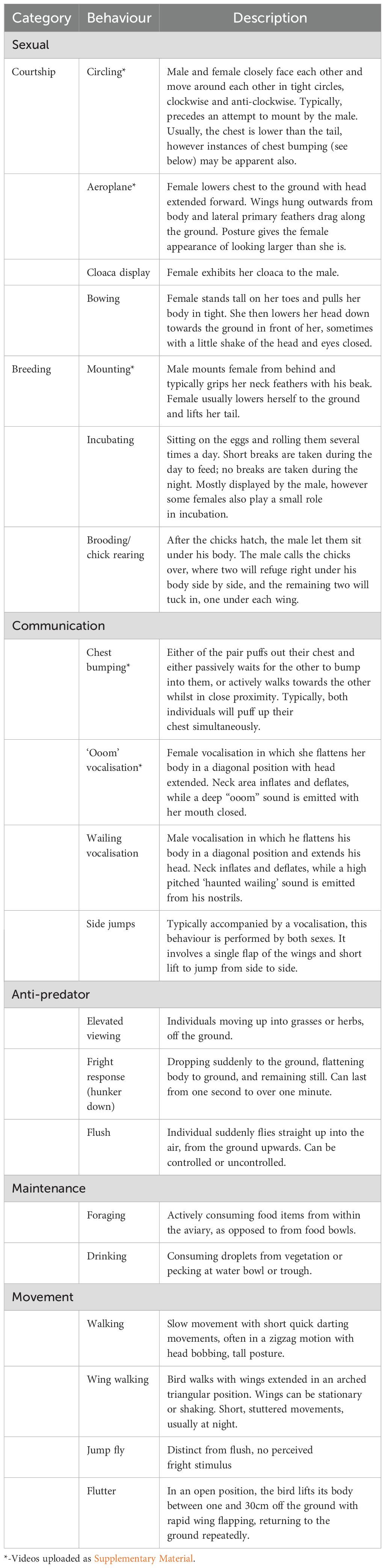
Table 1. Ethogram developed for the critically endangered Plains-wanderer based on CCTV-captured footage at three breeding institutions (adapted from Pauligk, 2020) as part of the recovery program.
Discussion
Here we establish an ethogram of ‘wild-type’ behaviour that has been observed in wild-born Plains-wanderers brought into the ex-situ breeding program. The behaviours described here are by no means exhaustive, however due to their relative regularity between individuals and across institutions, we suggest these behaviours provide the main repertoire as seen in wild Plains-wanderer. In some cases where function is currently speculative, we have tried to include form as a means of avoiding possible confusion when assessing behaviour going forward. The development of the ethogram allowed for consistency and standardisation of the behaviours’ description and meaning to ensure objectivity and uniformity of terminology. Thus, they can be used as a benchmark of wild behaviours against which the behaviour of birds within the ex-situ population can be compared.
There is no detailed description of Plains-wanderer behaviours in the wild which prevents comparisons with the behaviours exhibited by the birds in the ex-situ population. However, as the behaviours described in the ethogram were based on observations of wild birds collected for the insurance population and recorded soon after their transition into the ex-situ program, we assume they are representative of the behavioural suite exhibited by Plains-wanderer in natural habitats. For example, observations of mating behaviours during the twilight hours mirror observations made during field-based activities (David Parker, pers.obs.). Further, Plains-wanderer commonly consumed water droplets on leaves after rain or irrigation, not just from water bowls provided, which suggests this is how they access water in the wild.
The establishment of this ethogram is especially relevant as the Plains-wanderer recovery program is reaching the next stage of trialling wild translocations to boost natural populations. Considering that the phenotypic quality of captive-bred animals is critical in determining the success of reintroduction programs (Tripovich et al., 2021; Crates et al., 2022), the more we understand and agree on typical behaviours the more informed/evidence-based decisions will be about release cohorts or release candidate suitability.
Identifying the behavioural factors that determine current and future reproductive success is the obvious next step when analysing Plains-wanderer behaviour. Currently data is being collated from all successful mating events across all institutions to retrospectively determine which factors may have contributed to successful mating. Once these factors are established, we can investigate the role that behavioural matching and mate-choice has on factors such as clutch size and chick health. Recent evidence has shown that incorporating behavioural compatibility and mate-choice into breeding programs enhances reproductive output and survivorship (Hartnett et al., 2018; Martin-Wintle et al., 2018).
Further, it is known that captivity can cause changes in important life history and behavioural traits in various species over time (Crates et al., 2022), thus putting individuals earmarked for release potentially at a disadvantage upon reintroduction to the wild. A full grasp on typical behaviours will inform management decisions regarding the most suitable candidates for release as well as the release protocol. For example, the Regent Honeyeater (Anthochaera phrygia), another critically endangered Australian bird currently being managed through a conservation breeding program, has been bred in zoos for approximately 20 years and over 400 individuals released to the wild. Over that time changes have been observed in the vocalisations of the species both in captivity and the wild, likely due to both small populations limiting learning opportunities and mimicry of other, more abundant species (Crates et al., 2022). A recent study (Appleby et al., 2023) indicated that female Regent Honeyeaters tend to prefer songs of males they are familiar with. Further, analysis of the fitness of released individuals highlighted the importance of song tutoring, as well as complex pre-release zoo habitats (Tripovich et al., 2021). Behavioural management has now been implemented to monitor and enhance the fitness of birds and assist in selecting release candidates.
The detailed behavioural observations and resulting development of the Plains-wanderer ethogram provide a consistent framework for using typical behaviours as benchmarks to inform release candidate selection. For example, by comparing behaviours observed as part of the ongoing husbandry (such as foraging) to behaviours when pre-release changes are introduced (such as consistent foraging behaviour when scatter feed is increased or changes in behaviour following attachment of a tracking device), then birds that are behaviourally suitable for release, in addition to being demographically and genetically suitable, can be confirmed. These traits may include the inability to recognise natural foods or predators, or deficient locomotor skills and/or spatial awareness, which, if recognised in advance, may provide an opportunity to address potential deficiencies in a release cohort by, for example, introducing pre-release training. Whether this is the case for bird species is largely unknown and thus this project provides a unique opportunity to intensively monitor the behaviour of birds from the time they enter the ex-situ population, to the time their descendants can be released.
As ex-situ breeding programs increasingly become an essential component of the recovery efforts for ‘at-risk’ wildlife, all information on typical aspects of the species biology is essential, especially for evolutionary unique species for which relying on ‘proxy’ species is difficult, as is the case for the Plains-wanderer. The systematic description of behaviours in ethograms brings rigour and consistency to ex-situ breeding programs by removing inherent subjectivity and variation due to different stakeholders. Further, the implementation of systematic behaviour observations and descriptions allow for monitoring if and how behaviour changes over time. This would allow for adaptive management changes within the breeding program to avoid behavioural changes within a captive environment and ensure birds for release are as behaviourally sound as possible.
Data availability statement
The raw data supporting the conclusions of this article will be made available by the authors, without undue reservation.
Ethics statement
The animal study was approved by Taronga Animal Ethics Committee. The study was conducted in accordance with the local legislation and institutional requirements.
Author contributions
MVS: Conceptualization, Data curation, Supervision, Writing – original draft, Writing – review & editing. YP: Data curation, Formal analysis, Investigation, Validation, Writing – review & editing. AB: Conceptualization, Data curation, Formal analysis, Methodology, Writing – original draft, Writing – review & editing. MO’R: Data curation, Investigation, Validation, Writing – review & editing. RM: Investigation, Validation, Writing – review & editing. CH: Investigation, Supervision, Validation, Writing – review & editing. BP: Conceptualization, Data curation, Formal analysis, Methodology, Supervision, Writing – original draft, Writing – review & editing.
Funding
The author(s) declare financial support was received for the research, authorship, and/or publication of this article. This study was partially funded by Saving Our Species Program, NSW Department of Climate Change, Energy, the Environment and Water. The review and collation of data collected at Werribee Open Range Zoo was supported by the Zoos Victoria Fellowship program. The NSW Wildlife Information Rescue and Education Service Inc. (WIRES) provided funding to the Plains-wanderer Recovery program at Taronga Conservation Society Australia.
Acknowledgments
We thank Courtney Cremasco and the many husbandry staff who spent countless hours reviewing the Plains-wanderer video footages and noting their behaviours. David Parker kindly reviewed the manuscript and offered invaluable suggestions. This research took place on the traditional lands of the Cammeraigal People of the Eora Nation, Tubbagah People of the Wiradjuri Nation, and the Bunurong People of the Kulin nation.
Conflict of interest
The authors declare that the research was conducted in the absence of any commercial or financial relationships that could be construed as a potential conflict of interest.
Publisher’s note
All claims expressed in this article are solely those of the authors and do not necessarily represent those of their affiliated organizations, or those of the publisher, the editors and the reviewers. Any product that may be evaluated in this article, or claim that may be made by its manufacturer, is not guaranteed or endorsed by the publisher.
Correction note
A correction has been made to this article. Details can be found at: 10.3389/fonc.2025.1661708.
Supplementary material
The Supplementary Material for this article can be found online at: https://www.frontiersin.org/articles/10.3389/fcosc.2024.1457664/full#supplementary-material
References
Antos M. and Schultz N. L. (2020). Climate-mediated changes to grassland structure determine habitat suitability for the critically endangered plains-wanderer (Pedionomus torquatus). Emu - Austral Ornithology. 120 (1), 2–10 doi: 10.1080/01584197.2019.1641415
Appleby D. L., Tripovich J. S., Langmore N. E., Heinsohn R., Pitcher B. J., and Crates R. (2023). Zoo-bred female birds prefer songs of zoo-bred males: Implications for adaptive management of reintroduction programs. Biol. Conserv. 284. doi: 10.1016/j.biocon.2023.110171
Baker-Gabb D. J. (1988). The diet and foraging behaviour of the Plains-wanderer Pedionomus torquatus. Emu-Austral Ornithology 88, 115–118.
Baker-Gabb D. J., Antos M., and Brown G. (2016). Recent decline of the critically endangered Plains-wanderer (Pedionomus torquatus), and the application of a simple method for assessing its cause: major changes in grassland structure. Ecol. Manage. Restor. 17, 1–8. doi: 10.1111/emr.12221
Baker-Gabb D. J., Benshemesh J. S., and Maher P. N. (1990). A revision of the distribution, status and management of the Plains-wanderer Pedionomus torquatus. Emu 90, 161–168.
Bennett S. (1983). A review of the distribution, status and Biology of the Plains-wanderer Pedionomus torquatus, Gould. Emu - Austral Ornithology 83, 1–11. doi: 10.1071/MU9830001
Berger-Tal O., Blumstein D. T., and Swaisgood R. R. (2019). Conservation translocations: a review of common difficulties and promising directions. Anim. Conserv. 23, 121–131. doi: 10.1111/acv.12534
BirdLife International (2022).Pedionomus torquatus. In: The IUCN red list of threatened species 2022 (Accessed 28 August 2024). e.T22693049A212570062.
Commonwealth of Australia (2016). National Recovery Plan for the Plains-wanderer (Pedionomus torquatus). Available online at: https://www.dcceew.gov.au/sites/default/files/documents/national-recovery-plan-plains-wanderer.pdf.
Crates R., Stojanovic D., and Heinsohn R. (2022). The phenotypic costs of captivity. Biol. Rev. 98, 434–449. doi: 10.1111/brv.12913
Fern F. K., Thompson L. J., and Downs C. T. (2022). An ethogram for the nesting and breeding behaviour of the Hooded Vulture Necrosyrtes monachus. Ostrich 93 (2),129–140. doi: 10.2989/00306525.2022.2072965
Greggor A. L., Berger-Tal O., and Blumstein D. T. (2020). The rules of attraction: the necessary role of animal cognition in explaining conservation failures and successes. Annu. Rev. Ecology Evolution Systematics 51, 483–503.
Greggor A. L., Blumstein D. T., Wong B. B. M., and Berger-Tal O. (2019). Using animal behavior in conservation management: a series of systematic reviews and maps. Environ. Evidence 8, 23.
Hartnett C. M., Parrott M. L., Mulder R. A., Coulson G., and Magrath M. J. L. (2018). Opportunity for female mate choice improves reproductive outcomes in the conservation breeding program of the eastern barred bandicoot (Perameles gunnii). Appl. Anim. Behav. Sci. 199, 67–74.
Hopton I. and Carpenter G. (2021). Plains-wanderers in the north west and nullarbor regions, south Australia. South Aust. Ornithologist 45, 118–122.
Jetz W., Thomas G. H., Joy J. B., Redding D. W., Hartmann K., and Mooers A. O. (2014). Global distribution and conservation of evolutionary distinctness in birds. Curr. Biol. 24, 919–930.
Martin-Wintle M. S., Wintle N. J. P., Díez-León M., Swaisgood R. R., and Asa C. S. (2018). Improving the sustainability of ex situ populations with mate choice. Zoo Biol. 38, 119–132.
McClure C. J. W., Berkunsky I., Buechley E. R., Dunn L., Johnson J., McCabe, et al. (2023). Conserving the evolutionary history of birds. Conserv. Biol. 1–11 doi: 10.1111/cobi.14141
Nugent D. T., Baker-Gabb D. J., Green P., Dawlings F., Clarke R. H., and Morgan J. W. (2022). Multi-scale habitat selection by a cryptic, critically endangered grassland bird—The Plains-wanderer (Pedionomus torquatus): Implications for habitat management and conservation. Austral Ecol. 1–15 doi: 10.1111/aec.13157
Parker D., Nugent D., Baker-Gabb D. G., Antos M., and Garnett S. T. (2021). “Plains-wanderer pedionomus torquatus,” in The action plan for Australian birds 2020. Eds. Garnett S. T. and Baker G. B. (CSIRO Publishing, Melbourne), 257–259.
Pauligk Y. (2020). Plains-wanderer captive report: investigating behaviours, vocalisations, reproduction, development, housing and acclimatisation. Tech. Rep Pp: 156. doi: 10.13140/RG.2.2.20439.50085
Rose P. E. and Riley L. M. (2021). Conducting behavioural research in the Zoo: A guide to ten important methods, concepts and theories. J. Zoological Botanical Gardens 2, 421–444. doi: 10.3390/jzbg203003
Sutherland W. J. (1998). The importance of behavioural studies in conservation biology. Anim. Behav. 56, 80–809.
Tripovich J. S., Popovic G., Elphinstone A., Ingwersen D., Johnson G., Schmelitschek E., et al. (2021). Born to be wild: evaluating the zoo-based regent honeyeater breed for release program to optimise individual success and conservation outcomes in the wild. Front. Conserv. Sci. 2, 1–16. doi: 10.3389/fcosc.2021.669563
Keywords: Plain-wanderer, ethogram, recovery program, conservation outcomes, adaptation, ex-situ
Citation: Van Sluys M, Pauligk Y, Burns A, O’Riordan M, Matkovics R, Hartnett C and Pitcher BJ (2024) Behavioural ethogram to inform ex-situ initiatives for a critically endangered bird – the case of the Plains-wanderer. Front. Conserv. Sci. 5:1457664. doi: 10.3389/fcosc.2024.1457664
Received: 01 July 2024; Accepted: 26 September 2024;
Published: 16 October 2024; Corrected: 22 July 2025.
Edited by:
William Holt, The University of Sheffield, United KingdomReviewed by:
Bob Doneley, The University of Queensland, AustraliaAlick Simmons, Independent Researcher, Ilminster, United Kingdom
Copyright © 2024 Van Sluys, Pauligk, Burns, O’Riordan, Matkovics, Hartnett and Pitcher. This is an open-access article distributed under the terms of the Creative Commons Attribution License (CC BY). The use, distribution or reproduction in other forums is permitted, provided the original author(s) and the copyright owner(s) are credited and that the original publication in this journal is cited, in accordance with accepted academic practice. No use, distribution or reproduction is permitted which does not comply with these terms.
*Correspondence: Monique Van Sluys, bXZhbnNsdXlzQHpvby5uc3cuZ292LmF1