

- 1 Department of Psychology, Brunel University, Uxbridge, UK
- 2 Instituto de Neurociencias de Alicante, Consejo Superior de Investigaciones Científicas-Universidad Miguel Hernández, Sant Joan d’Alacant, Spain
Misdirection refers to the magician’s ability to manipulate people’s attention, thoughts, and memory. It has been argued that some of the techniques used by magicians to orchestrate people’s attention and awareness may provide valuable insights into human cognition. In this paper we review the scientific, as well as some of the magic literature on misdirection. We focus on four main points: (1) the magician’s concept of misdirection, (2) the paradigms used to study misdirection scientifically, (3) review of the current scientific findings, and (4) future directions.
“The principle of misdirection plays such an important role in magic that one might say that magic is misdirection and misdirection is magic” Hugard (1960, p. 115)
Introduction
Over the centuries magicians have developed powerful ways of manipulating people’s perception (Christopher, 2006). In recent years there has been much interest in understanding the scientific basis of some of the techniques, as they are thought to provide valuable insights into human cognition (Kuhn et al., 2008a; Macknik et al., 2008; Kuhn, 2010). Much of this work has focused on the concept of misdirection, a technique that is broadly defined as manipulating people’s attention, thoughts, and memory. The aim of this paper is to review the scientific, as well as some of the magic literature on misdirection, to identify the differences between the magician’s concept and the scientific view, while highlighting the current scientific findings and potential future directions.
Magicians can manipulate people to an extraordinary degree because our subjective impression of the world does not necessarily match reality (Gregory, 2009). For instance, we consciously experience the world as a seamless whole, continuous both in space and time. However, our subjective perception of a scene is actually based on a partial analysis performed by cells located within separate brain areas and each selective to distinct aspects of an object or event in different regions of visual space. In addition, our eyes constantly move as we explore the environment providing a sequence of multiple views of the objects in our surroundings. Visual continuity is, therefore, a brain construct that depends, among other things, on our ability to store properties of a scene and compare them across these perceptual interruptions. This task is even more challenging considering our usual cluttered visual environment, which is filled with information that is both relevant and irrelevant for our current behavior. The neural mechanisms underlying our capacity to visually interpret the world are still highly debated. Attention, defined as the process by which we select a subset of available information while filtering out the rest (Desimone and Duncan, 1995), seem to play a critical role in determining what (and how) we perceive about ourselves and the environment, hence the famous saying that we only see that to what we pay attention. Moreover, we frequently perceive and process events based on expectations, rather than the physical state of the world. For example Bunzeck et al. (2005) found activations in the auditory cortex during presentation of scenes normally accompanied by characteristic auditory stimuli, thus demonstrating the subjectiveness of perception on a neural level. Magicians have long taken advantage of perceptual processes involving attention and awareness to manipulate their audience’s conscious experience during magic tricks. We believe that magical techniques, if used in a controlled, laboratory like, environment, will become an invaluable tool to explore the neural mechanisms and behavioral underpinnings of consciousness, attention, and visual perception.
Misdirection – The Magician’s Concept
Misdirection deals with manipulating what people see and remember about an event. Given the complexity of the perceptual process, it may come as little surprise that defining misdirection is rather difficult. As Fitzkee (1945) points out, the magic literature has failed to come up with any satisfactory definition of misdirection. In a literal sense, the prefix “mis” means wrong or wrongly, whilst direction means to point out a way or to guide or to instruct. Misdirection can therefore literally be defined as pointing out the wrong way. Another way of defining misdirection is by focusing on its function. Any magic effect (what the spectator sees) requires a method (the method used to produce the effect). The main purpose of misdirection is to disguise the method and thus prevent the audience from detecting it whilst still experiencing the effect (Figure 1; Sharpe, 1988; Lamont and Wiseman, 1999).
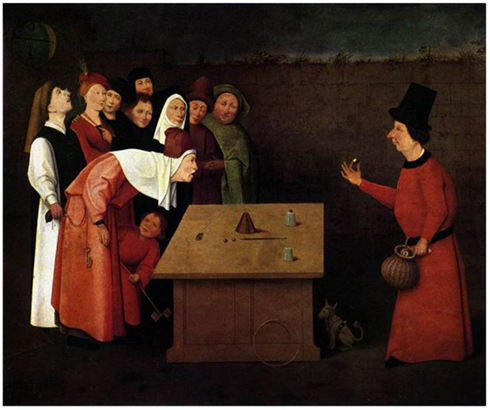
Figure 1. The Conjuror by Hieronymus Bosch (estimated 1475–1505). The conjuror on the right captures his audience attention with a game of cups and balls. Cups and balls routines were first introduced more than 2000 years ago and entail a host of classic effects of magic, such as vanishes, appearances, transpositions, and substitutions. Performing a cups and balls trick is highly regarded amongst magicians since it requires a great deal of motor skills and coordination, combined with an excellent audience management to effectively misdirect the spectators’ attention away from the method. In this painting, misdirection is so powerful that the spectator in the forefront, mesmerized by the conjuror’s performance, fails to notice that someone standing behind him is stealing his wallet.
Misdirection is central to magic, and has attracted much interest from magicians. Our conscious experience of the world is determined by a cascade of cognitive and neurological processes; generally starting with the encoding of perceptual information, which is then further processed and stored in memory, before being retrieved and thus entering consciousness (Koch, 2004). Alterations to any of these processes will influence our conscious experience and lead to conspicuous failures in awareness such as change blindness (Simons and Rensink, 2005), inattentional blindness (Mack and Rock, 1998; Simons and Chabris, 1999), repetition blindness (Kanwisher, 1987; Whittlesea and Podrouzek, 1995; Whittlesea et al., 1995), visual masking (Macknik, 2006), the attentional blink (Raymond et al., 1992), or simply forgetting or mis-remembering (Loftus, 1979).
As a consequence magicians have developed techniques that manipulate different levels of this perceptual chain. For example, what we attend to (i.e., manipulating spatial attention)? How we remember an event? How do we interpret causality? Whilst much of the practical, as well as theoretical, knowledge about misdirection is typically linked to specific magic tricks, numerous magic scholars have proposed frameworks that formulate some of the general principles of misdirection. For example, Sharpe (1988) distinguished between active and passive misdirection, whereby the former involves those methods that attract spatial attention due to some kind of transient change in sound or movement. Passive misdirection, on the other hand, refers to methods that work by unobtrusively manipulating our minds through the way in which people react to static stimuli. Ascanio and Etcheverry (2000), on the other hand, described 3 degrees of misdirection. The first degree would be when the magician performs two simultaneous actions, the method behind the magic trick, or secret move, and a distractor. Having to attend to both, the spectator cannot focus on the method and that, in general, suffices to make this go unnoticed. In the second degree, the two actions are not perceptually equivalent, such as when a big move covers a small move, and as a result misdirection is enhanced. Ascanio’s third degree would be the same as Sharp’s active misdirection. Magicians often talk about misdirection in terms of creating zones of high and low interest, whereby the former will attract attention at the expense of the latter (Figure 2). In fact, Apollo Robins, believes that misdirection is not merely to divert attention away from the secret move. He thinks it is more about the magician’s capacity to draw attention to a particular place, which he calls frame, at a particular time (Robins, 2007; Magic of Consciousness Symposium; http://assc2007.neuralcorrelate.com). This creates a sort of tunnel vision in which any action occurring outside of the frame goes unnoticed and, in addition, the smaller the frame the stronger the sense of misdirection (see also Ascanio and Etcheverry, 2000). Moreover, differences are drawn between manipulations of spatial attention and time perception (Sharpe, 1988; Tamariz, 1988; Lamont and Wiseman, 1999; Ortiz, 2006). Time misdirection works because magicians separate the method from the magical effect and this separation generates false causal links between unrelated actions, preventing the audience from being able to mentally reconstruct the trick. As is apparent from this small, and rather incomplete, review the concept of misdirection has attracted much interest amongst magicians, and whilst it is somewhat poorly defined and lacks a clear overarching theory, magicians have developed much expertise in how our perception can be manipulated.
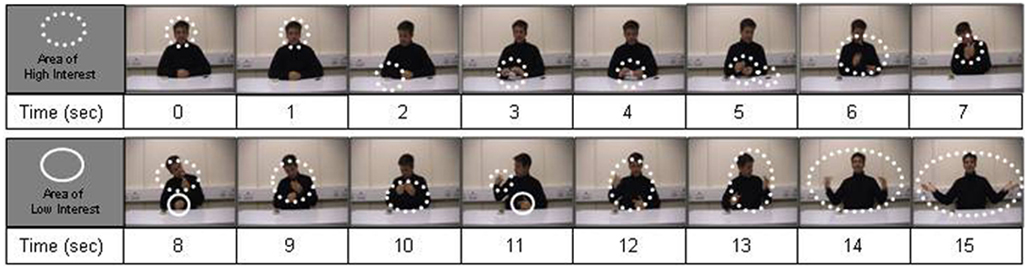
Figure 2. Zones of high and low interest during a magic trick. The figure shows the second by second breakdown of a misdirection routine. The magic effect behind the trick was the disappearing of a lighter and a cigaret; the method was for the magician to simply drop the items into his lap. Although the dropping gesticulation was fully visible, misdirection prevented most of the observers from seeing this event. The dotted and solid ovals represent the areas of high and low interest, respectively. A cigaret is removed from the packet and deliberately placed in the magician’s mouth the wrong way round (1–7 s). The magician then pretends to light the cigaret (7 s). The flame creates a high luminance and attracts attention. Both the spectator and magician then notice this mistake, which raises the interest in the cigaret (8 s). The magician then turns the cigaret around, while keeping his gaze fixed on the cigaret and the hand manipulating it (8–9 s). During this maneuver, the hand holding the lighter is lowered to the tabletop and drops the lighter into the magician’s lap. This dropping of the lighter happens in a low area of interest. The disappearing lighter is dramatically revealed by snapping his fingers and waving his hands (11 s). The method for making the cigaret disappear relies on it being dropped into the lap. This action is fully visible, with the cigaret dropped from 15 cm above the table top (11 s). Surprisingly, most participants did not see this: at the time the cigaret is dropped it is an area of low interest (the other hand is an area of high interest). In this case, the high interest is manipulated by three things: (i) surprise: the disappearance of the lighter automatically leads to interest, (ii) social cues: the magician looks at the hand that previously held the lighter and rotates his body in that direction, and (iii) movement and sound: at the time of the drop the magician snaps his fingers and waves his hand, thereby attracting attention. Adapted from Kuhn et al. (2008a).
Misdirection – The Scientific Paradigm
Science relies on clear definitions of concepts. Rather than explaining misdirection as a whole, attempts have been made to link some of the misdirection principles to scientific concepts of perception, and develop paradigms that can be used to explore these mechanisms more systematically. One such paradigm is the Misdirection Paradigm (Figure 2), in which participants view a pseudo “magic trick” in which the magician makes a cigaret and lighter disappear (Kuhn and Tatler, 2005). The disappearance of these objects relies on the magician dropping them into his lap, which happens in full view of the observer. However, the misdirection employed by the magician prevents most observers from detecting this event. Crucially, as the method (i.e., the dropping of the objects) takes place in full view, we can use participants’ detection of the method (i.e., did you see the object being dropped?) as a probe of the misdirection’s effectiveness.
It has been argued that the mechanism involved in preventing participants from detecting the method is analogous to inattentional blindness (Kuhn and Tatler, 2005; Kuhn and Findlay, 2010). Inattentional blindness refers to the phenomena that people often fail to perceive a fully visible event when engaged in an attentionally demanding distractor task (Mack and Rock, 1998; Simons and Chabris, 1999). Given the similarity between inattentional blindness and misdirection, it has been argued that the principles involved in misdirection rely on inattentional blindness, whereby people’s attention is misdirected thus preventing them from perceiving the method (Kuhn and Findlay, 2010). The similarities and differences between inattentional blindness and misdirection have caused much debate. Whilst some have argued for numerous discontinuities between the two (Memmert, 2010; Memmert and Furley, 2010), others have suggested that they do indeed involve very similar concepts (Moran and Brady, 2010; Most, 2010; Kuhn and Tatler, 2011). What is clear from this debate is that whilst inattentional blindness paradigms typically require participants’ attention to be distracted using an explicit distractor task (e.g., count the number of basket ball passes), the distraction in the misdirection paradigm occurs implicitly through different misdirection principles (Kuhn and Tatler, 2011). Indeed it is people’s failure in realizing that they have been misdirected, that is crucial, and one of the features that distinguishes it from simple distraction (Lamont et al., 2010).
The related phenomena of change blindness refers to people’s failure in noticing substantial changes to a visual scene, if the visual transient associated with the change is masked (Rensink et al., 1997). Moreover, if attention is captured using a strong attentional cue, participants often fail to notice the change, thus demonstrating that attention is needed to consciously perceive it (O’Regan et al., 1999). Change blindness could also involve a limit in the amount of information about a scene that can be stored in visual short-term memory (vSTM) at any given time, or a limit on the comparison process (Scott-Brown et al., 2000). The exact way that these different aspects of scene perception are involved is still unclear. There are numerous situations in which a magician may switch an item for something else, and misdirection is employed to prevent participants from detecting the change. As such, rather than relaying on people’s perception of a transient event, their susceptibility toward change blindness offers a valuable probe to investigate the effectiveness of misdirection. For example, in a series of experiments, misdirection has been used to prevent people from seeing an obvious color change to a deck of cards (Teszka et al., 2011). Here linguistic social cues (i.e., asking a question) were used to prevent participants from detecting this change; thus change detection was used to measure the effectiveness of the misdirection. Although the mechanism between inattentional and change blindness may differ substantially (Rensink, 2000), in practice misdirection may be used to induce both types of blindness (Memmert, 2010; Kuhn and Tatler, 2011).
Misdirection has also been used to investigate the mechanisms involved in vSTM. Change blindness has been studied both in the laboratory and in more realistic, real-world situations. In a laboratory setting, it is easy to control for cognitive load, vSTM capacity, and the allocation of attention. However, change blindness protocols often employ rather un-naturalistic viewing conditions in which subjects are asked to perform many repetitions of a task that they know, or even have practiced, beforehand. During natural vision experiments, on the other hand, subjects are naïve to the task but it is difficult to control where they are directing their attention to and whether or not they may be engaged in other, competing, cognitive tasks. Some magic tricks provide a new and unique opportunity to leverage the strengths of the two experimental approaches while avoiding their particular drawbacks. Alonso-Pablos et al. (submitted) have recently used misdirection to study the interaction between attention and vSTM. Their results show that items, cards or human faces in this case, that lie outside the focus of attention can still be effectively stored in vSTM (see also Simons et al., 2002). Moreover, this passive representation of a visual scene is rather rich and, even though it does not give rise to conscious perception, it can be unconsciously retrieved and used in a two-alternative forced choice paradigm as efficiently as the previously attended objects. These results suggest that a classical change detection paradigm might not be the best approach to study the capacity of vSTM (see also Makovski et al., 2006). Interestingly, this passive, unconscious, vSTM was very labile and the authors showed that patter, the casual chitchat used by magicians to distract audiences, can effectively interfere with, and even completely abolish, its contents. These results further illustrate that magicians’ intuitions about the potential for distraction of verbal misdirection, involving linguistic social cues, are fundamentally correct.
Where people look provide us with an effective online measure of overt attention (Liversedge and Findlay, 2000; Henderson, 2003). Advances in eye tracking technologies have enabled researchers to accurately measure people’s eye movements whilst watching different types of magic tricks. Indeed these studies have demonstrated a high consistency of eye movements, thus illustrating that misdirection is very effective in manipulating were people look (Kuhn and Tatler, 2005; Kuhn and Land, 2006). Macknik et al. (2008) have defined overt misdirection as the magician’s actions that divert the spectator’s gaze away from the method behind the effect. Covert misdirection, on the other hand, refers to instances in which it is the attention of the audience that is directed away from the method, irrespective of the position of their gaze (e.g., Kuhn and Tatler, 2005). Whilst magicians are mainly concerned with what people see, rather than were they look, misdirection clearly offers a valuable tool to investigate, in addition, oculomotor behavior (e.g., Kuhn and Tatler, 2005; Kuhn and Land, 2006; Otero-Millan et al., 2011).
Rather than using misdirection to prevent people seeing an event, misdirection can make people perceive illusory events that have not occurred. For example, Triplett (1900; Kuhn and Land, 2006) developed the vanishing ball illusion in which a magician is seen throwing a ball up in the air a couple of times, before merely pretending to throw it. Most of the observers claimed to have seen a “ghost ball” leaving the hand on the final throw, thus illustrating that people’s perception of an event is largely influenced by expectations, rather than the physical presence of the ball. Kuhn and Land (2006) developed careful measures enabling them to establish the effectiveness of this illusion. Cui et al. (2011) developed a related paradigm in which participants were repeatedly asked to view a video clip of a magician tossing a coin from one hand to the other. On some of the trials the coin was tossed for real, whilst on the other half of the trial the magician merely pretended to toss the coin. On a large proportion of trials, participants claimed to have seen the coin fly from one hand to the other, even though it was not physically present. People’s perception of this illusory event could be used to measure the effectiveness of the illusions.
Whilst the magicians’ concept of misdirection may be rather broadly defined, scientists have come up with a variety of paradigms that enable us to investigate some of the principles of misdirection scientifically, and even take advantage of these magical techniques to explore the neural and behavioral correlates of visual perception, attention, and awareness.
Misdirection – The Scientific Findings
Numerous studies have now demonstrated that misdirection provides an extremely effective way of manipulating what people see. Rather surprisingly, these studies have consistently shown that people’s detection of the event (i.e., the lighter or cigaret drop) was independent of where they were looking (Figure 3), thus demonstrating that misdirection generally relies on manipulating covert (i.e., attention in the absence of eye movements), rather than overt attention (i.e., were people look; Kuhn and Tatler, 2005; Kuhn et al., 2008b, 2009; Kuhn and Findlay, 2010). However, participants who detected the drop were significantly faster to fixate the location of where the event took place in subsequent saccades than those who missed it. These results clearly illustrate that whilst covert and overt attention can be dissociated in space (Posner, 1980), there is a clear temporal link between the two.
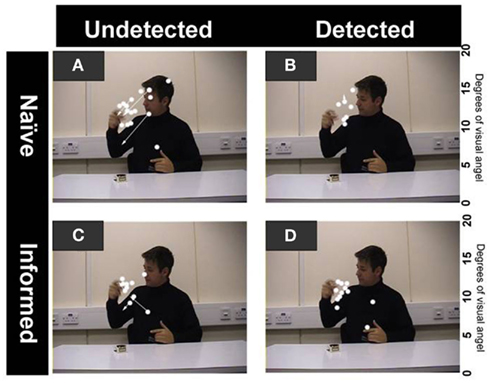
Figure 3. Misdirection works independently of direction of gaze. An eye-tracker was used to record the subjects’ fixation points at the time of the cigaret drop during the magic trick presented in Figure 2. (A) Results from naïve participants who missed the cigaret drop. (B) Naïve participants who detected the cigaret drop. (C) Informed participants who missed the cigaret drop. (D) Informed participants who detected the cigaret drop. Most of the naïve participants fixated either on the lighter hand, the head, or the area between the lighter hand and the head. Most of the informed participants looked at the lighter hand or the area between the lighter hand and the head. Interestingly, only one informed participant was able to detect the cigaret drop by using his foveal vision, showing that no systematic differences were found between the two conditions. Adapted from Kuhn et al. (2008a).
Whilst magic works when viewed live as well as on television, the subjective experience of watching a magician face-to-face is clearly different from observing him/her on television. That said, misdirection has been shown to be effective both when viewed in a face-to-face interaction (Kuhn and Tatler, 2005; Tatler and Kuhn, 2007) as well as when observed on a computer monitor (Kuhn et al., 2008b). However, differences did emerge. For example, the misdirection experienced in the face-to-face interaction was more effective than when viewed on a monitor. Moreover, in the face-to-face scenario, participants’ instruction as to what they were about to see did not influence their eye movement behavior, nor did it improve their detection of the dropped cigaret. However, when viewed on a computer monitor, prior instructions influenced both detection as well as eye movement behavior. It has recently been shown that eye movements in social context greatly vary depending on whether a person is seen for real compared to a video screen (Laidlaw et al., 2011), and future research could investigate the role that the presentation medium has on misdirection.
One of the key rules in magic states that magicians should never repeat the same trick using the same method. Indeed all of the published papers to date demonstrate that participants are less susceptible toward misdirection when the same trial is repeated (Kuhn and Tatler, 2005; Kuhn et al., 2008b, 2009; Kuhn and Findlay, 2010; Cui et al., 2011). Whereas some research groups have relied on single presentation of trials, others have opted to use numerous presentations of the same trial (e.g., Cui et al., 2011). Whilst the latter method is clearly advantageous in terms of efficient data collection, the fact that the effectiveness of misdirection is greatly reduced does raise some questions as to the reliability of multiple trial presentations.
Even as many of the misdirection techniques are heavily debated amongst magicians, most would agree that social cues (i.e., where the magician looks) play a fundamental role in misdirection. For example, as Sharpe points out “people tend to look in the same direction as the person they are watching looks” (1988, p. 64). Indeed most of the experimental work supports the view that gaze cues play an important role in manipulating what people see. For example, using the vanishing ball illusion, it has been shown that participants’ susceptibility toward the illusion is greatly influenced by the magician’s social cues (Kuhn and Land, 2006). When the magician looked at the hand that was concealing the ball, rather than following the imaginary trajectory of the ball, the effectiveness of the illusion was greatly reduced. Using the Misdirection Paradigm, an analysis of people’s eye movements showed a strong correlation between were the magician was looking and the observer’s gaze (Tatler and Kuhn, 2007). Moreover, using an experimental approach in which the magician’s gaze cues were experimentally manipulated, it was shown that the magician’s gaze cues influenced both what people saw, as well as where they were looking (Kuhn et al., 2009). Cui et al. (2011) on the other hand, argue that, at least in some routines, perception of magic can be stronger without social cues. Their conclusion is based on findings from the vanishing coin trick, in which the magician either tosses a coin for real, or merely pretends to toss it from one hand to the other. Immediately prior to the toss the magician’s gaze is directed toward the observer, and it was thought that this direct eye gaze would capture participants’ attention and thus prevent them from distinguishing between the real and the fake toss. The magician’s joint attention cues were manipulated by occluding his head using an artificial mask. They found that subjects did not direct their gaze at the magicians face at the time of the toss, and that the illusion was strongest in the presentations where the magician’s head was occluded. These results suggest that joint attention plays no role in the perception of this effect. However, it should be noted that the mask itself may have captured people’s attention and thus misdirected them from the method. As acknowledged by the authors, further research in which the magician’s gaze is experimentally manipulated is required before any final conclusions about the use of social cues in this illusion can be drawn. However, on the whole, the scientific evidence supports the notion that social cues play a pivotal role in misdirection.
Anecdotal evidence from magicians suggests that not everyone is equally deceived by misdirection. To date, however, there is only one experimental study that has investigated individual differences in misdirection. Individuals with autism have rather specific impairments in processing social information, and it is thought that these individuals tend to avoid social information (Nation and Penny, 2008), and in particular tend to be less effective at using joint attention (Leekam et al., 1998). Given the importance that social cues play in misdirecting attention, it was predicted that individuals with autism should be less misdirected and thus less susceptible toward the Vanishing Ball illusion. However, rather surprisingly, it was shown that individuals with autism did make use of the social cues, and in fact were more susceptible toward the Vanishing Ball illusion (Kuhn et al., 2010). This study further highlighted that individuals with autism had particular difficulties in allocating attention fast enough to the relevant location, which may have resulted in higher levels of deception. We are obviously only at the beginning of understanding some of the individual differences in susceptibility toward misdirection, but misdirection clearly offers a valuable tool to investigate individual differences in attentional allocation.
Otero-Millan et al. (2011), investigated the effectiveness of different types of motion trajectories in misdirecting attention. These authors showed that curved motion resulted in different types of eye movements (more smooth pursuit) than rectilinear motion, and participants were less likely to look back at the hand from which attention was being misdirected. These findings offer a valuable starting point for investigating the way in which different movements influence attention.
Future Directions
From this review it is apparent that the recent interest in the science of magic has lead to great advances in understanding some of the brain mechanisms involved in misdirection. More importantly, the scientific investigations into misdirection have greatly furthered our understanding of visual cognition and perception in general. That said, this science of magic is clearly in its infancy, leaving much scope for future explorations. What direction should this field of study take? One obvious step would be to establish a taxonomy and more unifying theory of misdirection. There are several theoretical texts which try to conceptualize misdirection (Fitzkee, 1945; Sharpe, 1988; Tamariz, 1988, 2007; Ortiz, 2006), however, most knowledge and experience about misdirection is described within the context of specific magic tricks (e.g., Ganson, 1980). Whereas it is debatable whether such an all-inclusive theory of misdirection is feasible (Lamont et al., 2010), a comprehensive, and up to date review of the magic literature focusing on misdirection would certainly be a valuable starting point for future scientific explorations. Crucially, it would at least make this knowledge accessible to researchers with little background in magic. Whilst some attempts have been made to bridge the gap between magic and science (Fraps, 1998; Lamont and Wiseman, 1999; Macknik et al., 2010), most theory to date has been written from the perspective of the magician, rather than the scientist. A wide-ranging review of the literature on misdirection would certainly require and benefit from the close collaboration between the two fields.
In addition, further steps should be taken in understanding the cognitive as well as neural mechanisms involved in misdirection. Magicians are primarily interested in discovering powerful and reliable ways of manipulating the audiences’ awareness. As scientists, on the other hand, we are interested in understanding the underlying brain mechanisms of this deception. In principle, they could be at a perceptual level or involve higher cognitive processes, such as working memory or attentional mechanisms. For example, Apollo Robins’ intuition that misdirection is stronger when the magician draws attention into a small frame could be reminiscent of a recent report showing that, in monkey primary visual cortex (V1), increasing task difficulty enhances neuronal firing rate at the focus of attention and suppresses it in regions surrounding the focus (Chen et al., 2008). Similar center–surround mechanisms of spatial attention (Moran and Desimone, 1985; Treue and Maunsell, 1996; Reynolds et al., 1999; Recanzone and Wurtz, 2000; Martinez-Trujillo and Treue, 2002; Ghose and Maunsell, 2008) have been reported previously in different visual cortical areas, including V4 (Sundberg et al., 2009) and even in motion processing areas such as hMT+/V5 (Moutsiana et al., 2011), It is, therefore, even possible that active and passive, or overt and covert, forms of misdirection have different neural correlates. Thus, magical techniques offer a unique test bed for current theories of visual perception, attention, and awareness. If used in a controlled laboratory environment, they will certainly shed new light on highly debated perceptual phenomena such as change blindness, inattentional blindness, and others. As suggested above, whilst some of the mechanism used by magicians are likely to be the same as those used in traditional experimental paradigms (e.g., attentional orientating by gaze cues), others may differ and may be specific to magic (e.g., social conformity). Only future research will inform us about the exact relationship between misdirection and other attentional manipulations. We do not argue that misdirection is a concept entirely removed from what has been studied by scientists in the past. The main advantage of studying misdirection is that it allows us to exploit the magicians’ real-world experience in attentional manipulation, and as such may inform us about the aspects of the environment responsible for driving attention in the real-world.
Misdirection will only be truly understood through empirical investigations using a broad range of new paradigms, each with their own and unique merits and pitfalls (Kuhn et al., 2008a; Macknik et al., 2008; Barnhart, 2010). These new avenues of research will permit to address countless unanswered questions that remain to be explored. What makes the techniques used in misdirection such powerful tools to manipulate spatial attention? Can we identify new attentional principles used by magicians, yet ignored by scientist? How does the context in which the magician is observed influence misdirection? How do magicians control the “collective attention” in an audience? Is this a self-organizing process, alike to what happens when an audience turns into synchronized clapping at the end of a play in a theater? What are the neural correlates of these synchronizing strategies employed by magicians? The answer to these questions, and many others, may be just a few steps away if we adopt magical techniques, such as those used in misdirection, as part of our laboratory toolkit to investigate sensory awareness.
Conflict of Interest Statement
The authors declare that the research was conducted in the absence of any commercial or financial relationships that could be construed as a potential conflict of interest.
Acknowledgments
Work in the laboratory of Luis M. Martinez is supported by grants CONSOLIDER CSD2007-00023 (European Regional Development Fund) and BFU2007-67834 and BFU2010-22220 (Spanish Ministry of Education and Science).
References
Barnhart, A. S. (2010). The exploitation of Gestalt principles by magicians. Perception 39, 1286–1289.
Bunzeck, N., Wuestenberg, T., Lutz, K., Heinze, H. J., and Jancke, L. (2005). Scanning silence: mental imagery of complex sounds. Neuroimage 26, 1119–1127.
Chen, Y., Martinez-Conde, S., Macknik, S. L., Bereshpolova, Y., Swadlow, H. A., and Alonso, J.-M. (2008). Task difficulty modulates activity of specific neuronal populations in primary visual cortex. Nat. Neurosci. 11, 974–982.
Cui, J., Otero-Millan, J., Macknik, S. L., King, M., and Martinez-Conde, S. (2011). Social misdirection fails to enhance a magic illusion. Front. Hum. Neurosci. 5:103.
Desimone, R., and Duncan, J. (1995). Neural mechanisms of selective visual attention. Annu. Rev. Neurosci. 18, 193–222.
Fraps, T. (1998). “The blind spot,” in The Book or Don’t Forget to Point, eds T. Fraps, H. Thun, and J. Willich (Washington, DC: Kaufman and Company), 142–154.
Ghose, G. M., and Maunsell, J. H. (2008). Spatial summation can explain the attentional modulation of neuronal responses to multiple stimuli in area V4. J. Neurosci. 28, 5115–5126.
Henderson, J. M. (2003). Human gaze control during real-world scene perception. Trends Cogn. Sci. (Regul. Ed.) 7, 498–504.
Kanwisher, N. G. (1987). Repetition blindness: type recognition without token individuation. Cognition 27, 117–143.
Koch, C. (2004). Quest for Consciousness: A Neurobiological Approach. Englewood, CO: Roberts and Co.
Kuhn, G., Amlani, A. A., and Rensink, R. A. (2008a). Towards a science of magic. Trends Cogn. Sci. (Regul. Ed.) 12, 349–354.
Kuhn, G., Tatler, B. W., Findlay, J. M., and Cole, G. G. (2008b). Misdirection in magic: implications for the relationship between eye gaze and attention. Vis. Cogn. 16, 391–405.
Kuhn, G. (ed.). (2010). Cognitive Illusions: From Magic to Science, Amsterdam: John Benjamins Publishing Company.
Kuhn, G., and Findlay, J. M. (2010). Misdirection, attention and awareness: inattentional blindness reveals temporal relationship between eye movements and visual awareness. Q. J. Exp. Psychol. (Hove) 63, 136–146.
Kuhn, G., Kourkoulou, A., and Leekam, S. R. (2010). How magic changes our expectations about autism. Psychol. Sci. 21, 1487–1493.
Kuhn, G., and Land, M. F. (2006). There’s more to magic than meets the eye. Curr. Biol. 16, R950–R951.
Kuhn, G., and Tatler, B. W. (2005). Magic and fixation: now you don’t see it, now you do. Perception 34, 1155–1161.
Kuhn, G., and Tatler, B. W. (2011). Misdirected by the gap: the relationship between inattentional blindness and attentional misdirection. Conscious. Cogn. 20, 432–436.
Kuhn, G., Tatler, B. W., and Cole, G. G. (2009). You look where I look! Effect of gaze cues on overt and covert attention in misdirection. Vis. Cogn. 17, 925–944.
Laidlaw, K. E., Foulsham, T., Kuhn, G., and Kingstone, A. (2011). Potential social interactions are important to social attention. Proc. Natl. Acad. Sci. U.S.A. 108, 5548–5553.
Lamont, P., Henderson, J. M., and Smith, T. J. (2010). Where science and magic meet: the illusion of a “science of magic.” Rev. Gen. Psychol. 14, 16–21.
Leekam, S. R., Hunnisett, E., and Moore, C. (1998). Targets and cues: gaze following in children with autism. J. Child Psychol. Psychiatry 39, 951–962.
Liversedge, S. P., and Findlay, J. M. (2000). Saccadic eye movements and cognition. Trends Cogn. Sci. (Regul. Ed.) 4, 6–14.
Macknik, S. L. (2006). Visual masking approaches to visual awareness. Prog. Brain Res. 155, 177–215.
Macknik, S. L., King, M., Randi, J., Robbins, A., Teller, O., Thompson, J., and Martinez-Conde, S. (2008). Attention and awareness in stage magic: turning tricks into research. Nat. Rev. Neurosci. 9, 871–879.
Macknik, S. L., Martinez-Conde, S., and Blakeslee, S. (2010). Sleights of Mind: What the Neuroscience of Magic Reveals about Our Everyday Deceptions, New York: Henry Holt and Company.
Makovski, T., Shim, W. M., and Jiang, Y. V. (2006). Interference from filled delays on visual change detection. J. Vis. 6, 1459–1470.
Martinez-Trujillo, J. C., and Treue, S. (2002). Attentional modulation strength in cortical area MT depends on stimulus contrast. Neuron 35, 365–370.
Memmert, D. (2010). The gap between inattentional blindness and attentional misdirection. Conscious. Cogn. 19, 1097–1101.
Memmert, D., and Furley, P. (2010). Beyond inattentional blindness and attentional misdirection: from attentional paradigms to attentional mechanisms. Conscious. Cogn. 19, 1107–1109.
Moran, A., and Brady, N. (2010). Mind the gap: misdirection, inattentional blindness and the relationship between overt and covert attention. Conscious. Cogn. 19, 1105–1106; discussion 1107–1109.
Moran, J., and Desimone, R. (1985). Selective attention gates visual processing in the extrastriate cortex. Science 229, 782–784.
Most, S. B. (2010). What’s “inattentional” about inattentional blindness? Conscious. Cogn. 19, 1102–1104; discussion 1107–1109.
Moutsiana, C., Field, D. T., and Harris, J. P. (2011). The neural basis of centre-surround interactions in visual motion processing. PLoS ONE 6, e22902.
Nation, K., and Penny, S. (2008). Sensitivity to eye gaze in autism: is it normal? Is it automatic? Is it social? Dev. Psychopathol. 20, 79–97.
O’Regan, J. K., Rensink, R. A., and Clark, J. J. (1999). Change-blindness as a result of ‘mudsplashes.’ Nature 398, 34–34.
Otero-Millan, J., Macknik, S. L., Robbins, A., and Martinez-Conde, S. (2011). Stronger misdirection in curved than in straight motion. Front. Hum. Neurosci. 5:133.
Raymond, J. E., Shapiro, K. L., and Arnell, K. M. (1992). Temporary suppression of visual processing in an RSVP task: an attentional blink? J. Exp. Psychol. Hum. Percept. Perform. 18, 849–860.
Recanzone, G. H., and Wurtz, R. H. (2000). Effects of attention on MT and MST neuronal activity during pursuit initiation. J. Neurophysiol. 83, 777–790.
Rensink, R. A. (2000). When good observers go bad: change blindness, inattentional blindness, and visual experience. Psyche (Stuttg) 6.
Rensink, R. A., O’Regan, J. K., and Clark, J. J. (1997). To see or not to see: the need for attention to perceive changes in scenes. Psychol. Sci. 8, 368–373.
Reynolds, J. H., Chelazzi, L., and Desimone, J. (1999). Competitive mechanisms subserve attention in macaque areas V2 and V4. J. Neurosci. 19, 1736–1753.
Robins, A. (2007). Magic of Consciousness Symposium, Association for the Scientific Study of Consciousness, Las Vegas.
Scott-Brown, K. C., Baker, M. R., and Orbach, H. S. (2000). Comparison blindness. Vis. Cogn. 7, 253–267.
Simons, D. J., and Chabris, C. F. (1999). Gorillas in our midst: sustained inattentional blindness for dynamic events. Perception 28, 1059–1074.
Simons, D. J., Chabris, C. F., and Schnur, T. (2002). Evidence for preserved representations in change blindness. Conscious. Cogn. 11, 78–97.
Simons, D. J., and Rensink, R. A. (2005). Change blindness: past, present, and future. Trends Cogn. Sci. (Regul. Ed.) 9, 16–20.
Sundberg, K. A., Mitchell, J. F., and Reynolds, J. H. (2009). Spatial attention modulates center-surround interactions in macaque visual area V4. Neuron 61, 952–963.
Tatler, B. W., and Kuhn, G. (2007). “Don’t look now: the magic of misdirection,” in Eye Movements: A Window on Mind and Brain, eds R. P. G. van Gompel, M. H. Fischer, W. S. Murray, and R. L. Hill (Oxford: Elsevier), 697–714.
Teszka, R., Kuhn, G., and Kingstone, A. (2011). Now you see it, now you don’t: how social cues and questions misdirect our attention. Paper Presented at the Cognitive Science, Boston.
Treue, S., and Maunsell, J. H. (1996). Attentional modulation of visual motion processing in cortical areas MT and MST. Nature 382, 539–541.
Whittlesea, W. A., Dorken, M. D., and Podrouzek, K. W. (1995). Repeated events in rapid lists: part 1. Encoding and representation. J. Exp. Psychol. Learn. Mem. Cogn. 21, 1670–1688.
Keywords: misdirection, magic, attention, awareness
Citation: Kuhn G and Martinez LM (2012) Misdirection – past, present, and the future. Front. Hum. Neurosci. 5:172. doi: 10.3389/fnhum.2011.00172
Received: 20 June 2011; Accepted: 12 December 2011;
Published online: 06 January 2012.
Edited by:
Idan Segev, The Hebrew University of Jerusalem, IsraelReviewed by:
Lutz Jäncke, University of Zurich, SwitzerlandShlomo Bentin, The Hebrew University of Jerusalem, Israel
Copyright: © 2012 Kuhn and Martinez. This is an open-access article distributed under the terms of the Creative Commons Attribution Non Commercial License, which permits non-commercial use, distribution, and reproduction in other forums, provided the original authors and source are credited.
*Correspondence: Gustav Kuhn, Department of Psychology, Brunel University, Uxbridge UB8 3PH, UK. e-mail:Z3VzdGF2Lmt1aG5AYnJ1bmVsLmFjLnVr;
Luis M. Martinez, Instituto de Neurociencias de Alicante, Consejo Superior de Investigaciones Científicas-Universidad Miguel Hernández, Campus de Sant Joan, Avenida Ramón y Cajal, S/N, 03550 Sant Joan d’Alacant, Spain. e-mail:bC5tYXJ0aW5lekB1bWguZXM=