 Mujda Nooristani1,2*
 Thomas Augereau1,2
 Karina Moïn-Darbari1,2
 Benoit-Antoine Bacon3
 François Champoux1,2
- 1École d’Orthophonie et d’Audiologie, Université de Montréal, Montréal, QC, Canada
- 2Centre de Recherche de l’Institut Universitaire de Gériatrie de Montréal, Montréal, QC, Canada
- 3Department of Psychology, Carleton University, Ottawa, ON, Canada
The effects of transcranial electrical stimulation (tES) approaches have been widely studied for many decades in the motor field, and are well known to have a significant and consistent impact on the rehabilitation of people with motor deficits. Consequently, it can be asked whether tES could also be an effective tool for targeting and modulating plasticity in the sensory field for therapeutic purposes. Specifically, could potentiating sensitivity at the central level with tES help to compensate for sensory loss? The present review examines evidence of the impact of tES on cortical auditory excitability and its corresponding influence on auditory processing, and in particular on hearing rehabilitation. Overall, data strongly suggest that tES approaches can be an effective tool for modulating auditory plasticity. However, its specific impact on auditory processing requires further investigation before it can be considered for therapeutic purposes. Indeed, while it is clear that electrical stimulation has an effect on cortical excitability and overall auditory abilities, the directionality of these effects is puzzling. The knowledge gaps that will need to be filled are discussed.
Introduction
Transcranial Electrical Stimulation (tES) is a Non-Invasive Brain Stimulation (NIBS) approach, in use for several decades, that involves applying a low electrical current on the human head and assessing its effects. tES has been shown to modulate spontaneous cortical activity and excitability, leading to alterations of behavior, cognition and sensory perception (for a review: Yavari et al., 2018). tES can be generated by applying either direct current or alternating current.
Transcranial Direct Current Stimulation (tDCS) is the most frequently used type of tES in both clinical and research domains. tDCS has been reported to modulate resting membrane potentials by depolarizing or hyperpolarizing cortical neurons, thereby altering their firing rate (Creutzfeldt et al., 1962; Bindman et al., 1964; Purpura and McMurtry, 1965; Radman et al., 2009). This technique consists of applying a weak direct electrical current through two or more electrodes (Priori et al., 1998). The polarity of the active electrode can be positive (anode) or negative (cathode), and the effects induced by tDCS notably depend on the polarity of the current applied. Anodal tDCS (a-tDCS) at 1 mA has been shown to typically have an excitatory effect as it induces a depolarization of the resting membrane potential and consequently an increase of the firing rate of neurons (Nitsche and Paulus, 2000). On the contrary, cathodal tDCS (c-tDCS) at 1 mA induces a hyperpolarization of the resting membrane potential, which thereby decreases the firing rate of neurons. These effects were demonstrated in the motor cortex by means of Motor Evoked Potentials (MEPs); a-tDCS increased MEPs amplitude and c-tDCS decreased it (Paulus, 2011). However, a reverse effect of a-tDCS and c-tDCS can be observed depending on many factors, such as the direction of current flow relative to neuronal orientation or duration of stimulation (Jefferys, 1981; Bikson et al., 2004; Kabakov et al., 2012; Paulus et al., 2013). tDCS effects have been observed during stimulation (online effect), but also after a sufficient stimulation (offline effect). Previous studies demonstrated that the after-effect of tDCS can last for several minutes and even hours following the end of stimulation. However, to induce an offline effect, the intensity and duration of stimulation have to be adjusted. This effect is mediated by mechanisms similar to Long-Term Potentiation (LTP) and Long-Term Depression (LTD) (Bindman et al., 1964; Nitsche and Paulus, 2000; Fritsch et al., 2010; Paulus et al., 2012).
Transcranial Alternating Current Stimulation (tACS) consists of a sinusoidal current applied at a specific frequency that alternates between electrodes (Reed and Kadosh, 2018). This neuromodulation technique modulates neuronal firing to the external frequency applied with tACS and thereby synchronizes cortical oscillation (Antal and Paulus, 2013; Herrmann et al., 2013). tACS therefore enables to assess the influence of cortical oscillation on perception and cognition. It has been demonstrated to have an after-effect similar to tDCS, which is linked to induced neuroplastic changes (Vossen et al., 2015).
Multiple alternating currents can also be applied simultaneously in an approach known as transcranial Random Noise Stimulation (tRNS). tRNS induces noise by means of multiple alternating currents varying in amplitude and frequency. The bandwidth can vary from 0.1 to 640 Hz, and it can also be divided into lower (0.1–100 Hz) or higher (100–640 Hz) frequency bands. The mechanism behind the effect of tRNS is Stochastic Resonance (SR) which enables the enhancement of information processing and detection of subthreshold signals by adding noise in a non-linear system, such as the human brain (McDonnell and Ward, 2011). A previous study has demonstrated that tRNS applied on the motor cortex induces an enhancement of cortical excitability and effect lasting up to 1-h post-stimulation (Terney et al., 2008). The putative mechanism of tRNS action has been linked to the potentiation of voltage-gated sodium channels (Terney et al., 2008).
tES has been primarily shown to have an influence on motor cortical excitability by increasing and decreasing MEPs (Nitsche and Paulus, 2000), however, the application of tES on the motor cortex can also modulate a number of motor functions. Indeed, a-tDCS has been shown to improve performance of different motor tasks (e.g., Boggio et al., 2006; Vines et al., 2008; Sohn et al., 2012). Recently, there has been increasing evidence of the therapeutic effects of tES, notably an enhancement of motor functions and cognitive performances in older adults and in individuals with various neurological disorders. A recent meta-analysis reported robust beneficial evidences of a-tDCS for an array of motor functions, but also for some cognitive functions, such as working memory and language production (Summers et al., 2016).
Another clinical population that seems to benefit from tES approaches is stroke patients. Specifically, multiple studies reported that electrical stimulation, and more particularly tDCS, enhanced the upper and lower limb recovery of stroke patients showing motor dysfunctions (for review see Bai et al., 2019). Interestingly, other studies reported improvement on motor tasks as well as an enhancement of the acquisition of motor tasks in stroke patients with tDCS, and the effect lasted minutes to hours post-stimulation (Hummel et al., 2005; Zimerman et al., 2012). Stroke patients can also benefit from a-tDCS for language recovery, as such stimulation has been shown to improve naming performance and naming reaction time (Baker et al., 2010; Fridriksson et al., 2011). Furthermore, tES techniques seem to have therapeutic effects for several other neurological disorders, notably Parkinson’s disease (Broeder et al., 2015; Chen and Chen, 2019) and Alzheimer’s disease (Hsu et al., 2015; Chang et al., 2018). However, it is still unclear whether these therapeutic effects would extend to the sensory field.
Here, we review the evidence that supports the use of tES as a tool for targeting and modulating plasticity in the sensory field. Indeed, if tES is recognized as a potentiator of sensitivity at the central level, it could help to alleviate sensory loss. We more specifically sought to examine the evidence revealing the impact of tES on cortical auditory excitability and its corresponding effect on auditory processing, and in particular on hearing rehabilitation.
The Effects of Transcranial Electrical Stimulation on Auditory Cortical Excitability
Emerging literature suggests that tES techniques can have an effect on the excitability of the auditory cortex. Indeed it was repeatedly demonstrated, as summarized in Table 1, that electrophysiological responses are modulated by electrical stimulation. Two different paradigms are generally employed to investigate the effects of tES on auditory electrophysiological responses, namely (i) Auditory Evoked Potentials (AEPs) and (ii) auditory event-related potentials (AERPs).
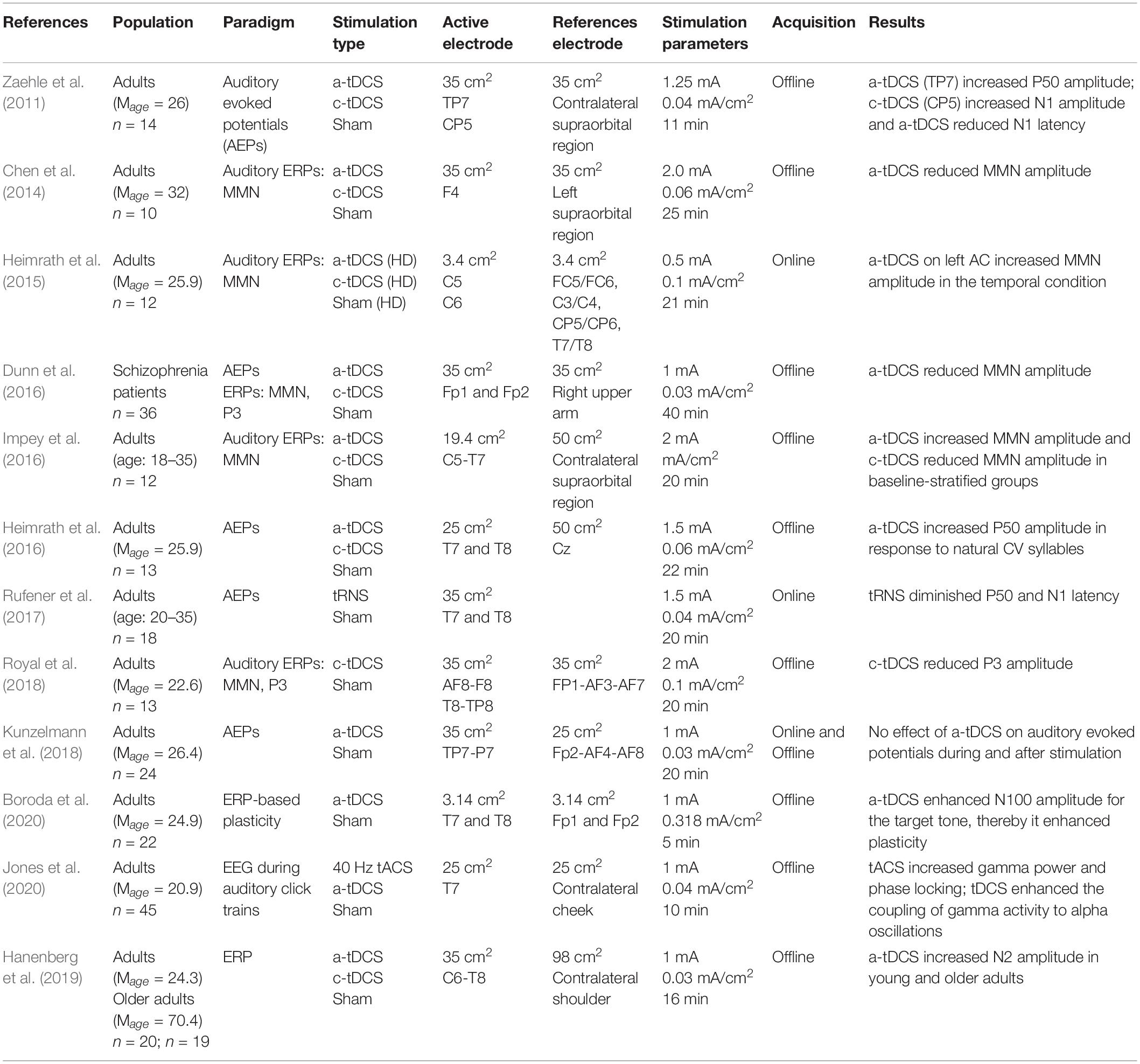
Table 1. Auditory electrophysiological responses.
Zaehle et al. (2011) reported the effect of tDCS on AEPs amplitude, with a-tDCS increasing P50 amplitude and c-tDCS increasing N1 amplitude. These effects were dependent on the position of the active electrode: a-tDCS had an effect when the TP7 region was stimulated and c-tDCS had an effect when applied on CP5. Heimrath et al. (2016) demonstrated similar AEPs results in response to voiced and voiceless natural CV syllables. However, Kunzelmann et al. (2018) did not find an effect of a-tDCS on AEPs. These discrepancies can be attributed to the positioning of the active electrode and to the specificities of stimulation parameters. Indeed, Kunzelmann et al. (2018) placed the active electrode at a temporo-parietal location (over TP7 and P7), while Zaehle et al. (2011) placed the active electrode slightly higher (CP5) in the temporo-parietal area, or at a temporal level (TP7). A temporal area (T7 and T8) was also chosen by Heimrath et al. (2016), and the results were similar to Zaehle et al. (2011), as an increase of P50 was observed with a-tDCS. These results underline the importance of electrode positioning in the assessment of tES effects on electrophysiological responses. The different stimulation parameters used also contributed to the discrepancies of results; notably, current intensity, current density, the duration of stimulation and the size of electrodes were different in all three studies.
Only one study examined the effect of tRNS on AEPs. Rufener et al. (2017) revealed that such stimulation reduced P50 and N1 latency. These results are in line with the improved performance observed on the Gap Detection Task (GDT) assessed in the second part of their study (see section on “Temporal Processing”). Therefore, they suggest that tRNS can improve neural conduction time by reducing responses latencies.
Several studies also used the auditory event-related potentials paradigm to study the influence of tES on electrophysiological responses, and there are once again large discrepancies between studies. Indeed, some studies demonstrated a decrease of the mismatch negativity (MMN) amplitude with a-tDCS when stimulating frontal regions (Chen et al., 2014; Dunn et al., 2016), while others showed that a-tDCS over auditory cortices increased MMN amplitude (Heimrath et al., 2015; Impey et al., 2016). No study found effects of c-tDCS on MMN, but one reported a reduction of P3 amplitude (Royal et al., 2018). Stimulation locations and electrode montage differed between the various studies. It is expected that a variety of effects that can be obtained through different stimulation parameters, considering that MMN can originate from multiple generators.
Interestingly, Heimrath et al. (2015) used a novel type of electrode montage, namely High-Definition (HD) tDCS. This stimulation montage consists of 4 reference electrodes, making a ring around the active electrode on the target region. This electrode montage has been reported to improve spatial definition, to induce a higher electrical field and to reduce the risk of unwanted effect from a single reference electrode (Datta et al., 2009, 2012). They revealed an increase of MMN amplitude with HD a-tDCS, lateralized to the left auditory cortex.
Using an ERP-based paradigm, Boroda et al. (2020) demonstrated that a-tDCS applied bilaterally to the auditory cortex enhanced cortical plasticity. The application of a-tDCS during the repetitive presentation of the target tone induced an additional enhancement of the N100 amplitude, as compared to sham stimulation.
Another electrophysiological indication of the potential of tES approaches in rehabilitation was shown by Jones et al. (2020) who revealed that tACS and tDCS can modulate different components of auditory gamma responses. Indeed, tACS increased gamma evoked power and phase locking to the auditory stimulus, while tDCS strengthened the alpha-gamma phase-amplitude coupling in the absence of auditory stimuli. This finding is particularly interesting considering that multiple neurological disorders, such as autism spectrum disorder (Khan et al., 2013; Rojas and Wilson, 2014), schizophrenia (Edgar et al., 2014; Hirano et al., 2018) and bipolar disorder (Maharajh et al., 2007), present a disrupted auditory gamma responses and a disrupted cross-frequency coupling to gamma activity. Therefore, such tES techniques could potentially be used as a therapeutic approach on populations with these neurological disorders.
The Effects of Transcranial Electrical Stimulation on Auditory Processing
Considering the impact of tES on auditory cortical excitability, behavioral effects would be expected to follow. Behavioral studies have focused on tES effects on temporal processing, spectral processing, binaural integration, auditory scene analysis and speech comprehension.
Temporal Processing
Results of different studies investigating the effect of tES approaches on temporal processing are summarized in Table 2. Using a random GDT to examine temporal resolution performance, Ladeira et al. (2011) have been the first to suggest (i) an enhancement of performance with a-tDCS and (ii) a decrease of performance with c-tDCS. Studies have also examined the effect of tES in GDT: Baltus et al. (2018) demonstrated that applying tACS at 4 Hz above the individual’s gamma frequency enabled subjects to detect significantly smaller gap sizes. On the other hand, Rufener et al. (2017) studied the effect of tRNS on the GDT, showing an enhancement of temporal processing. Conversely, Heimrath et al. (2014) showed a decrease of temporal resolution on the GDT induced by a-tDCS.

Table 2. Temporal processing.
The different methodologies used in these studies might explain the disparities in the effect of a-tDCS on temporal processing. First, the different results could be explained partially by the electrode montage used as Ladeira et al. (2011) used a bilateral montage that stimulated both temporal cortices simultaneously, whereas only one temporal cortex was stimulated by Heimrath et al. (2014). Furthermore, the intensity of the current applied differed between those two experiments, as well as the size of the active electrode and the position of the active and reference electrodes (extracephalic vs. cephalic). The importance of these parameters has been shown previously in the motor domain (Dissanayaka et al., 2017). For example, an extracephalic reference electrode can reduce electrical field due to the greater distance between the active and reference electrodes (Moliadze et al., 2010). However, this type of electrode montage reduces the stimulation of unsolicited cortical areas (Im et al., 2012).
To further examine the effects of tES on temporal processing, a few studies investigated the influence of tDCS and tACS on a voice onset time categorization task, with similarly conflicting outcomes. Indeed, while the results of Heimrath et al. (2016) suggest an improvement in temporal processing induced by c-tDCS, other results using 40 Hz tACS appear to be dependent of the age of the participant, indicating an improvement of performance in older subjects, and reduced performance in younger adults (Rufener et al., 2016a,b).
Spectral Processing
The effects of tDCS on spectral processing are summarized in Table 3. The first evidence of the impact of tDCS on spectral processing was reported by Mathys et al. (2010), as they examined the effect of a-tDCS and c-tDCS on a pitch direction discrimination task. Results showed that c-tDCS over the left and the right auditory cortex lead to reduced performance in pitch discrimination. However, a-tDCS did not have any effect on performance in this task. Other researchers also studied pitch discrimination, but with a specific focus on pitch learning (Matsushita et al., 2015). The results showed that a-tDCS blocked pitch discrimination learning, as compared to c-tDCS and sham, as the only group showing no significant improvement of threshold over the 3 days of training was the one stimulated with a-tDCS.
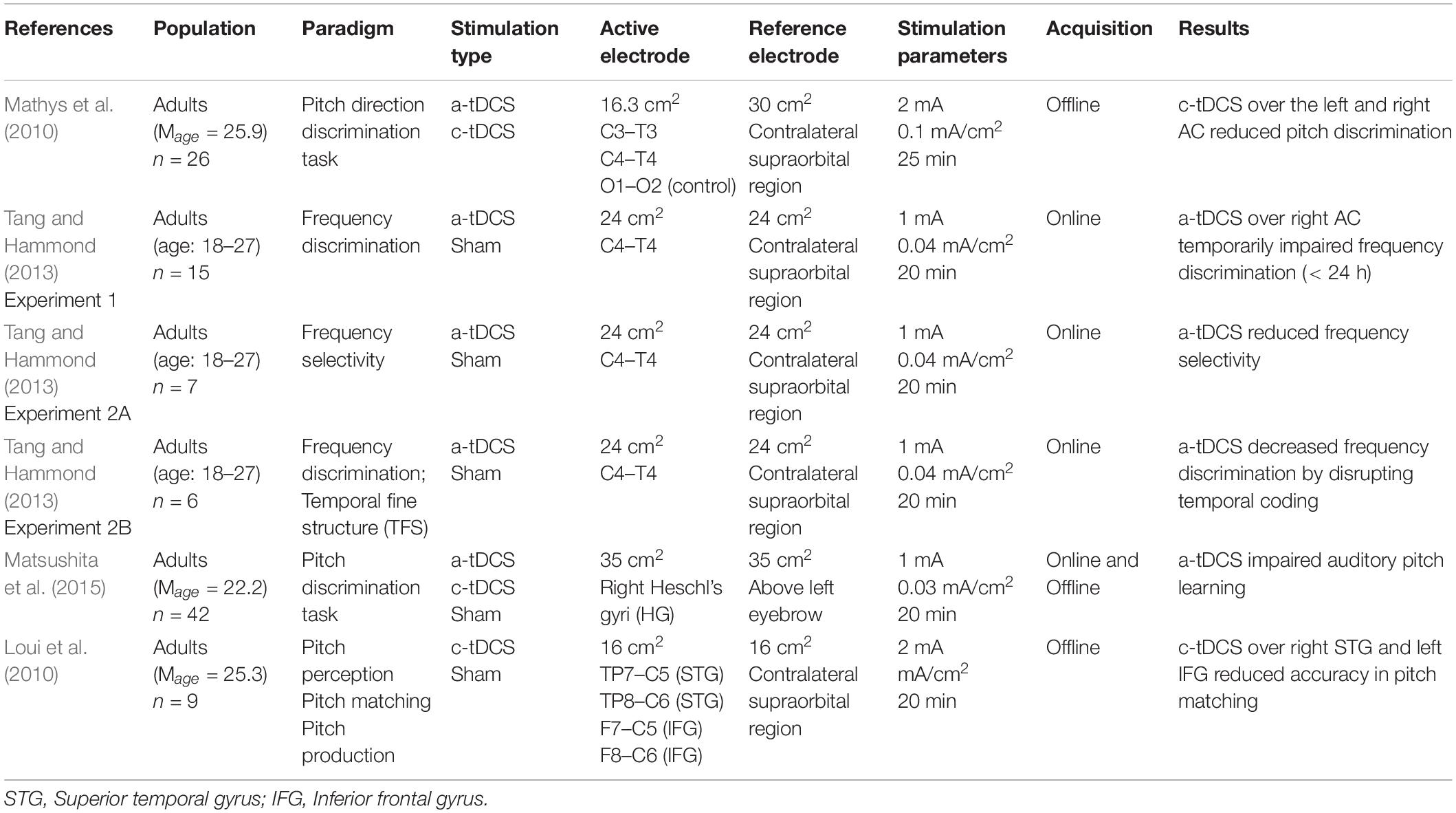
Table 3. Spectral processing.
Tang and Hammond (2013) reported similar effects of tDCS on learning processes. Indeed, they showed through a series of experiments that a-tDCS had detrimental effects on frequency discrimination and learning processes, as well as on frequency selectivity. Interestingly, in their first experiment they showed that both the a-tDCS and sham groups presented a similarly rapid perceptual learning, as they both improved over the experimental blocks. Although no significant difference for rate of learning was found, subjects in the a-tDCS group were not performing as well as the sham group, suggesting a decreased frequency discrimination without affecting learning process. Nevertheless, when assessed on the second day (without stimulation), the performance of participants in the a-tDCS group nearly returned to baseline levels, while performance of the sham group remained stable. This finding suggested that a-tDCS blocked the learning and consolidation process. Furthermore, this study also suggests that tDCS had a sustained effect on frequency discrimination, as subjects in the tDCS group still performed more poorly compared to the sham group on the second day. In their second experiment, Tang and Hammond (2013) demonstrated that tDCS decreased frequency selectivity, as a-tDCS caused psychophysical tuning curves to be broader.
Pitch processing was further examined by Loui et al. (2010), using pitch perception, pitch matching and pitch production tasks. This study revealed that c-tDCS only influences pitch matching by decreasing task accuracy.
Taken together, these results suggest that a-tDCS and c-tDCS both seem to have similar effects on various spectral processing tasks, leading to a decrease in performance. However, it is noteworthy to mention that all experiments conducted so far involved healthy young adults, which were arguably already performing at an optimal level. It should be noted, also, that all experiments used a similar stimulation duration (20–25 min) and an electrode montage with an active electrode on the temporal cortex (right/left) and an extracephalic reference electrode, which may explain the homogeneous results obtained. The varying current intensity (1–2 mA), density (0.03–0.1 mA/cm2) and electrode sizes (16–35 cm2) between studies did not induce different task performance patterns.
Binaural Integration
The influence of tES techniques on binaural integration have only been investigated in a few experiments, as can be seen in Table 4. Using a unilateral montage, D’Anselmo et al. (2015) reported no effects of a-tDCS and c-tDCS on performance at a dichotic listening task. More recently, Prete et al. (2018) observed a similar result with unilateral high frequency tRNS (hf-tRNS). However, in a second experiment, Prete et al. (2018) demonstrated that a bilateral montage of hf-tRNS enhanced the right ear advantage. These results on the effect of tES on binaural integration suggest that only a bilateral montage can modulate this auditory ability, presumably by more efficiently inducing stochastic resonance, as compared to unilateral tRNS where only one active electrode induces noise in the system. Similarly, it was also shown in language rehabilitation and sound perception that a bilateral montage is more effective than a unilateral montage (Galletta et al., 2015; Prete et al., 2017). Differences in the parameters used might also had an impact on the results. Indeed, both studies using a unilateral montage used an extracephalic reference electrode, therefore increasing the distance between the electrodes. According to Moliadze et al. (2010) such a montage may explain the absence of a stimulation effect.
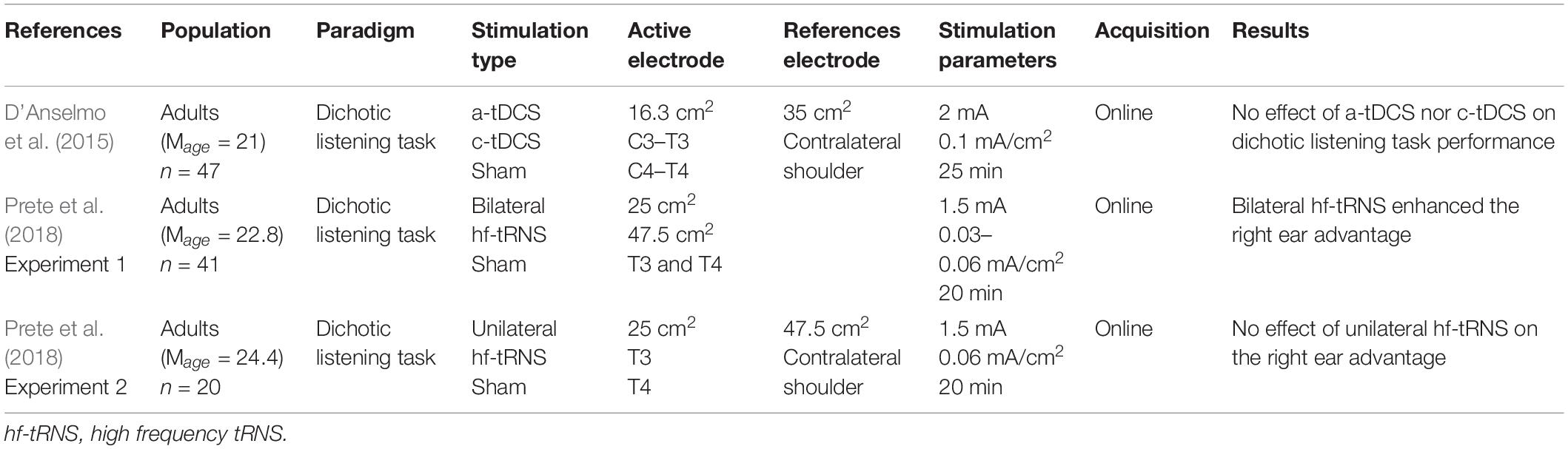
Table 4. Binaural integration.
Auditory Scene Analysis
Auditory scene analysis has been studied to a lesser extent in the tES domain, as can be seen in Table 5. Lewald (2016) reported no effect of tDCS on sound localization, but a significant effect on spatial sound separation. Indeed, a-tDCS placed on the left Superior Temporal Gyrus (STG) and c-tDCS placed over the right STG improved the accuracy of target localization in the left hemispace. The author suggested that bipolar tDCS with c-tDCS over the right STG increased the suppression of the activity of neuronal populations coding for locations of concurrent sounds, thus facilitating the segregation of target sound vs. concurrent sounds. This result shows the efficiency of bipolar tDCS in improving auditory segregation by decreasing concurrent neural activity. Deike et al. (2016) also revealed an effect of tDCS on auditory segregation. They used a segregation task where subjects had to listen to harmonic tone complexes and to indicate if only one stream or two separate streams were perceived. They revealed a reduction in performance following a-tDCS, which is contrary to the results of Lewald (2016). Such discrepancy can be partially related to different tasks and montage, as Lewald (2016) applied a bilateral bipolar montage and stimulated both STGs simultaneously with different current polarities, while Deike et al. (2016) used a unilateral montage with one current polarity. Different use of current intensity and density applied could also explain such differences in the results. Indeed, both stimulation parameters were higher in Deike et al. (2016). Furthermore, previous studies in the motor domain have demonstrated that increasing current intensity can invert the direction of excitability. This suggests that a-tDCS could lead to a decrease in cortical excitability, whereas c-tDCS could generate the opposite (Batsikadze et al., 2013).
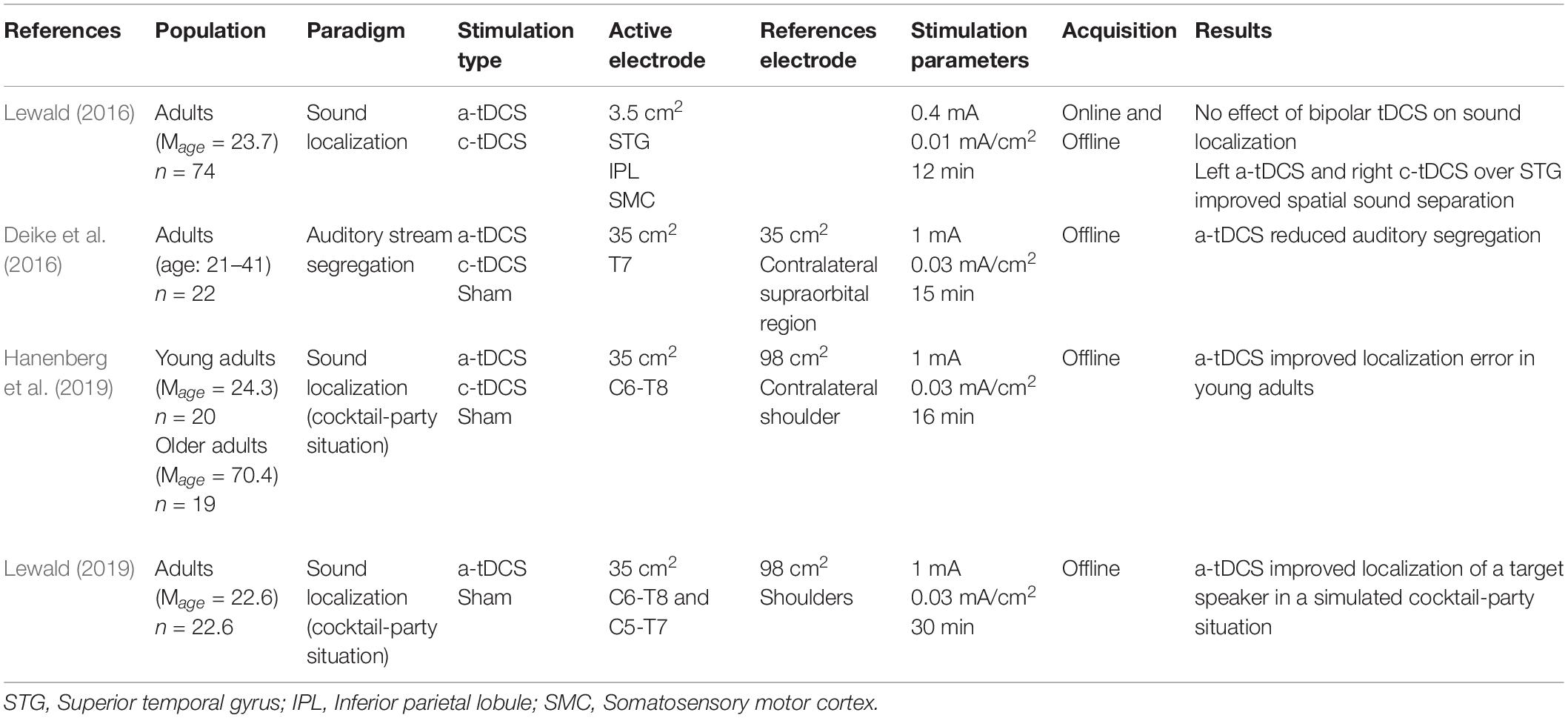
Table 5. Auditory scene analysis.
Hanenberg et al. (2019) investigated the effects of tDCS on the electrophysiological correlates of auditory selective spatial attention, with a focus on the N2 component of the ERP, in young and older adults. Their data demonstrated behavioral and electrophysiological effects of a-tDCS, more specifically an increased N2 amplitude, and improved localization performances. However, no effects of c-tDCS were revealed, in opposition to previous results (Lewald, 2016). The demonstrated impact of a-tDCS on sound localization in a cocktail-party situation in young adults was confirmed by Lewald (2019). Based on the theory that during a complex task, neuronal patterns encoding concurrent distractors are activated in addition to the patterns encoding the target stimulus, it was proposed that a-tDCS specifically increased the excitability of inhibitory interneurons that suppress irrelevant sound sources, thereby facilitating effects of selective attention.
Speech Comprehension
Research on the impact of tES on speech comprehension are summarized in Table 6. Giustolisi et al. (2018) demonstrated that a-tDCS over the left inferior frontal gyrus in healthy adults can improve the language comprehension of syntactically simple and complex sentences. Indeed, participants stimulated with a-tDCS for 30 min showed improved accuracy compared to participants in the sham group. Lum et al. (2019) showed that a-tDCS can have an impact on sentence comprehension, as they reported that applying electrical stimulation on the left inferior frontal gyrus improved reaction time as compared to baseline performance. Therefore, their results suggest that a-tDCS can improve the speed of sentence comprehension. On the other hand, Kadir et al. (2020) aimed at investigating whether tACS with a speech envelope could modulate speech in noise comprehension, and showed that electrical stimulation mostly worsened the speech comprehension of normal hearing adults in a background of babble noise.
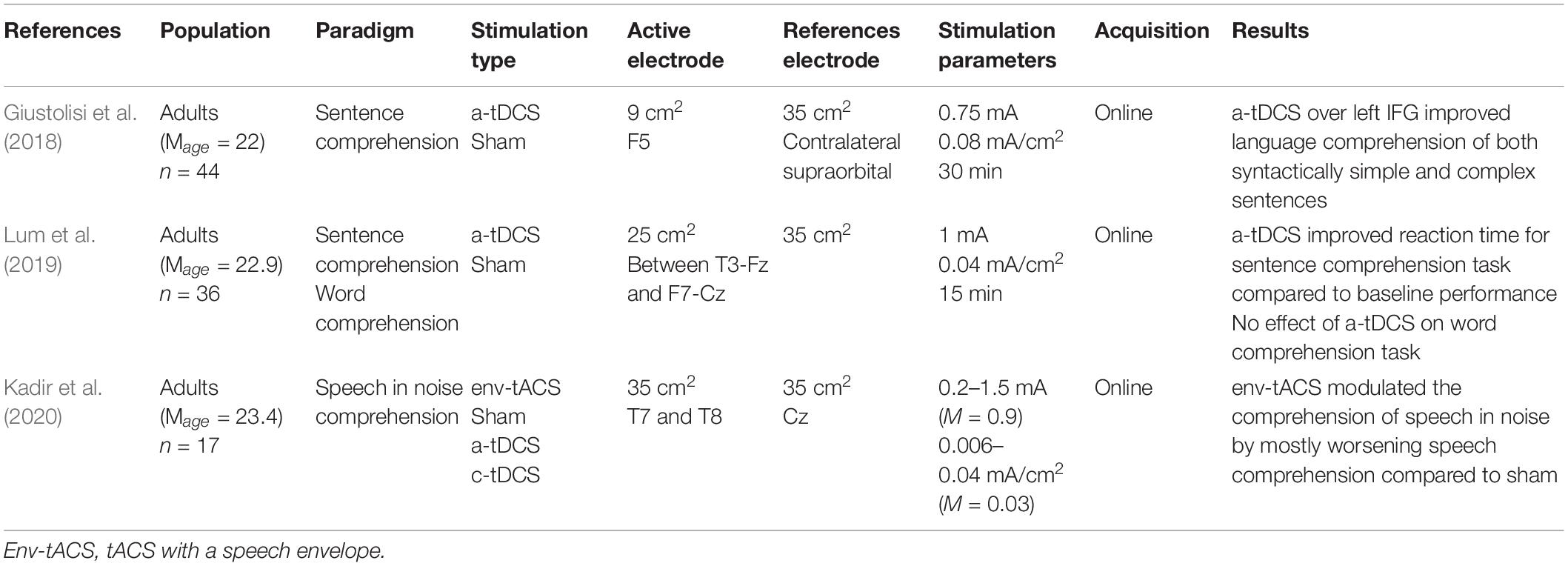
Table 6. Speech comprehension.
Discussion
The present review summarizes how transcranial electrical stimulation (tES) techniques can have a significant impact on the excitability of auditory cortical regions and its behavioral effects. Overall, research suggests that these techniques can be used to modulate nearly all auditory functions and abilities. However, there are tremendous discrepancies between studies, making it difficult to predict the directionality of the various effects.
Experimental reports on temporal and spectral processing are the only ones reporting constant outcomes. Indeed, all studies suggest that a-tDCS and c-tDCS have a positive effect on temporal processing, but a negative effect on spectral processing. Other results are scarce or often conflicting.
The results on the effect of tES techniques, notably bilateral tRNS, on binaural integration seem promising. However, more research is needed to determine whether tES could present a potential enhancing effect on binaural integration. Likewise, the potential improvement of auditory scene analysis with tDCS needs to be confirmed, as data are still preliminary. Finally, current knowledge does not allow the drawing of a clear conclusion on the impact of tES on speech comprehension, considering the very limited number of studies and the significant discrepancies between the results of these studies.
Since it is not possible to predict a constant improvement for one auditory process without affecting other aspects of auditory function, it is not possible to make any recommendation at this time. Indeed, from an audiological point of view, the use of this technique could even be harmful, and studies on spectral processing suggest that the potential applicability of tES techniques in auditory rehabilitation could be particularly damaging.
Stimulation parameters and electrode montage differ largely across studies, which could partially account for the discrepancies in the results. The importance of stimulation parameters on the induced effect has already been reported in the motor domain (e.g., Dissanayaka et al., 2017). Indeed, previous studies in the motor as well as in sensory domains demonstrate that an increase of current intensity, stimulation duration and electrode montage can invert the direction of the effect of tDCS (Paulus et al., 2013; Parkin et al., 2019). Indeed, Parkin et al. (2019) notably demonstrated that the classic effects of unilateral tDCS reported by Nitsche and Paulus (2000), as a-tDCS induces excitation and c-tDCS induces inhibition, are not extended to every stimulation protocols. No significant effect was obtained on MEP amplitude when bilateral 1 mA tDCS was applied or when the intensity was increased to 2 mA. The impact of changes in stimulation parameters are less known for tACS and tRNS, but some studies suggest that these techniques are frequency-dependent (Moreno-Duarte et al., 2014). The type of acquisition (i.e., online; offline) might also have an influence on the effect induced. Indeed, undergoing a task during stimulation could reverse the effect expected since there is ongoing brain activity due to the task (see Batsikadze et al., 2013). As such, until a concerted effort is made to use the same parameters and montage and to establish proper stimulation guidelines, there is no doubt that these observed discrepancies will persist.
Another possible explanation for the significant variations of tES results in the auditory domain could be the anatomical location of the auditory cortex, which is located deep in the superior temporal gyrus (STG) and extends to the lateral sulcus and Heschl’s Gyrus (HG). It was previously suggested that tES has a larger effect on superficial neurons (Paulus et al., 2013). This may therefore suggest that higher stimulation intensity and/or bilateral stimulation would be more likely to induce an effect on auditory functions, as it was demonstrated to stimulate deeper region in the motor cortex (Paulus et al., 2013).
Furthermore, the auditory cortex has different tonotopic gradients and neurons have different characteristic frequencies. As such, neuronal orientation may vary throughout the cortex (Talavage et al., 2004; Humphries et al., 2010; Costa et al., 2011; Langers and van Dijk, 2012; Tang and Hammond, 2013). Some studies demonstrated that the effect of tES, and more specifically tDCS, depends on the direction of the current relative to neuronal orientation. Indeed, a current applied parallel to a neuron can induce hyperpolarization while a current applied perpendicularly can induce depolarization or no effect at all (Jefferys, 1981; Bikson et al., 2004; Kabakov et al., 2012). The latter results may suggest that in the auditory cortex, where neuron orientation is not uniform, part of the neuronal population may be hyperpolarized, and another part depolarized depending on the direction of the current applied.
In the same vein, the variability of neuronal orientations in the auditory cortex underlines the importance of the active electrode position, since a small difference in position might change the effects due to a different alignment with neuronal orientation (Talavage et al., 2004; Humphries et al., 2010; Costa et al., 2011; Langers and van Dijk, 2012). This is indeed the hypothesis proposed by Ladeira et al. (2011) who showed that tDCS only had an effect at 4,000 Hz, but no effect at 500, 1,000, and 2,000 Hz. Indeed, lower frequencies are coded in the anterolateral portion of the HG, whereas higher frequencies are coded in the postero-medial part of the HG (Bhatgnagar, 2002; Langers et al., 2007). The stimulation electrodes used by Ladeira et al. (2011) were placed in the posterior portion of the temporal cortex, which may explain the specific improvement of random GDT at 4,000 Hz.
One could also suggest that it might be more appropriate to use tRNS on the auditory cortex to avoid effects of neuronal orientation, since tRNS stimulate neurons irrespective of their spatial orientation (Terney et al., 2008). As suggested by the present review, all the studies using tRNS reported an improvement in performance. However, the number of studies is too limited to conclude with certainty that tRNS is more efficient. In addition, there is no clear evidence as to which tES technique is optimal in the auditory domain. As such, the data do not support the use of this technique in audiological practice.
Another obvious shortcoming is the lack of data in populations with impaired hearing function or impaired auditory processing, notably older adults. Indeed, it is well known that a decrease in temporal processing occurs with age (Fitzgibbons and Gordon-Salant, 1996; Pichora-Fuller and Souza, 2003) and that the improvements induced by tDCS have been hypothesized to be greater in non-proficient systems (Reis et al., 2014). For example, some effects discussed earlier appear to be age-dependent—with an improved performance being observed in older subjects and conversely a reduced performance being seen in younger adults (Rufener et al., 2016a,b). These results suggest that the effects of tES on voice onset time categorization might depend on the efficiency of the auditory system. These elements alone could explain the improvements in temporal processing induced in older adults. Indeed, it is possible that tACS perturbs a normal, well-functioning system and leads to a processing deterioration in younger adults, because the neuronal reactivity level is already optimal in this group (Krause et al., 2013; Schaal et al., 2013). Future studies should therefore investigate the effect of tES techniques in older adults with hearing loss and/or impaired auditory processing, to determine if such techniques could have a clinical relevance in audiology.
Another important variable might also explain the divergence found between younger and older participants, namely, the homeostatic control of cortical excitability (Schaal et al., 2017). Unfortunately, the studies included in the present review were only conducted with normal-hearing individuals. One may therefore wonder if such variability in results would have been present in people with a suboptimal auditory system. For example, all studies using tDCS on spectral processing reported a decreased performance in the different tasks studied. However, it is important to note that all the studies reviewed studied young adults with no apparent spectral processing difficulties. Furthermore, a few studies even recruited participants with musical experience. Therefore, it can be hypothesized that the participants not only had no spectral processing impairment, but also had great auditory skills. As such, adding electrical stimulation could only disrupt that optimal level and decrease their performance. It would be important to assess the impact of tES on populations with impaired spectral processing, and then draw conclusion on the rehabilitation potential of this method.
In conclusion, the present review demonstrated that tES can have an influence on several auditory abilities. While the results are still inconclusive, the impact of the stimulation of other cortical structures on auditory perception would also deserve attention, particularly in relation to auditory scene analysis and speech comprehension, which depend on multisensory processes. Indeed, results of preliminary studies on the effect of tDCS on multisensory integration are promising. Marques et al. (2014) examined the influence of a-tDCS and c-tDCS on the McGurk illusion, a multisensory integration task. They reported that c-tDCS appears to reduce the McGurk illusion when active electrodes are placed on temporal cortices, but that applying a-tDCS to the same regions has no effect. However, a-tDCS applied on parietal cortices increased the McGurk illusion. It is therefore likely that further studies of the effect of tES on multisensory cortical structures could provide interesting avenues for audiological practice. Furthermore, this review underlined important methodological discrepancies between studies, therefore, future studies should determine the optimal stimulation parameters to apply.
Author Contributions
MN, TA, KM-D, B-AB, and FC wrote the article. All authors discussed the results and commented on the manuscript at all stages.
Funding
This work was supported by the Natural Sciences and Engineering Research Council of Canada (NSERC) (Grant No. RGPIN-2016-05211).
Conflict of Interest
The authors declare that the research was conducted in the absence of any commercial or financial relationships that could be construed as a potential conflict of interest.
Publisher’s Note
All claims expressed in this article are solely those of the authors and do not necessarily represent those of their affiliated organizations, or those of the publisher, the editors and the reviewers. Any product that may be evaluated in this article, or claim that may be made by its manufacturer, is not guaranteed or endorsed by the publisher.
References
Antal, A., and Paulus, W. (2013). Transcranial alternating current stimulation (tACS). Front. Hum. Neurosci. 7:317.
Bai, X., Guo, Z., He, L., Ren, L., McClure, M. A., and Mu, Q. (2019). Different therapeutic effects of transcranial direct current stimulation on upper and lower limb recovery of stroke patients with motor dysfunction: a meta-analysis. Neural Plast. 2019:e1372138. doi: 10.1155/2019/1372138
Baker, J. M., Rorden, C., and Fridriksson, J. (2010). Using transcranial direct-current stimulation to treat stroke patients with aphasia. Stroke 41, 1229–1236.
Baltus, A., Wagner, S., Wolters, C. H., and Herrmann, C. S. (2018). Optimized auditory transcranial alternating current stimulation improves individual auditory temporal resolution. Brain Stimul. 11, 118–124. doi: 10.1016/j.brs.2017.10.008
Batsikadze, G., Moliadze, V., Paulus, W., Kuo, M.-F., and Nitsche, M. A. (2013). Partially non-linear stimulation intensity-dependent effects of direct current stimulation on motor cortex excitability in humans. J. Physiol. 591, 1987–2000. doi: 10.1113/jphysiol.2012.249730
Bhatgnagar, S. (2002). Neurociências para o Estudo dos Distúrbios da Comunicação. Rio de Janeiro: Guanabara Koogan.
Bikson, M., Inoue, M., Akiyama, H., Deans, J. K., Fox, J. E., Miyakawa, H., et al. (2004). Effects of uniform extracellular DC electric fields on excitability in rat hippocampal slices in vitro. J. Physiol. 557, 175–190. doi: 10.1113/jphysiol.2003.055772
Bindman, L. J., Lippold, O. C. J., and Redfearn, J. W. T. (1964). The action of brief polarizing currents on the cerebral cortex of the rat (1) during current flow and (2) in the production of long-lasting after-effects. J. Physiol. 172, 369–382. doi: 10.1113/jphysiol.1964.sp007425
Boggio, P. S., Castro, L. O., Savagim, E. A., Braite, R., Cruz, V. C., Rocha, R. R., et al. (2006). Enhancement of non-dominant hand motor function by anodal transcranial direct current stimulation. Neurosci. Lett. 404, 232–236.
Boroda, E., Sponheim, S. R., Fiecas, M., and Lim, K. O. (2020). Transcranial direct current stimulation (tDCS) elicits stimulus-specific enhancement of cortical plasticity. NeuroImage 211:116598. doi: 10.1016/j.neuroimage.2020.116598
Broeder, S., Nackaerts, E., Heremans, E., Vervoort, G., Meesen, R., Verheyden, G., et al. (2015). Transcranial direct current stimulation in Parkinson’s disease: neurophysiological mechanisms and behavioral effects. Neurosci. Biobehav. Rev. 57, 105–117. doi: 10.1016/j.neubiorev.2015.08.010
Chang, C.-H., Lane, H.-Y., and Lin, C.-H. (2018). Brain stimulation in Alzheimer’s disease. Front. Psychiatry 9:201.
Chen, J. C., Hämmerer, D., Strigaro, G., Liou, L. M., Tsai, C. H., Rothwell, J. C., et al. (2014). Domain-specific suppression of auditory mismatch negativity with transcranial direct current stimulation. Clin. Neurophysiol. 125, 585–592. doi: 10.1016/j.clinph.2013.08.007
Chen, K.-H. S., and Chen, R. (2019). Invasive and noninvasive brain stimulation in Parkinson’s disease: clinical effects and future perspectives. Clin. Pharmacol. Ther. 106, 763–775. doi: 10.1002/cpt.1542
Costa, S. D., Zwaag, W., Marques, J. P., Frackowiak, R. S. J., Clarke, S., and Saenz, M. (2011). Human primary auditory cortex follows the shape of Heschl’s Gyrus. J. Neurosci. 31, 14067–14075. doi: 10.1523/jneurosci.2000-11.2011
Creutzfeldt, O. D., Fromm, G. H., and Kapp, H. (1962). Influence of transcortical d-c currents on cortical neuronal activity. Exp. Neurol. 5, 436–452. doi: 10.1016/0014-4886(62)90056-0
D’Anselmo, A., Prete, G., Tommasi, L., and Brancucci, A. (2015). The dichotic right ear advantage does not change with Transcranial Direct Current Stimulation (tDCS). Brain Stimul. Basic Transl. Clin. Res. Neuromodulation 8, 1238–1240. doi: 10.1016/j.brs.2015.09.007
Datta, A., Bansal, V., Diaz, J., Patel, J., Reato, D., and Bikson, M. (2009). Gyri-precise head model of transcranial DC stimulation: improved spatial focality using a ring electrode versus conventional rectangular pad. Brain Stimul. 2, 201–207. doi: 10.1016/j.brs.2009.03.005
Datta, A., Truong, D., Minhas, P., Parra, L. C., and Bikson, M. (2012). Inter-individual variation during transcranial direct current stimulation and normalization of dose using MRI-Derived computational models. Front. Psychiatry 3:91. doi: 10.3389/fpsyt.2012.00091
Deike, S., Deliano, M., and Brechmann, A. (2016). Probing neural mechanisms underlying auditory stream segregation in humans by transcranial direct current stimulation (tDCS). Neuropsychologia 91, 262–267. doi: 10.1016/j.neuropsychologia.2016.08.017
Dissanayaka, T., Zoghi, M., Farrell, M., Egan, G. F., and Jaberzadeh, S. (2017). Does transcranial electrical stimulation enhance corticospinal excitability of the motor cortex in healthy individuals? a systematic review and meta-analysis. Eur. J. Neurosci. 46, 1968–1990. doi: 10.1111/ejn.13640
Dunn, W., Rassovsky, Y., Wynn, J. K., Wu, A. D., Iacoboni, M., Hellemann, G., et al. (2016). Modulation of neurophysiological auditory processing measures by bilateral transcranial direct current stimulation in schizophrenia. Schizophr. Res. 174, 189–191. doi: 10.1016/j.schres.2016.04.021
Edgar, J. C., Chen, Y.-H., Lanza, M., Howell, B., Chow, V. Y., Heiken, K., et al. (2014). Cortical thickness as a contributor to abnormal oscillations in schizophrenia? NeuroImage Clin. 4, 122–129. doi: 10.1016/j.nicl.2013.11.004
Fitzgibbons, P. J., and Gordon-Salant, S. (1996). Auditory temporal processing in elderly listeners. J. Am. Acad. Audiol. 7, 183–189.
Fridriksson, J., Richardson, J. D., Baker, J. M., and Rorden, C. (2011). Transcranial direct current stimulation improves naming reaction time in fluent aphasia. Stroke 42, 819–821. doi: 10.1161/strokeaha.110.600288
Fritsch, B., Reis, J., Martinowich, K., Schambra, H. M., Ji, Y., Cohen, L. G., et al. (2010). Direct current stimulation promotes BDNF-dependent synaptic plasticity: potential implications for motor learning. Neuron 66, 198–204. doi: 10.1016/j.neuron.2010.03.035
Galletta, E. E., Cancelli, A., Cottone, C., Simonelli, I., Tecchio, F., Bikson, M., et al. (2015). Use of computational modeling to Inform tDCS electrode montages for the promotion of language recovery in post-stroke Aphasia. Brain Stimul. 8, 1108–1115. doi: 10.1016/j.brs.2015.06.018
Giustolisi, B., Vergallito, A., Cecchetto, C., Varoli, E., and Romero Lauro, L. J. (2018). Anodal transcranial direct current stimulation over left inferior frontal gyrus enhances sentence comprehension. Brain Lang. 176, 36–41. doi: 10.1016/j.bandl.2017.11.001
Hanenberg, C., Getzmann, S., and Lewald, J. (2019). Transcranial direct current stimulation of posterior temporal cortex modulates electrophysiological correlates of auditory selective spatial attention in posterior parietal cortex. Neuropsychologia 131, 160–170. doi: 10.1016/j.neuropsychologia.2019.05.023
Heimrath, K., Breitling, C., Krauel, K., Heinze, H.-J., and Zaehle, T. (2015). Modulation of pre-attentive spectro-temporal feature processing in the human auditory system by HD-tDCS. Eur. J. Neurosci. 7, 1580–1586. doi: 10.1111/ejn.12908
Heimrath, K., Fischer, A., Heinze, H.-J., and Zaehle, T. (2016). Changed categorical perception of consonant–vowel syllables induced by transcranial direct current stimulation (tDCS). BMC Neurosci. 17:8. doi: 10.1186/s12868-016-0241-3
Heimrath, K., Kuehne, M., Heinze, H.-J., and Zaehle, T. (2014). Transcranial direct current stimulation (tDCS) traces the predominance of the left auditory cortex for processing of rapidly changing acoustic information. Neuroscience 261, 68–73. doi: 10.1016/j.neuroscience.2013.12.031
Herrmann, C. S., Rach, S., Neuling, T., and Strüber, D. (2013). Transcranial alternating current stimulation: a review of the underlying mechanisms and modulation of cognitive processes. Front. Hum. Neurosci. 7:279.
Hirano, S., Nakhnikian, A., Hirano, Y., Oribe, N., Kanba, S., Onitsuka, T., et al. (2018). Phase-amplitude coupling of the electroencephalogram in the auditory cortex in schizophrenia. Biol. Psychiatry Cogn. Neurosci. Neuroimaging 3, 69–76. doi: 10.1016/j.bpsc.2017.09.001
Hsu, W.-Y., Ku, Y., Zanto, T. P., and Gazzaley, A. (2015). Effects of noninvasive brain stimulation on cognitive function in healthy aging and Alzheimer’s disease: a systematic review and meta-analysis. Neurobiol. Aging 36, 2348–2359. doi: 10.1016/j.neurobiolaging.2015.04.016
Hummel, F., Celnik, P., Giraux, P., Floel, A., Wu, W.-H., Gerloff, C., et al. (2005). Effects of non-invasive cortical stimulation on skilled motor function in chronic stroke. Brain 128, 490–499. doi: 10.1093/brain/awh369
Humphries, C., Liebenthal, E., and Binder, J. R. (2010). Tonotopic organization of human auditory cortex. Neuroimage 50, 1202–1211. doi: 10.1016/j.neuroimage.2010.01.046
Im, C.-H., Park, J.-H., Shim, M., Chang, W. H., and Kim, Y.-H. (2012). Evaluation of local electric fields generated by transcranial direct current stimulation with an extracephalic reference electrode based on realistic 3D body modeling. Phys. Med. Biol. 57, 2137–2150. doi: 10.1088/0031-9155/57/8/2137
Impey, D. de la Salle, S., and Knott, V. (2016). Assessment of anodal and cathodal transcranial direct current stimulation (tDCS) on MMN-indexed auditory sensory processing. Brain Cogn. 105, 46–54. doi: 10.1016/j.bandc.2016.03.006
Jefferys, J. G. (1981). Influence of electric fields on the excitability of granule cells in guinea-pig hippocampal slices. J. Physiol. 319, 143–152. doi: 10.1113/jphysiol.1981.sp013897
Jones, K. T., Johnson, E. L., Tauxe, Z. S., and Rojas, D. C. (2020). Modulation of auditory gamma-band responses using transcranial electrical stimulation. J. Neurophysiol. 123, 2504–2514. doi: 10.1152/jn.00003.2020
Kabakov, A. Y., Muller, P. A., Pascual-Leone, A., Jensen, F. E., and Rotenberg, A. (2012). Contribution of axonal orientation to pathway-dependent modulation of excitatory transmission by direct current stimulation in isolated rat hippocampus. J. Neurophysiol. 107, 1881–1889. doi: 10.1152/jn.00715.2011
Kadir, S., Kaza, C., Weissbart, H., and Reichenbach, T. (2020). Modulation of speech-in-noise comprehension through transcranial current stimulation with the phase-shifted speech envelope. IEEE Trans. Neural Syst. Rehabil. Eng. 28, 23–31. doi: 10.1109/TNSRE.2019.2939671
Khan, S., Gramfort, A., Shetty, N. R., Kitzbichler, M. G., Ganesan, S., Moran, J. M., et al. (2013). Local and long-range functional connectivity is reduced in concert in autism spectrum disorders. PNAS 110, 3107–3112. doi: 10.1073/pnas.1214533110
Krause, B., Márquez-Ruiz, J., and Cohen Kadosh, R. (2013). The effect of transcranial direct current stimulation: a role for cortical excitation/inhibition balance? Front. Hum. Neurosci. 7:602.
Kunzelmann, K., Meier, L., Grieder, M., Morishima, Y., and Dierks, T. (2018). No effect of transcranial direct current stimulation of the auditory cortex on auditory-evoked potentials. Front. Neurosci. 12:880.
Ladeira, A., Fregni, F., Campanhã, C., Valasek, C. A., Ridder, D. D., Brunoni, A. R., et al. (2011). Polarity-dependent transcranial direct current stimulation effects on central auditory processing. PLoS One 6:e25399. doi: 10.1371/journal.pone.0025399
Langers, D. R. M., and van Dijk, P. (2012). Mapping the tonotopic organization in human auditory cortex with minimally salient acoustic stimulation. Cereb. Cortex 22, 2024–2038. doi: 10.1093/cercor/bhr282
Langers, D. R., and Backes, W. H., and van Dijk, P. (2007). Representation of lateralization and tonotopy in primary versus secondary human auditory cortex. Neuroimage 34, 264–273. doi: 10.1016/j.neuroimage.2006.09.002
Lewald, J. (2016). Modulation of human auditory spatial scene analysis by transcranial direct current stimulation. Neuropsychologia 84, 282–293. doi: 10.1016/j.neuropsychologia.2016.01.030
Lewald, J. (2019). Bihemispheric anodal transcranial direct-current stimulation over temporal cortex enhances auditory selective spatial attention. Exp. Brain Res. 237, 1539–1549. doi: 10.1007/s00221-019-05525-y
Loui, P., Hohmann, A., and Schlaug, G. (2010). Inducing disorders in pitch perception and production: a reverse-engineering approach. Proc. Mtgs. Acoust. 9:050002. doi: 10.1121/1.3431713
Lum, J. A. G., Clark, G. M., Rogers, C. M., Skalkos, J. D., Fuelscher, I., Hyde, C., et al. (2019). Effects of Anodal Transcranial Direct Current Stimulation (atDCS) on sentence comprehension. J. Int. Neuropsychol. Soc. 25, 331–335. doi: 10.1017/s1355617718001121
Maharajh, K., Abrams, D., Rojas, D. C., Teale, P., and Reite, M. L. (2007). Auditory steady state and transient gamma band activity in bipolar disorder. Int. Congress Ser. 1300, 707–710. doi: 10.1016/j.ics.2006.12.073
Marques, L. M., Lapenta, O. M., Merabet, L. B., Bolognini, N., and Boggio, P. S. (2014). Tuning and disrupting the brain—modulating the McGurk illusion with electrical stimulation. Front. Hum. Neurosci. 8:533. doi: 10.3389/fnhum.2014.00533
Mathys, C., Loui, P., Zheng, X., and Schlaug, G. (2010). Non-invasive brain stimulation applied to Heschl’s Gyrus modulates pitch discrimination. Front. Psychol. 1:193. doi: 10.3389/fpsyg.2010.00193
Matsushita, R., Andoh, J., and Zatorre, R. J. (2015). Polarity-specific transcranial direct current stimulation disrupts auditory pitch learning. Front. Neurosci. 9:174. doi: 10.3389/fnins.2015.00174
McDonnell, M. D., and Ward, L. M. (2011). The benefits of noise in neural systems: bridging theory and experiment. Nat. Rev. Neurosci. 12, 415–425. doi: 10.1038/nrn3061
Moliadze, V., Antal, A., and Paulus, W. (2010). Electrode-distance dependent after-effects of transcranial direct and random noise stimulation with extracephalic reference electrodes. Clin. Neurophysiol. 121, 2165–2171. doi: 10.1016/j.clinph.2010.04.033
Moreno-Duarte, I., Nigel, G., Schestatsky, P., Guleyupoglu, B., Reato, D., Bikson, M., et al. (2014). “Transcranial electrical stimulation: Transcranial direct current stimulation (tDCS), Trascranial Alternating current stimulation (tACS), Transcranial Pulsed current stimulation (tPCS), and Transcranial random noise stimulation (tRNS),” in The Stimulated Brain: Cognitive Enhancement Using Non-Invasive Brain Stimulation, ed. R. C. Kodosh (London: Elsevier), 35–39.
Nitsche, M. A., and Paulus, W. (2000). Excitability changes induced in the human motor cortex by weak transcranial direct current stimulation. J. Physiol. 527, 633–639. doi: 10.1111/j.1469-7793.2000.t01-1-00633.x
Parkin, B. L., Bhandari, M., Glen, J. C., and Walsh, V. (2019). The physiological effects of transcranial electrical stimulation do not apply to parameters commonly used in studies of cognitive neuromodulation. Neuropsychologia 128, 332–339. doi: 10.1016/j.neuropsychologia.2018.03.030
Paulus, W. (2011). Transcranial electrical stimulation (tES – tDCS; tRNS, tACS) methods. Neuropsychol. Rehabil. 21, 602–617.
Paulus, W., Antai, A., and Nitsche, M. (2012). “Physiological basis and methodological aspects of transcranial electric stimulation (tDCS, tACS and tRNS),” in Transcranial Brain Stimulation, eds C. Miniussi, W. Paulus, and M. Rossini (Milton Park: Taylor and Francis Group). doi: 10.1080/09602011.2011.557292
Paulus, W., Peterchev, A. V., and Ridding, M. (2013). “Transcranial electric and magnetic stimulation: technique and paradigms,” in Handbook of Clinical Neurology Brain Stimulation, eds A. M. Lozano and M. Hallett (Amsterdam: Elsevier), 329–342.
Pichora-Fuller, M. K., and Souza, P. E. (2003). Effects of aging on auditory processing of speech. Int. J. Audiol. 42, 11–16.
Prete, G., D’Anselmo, A., Tommasi, L., and Brancucci, A. (2017). Modulation of illusory auditory perception by transcranial electrical stimulation. Front. Neurosci. 11:351.
Prete, G., D’Anselmo, A., Tommasi, L., and Brancucci, A. (2018). Modulation of the dichotic right ear advantage during bilateral but not unilateral transcranial random noise stimulation. Brain Cogn. 123, 81–88. doi: 10.1016/j.bandc.2018.03.003
Priori, A., Berardelli, A., Rona, S., Accornero, N., and Manfredi, M. (1998). Polarization of the human motor cortex through the scalp. NeuroReport 9, 2257–2260.
Purpura, D. P., and McMurtry, J. G. (1965). Intracellular activities and evoked potential changes during polarization of motor cortex. J. Neurophysiol. 28, 166–185. doi: 10.1152/jn.1965.28.1.166
Radman, T., Ramos, R. L., Brumberg, J. C., and Bikson, M. (2009). Role of cortical cell type and morphology in subthreshold and suprathreshold uniform electric field stimulation in vitro. Brain Stimul. 2, 215–228.e3. doi: 10.1016/j.brs.2009.03.007
Reed, T., and Kadosh, R. C. (2018). Transcranial electrical stimulation (tES) mechanisms and its effects on cortical excitability and connectivity. J. Inherit. Metab. Dis. 41, 1123–1130.
Reis, J., Prichard, G., and Fritsch, B. (2014). “Chapter 8 - motor system,” in The Stimulated Brain, ed. R. Cohen Kadosh (San Diego: Academic Press).
Rojas, D. C., and Wilson, L. B. (2014). γ-band abnormalities as markers of autism spectrum disorders. Biomark. Med. 8, 353–368. doi: 10.2217/bmm.14.15
Royal, I., Zendel, B. R., Desjardins, M. -È, Robitaille, N., and Peretz, I. (2018). Modulation of electric brain responses evoked by pitch deviants through transcranial direct current stimulation. Neuropsychologia 109, 63–74. doi: 10.1016/j.neuropsychologia.2017.11.028
Rufener, K. S., Oechslin, M. S., Zaehle, T., and Meyer, M. (2016a). Transcranial Alternating Current Stimulation (tACS) differentially modulates speech perception in young and older adults. Brain Stimul. 9, 560–565. doi: 10.1016/j.brs.2016.04.002
Rufener, K. S., Zaehle, T., Oechslin, M. S., and Meyer, M. (2016b). 40Hz-Transcranial alternating current stimulation (tACS) selectively modulates speech perception. Int. J. Psychophysiol. 101, 18–24. doi: 10.1016/j.ijpsycho.2016.01.002
Rufener, K. S., Ruhnau, P., Heinze, H.-J., and Zaehle, T. (2017). Transcranial Random Noise Stimulation (tRNS) shapes the processing of rapidly changing auditory information. Front. Cell. Neurosci. 11:162. doi: 10.3389/fncel.2017.00162
Schaal, N. K., Pollok, B., and Banissy, M. J. (2017). Hemispheric differences between left and right supramarginal gyrus for pitch and rhythm memory. Sci. Rep. 7:42456. doi: 10.1038/srep42456
Schaal, N. K., Williamson, V. J., and Banissy, M. J. (2013). Anodal transcranial direct current stimulation over the supramarginal gyrus facilitates pitch memory. Eur. J. Neurosci. 38, 3513–3518. doi: 10.1111/ejn.12344
Sohn, M. K., Kim, B. O., and Song, H. T. (2012). Effect of stimulation polarity of transcranial direct current stimulation on non-dominant hand function. Ann. Rehabil. Med. 36, 1–7. doi: 10.5535/arm.2012.36.1.1
Summers, J. J., Kang, N., and Cauraugh, J. H. (2016). Does transcranial direct current stimulation enhance cognitive and motor functions in the ageing brain? a systematic review and meta- analysis. Ageing Res. Rev. 25, 42–54. doi: 10.1016/j.arr.2015.11.004
Talavage, T. M., Sereno, M. I., Melcher, J. R., Ledden, P. J., Rosen, B. R., and Dale, A. M. (2004). Tonotopic organization in human auditory cortex revealed by progressions of frequency sensitivity. J. Neurophysiol. 91, 1282–1296. doi: 10.1152/jn.01125.2002
Tang, M. F., and Hammond, G. R. (2013). Anodal transcranial direct current stimulation over auditory cortex degrades frequency discrimination by affecting temporal, but not place, coding. Eur. J. Neurosci. 38, 2802–2811. doi: 10.1111/ejn.12280
Terney, D., Chaieb, L., Moliadze, V., Antal, A., and Paulus, W. (2008). Increasing human brain excitability by transcranial high-frequency random noise stimulation. J. Neurosci. 28, 14147–14155. doi: 10.1523/jneurosci.4248-08.2008
Vines, B. W., Nair, D., and Schlaug, G. (2008). Modulating activity in the motor cortex affects performance for the two hands differently depending upon which hemisphere is stimulated. Eur. J. Neurosci. 28, 1667–1673. doi: 10.1111/j.1460-9568.2008.06459.x
Vossen, A., Gross, J., and Thut, G. (2015). Alpha power increase after transcranial alternating current stimulation at alpha frequency (α-tACS) reflects plastic changes rather than entrainment. Brain Stimul. 8, 499–508. doi: 10.1016/j.brs.2014.12.004
Yavari, F., Jamil, A., Mosayebi Samani, M., Vidor, L. P., and Nitsche, M. A. (2018). Basic and functional effects of transcranial electrical stimulation (tES)—an introduction. Neurosci. Biobehav. Rev. 85, 81–92. doi: 10.1016/j.neubiorev.2017.06.015
Zaehle, T., Beretta, M., Jäncke, L., Herrmann, C. S., and Sandmann, P. (2011). Excitability changes induced in the human auditory cortex by transcranial direct current stimulation: direct electrophysiological evidence. Exp. Brain Res. 215, 135–140.
Zimerman, M., Heise, K. F., Hoppe, J., Cohen, L. G., Gerloff, C., and Hummel, F. C. (2012). Modulation of training by single-session transcranial direct current stimulation to the intact motor cortex enhances motor skill acquisition of the paretic hand. Stroke 43, 2185–2191. doi: 10.1161/STROKEAHA.111.645382
Keywords: transcranial electrical stimulation, transcranial direct current stimulation, transcranial alternating current stimulation, transcranial random noise stimulation, auditory processing, auditory abilities, audiology
Citation: Nooristani M, Augereau T, Moïn-Darbari K, Bacon B-A and Champoux F (2021) Using Transcranial Electrical Stimulation in Audiological Practice: The Gaps to Be Filled. Front. Hum. Neurosci. 15:735561. doi: 10.3389/fnhum.2021.735561
Received: 02 July 2021; Accepted: 01 November 2021;
Published: 23 November 2021.
Edited by:
Ken-Ichiro Tsutsui, Tohoku University, JapanReviewed by:
Luca Sebastianelli, Hospital of Vipiteno, ItalyAnita D’Anselmo, University of Bologna, Italy
Copyright © 2021 Nooristani, Augereau, Moïn-Darbari, Bacon and Champoux. This is an open-access article distributed under the terms of the Creative Commons Attribution License (CC BY). The use, distribution or reproduction in other forums is permitted, provided the original author(s) and the copyright owner(s) are credited and that the original publication in this journal is cited, in accordance with accepted academic practice. No use, distribution or reproduction is permitted which does not comply with these terms.
*Correspondence: Mujda Nooristani, bXVqZGEubm9vcmlzdGFuaUB1bW9udHJlYWwuY2E=