 Elisa Scerrati
 Stefania D'Ascenzo
 Luisa Lugli
 Cristina Iani
 Sandro Rubichi
 Roberto Nicoletti
- 1Department of Education and Humanities, University of Modena and Reggio Emilia, Reggio Emilia, Italy
- 2Department of Philosophy and Communication, University of Bologna, Bologna, Italy
- 3Department of Surgery, Medicine, Dentistry and Morphological Sciences With Interest in Transplant, Oncology and Regenerative Medicine, University of Modena and Reggio Emilia, Modena, Italy
- 4Center for Neuroscience and Neurotechnology, University of Modena and Reggio Emilia, Modena, Italy
A Corrigendum on
Exploring the Role of Action Consequences in the Handle-Response Compatibility Effect
by Scerrati, E., D'Ascenzo, S., Lugli, L., Iani, C., Rubichi, S., and Nicoletti, R. (2020). Front. Hum. Neurosci. 14:286. doi: 10.3389/fnhum.2020.00286
In the original article, there was a mistake in Table 1 as published. There was a missing reference of Kourtis and Vingerhoets (2015). The corrected Table 1 appears below.
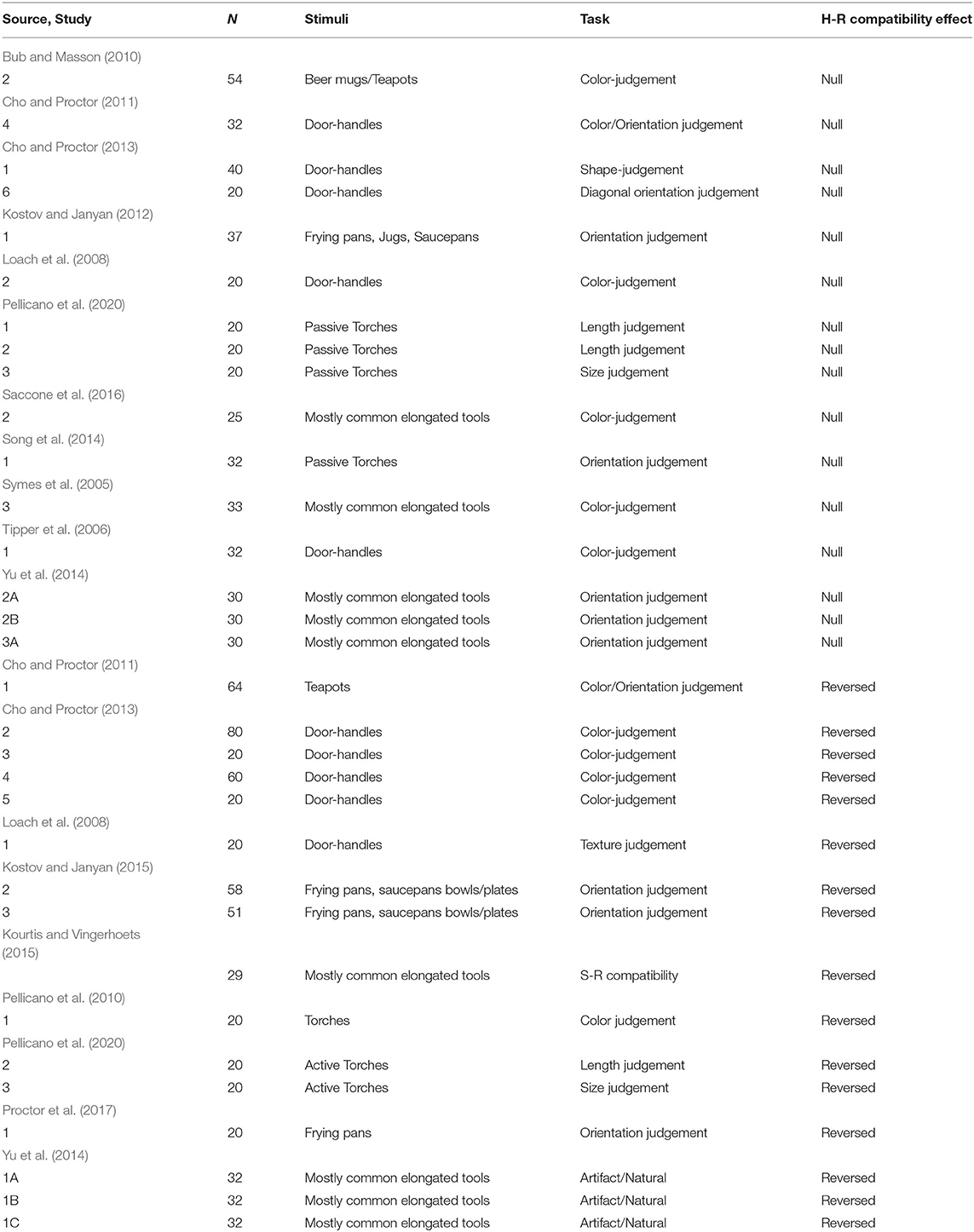
Table 1. Prior known tests of the Handle–Response (H–R) compatibility effect showing null and/or reversed effects.
In the original article, there was an error. The authors mistakenly reported as evidence a hypothetical interpretation offered by Kourtis and Vingerhoets (2015) of their neurophysiological results. A correction has been made to Introduction, Paragraph 2:
Evidence in favor of the H-R compatibility effect was initially provided by Tucker and Ellis (1998) who showed that judging the upright or inverted position of depicted graspable objects was influenced by the orientation of the object's handle. That is, responses were faster when the position of the handle and the responding hand were spatially aligned as compared to when they were not. This result was replicated across different tasks (e.g., Tipper et al., 2006; Saccone et al., 2016), stimuli (e.g., Pellicano et al., 2010; Pappas, 2014; Iani et al., 2018; Scerrati et al., 2019, 2020), populations (e.g., Dekker and Mareschal, 2013), response devices (e.g., Bub and Masson, 2010), and response modes (e.g., Phillips and Ward, 2002; Cho and Proctor, 2010; Proctor et al., 2017; Bub et al., 2018; for a review see Proctor and Miles, 2014; for a recent meta-analysis see Azaad et al., 2019).
The authors apologize for this error and state that this does not change the scientific conclusions of the article in any way. The original article has been updated.
Publisher's Note
All claims expressed in this article are solely those of the authors and do not necessarily represent those of their affiliated organizations, or those of the publisher, the editors and the reviewers. Any product that may be evaluated in this article, or claim that may be made by its manufacturer, is not guaranteed or endorsed by the publisher.
References
Azaad, S., Laham, S. M., and Shields, P. (2019). A meta-analysis of the object-based compatibility effect. Cognition 190, 105–127. doi: 10.1016/j.cognition.2019.04.028
Bub, D. N., and Masson, M. E. (2010). Grasping beer mugs: on the dynamics of alignment effects induced by handled objects. J. Exp. Psychol. 36, 341–358. doi: 10.1037/a0017606
Bub, D. N., Masson, M. E., and Kumar, R. (2018). Time course of motor affordances evoked by pictured objects and words. J. Exp. Psychol. 44, 53–68. doi: 10.1037/xhp0000431
Cho, D. T., and Proctor, R. W. (2010). The object-based Simon effect: grasping affordance or relative location of the graspable part? J. Exp. Psychol. 36, 853–861. doi: 10.1037/a0019328
Cho, D. T., and Proctor, R. W. (2011). Correspondence effects for objects with opposing left and right protrusions. J. Exp. Psychol. 37, 737–749. doi: 10.1037/a0021934
Cho, D. T., and Proctor, R. W. (2013). Object-based correspondence effects for action-relevant and surface-property judgments with keypress responses: evidence for a basis in spatial coding. Psychol. Res. 77, 618–636. doi: 10.1007/s00426-012-0458-4
Dekker, T. M., and Mareschal, D. (2013). Object processing for action across childhood. Br. J. Dev. Psychol. 31, 425–435. doi: 10.1111/bjdp.12017
Iani, C., Ferraro, L., Maiorana, N. V., Gallese, V., and Rubichi, S. (2018). Do already grasped objects activate motor affordances? Psychol. Res. 83, 1363–1374. doi: 10.1007/s00426-018-1004-9
Kostov, K., and Janyan, A. (2012). The role of attention in the affordance effect: can we afford to ignore it? Cogn. Process. 13, 215–218. doi: 10.1007/s10339-012-0452-1
Kostov, K., and Janyan, A. (2015). Reversing the affordance effect: negative stimulus–response compatibility observed with images of graspable objects. Cogn. Process. 16, 287–291. doi: 10.1007/s10339-015-0708-7
Kourtis, D., and Vingerhoets, G. (2015). Perceiving objects by their function: an EEG study on feature saliency and prehensile affordances. Biol. Psychol. 110, 138–147. doi: 10.1016/j.biopsycho.2015.07.017
Loach, D., Frischen, A., Bruce, N., and Tsotsos, J. K. (2008). An attentional mechanism for selecting appropriate actions afforded by graspable objects. Psychol. Sci. 19, 1253–1257. doi: 10.1111/j.1467-9280.2008.02234.x
Pappas, Z. (2014). Dissociating Simon and affordance compatibility effects: Silhouettes and photographs. Cognition 133, 716–728. doi: 10.1016/j.cognition.2014.08.018
Pellicano, A., Iani, C., Borghi, A. M., Rubichi, S., and Nicoletti, R. (2010). Simon-like and functional affordance effects with tools: the effects of object perceptual discrimination and object action state. Q. J. Exp. Psychol. 63, 2190–2201. doi: 10.1080/17470218.2010.486903
Pellicano, A., Iani, C., Maiorana, N. V., Horoufchin, H., Rubichi, S., Lugli, L., et al. (2020). Correspondence effect driven by salient visual asymmetries in integral object stimuli. Psychol. Res. 84, 728–742. doi: 10.1007/s00426-018-1079-3
Phillips, J. C., and Ward, R. (2002). SR correspondence effects of irrelevant visual affordance: time course and specificity of response activation. Vis. Cogn. 9, 540–558. doi: 10.1080/13506280143000575
Proctor, R. W., Lien, M. C., and Thompson, L. (2017). Do silhouettes and photographs produce fundamentally different object-based correspondence effects? Cognition 169, 91–101. doi: 10.1016/j.cognition.2017.08.009
Proctor, R. W., and Miles, J. D. (2014). Does the concept of affordance add anything to explanations of stimulus–response compatibility effects? Psychol. Learn. Motiv. 60, 227–266. doi: 10.1016/b978-0-12-800090-8.00006-8
Saccone, E. J., Churches, O., and Nicholls, M. E. (2016). Explicit spatial compatibility is not critical to the object handle effect. J. Exp. Psychol. 42, 1643–1653. doi: 10.1037/xhp0000258
Scerrati, E., Iani, C., Lugli, L., Nicoletti, R., and Rubichi, S. (2020). Do my hands prime your hands? The hand-to-response correspondence effect. Acta Psychol. 203:103012. doi: 10.1016/j.actpsy.2020.103012
Scerrati, E., Iani, C., Lugli, L., and Rubichi, S. (2019). Is there an action potentiation effect with two-handles objects? Giornale italiano di Psicologia 46, 987–996.
Song, X., Chen, J., and Proctor, R. W. (2014). Correspondence effects with torches: grasping affordance or visual feature asymmetry? Q. J. Exp. Psychol. 67, 665–675. doi: 10.1080/17470218.2013.824996
Symes, E., Ellis, R., and Tucker, M. (2005). Dissociating object-based and space-based affordances. Vis. Cogn. 12, 1337–1361. doi: 10.1080/13506280444000445
Tipper, S. P., Paul, M. A., and Hayes, A. E. (2006). Vision-for-action: the effects of object property discrimination and action state on affordance compatibility effects. Psychon. Bull. Rev. 13, 493–498. doi: 10.3758/bf03193875
Tucker, M., and Ellis, R. (1998). On the relations between seen objects and components of potential actions. J. Exp. Psychol. 24, 830–846. doi: 10.1037/0096-1523.24.3.830
Keywords: handle-response compatibility, response-effect compatibility, common coding of intention and action, ideomotor theory, affordance
Citation: Scerrati E, D'Ascenzo S, Lugli L, Iani C, Rubichi S and Nicoletti R (2021) Corrigendum: Exploring the Role of Action Consequences in the Handle-Response Compatibility Effect. Front. Hum. Neurosci. 15:750105. doi: 10.3389/fnhum.2021.750105
Received: 30 July 2021; Accepted: 03 August 2021;
Published: 15 September 2021.
Edited and reviewed by: Dimitrios Kourtis, University of Stirling, United Kingdom
Copyright © 2021 Scerrati, D'Ascenzo, Lugli, Iani, Rubichi and Nicoletti. This is an open-access article distributed under the terms of the Creative Commons Attribution License (CC BY). The use, distribution or reproduction in other forums is permitted, provided the original author(s) and the copyright owner(s) are credited and that the original publication in this journal is cited, in accordance with accepted academic practice. No use, distribution or reproduction is permitted which does not comply with these terms.
*Correspondence: Elisa Scerrati, ZWxpc2Euc2NlcnJhdGlAdW5pbW9yZS5pdA==; ZWxpc2Euc2NlcnJhdGlAdW5pYm8uaXQ= orcid.org/0000-0002-4042-6140