 Courtney C. Louis
 Christopher T. Webster
 Lilianne M. Gloe
 Jason S. Moser
Introduction
Within the neuroscience field, there have been efforts to address the ways systemic racism has permeated and negatively affected our research practice and body of knowledge (Abiodun, 2019; Choy et al., 2021; Carter et al., 2022; Webb et al., 2022). Neuroscience methods that require access to the hair and scalp systematically exclude groups of people, particularly Black communities, over and beyond the embedded exclusionary factors in the broader human research landscape (Gatzke-Kopp, 2016; Roberts et al., 2020; Fulvio et al., 2021; Taylor et al., 2021; Goldfarb and Brown, 2022). Indeed, recent papers have highlighted the shortcomings of current neuroscience methods (Choy et al., 2021; Parker and Ricard, 2022; Webb et al., 2022). Recently, Bradford et al. (2022) discussed underrepresentation in psychophysiological research samples and offered insightful recommendations for researchers to improve inclusion. We amplify and extend these valuable efforts, with a particular focus on methods that require access to participants' hair, such as electroencephalography (EEG) and hair sample collection. We briefly review factors that have led to the systematic exclusion of underrepresented groups in psychophysiological research and synthesize practical recommendations for researchers to increase inclusion moving forward.
To understand systematic exclusion in neuroscience methods, it is essential to name the legacy of anti-Black racism and its impact on research practices. Many early empirical pursuits often aimed to provide scientific justification for the exclusion and continued maltreatment of Black populations (Kuria, 2014). There are well-documented instances of unethical and harmful research conducted with Black populations (Washington, 2006). Additionally, there is continued mistrust in institutions given present-day experiences of racism and discrimination in medical and academic settings (for examples, see: Barber et al., 2020; Hassen et al., 2021). These historical and current experiences continue to influence neuroscience research. For instance, underrepresentation of Black, Indigenous, and people of color (BIPOC) researchers leads to a lack of diversity in research samples (Buchanan and Wiklund, 2020; Roberts et al., 2020). Many scholars have highlighted the tendency for psychological and neuroscientific research to primarily include western, educated, industrialized, rich, and democratic (WEIRD) samples (Henrich et al., 2010). Such research has also historically excluded BIPOC individuals and women (Taffe and Gilpin, 2021; Taylor et al., 2021), with individuals at the intersection of different marginalized identities (e.g., BIPOC women) being even less represented (Spates, 2012; Kuria, 2014). Exclusion in neuroscience research occurs despite evidence that suggests Black and POC participants are willing to participate in research overall (Wendler et al., 2005; Jones and Neblett, 2017; Manns-James and Neal-Barnett, 2019). This lack of representation has harmed our ability to make scientific progress, as findings commonly thought to be “generalizable” often only speak to a subset of WEIRD and White people and perpetuates harm onto BIPOC communities.
EEG and hair sample collection: Highlighting exclusion within methods that require contact with hair
The methods employed in neuroscience research often serve as an indirect source of systematic exclusion, in that the methods themselves lead to consistent exclusion of specific populations. The source of this exclusion lies in the inadequacy of a given method to accommodate people with a variety of phenotypic traits, a direct form of “phenotypic bias” (Webb et al., 2022). When access to a participant's hair is required, even without the use of equipment, as is the case for hair sample collection, phenotypic bias can still be present and affect research practices methods and contribute to underrepresentation in research samples (Manns-James and Neal-Barnett, 2019; Choy et al., 2021). To highlight this, we focus our discussion on how EEG and hair sample collection to assay for cortisol results in the exclusion of Black participants, in particular.
Lack of inclusive methodologies
Many EEG devices require access to the scalp to measure electrical brain activity. Thicker (i.e., coarser) and curlier hair can make access to the scalp more difficult when applying conductive electrode gel. Conductive gel acts as a bridge to establish the proper connection between the scalp and electrodes and can result in poor signal quality if access to the scalp is impeded. When EEG devices are used clinically, poor signal quality can affect clinical diagnosis and contribute to a burdensome experience for patients (Etienne et al., 2020). Researchers have attempted to compensate for the current limitations of EEG devices by applying more conductive gel to help establish a connection. However, this can result in the additional gel spreading across the scalp and bridging electrodes, which reduces spatial resolution (Etienne et al., 2020), and discomfort for the participant who is left with an abundance of hair gel to remove afterward. It is therefore common for EEG researchers to exclude participants with thick, curly hair due to poor data quality (Choy et al., 2021).
Most extant protocols for collecting hair samples to assay for cortisol do not account for differences in hair texture (e.g., curliness or thickness; Russell et al., 2012; Wright et al., 2018). Indeed, most require several centimeters of hair to be available for collection. Accounting for hair texture is necessary for determining the accurate length of hair samples and ensures that hair collection minimizes damage to the participant's hair (Wright et al., 2018). Using traditional protocols created for straight hair textures, hair cortisol researchers may exclude some individuals with curly hair because such individuals' hair may be considered too short (Wright et al., 2018).
In addition to methodologies being unaccommodating of thick and curly hair textures, these methodologies are also less well suited to hairstyles such as braids, twists, cornrows, or locs that are more likely to be worn by Black individuals. Individuals from various backgrounds may also wear extensions or wigs. Participants may have to partially or fully undo hairstyles for research studies, which may influence their participation. For instance, a recent study found that nearly half of Black women participants who declined to provide a hair sample reported doing so because they had hairstyles that would make accessing their natural hair more difficult (Manns-James and Neal-Barnett, 2019). Many of these hairstyles can take significant time to remove and can be quite expensive to redo, leading to increased cost and burden of participating in EEG and hair cortisol studies.
Lack of inclusive staff training
Even if participants with thick, curly hair, or the aforementioned hairstyles are enrolled, research staff may not be trained or prepared to have respectful discussions with participants about their hair to facilitate data collection. Moreover, negative interactions with untrained staff can be harmful to research participants if disparaging or devaluing statements are made about their hair. For example, study staff may make statements about certain hair textures or styles being “bad,” “difficult,” or “undesirable” when difficulties in data collection arise. In addition, pervasive racial bias about hair textures and hairstyles may be communicated to participants during the data collection process (MacFarlane et al., 2017; Mbilishaka et al., 2020). Such interactions likely contribute to systematic disengagement of diverse populations from participating in EEG and cortisol studies. Finally, cultural and religious differences surrounding the value of hair can also influence participation in research that requires access to the hair/scalp. For example, individuals who wear headscarves may not feel comfortable removing their headscarves around male research staff or others for various reasons. This can be a barrier to participation if there are no female researchers on the research team. To our knowledge, there are no published recommendations for accommodating participants who wear headscarves in EEG or hair cortisol studies, and, therefore, such individuals may be less likely to participate. In addition, some individuals may not want to provide hair samples because their natural hair has cultural or religious significance (Manns-James and Neal-Barnett, 2019).
Foundations of these methodological/training limitations
The limitations of both EEG and hair collection methods may have led to exclusionary practices in neuroscience research, such as biased exclusionary criteria, increased financial burden on BIPOC participants, and harmful interactions with study staff. The limitations of these methodologies and staff training are likely related to the lack of diversity among researchers who developed them. For instance, less than 5% of psychologists and neuroscientists identify as BIPOC researchers (Society for Neuroscience, 2017; Lin et al., 2018). Reviewing operating manuals for popular EEG devices (i.e., ActiveTwo, NeuroScan, Brain Products) revealed no explicit instructions for EEG setup on participants with thick, curly hair or any mention of different hair textures or styles. Visual depictions of EEG setup only included images of individuals with straight hair textures. The operating manuals from these popular EEG devices highlight the extent to which EEG device manufacturers have neglected individual differences in hair texture.
Recommendations
We present recommendations based on extant research to increase inclusivity in neuroscience research using physiological methods that involve contact with hair in Table 1. First, we recommend that researchers increase collaboration with BIPOC researchers. Author positionality directly affects the ways in which research is conducted (Taylor and Rommelfanger, 2022). The general standard to uphold scientific objectivity may often blind researchers to the legacy and current effects of anti-Black racism, and how it continues to affect our research practices. Therefore, collaborating with BIPOC researchers allows for diversity in scientific thought and ultimately improves our research questions, research ethics, and development of novel methodological solutions. For instance, Etienne et al. (2020) have introduced SEVO (Haitian Kreyól for “brain”) electrodes that allow direct access to the scalp for individuals with thick and curly hair. SEVO electrodes leverage a conventional Black hairstyle (i.e., cornrows) to improve EEG application, and employ attachments designed similar to hair barrettes to secure electrode placement and reduce the signal-to-noise ratio. Etienne et al., (2020) modified EEG design provides an innovative solution that improves data quality and participants' experience by addressing the limitations of many EEG devices.
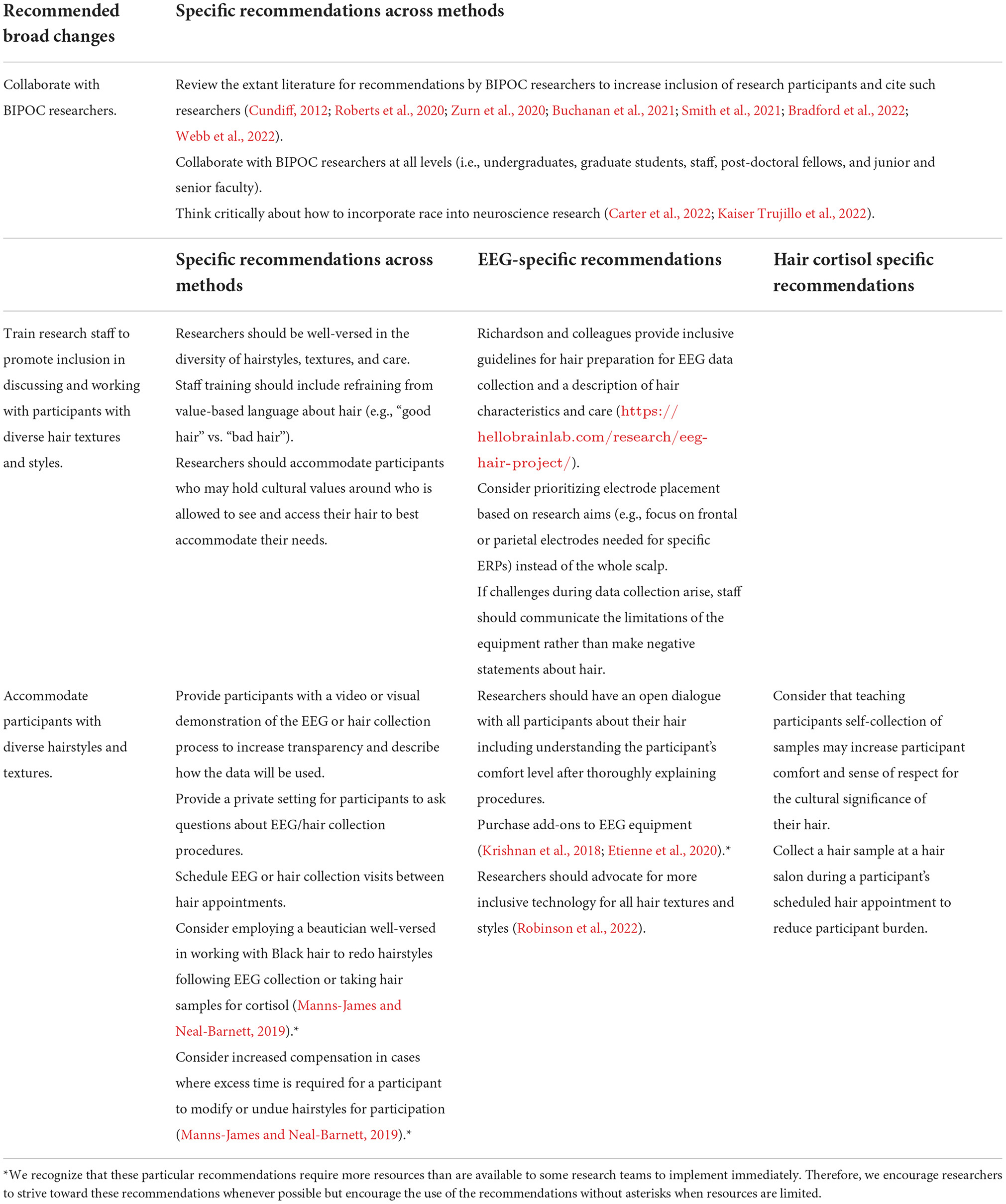
Table 1. Recommendations for researchers to improve inclusive practices in EEG and hair cortisol research.
Second, we encourage increased research training on hair types and styles. Understanding differences in hair types and styles is critical for preparing hair for EEG and hair sample collection, communicating steps to research participants, and promoting a more inclusive environment. We encourage researchers to go about this process with cultural humility (as opposed to cultural competence), which involves the dual praxis of self-reflection and continuous learning (Yeager and Bauer-Wu, 2013).
Third, we recommend that researchers strive to accommodate all hair textures and styles. Equipment and protocols must be altered to make them more accommodating of thick and curly hair. Others have suggested employing a beautician well-versed in working with Black hair to redo hairstyles following EEG collection or taking hair samples for cortisol (Wright et al., 2018). Researchers could also acknowledge the increased burden on BIPOC participants by offering additional compensation to those who need hairstyles to be removed and/or scheduling study visits before hair appointments (Manns-James and Neal-Barnett, 2019).
Additionally, researchers should collaborate with participants toward successful data collection, such as allowing participants to self-collect their own hair samples or working with participants to determine how to best collect data when access to their scalp is impeded. For example, researchers interested in fronto-central or centro-parietal neural signals (the most canonical locations for many common EEG/ERP metrics) could prioritize the placement of midline sites if access to other areas of the scalp is occluded. Finally, researchers should be conscious that certain cultural/religious practices dictate that only people of the same gender can see their hair. Therefore, we recommend conducting EEG and hair sample collection in a private space and that lab visits are adjusted, if needed, to meet the participant's needs.
Conclusion
In sum, anti-Black racism continues to shape research practices that rely on physiological methods involving contact with hair. While it may not be explicit, the use of these methods has a significant impact on who participates in research studies. Blindly abiding by the limitations of equipment or protocols leads to underrepresented samples, limited science, and a body of knowledge that does not apply to many. We believe a critical starting point to move toward inclusion is to modify research lab practices. While we have specifically reviewed EEG and hair cortisol, it is vital for this critical reflection and action to take place across multiple phases of the research process for a variety of research methodologies. We hope these recommendations may provide practical steps for researchers to employ in their labs to improve inclusion and expand the applicability and relevance of neuroscience research beyond White and WEIRD individuals.
Author contributions
CL, CW, and LG conceptualized and drafted the manuscript. All authors provided critical revision of the manuscript and approved the final version for submission.
Funding
This work was supported by the National Institute of Mental Health of the National Institutes of Health under Award Number F31MH125604.
Acknowledgments
We would like to acknowledge all members of the Clinical Psychophysiology Lab who, on some level, participated in critical discussions on this topic.
Conflict of interest
The authors declare that the research was conducted in the absence of any commercial or financial relationships that could be construed as a potential conflict of interest.
Publisher's note
All claims expressed in this article are solely those of the authors and do not necessarily represent those of their affiliated organizations, or those of the publisher, the editors and the reviewers. Any product that may be evaluated in this article, or claim that may be made by its manufacturer, is not guaranteed or endorsed by the publisher.
Author disclaimer
The content is solely the responsibility of the authors and does not necessarily represent the official views of the National Institutes of Health.
References
Abiodun, S. J. (2019). “Seeing Color,” a discussion of the implications and applications of race in the field of neuroscience. Front. Hum. Neurosci. 13, 280. doi: 10.3389/fnhum.2019.00280
Barber, S., Gronholm, P. C., Ahuja, S., Rüsch, N., and Thornicroft, G. (2020). Microaggressions towards people affected by mental health problems: a scoping review. Epidemiol. Psychiatr. Sci. 29, e82. doi: 10.1017/S2045796019000763
Bradford, D. E., DeFalco, A., Perkins, E., Carbajal, I., Kwasa, J., Goodman, F. R., et al. (2022). Whose signals are we amplifying? Towards a more equitable clinical psychophysiology. Clin. Psychol. Sci. doi: 10.31234/osf.io/c2naf
Buchanan, N. T., Perez, M., Prinstein, M. J., and Thurston, I. B. (2021). Upending racism in psychological science: Strategies to change how science is conducted, reported, reviewed, and disseminated. Am. Psychol. 76, 1097–1112. doi: 10.1037/amp0000905
Buchanan, N. T., and Wiklund, L. O. (2020). Why clinical science must change or die: Integrating intersectionality and social justice. Women Therapy 43, 309–329. doi: 10.1080/02703149.2020.1729470
Carter, S. E., Mekawi, Y., and Harnett, N. G. (2022). It's about racism, not race: a call to purge oppressive practices from neuropsychiatry and scientific discovery. Neuropsychopharmacology. 47, 2179–2180. doi: 10.1038/s41386-022-01367-5
Choy, T., Baker, E., and Stavropoulos, K. (2021). Systemic Racism in EEG Research: Considerations and Potential Solutions. Affect Sci. 3, 14–20. doi: 10.1007/s42761-021-00050-0
Cundiff, J. L. (2012). Is mainstream psychological research “Womanless” and “Raceless”? An updated analysis. Sex Roles 67, 158–173. doi: 10.1007/s11199-012-0141-7
Etienne, A., Laroia, T., Weigle, H., Afelin, A., Kelly, S. K., Krishnan, A., et al. (2020). Novel electrodes for reliable EEG recordings on coarse and curly hair. In 2020 42nd Annual International Conference of the IEEE Engineering in Medicine & Biology Society (EMBC). (IEEE), pp. 6151–6154. doi: 10.1109/EMBC44109.2020.9176067
Fulvio, J. M., Akinnola, I., and Postle, B. R. (2021). Gender (Im)balance in citation practices in cognitive neuroscience. J. Cogn. Neurosci. 33, 3–7. doi: 10.1162/jocn_a_01643
Gatzke-Kopp, L. M. (2016). Diversity and representation: key issues for psychophysiological science. Psychophysiology 53, 3–13. doi: 10.1111/psyp.12566
Goldfarb, M. G., and Brown, D. R. (2022). Diversifying participation: the rarity of reporting racial demographics in neuroimaging research. Neuroimage 254, 119122. doi: 10.1016/j.neuroimage.2022.119122
Hassen, N., Lofters, A., Michael, S., Mall, A., Pinto, A. D., and Rackal, J. (2021). Implementing anti-racism interventions in healthcare settings: a scoping review. Int. J. Environ. Res. Public Health 18, 2993. doi: 10.3390/ijerph18062993
Henrich, J., Heine, S. J., and Norenzayan, A. (2010). The weirdest people in the world? Behav. Brain Sci. 33, 61–83. doi: 10.1017/S0140525X0999152X
Jones, S. C. T., and Neblett, E. W. (2017). Future directions in research on racism-related stress and racial-ethnic protective factors for black youth. J. Clin. Child Adolesc. Psychol. 46, 754–766. doi: 10.1080/15374416.2016.1146991
Kaiser Trujillo, A., Kessé, E. N., Rollins, O., Della Sala, S., and Cubelli, R. (2022). A discussion on the notion of race in cognitive neuroscience research. Cortex 150, 153–164. doi: 10.1016/j.cortex.2021.11.007
Krishnan, A., Kumar, R., Etienne, A., Robinson, A., Kelly, S., Behrmann, M., et al. (2018). Challenges and opportunities in instrumentation and use of high-density EEG for underserved regions. in Innovations and Interdisciplinary Solutions for Underserved Areas. InterSol 2018. Lecture Notes of the Institute for Computer Sciences, Social Informatics and Telecommunications Engineering, vol 249. eds C. Kebe, A. Gueye, A. Ndiaye, A. Garba (Cham, New York, NY: Springer). doi: 10.1007/978-3-319-98878-8_7
Kuria, E. N. (2014). Theorizing race (ism) while neuroGendering. Gendered Neurocultures: Feminist and Queer Perspectives on Current Brain Discourses. p. 109–123.
Lin, L., Stamm, K., and Christidis, P. (2018). Demographics of the US Psychology Workforce. Washington, DC: Author.
MacFarlane, J., Tropp, L. R., and Goff, P. A. (2017). Explicit and Implicit Attitudes Toward Black Women's Hair. Available online at: https://perception.org/wp-content/uploads/2017/01/TheGoodHairStudyFindingsReport.pdf
Manns-James, L., and Neal-Barnett, A. (2019). Development of a culturally informed protocol for hair cortisol sampling in Black women. Public Health Nurs. 36, 872–879. doi: 10.1111/phn.12668
Mbilishaka, A. M., Clemons, K., Hudlin, M., Warner, C., and Jones, D. (2020). Don't get it twisted: Untangling the psychology of hair discrimination within Black communities. Am. J. Orthopsychiatry 90, 590–599. doi: 10.1037/ort0000468
Parker, T. C., and Ricard, J. A. (2022). Structural racism in neuroimaging: perspectives and solutions. Lancet Psychiatry 9, e22. doi: 10.1016/S2215-0366(22)00079-7
Roberts, S. O., Bareket-Shavit, C., Dollins, F. A., Goldie, P. D., and Mortenson, E. (2020). Racial inequality in psychological research: trends of the past and recommendations for the future. Perspect. Psychol. Sci. 15, 1295–1309. doi: 10.1177/1745691620927709
Robinson, J. T., Rommelfanger, K. S., Anikeeva, P. O., Etienne, A., French, J., Gelinas, J., et al. (2022). Building a culture of responsible neurotech: neuroethics as socio-technical challenges. Neuron 110, 2057–2062. doi: 10.1016/j.neuron.2022.05.005
Russell, E., Koren, G., Rieder, M., and Van Uum, S. (2012). Hair cortisol as a biological marker of chronic stress: current status, future directions and unanswered questions. Psychoneuroendocrinology 37, 589–601. doi: 10.1016/j.psyneuen.2011.09.009
Smith, C. A., Williams, E. L., Wadud, I. A., Pirtle, W. N., and Collective, C. B. W. (2021). Cite black women: a critical praxis (a statement). Fem. Anthropol. 2, 10–17. doi: 10.1002/fea2.12040
Society for Neuroscience. (2017). Report of Neuroscience Departments & Programs Survey. Available online at: https://www.sfn.org/-/media/SfN/Documents/SurveyReports/NDP-Final-Report.ashx?la=en
Spates, K. (2012). “The Missing Link” the exclusion of black women in psychological research and the implications for black women's mental health. Sage Open 2, 2158244012455179. doi: 10.1177/2158244012455179
Taffe, M. A., and Gilpin, N. W. (2021). Equity, diversity and inclusion: racial inequity in grant funding from the US National Institutes of Health. Elife 10, e65697. doi: 10.7554/eLife.65697
Taylor, C. M., Pritschet, L., and Jacobs, E. G. (2021). The scientific body of knowledge – Whose body does it serve? A spotlight on oral contraceptives and women's health factors in neuroimaging. Front. Neuroendocrinol. 60, 100874. doi: 10.1016/j.yfrne.2020.100874
Taylor, L., and Rommelfanger, K. S. (2022). Mitigating white Western individualistic bias and creating more inclusive neuroscience. Nat. Rev. Neurosci. 23, 389–390. doi: 10.1038/s41583-022-00602-8
Washington, H. A. (2006). Medical Apartheid: The Dark History of Medical Experimentation on Black Americans from Colonial Times to the Present. New York, NY: Doubleday Books.
Webb, E. K., Etter, J. A., and Kwasa, J. A. (2022). Addressing racial and phenotypic bias in human neuroscience methods. Nat. Neurosci. 25, 410–414. doi: 10.1038/s41593-022-01046-0
Wendler, D., Kington, R., Madans, J., Wye, G. V., Christ-Schmidt, H., Pratt, L. A., et al. (2005). Are Racial and Ethnic Minorities Less Willing to Participate in Health Research? PLoS Med. 3, e19. doi: 10.1371/journal.pmed.0030019
Wright, K. D., Ford, J. L., Perazzo, J., Jones, L. M., Mahari, S., Sullenbarger, B. A., et al. (2018). Collecting hair samples for hair cortisol analysis in African Americans. J. Vis. Exp. 57288. doi: 10.3791/57288
Yeager, K. A., and Bauer-Wu, S. (2013). Cultural humility: essential foundation for clinical researchers. Appl. Nurs. Res. 26, 251–256. doi: 10.1016/j.apnr.2013.06.008
Keywords: EEG, hair cortisol, anti-Black racism, inclusion, hair-bias
Citation: Louis CC, Webster CT, Gloe LM and Moser JS (2022) Hair me out: Highlighting systematic exclusion in psychophysiological methods and recommendations to increase inclusion. Front. Hum. Neurosci. 16:1058953. doi: 10.3389/fnhum.2022.1058953
Received: 30 September 2022; Accepted: 21 November 2022;
Published: 08 December 2022.
Edited by:
Stefanie Bodison, University of Florida, United StatesReviewed by:
Hiram H. Brownell, Boston College, United StatesCopyright © 2022 Louis, Webster, Gloe and Moser. This is an open-access article distributed under the terms of the Creative Commons Attribution License (CC BY). The use, distribution or reproduction in other forums is permitted, provided the original author(s) and the copyright owner(s) are credited and that the original publication in this journal is cited, in accordance with accepted academic practice. No use, distribution or reproduction is permitted which does not comply with these terms.
*Correspondence: Courtney C. Louis, bG91aXNjb3VAbXN1LmVkdQ==
†These authors have contributed equally to this work and share first authorship