 Clément Roume
- IRIMAS UR UHA 7499, University of Haute-Alsace, Mulhouse, France
The assessment of physiological complexity via the estimation of monofractal exponents or multifractal spectra of biological signals is a recent field of research that allows detection of relevant and original information for health, learning, or autonomy preservation. This tutorial aims at introducing Whittle’s maximum likelihood estimator (MLE) that estimates the monofractal exponent of time series. After introducing Whittle’s maximum likelihood estimator and presenting each of the steps leading to the construction of the algorithm, this tutorial discusses the performance of this estimator by comparing it to the widely used detrended fluctuation analysis (DFA). The objective of this tutorial is to propose to the reader an alternative monofractal estimation method, which has the advantage of being simple to implement, and whose high accuracy allows the analysis of shorter time series than those classically used with other monofractal analysis methods.
1 Introduction
For nearly three decades, numerous studies have shown that invariant-scale structures appear in biological signals. These studies have widely suggested that this type of structure, also called fractal structures, hints at the complexity of the system that produced the signal (Peng et al., 1994; Hausdorff et al., 1996; Ivanov et al., 1998; Goldberger et al., 2002; Kello et al., 2007; Delignieres and Torre, 2009; Harrison and Stergiou, 2015; Vaz et al., 2020). Formally, scale invariance can be described in several ways. In the time domain, a signal is scale-invariant when its statistical properties are consistent across scales
The estimation of the H exponent has become very relevant in the fields of health and aging because this fractal structure tends to diminish or even disappear with the first signs of age or disease, making the exponent H a very promising predictor. We (Almurad et al., 2017; Almurad et al., 2018; Ezzina et al., 2021) have also suggested, through several studies, that it was possible to restore complexity in older adults. However, all the participants in our studies were characterized by healthy aging and did not have any motor disability limiting their movements. Fractal analyses require long signals of more than 500 data points to ensure that the estimated H value is reliable, which, in the case of walking, represents an analysis time of 10–12 min (Phinyomark et al., 2020). It is obvious that for people whose age has a greater impact on their motor skills or who have diseases limiting their motricity, it is impossible to walk for such a long time. One can believe that it is necessary to develop a more precise method of analysis that would allow reducing the duration of the experimental process.
Among the mathematical models of long-memory processes, two models have been widely used to construct methods for estimating the H exponent. The first method, proposed by Mandelbrot and Van Ness (1968), is the fractional Gaussian noise (fGn) and fractional Brownian motion (fBm) model. It is the first fractal process model that has been formulated, describing both stationary (fGn) and non-stationary (fBm) processes. In this case, stationarity corresponds to a process with constant mean and variance, and non-stationarity corresponds to a process with a variance dependent on time and H. The second model, formulated by Granger and Joyeux (1980) and Hosking (1981), is the ARFIMA (p,d,q) model. This model allows the description of short memory processes (via MA and AR component) AND long memory processes (via FI component). In the context of this paper, we focus only on the long-memory FI component. The model used here is therefore an ARFIMA (0,d,0). Unlike the fBm/fGn model, the ARFIMA (0,d,0) model holds only for stationary processes. However, in the spectral domain, ARFIMA (0,d,0) and fGn have an equivalent spectral decay, which makes it possible to compare exponents d and H via the
One can note that the Hurst exponent
In addition to the series size issues mentioned previously, Beran et al. (2013) add that heuristic/graphical methods, such as DFA (Peng et al., 1995), “are easy to implement and may serve as descriptive tools and a first heuristic check, there are many reasons for using more sophisticated methods when it comes to actual statistical inference.” Among these more sophisticated methods are maximum likelihood estimators (MLEs) and, particularly, Whittle’s method. Whittle’s MLE is a parametric estimator based on an optimization problem. Beran suggests that this estimator, like the classical MLE, is consistent. The choice of Whittle’s MLE over the classical MLE has two explanations. The first is computational: the complexity of the classical MLE is
In a previous study (Roume et al., 2019), we had already suggested that Whittle’s MLE allows a better estimation of the H exponent than DFA and the spectral analysis. However, the algorithm we used, the ARFIMA (p,d,q) estimator proposed by G. Intzelt on the MathWorks File Exchange platform1, went far beyond the analysis of long-memory processes, allowing, for example, the addition of short-term components, forecasting, and signal generation. We therefore propose the present tutorial, which allows a simpler implementation of Whittle’s approximation of MLE, focusing only on the long-term dependencies.
The purpose of this tutorial is to provide a step-by-step guide to construct this analysis method similar to the method used by Ihlen in his tutorial for MF-DFA (Ihlen, 2012). In addition, at each step, we describe the formal aspects underlying the construction of the algorithm. We also propose to the reader a single-file and standalone algorithm to facilitate its use and diffusion. Then, to facilitate reading, we have used a different font for the variables, parameters, and commands used in MATLAB. We suggest the reader to download the code files and datasets deposited in a GitHub repository at https://github.com/clementroume/Whittle_maximum_likelihood_estimator_tutorial and add the downloaded folder to the MATLAB path to follow this tutorial. The remainder of this article is organized as follows: Section 2, Whittle’s maximum likelihood estimator in MATLAB, gives the step-by-step construction method of the whittle.m algorithm. Meanwhile, Section 3, Whittle’s maximum likelihood performances, outlines a complete benchmark of this algorithm against DFA.
2 Whittle’s maximum likelihood estimator in MATLAB
This method of analysis is an optimization problem, and the principle is to estimate the value of the Hurst exponent
where
•
•
•
•
•
•
Whittle’s log-likelihood function is an approximation of the likelihood function for stationary Gaussian processes, in this case, fGn or ARFIMA (0,d,0). As further illustrated in Figure 5, the principle is to construct the
We will detail this method through seven sections: Section 2.1, Periodogram power spectral density estimate, introduces the computation to estimate the periodogram of the signal. Section 2.2, Theoretical power spectral density of the model process, is a sub-step presenting the two possible alternatives in the choice of the theoretical spectrum. Section 2.3, Fitting the power of the model process to that of the signal, is a sub-step where the constant
Before beginning this guide, the reader can type load fractalsignals. mat in the MATLAB command window to load the time series: choleskyfgn, arfima0d0, whitenoise, and empirical. These signals will be used all along this guide to illustrate each step of the construction of the algorithm. choleskyfgn is a simulated exact fGn signal with an
2.1 Periodogram power spectral density estimate
The first step is to estimate the power spectral density of the observation vector. This estimation can be carried out by calculating the periodogram of the signal corresponding to the squared modulus of the discrete Fourier transform of the signal. The periodogram is formally written as
where the set of variables used in Equation 2 is the same as that described in Equation 1. To meet the requirements of Equation 1, we note that the frequency range
…………………………………………………………
MATLAB code 1: Periodogram estimation.
X=zscore(x); N=length(X);
m=floor((N-1)/2);
[Pxx,wxx]= periodogram(X); P=Pxx((2:m+1));
w=wxx((2:m+1));
…………………………………………………………
The first line standardizes the observation vector x by setting its mean to 0 and its standard deviation to 1. This operation is relatively common in the field and is essential for the rest of this tutorial because Equations 3, 4 in the following sections are derived from the autocorrelation function (and not from the autocovariance function) and therefore assume a variance equal to 1. This operation also normalizes the total power of the spectrum P, but it does not change the shape of the spectrum, so it does not alter the information of the fractal exponents.
The second line returns the length N of the input signal x, and the third computes the upper bound m. In the fourth line, we use the Signal Processing Toolbox command periodogram() to estimate the power spectral density of the input signal x, and an alternative code using the fft() command is given if the periodogram() command is not included in your MATLAB version. Finally, the fifth and the sixth lines bound P and w within the interval presented in Equation 2. Figure 1 represents the plot of the estimated periodograms of the series choleskyfgn, arfima0d0, whitenoise, and empirical.

FIGURE 1. Estimation of power spectral density via the periodogram method for choleskyfgn (A), arfima0d0 (B), whitenoise (C), and empirical (D) signals.
Type Fig1_PSD in the command window to access Figure 1.
…………………………………………………………
MATLAB code 1bis: Periodogram estimation using fast Fourier transform
X = zscore(x); N = length(X);
m = floor ((N-1)/2);
Y = fft(X);
P=(1/(pi*N))*abs (Y (2:m+1)′). ^2;
w=(2*pi*(1:m)′)/N
…………………………………………………………
2.2 Theoretical power spectral density of the model process
In this sub-step, we present the equations and their computation for the two theoretical spectral densities derived from the fGn/fBm and ARFIMA (0,d,0) models, respectively.
The theoretical fGn spectral density was given by Li and Lim (2006) as follows:
where
…………………………………………………………
MATLAB code 2: Theoretical power spectral density of the fGn process
Tp = sin (pi*H)*gamma ((2*H)+1)*(abs(w).^(1-(2*H)));
…………………………………………………………
The theoretical ARFIMA (0,d,0) spectral density was given by Taqqu et al. (1995) as follows:
where d is the integration parameter belonging to
…………………………………………………………
MATLAB code 3: Theoretical power spectral density of the ARFIMA (0,d,0) process
d = H-0.5;
Tp=(1/(2*pi))*(2*sin (w/2)).^-(2*d);
…………………………………………………………
Figure 2 repeats Figure 1 by adding the theoretical spectral densities calculated using MATLAB codes 2 and 3. To better illustrate the global functioning of the algorithm, in Figure 2, we present the theoretical power spectral densities computed with the estimated values of H and d obtained via whittle.m. These values are reported in Table 1.

FIGURE 2. Periodogram of choleskyfgn (A), arfima0d0 (B), whitenoise (C), and empirical (D) signals with the theoretical power spectral density of fGn (orange curve) and ARFIMA (0,d,0) (yellow curve). The theoretical power spectral densities were computed with the estimated values of H and d obtained via whittle.m. Those values, entered in MATLAB code 2 and 3, are presented in Table 1.
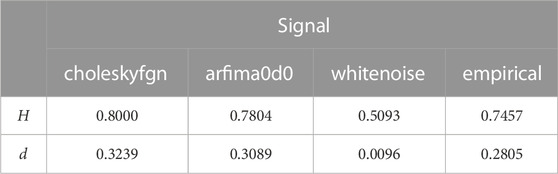
TABLE 1. H and d values of choleskyfgn, arfima0d0, whitenoise, and empirical signals estimated via whittle.m.
Type Fig2_TPSD in the command window to access Figure 2.
2.3 Fitting the power of the model process to that of the signal
As advised by Jennane et al. (2001), in this sub-step, we calculate the constant of proportionality
…………………………………………………………
MATLAB code 4: Fitting theoretical spectrum
c = sum(P)/sum (Tp);T = c*Tp;
…………………………………………………………
In the first line, the constant c is calculated, and in the second line, the theoretical spectrum Tp is adjusted to the empirical periodogram P. Figure 3 shows the plot of Figure 2 with adjusted theoretical spectrum. The total power of the theoretical spectrum Tp is determined by the value of H in Equation 3 or d in Equation 4, but the function of fractal exponents is to shape the spectrum, not to modulate its power, hence the need for adjustment between theoretical power and signal power.
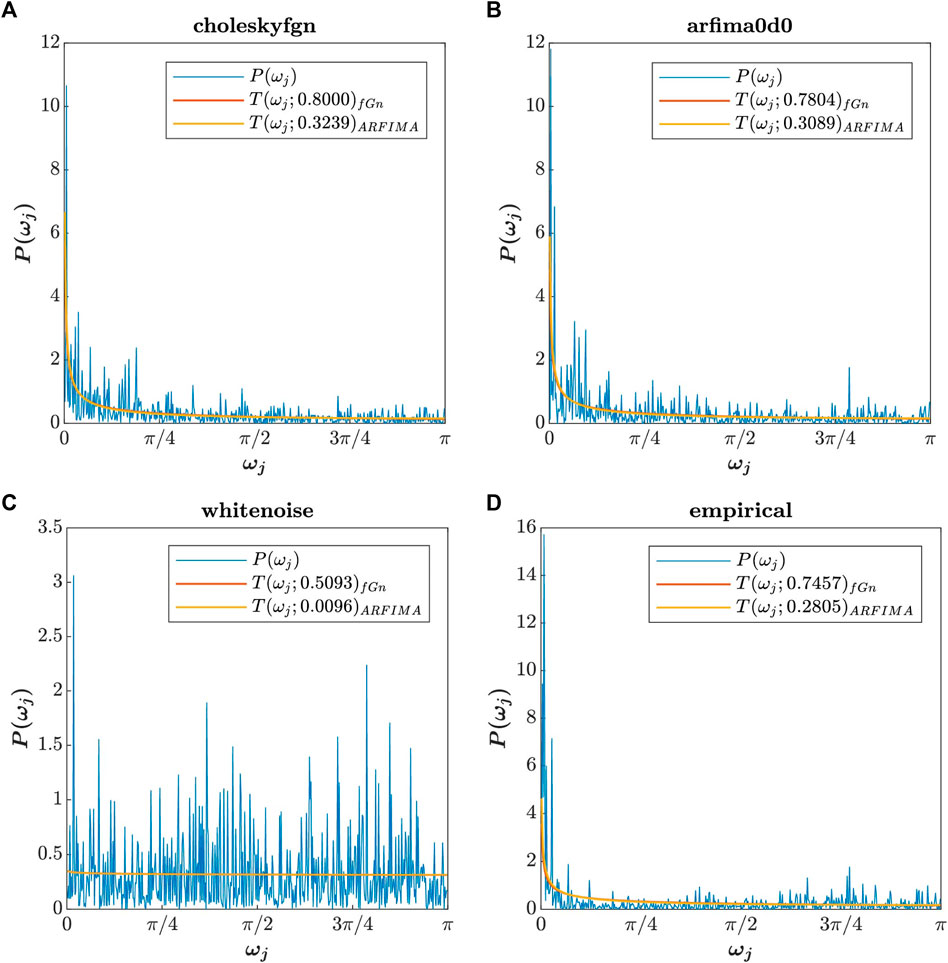
FIGURE 3. Periodogram of choleskyfgn (A), arfima0d0 (B), whitenoise (C), and empirical (D) signals (blue curve) with the adjusted theoretical power spectral density of fGn (orange curve) and ARFIMA (0,d,0) (yellow curve). The H and d values are the same as those used in the previous figure.
Type Fig3_TPSD_adjusted in the command window to access Figure 3.
2.4 Whittle’s log-likelihood function
In this second step, we construct Whittle’s log-likelihood function by injecting the two previous sub-steps into Equation 1, which is the function that we want to maximize. However, the optimization toolbox of MATLAB only allows minimizing functions, so we will have to minimize the inverse of Equation 1. This inverse function is written in the MATLAB code as follows:
…………………………………………………………
MATLAB code 5: Whittle’s log-likelihood function
lwH=(2/N)*sum (log(T)+(P./T));
…………………………………………………………
where lwH is the inverse of Whittle’s likelihood function, N is the length of the observation vector, T is the scaled theoretical periodogram computed via MATLAB codes 2 or 3 and then MATLAB code 4, and P is the estimated periodogram of the observation vector computed via MATLAB code 1. MATLAB codes 6 and 7 are given in the following sections, which are the functions declared in MATLAB and which we will have to minimize. These codes correspond to the combination of MATLAB codes 2–5. MATLAB code 6 gives the function based on the theoretical spectrum of fGn, while MATLAB code 7 gives the function based on the theoretical spectrum of ARFIMA (0,d,0). These functions will have to be placed either at the end of the mother code whittle.m (as is the case with the provided code) or in two separate files that can be named WLLFfgn.m and WLLFarf.m.
…………………………………………………………
MATLAB code 6: Whittle’s log-likelihood function with fGn theoretical PSD
function lwHfgn = WLLFfgn (H,w,P,N)
Tp = sin (pi*H)*gamma ((2*H)+1)*(abs(w).^(1-(2*H)));
c = sum(P)/sum (Tp);
T = c*Tp;
lwHfgn=(2/N)*sum (log(T)+(P./T));
…………………………………………………………
MATLAB code 7: Whittle’s log-likelihood function with ARFIMA (0,d,0) theoretical PSD
function lwHarf = WLLFarf (H,w,P,N)
d = H-0.5;
Tp=(1/(2*pi))*(2*sin (w/2)).^-(2*d);
c = sum(P)/sum (Tp);
T = c*Tp;
lwHarf=(2/N)*sum (log(T)+(P./T));
…………………………………………………………
In the first line, the function is used to declare the functions WLLFfgn and WLLFarf. The outputs are lwHfgn for code 6 and lwHarf for code 7 and correspond to
In Figure 4, we present the plots corresponding to these two functions for our four test signals: choleskyfgn, arfima0d0, whitenoise, and empirical, with H values ranging from 0.05 to 0.95 by steps of 0.05.
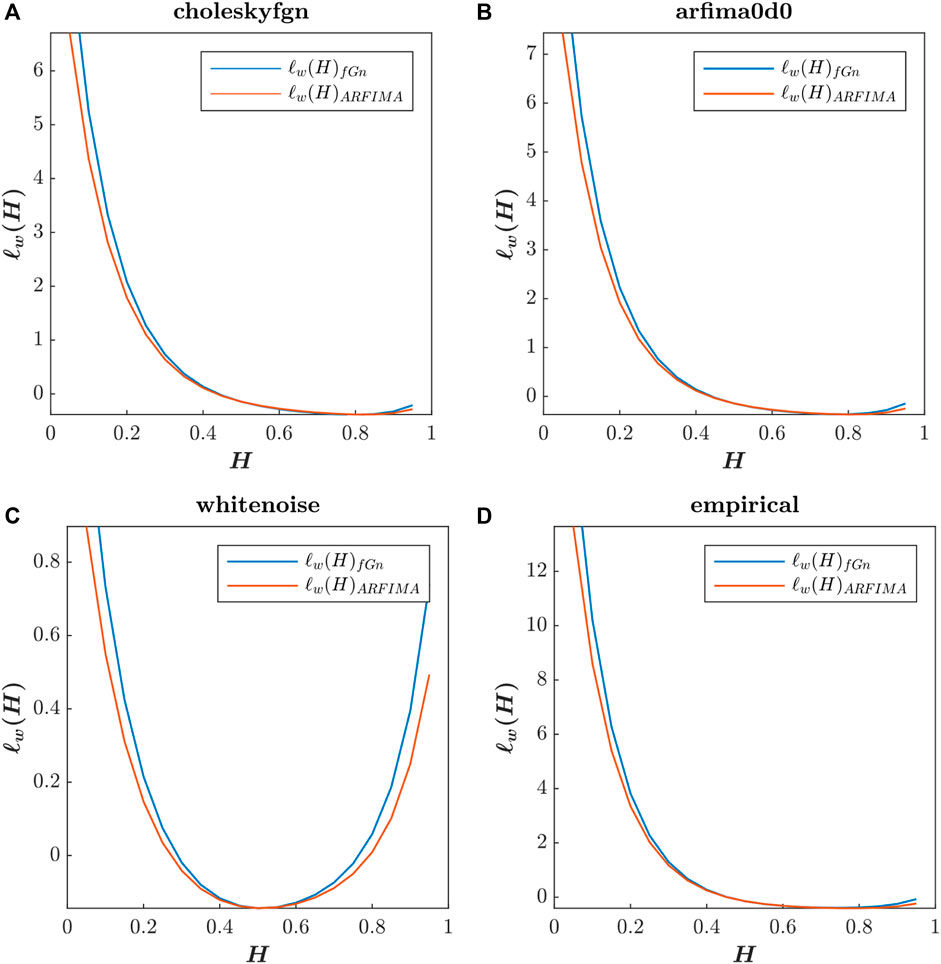
FIGURE 4. Whittle’s log-likelihood functions of choleskyfgn (A), arfima0d0 (B), whitenoise (C), and empirical (D) signals. The blue curves correspond to Whittle’s likelihood function calculated using the fGn theoretical spectrum, while the orange curves correspond to the same function calculated using the ARFIMA (0,d,0) theoretical spectrum.
Type Fig4_lwH in the command window to access Figure 4.
2.5 Resolving the optimization problem
In this third step, we describe the method to solve the optimization problem. In other words, we must find the value of
where
In order to implement the operation of Equation 6, we use the MATLAB function fminbnd(), which is a minimizer based on golden section search and parabolic interpolation. The MATLAB codes to find the minimum of the WLfgn and Wlarf functions are as follows:
…………………………………………………………
MATLAB code 8: Optimization for fGn-based Whittle’s log-likelihood function
Afgn = fminbnd (@(H) WLLFfgn (H,w,P,N),0,1);
…………………………………………………………
…………………………………………………………
MATLAB code 9: Optimization for ARFIMA (0,d,0)-based Whittle’s log-likelihood function
Aarf = fminbnd (@(H) WLLFarf (H,w,P,N),0,1);
…………………………………………………………
Afgn and Aarf are the two values of
2.6 The case of non-stationary signals
By definition, Whittle’s log-likelihood function only holds for stationary signals such as fGn or ARFIMA (0,d,0). As a result, when analyzing non-stationary signals, the minimum of this function occurs when
…………………………………………………………
MATLAB code 10: If the observation vector is non-stationary, fGn-based Whittle’s likelihood
if Afgn >= 0.9998
[Pyy,wyy]= periodogram (diff(X));
mdiff = floor ((N-2)/2);
Pdiff = Pyy ((2:mdiff+1));
wdiff = wyy ((2:mdiff+1));
Afgn = fminbnd (@(H) WLLFfgn (H,wdiff, Pdiff, (N-1)),0,1)+1;
end
…………………………………………………………
MATLAB code 11: If the observation vector is non-stationary, ARFIMA-based Whittle’s likelihood
if Aarf >= 0.9998
[Pyy,wyy]= periodogram (diff(X));
mdiff = floor ((N-2)/2);
Pdiff = Pyy ((2:mdiff+1));
wdiff = wyy ((2:mdiff+1));
Aarf = fminbnd (@(H) WLLFarf (H,wdiff, Pdiff, (N-1)),0,1)+1;
end
…………………………………………………………
The first line of both codes is the logical test. If the answer is true, then the four consecutive lines are computed. In the second line, the periodogram is estimated on the differentiated observation vector diff(x). In the third line, mdiff is calculated because diff(x) is one point shorter than x. In the fourth and fifth lines, the zero frequency and those greater than mdiff are excluded. Finally, in the sixth line, Afgn and Aarf are estimated by adding 1 to the value returned by fminbnd().
2.7 The construction of whittle.m algorithm
We would like to warn the reader that in order to make this tutorial progressive, the steps are not ordered in the same way as in the whittle.m algorithm. Moreover, some algorithmic intricacies were unfolded in sub-steps, giving more lines of code than necessary to build the all-in-one whittle.m algorithm. To construct whittle.m, the reader should proceed as follows:
1. Begin with the header: function [Afgn, Aarf] = whittle(x), where x is the observation vector, Aarf is the exponent estimated using ARFIMA (0,d,0) theoretical power spectral density, and Afgn is the exponent estimated using fGn theoretical power spectral density.
2. Then paste the MATLAB codes in the following order:
• MATLAB code 1: Periodogram estimation
• MATLAB code 8: Optimization for fGn-based Whittle’s log-likelihood function
• MATLAB code 10: If the observation vector is non-stationary, fGn-based Whittle’s likelihood
• MATLAB code 9: Optimization for ARFIMA (0,d,0)-based Whittle’s log-likelihood function
• MATLAB code 11: If the observation vector is non-stationary, ARFIMA-based Whittle’s likelihood
• MATLAB code 6: Whittle’s log-likelihood MATLAB function with fGn theoretical PSD
• MATLAB code 7: Whittle’s log-likelihood MATLAB function with ARFIMA (0,d,0) theoretical PSD
3 Whittle’s maximum likelihood performances
Now that all the steps have been described, we will test the performance of the whittle.m algorithm and, in particular, compare it to DFA, which is a widely used algorithm in fractal signal analysis. Regarding the first part of this tutorial, we propose to divide it into several sections. Section 3.1, Test signals and generator biases, describes the methodology applied to generate the signals used to test Whittle’s maximum likelihood estimator and describes the biases related to the two generators used. Section 3.2, Which is the best estimator?, evaluates and compares the three analysis methods using squared error values and thus determines which is of better quality. Then, the performance of ARFIMA-based Whittle’s likelihood depending on the signal length is discussed in Section 3.3, Signal length. Finally, Section 3.4, Limitations and future studies, outlines the misuse of fractal analysis on non-monofractal signals and the evolutions that can be made on this algorithm.
3.1 Test signals and generator biases
To test Whittle’s maximum likelihood estimator, we generated two sets of signals, one for each theoretical model (fGn/fBm and ARFIMA (0,d,0)). The first one, based on the fGn properties, is the Cholesky decomposition, whose algorithm is named cholfgn.m. The second one consists of ARFIMA (0,d,0) filtering, whose algorithm is named ARFIMA0d0.m. We thus generated, for each of these generators, 42 subsets of 120 signals of length N = 1,024 for a total of 5,040 signals for each generator. These 42 subsets correspond to 42 different
We then estimated
Figure 5 shows the whole set of computed
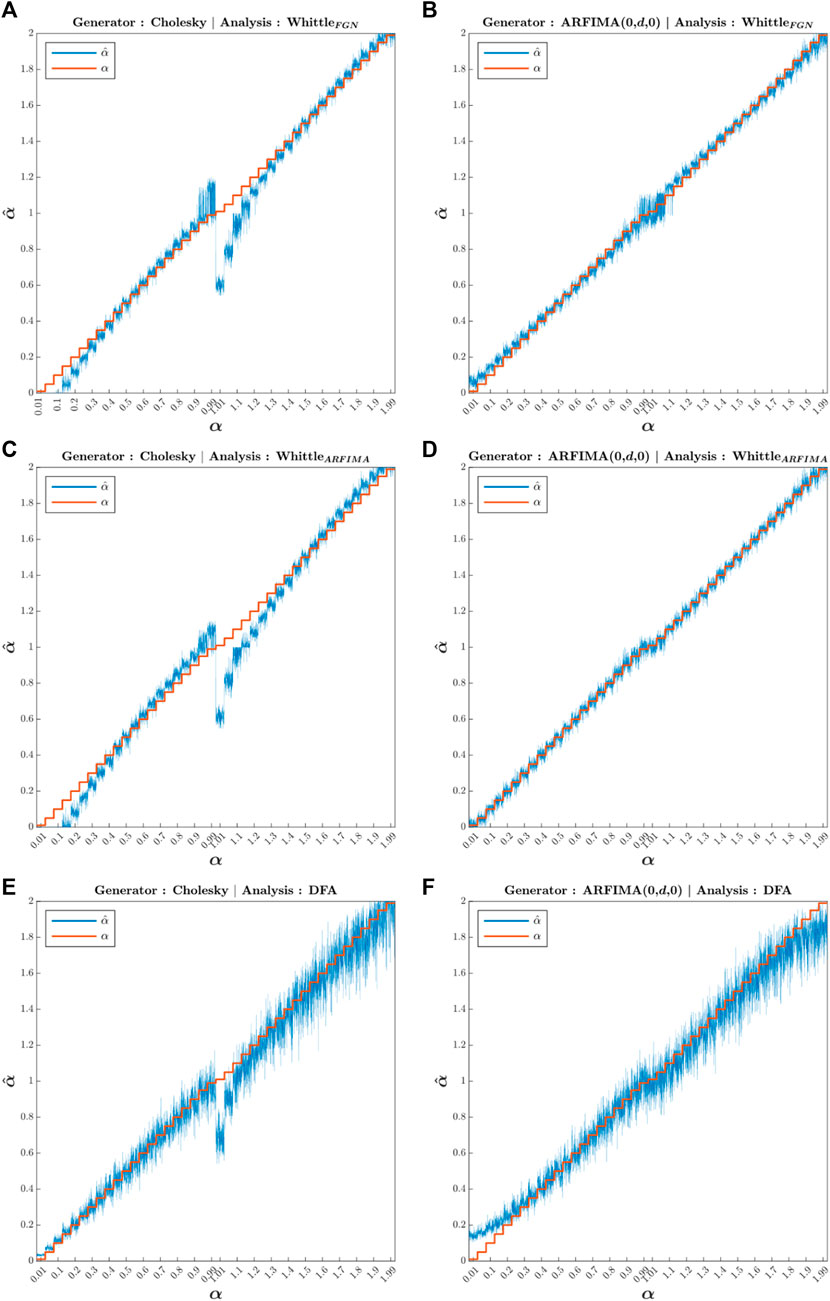
FIGURE 5. Whole set of
Type Fig5_Genbiases in the command window to access Figure 5.
3.2 Which is the best estimator?
In this section, we compare the efficiency of fGn-based Whittle’s likelihood, ARFIMA-based Whittle’s likelihood, and DFA. To assess the efficiency of these analysis methods, one must account for both their bias and variance. We therefore calculated Mean Squared Error (MSE), which is defined as the average of the squared error values. These analysis methods, being estimators in the sense of statistics, MSE can also be written as the sum of the variance and the squared bias of the values of
First, for each estimator, we calculated the 5,040 (42
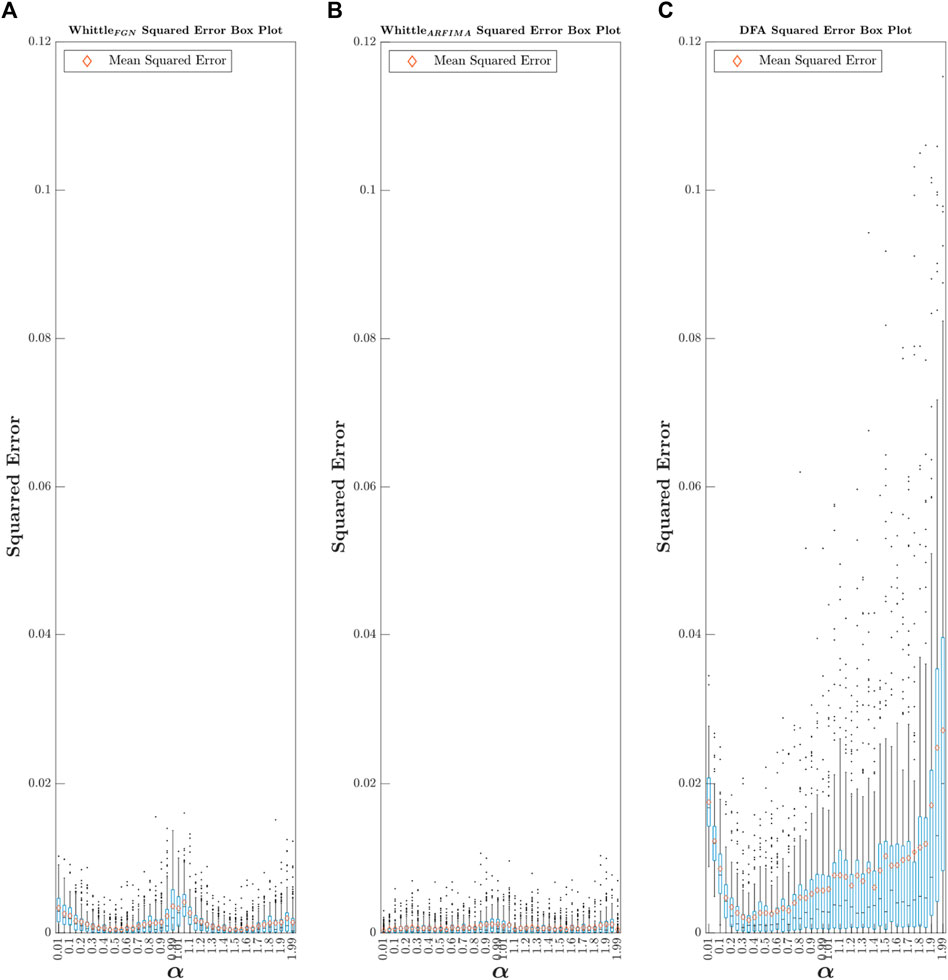
FIGURE 6. Box plot of
Type Fig6_SquarredError in the command window to access Figure 6.
In line with the results of the comparison of the MSE values, the first observation that can be made is that regardless of the value of
3.3 Signal length
In this section, we discuss the performance of ARFIMA-based Whittle’s likelihood depending on signal lengths. Fractal analysis, like DFA, often requires a large series (N > 500) to provide reliable alpha estimates (Damouras et al., 2010; Phinyomark et al., 2020). This can lead to experimental issues when working with physiological signals, such as the difficulty of older adults to walk for more than 5 min, which is between 100 and 250 strides (Moon et al., 2016; Phinyomark et al., 2020).
To assess the performance, we first made four sets of signals by reducing the length of tsarf from 1 to N, with the following four N values: 32, 64, 128, and 256. We then estimated
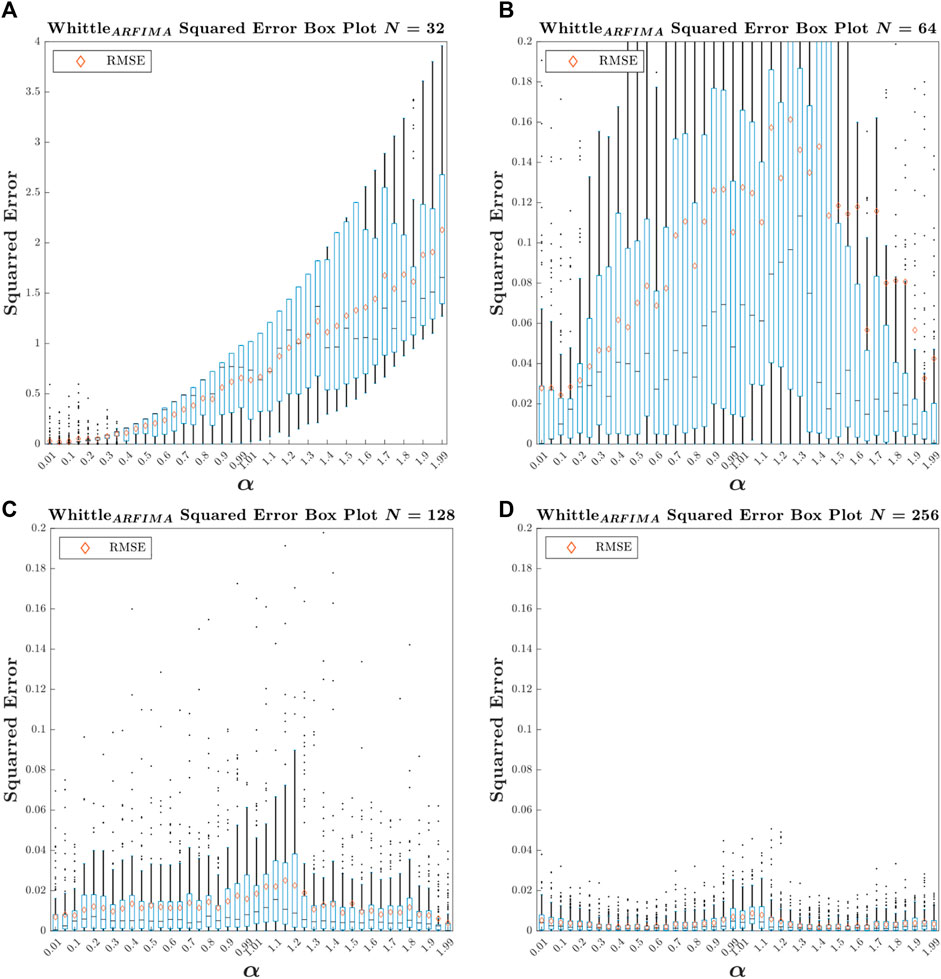
FIGURE 7. Box plot of
Type Fig7_SignalLength in the command window to access Figure 7.
The first observation that can be made from this figure is that the analysis method provides unreliable estimates for lengths N = 32 and 64. The second is that for N = 256, the ARFIMA-based Whittle’s likelihood gives more reliable estimates than DFA with N = 1,024. Finally, for N = 128, this method gives slightly less reliable estimates than DFA for 1,024 points.
In addition, it can be observed that, particularly for N = 128 and N = 256, the errors are maximized to approximately
For further comparison, we calculated the value of MSE for
3.4 Limitations and future studies
During the development of this tutorial, we tested Whittle’s maximum likelihood estimator on several physiological signals, including those made available by J. Hausdorff on the PhysioNet platform (Goldberger et al., 2000; Hausdorff, 2001). The results obtained are summarized in Table 2.
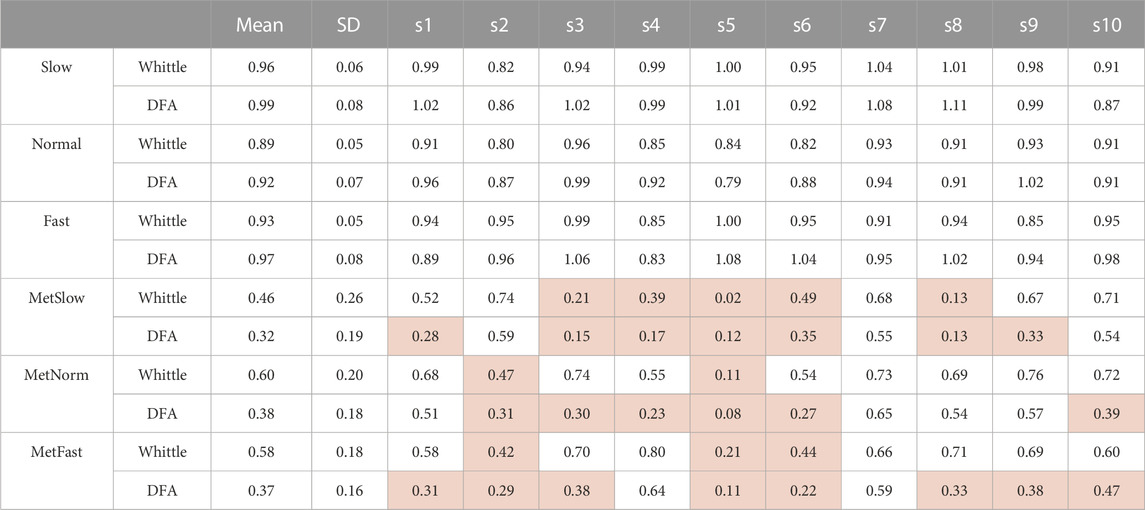
TABLE 2. Comparison of
Under the conditions without metronome (slow, normal, and fast), ARFIMA-based Whittle’s likelihood and DFA provide similar results for the mean
To understand why we obtained these results, we grouped the different series into three groups: the first group, “persistent behavior,” assembles the series for which DFA and Whittle’s likelihood analysis provide an

FIGURE 8. log-power spectral density of Hausdorff data rearranged into three groups: persistent behavior (A), anti-persistent behavior (B), and mixed behavior (C). log-power spectral density of an artificial ARFIMA(p,d,q) signal with parameters (2, −0.35.1) generated using ARFIMApdq.m (D).
Type Fig8_SpectralBehavior in the command window to access Figure 8.
In the first two columns, when the Whittle’s and DFA methods provided similar
This non-monotonicity of the spectrum in the logarithmic space, which was already observed by Torre and Delignières (2008), is not predicted in the two models, fGn/fBm and ARFIMA (0,d,0); therefore, we cannot apply these models, from a theoretical point of view, on a signal being characterized by such a spectrum. However, the ARFIMA (p,d,q) model allows the creation of non-monotonic spectra, as shown in the fourth column in Figure 8. It will therefore be interesting to improve the method that we have presented so far by incorporating in Equation 4 the AR and MA components known as short-memory components, all of which will give a theoretical spectrum with three parameters:
where
•
•
Finally, it will be interesting to compare the proposed method in this tutorial with Higuchi’s fractal dimension method that Phinyomark et al. (2020) has shown to be better than DFA, which is on our agenda for future work.
4 Conclusion
The long-term dependency structures, or fractal structures, present in biological signals inform about the complexity of the system that produced these signals. With age or disease, this structure tends to be altered, making the fractal exponent H an interesting predictor in the domain of healthcare. However, the length of the signal required by current analysis methods to properly estimate the H exponent requires long series that are difficult to perform for people with motor impairments caused by advanced age or pathologies. In this tutorial, we described the steps to implement an analysis method based on Whittle’s approximation; then, we showed that this estimator was of better quality than the popular DFA, allowing for a reliable estimation of the H exponent for small series adapted to people who cannot perform physical activities over long periods.
Data availability statement
The datasets presented in this study can be found in online repositories. The names of the repository/repositories and accession number(s) can be found at: The MATLAB codes and datasets generated and analyzed for this study are deposited in a GitHub repository at https://github.com/clementroume/Whittle_maximum_likelihood_estimator_tutorial.
Author contributions
CR: study conception and design, data collection, analysis and interpretation of results, and manuscript preparation.
Acknowledgments
The author thanks Pr. Olivier Haeberlé and Dr. Ali Moukadem (University of Haute-Alsace) for their comments and suggestions that greatly improved the manuscript. The author would also like to show his gratitude to Pr. Didier Delignières, for the whole of their discussions on this subject, but also for his benevolence and expertise which allowed the author to propose this paper. Merci pour tout Didier.
Conflict of interest
The author declares that the research was conducted in the absence of any commercial or financial relationships that could be construed as a potential conflict of interest.
Publisher’s note
All claims expressed in this article are solely those of the authors and do not necessarily represent those of their affiliated organizations, or those of the publisher, the editors, and the reviewers. Any product that may be evaluated in this article, or claim that may be made by its manufacturer, is not guaranteed or endorsed by the publisher.
Footnotes
1György Inzelt (2022). ARFIMA(p,d,q) estimator (https://www.mathworks.com/matlabcentral/fileexchange/30238-arfima-p-d-q-estimator), MATLAB Central File Exchange. Retrieved July 12, 2022.
2MathWorks Help Center (2021). periodogram. https://www.mathworks.com/help/signal/ref/periodogram.html
3MathWorks Help Center (2021). fminbnd. https://www.mathworks.com/help/matlab/ref/fminbnd.html
4The value displayed after the ± symbol is the standard deviation of the squared error of α.
References
Almurad, Z. M. H., and Delignières, D. (2016). Evenly spacing in detrended fluctuation analysis. Phys. Stat. Mech. Its Appl. 451, 63–69. doi:10.1016/j.physa.2015.12.155
Almurad, Z. M. H., Roume, C., Blain, H., and Delignières, D. (2018). Complexity matching: restoring the complexity of locomotion in older people through arm-in-arm walking. Front. Physiol. 9, 1766. doi:10.3389/fphys.2018.01766
Almurad, Z. M. H., Roume, C., and Delignières, D. (2017). Complexity matching in side-by-side walking. Hum. Mov. Sci. 54, 125–136. doi:10.1016/j.humov.2017.04.008
Beran, J., Feng, Y., Ghosh, S., and Kulik, R. (2013). Long-memory processes. Berlin, Heidelberg: Springer Berlin Heidelberg. doi:10.1007/978-3-642-35512-7
Damouras, S., Chang, M. D., Sejdić, E., and Chau, T. (2010). An empirical examination of detrended fluctuation analysis for gait data. Gait Posture 31, 336–340. doi:10.1016/j.gaitpost.2009.12.002
Delignieres, D., and Torre, K. (2009). Fractal dynamics of human gait: a reassessment of the 1996 data of Hausdorff et al. J. Appl. Physiol. 106, 1272–1279. doi:10.1152/japplphysiol.90757.2008
Diebolt, C., and Guiraud, V. (2005). A note on long memory time series. Qual. Quant. 39, 827–836. doi:10.1007/s11135-004-0436-z
Ezzina, S., Roume, C., Pla, S., Blain, H., and Delignières, D. (2021). Restoring Walking Complexity in Older Adults Through Arm-in-Arm Walking: were Almurad et al.’s (2018) Results an Artifact? Mot. Control 25, 475–490. doi:10.1123/mc.2020-0052
Goldberger, A. L., Amaral, L. A. N., Glass, L., Hausdorff, J. M., Ivanov, P.Ch., Mark, R. G., et al. (2000). PhysioBank, PhysioToolkit, and PhysioNet: components of a new research resource for complex physiologic signals. Circulation 101, E215–E220. doi:10.1161/01.CIR.101.23.e215
Goldberger, A. L., Amaral, L. A. N., Hausdorff, J. M., Ivanov, P. C., Peng, C.-K., and Stanley, H. E. (2002). Fractal dynamics in physiology: alterations with disease and aging. Proc. Natl. Acad. Sci. 99, 2466–2472. doi:10.1073/pnas.012579499
Granger, C. W. J., and Joyeux, R. (1980). An introduction to long-memory time series models and fractional differencing. J. Time Ser. Anal. 1, 15–29. doi:10.1111/j.1467-9892.1980.tb00297.x
Halley, J. M., and Inchausti, P. (2004). The increasing importance of 1/f-noises as models of ecological variability. Fluct. Noise Lett. 04, R1–R26. doi:10.1142/S0219477504001884
Harrison, S. J., and Stergiou, N. (2015). Complex adaptive behavior and dexterous action. Nonlinear Dyn. Psychol. Life Sci. 19, 345–394.
Hausdorff, J. M., Purdon, P. L., Peng, C. K., Ladin, Z., Wei, J. Y., and Goldberger, A. L. (1996). Fractal dynamics of human gait: stability of long-range correlations in stride interval fluctuations. J. Appl. Physiol. 80, 1448–1457. doi:10.1152/jappl.1996.80.5.1448
Hosking, J. R. M. (1981). Fractional differencing. Biometrika 68, 165–176. doi:10.1093/biomet/68.1.165
Ihlen, E. A. F. (2012). Introduction to multifractal detrended fluctuation analysis in Matlab. Front. Physiol. 3, 141. doi:10.3389/fphys.2012.00141
Ivanov, P. C., Rosenblum, M. G., Peng, C.-K., Mietus, J. E., Havlin, S., Stanley, H. E., et al. (1998). Scaling and universality in heart rate variability distributions. Phys. Stat. Mech. Its Appl. 249, 587–593. doi:10.1016/S0378-4371(97)00522-0
Jennane, R., Harba, R., and Jacquet, G. (2001). Méthodes d’analyse du mouvement brownien fractionnaire: théorie et résultats comparatifs. Trait. Signal 18, 419–436.
Kello, C. T., Beltz, B. C., Holden, J. G., and Van Orden, G. C. (2007). The emergent coordination of cognitive function. J. Exp. Psychol. Gen. 136, 551–568. doi:10.1037/0096-3445.136.4.551
Li, M., and Lim, S. C. (2006). A rigorous derivation of power spectrum of fractional Gaussian noise. Fluct. Noise Lett. 06, C33–C36. –C36. doi:10.1142/S0219477506003604
Mandelbrot, B. B., and Van Ness, J. W. (1968). Fractional brownian motions, fractional noises and applications. SIAM Rev. 10, 422–437. doi:10.1137/1010093
Moon, Y., Sung, J., An, R., Hernandez, M. E., and Sosnoff, J. J. (2016). Gait variability in people with neurological disorders: a systematic review and meta-analysis. Hum. Mov. Sci. 47, 197–208. doi:10.1016/j.humov.2016.03.010
Peng, C.-K., Buldyrev, S. V., Havlin, S., Simons, M., Stanley, H. E., and Goldberger, A. L. (1994). Mosaic organization of DNA nucleotides. Phys. Rev. E 49, 1685–1689. doi:10.1103/PhysRevE.49.1685
Peng, C. K., Havlin, S., Stanley, H. E., and Goldberger, A. L. (1995). Quantification of scaling exponents and crossover phenomena in nonstationary heartbeat time series. Chaos Woodbury N. 5, 82–87. doi:10.1063/1.166141
Phinyomark, A., Larracy, R., and Scheme, E. (2020). Fractal analysis of human gait variability via stride interval time series. Front. Physiol. 11, 333. doi:10.3389/fphys.2020.00333
Roume, C., Ezzina, S., Blain, H., and Delignières, D. (2019). Biases in the simulation and analysis of fractal processes. Comput. Math. Methods Med. 2019, 4025305–4025312. doi:10.1155/2019/4025305
Torre, K., and Delignières, D. (2008). Distinct ways of timing movements in bimanual coordination tasks: contribution of serial correlation analysis and implications for modeling. Acta Psychol. (Amst.) 129, 284–296. doi:10.1016/j.actpsy.2008.08.003
Keywords: fractals, Whittle’s likelihood, tutorial, fractional Gaussian noise, ARFIMA (0,d,0)
Citation: Roume C (2023) A guide to Whittle maximum likelihood estimator in MATLAB. Front. Netw. Physiol. 3:1204757. doi: 10.3389/fnetp.2023.1204757
Received: 12 April 2023; Accepted: 11 October 2023;
Published: 31 October 2023.
Edited by:
Plamen Ch. Ivanov, Boston University, United StatesReviewed by:
Jan W. Kantelhardt, Martin Luther University of Halle-Wittenberg, GermanyRuben Yvan Maarten Fossion, National Autonomous University of Mexico, Mexico
Copyright © 2023 Roume. This is an open-access article distributed under the terms of the Creative Commons Attribution License (CC BY). The use, distribution or reproduction in other forums is permitted, provided the original author(s) and the copyright owner(s) are credited and that the original publication in this journal is cited, in accordance with accepted academic practice. No use, distribution or reproduction is permitted which does not comply with these terms.
*Correspondence: Clément Roume, Y2xlbWVudC5yb3VtZUB1aGEuZnI=