 Elisabeth Gillis1†
 Ajay A. Kumar1†
 Ilse Luyckx1
 Christoph Preuss2
 Elyssa Cannaerts1
 Gerarda van de Beek1
 Björn Wieschendorf1,3
 Maaike Alaerts1Nikhita Bolar1Geert Vandeweyer1
 Josephina Meester1
 Florian Wünnemann2Russell A. Gould4
 Rustam Zhurayev5Dmytro Zerbino5
 Salah A. Mohamed3
 Seema Mital6Luc Mertens6Hanna M. Björck7
 Anders Franco-Cereceda8Andrew S. McCallion4Lut Van Laer1
 Judith M. A. Verhagen9Ingrid M. B. H. van de Laar9Marja W. Wessels9Emmanuel Messas10Guillaume Goudot10Michaela Nemcikova11Alice Krebsova12Marlies Kempers13Simone Salemink13
 Toon Duijnhouwer13Xavier Jeunemaitre10
 Juliette Albuisson10
 Per Eriksson7
 Gregor Andelfinger2Harry C. Dietz4,14Aline Verstraeten1
 Bart L. Loeys1,13* and Mibava Leducq Consortium
- 1Faculty of Medicine and Health Sciences, Center of Medical Genetics, University of Antwerp and Antwerp University Hospital, Antwerp, Belgium
- 2Cardiovascular Genetics, Department of Pediatrics, CHU Sainte-Justine, Université de Montreal, Montreal, QC, Canada
- 3Department of Cardiac and Thoracic Vascular Surgery, University Hospital Schleswig-Holstein, Lübeck, Germany
- 4McKusick-Nathans Institute of Genetic Medicine, Johns Hopkins University School of Medicine, Baltimore, MD, United States
- 5Department of Clinical Pathology, Lviv National Medical University after Danylo Halytsky, Lviv, Ukraine
- 6Cardiovascular Research, SickKids University Hospital, Toronto, ON, Canada
- 7Cardiovascular Medicine Unit, Department of Medicine, Karolinska Institute, Stockholm, Sweden
- 8Cardiothoracic Surgery Unit, Department of Molecular Medicine and Surgery, Karolinska Institute, Stockholm, Sweden
- 9Department of Clinical Genetics, Erasmus University Medical Center, Rotterdam, Netherlands
- 10Assistance Publique–Hôpitaux de Paris, Hôpital Européen Georges Pompidou; Université Paris Descartes, Paris Sorbonne Cité; Institut National de la Santé et de la Recherche Médicale, UMRS, Paris, France
- 11Department of Biology and Medical Genetics, 2nd Faculty of Medicine-Charles University and Motol University Hospital, Prague, Czechia
- 12Institute of Clinical and Experimental Medicine, Prague, Czechia
- 13Department of Human Genetics, Radboud University Medical Centre, Nijmegen, Netherlands
- 14Howard Hughes Medical Institute, Baltimore, MD, United States
A corrigendum on
Candidate Gene Resequencing in a Large Bicuspid Aortic Valve-Associated Thoracic Aortic Aneurysm Cohort: SMAD6 as an Important Contributor
by Gillis, E., Kumar, A. A., Luyckx, I., Preuss, C., Cannaerts, E., van de Beek, G., et al. (2017). Front. Physiol. 8:400. doi: 10.3389/fphys.2017.00400
In the original article, we noted two mutation annotation errors. The correction of these two mistakes does not change the scientific conclusions in any way. The authors apologize for these nomenclature errors. Please find below the corrected annotations of those two mutations:
(1) The correct RNA and protein annotations of the SMAD6 variant in P99 are c.455_461del and p.Pro152Profs*27, and not c.454_461del and p.Gly166Valfs*23.
(2) The correct RNA and protein annotations of the SMAD6 variant in P128 are c.74_79del and p.Ser27_Gly28del, and not c.73_79del and p.Gly26_Ser27del.
As a consequence, a correction has been made to RESULTS, Paragraphs 5 and 6:
The SMAD6 c.726del variant leads to a frameshift (p.Lys242Asnfs*300) and a predicted protein with a C-terminal extension due to loss of the intended stop codon. The c.455_461del frameshift variant (p.Pro152Profs*27) causes the introduction of a premature stop codon, most likely resulting in haploinsufficiency due to nonsense-mediated mRNA decay (NMD). Also the two nonsense variants (p.Tyr279* and p.Tyr288*) are predicted to lead to NMD. All of the missense variants cluster in the functionally important MH1 and MH2 domains (Makkar et al., 2009) (amino acids 148–275 and 331–496, respectively), which is not the case for the sole missense variant (p.Ser130Leu) found in a control individual (Figure 2). All but one (p.Arg443His) of the identified variants were absent in the ExAC control cohort (v0.3.1; Supplementary Table 2). Moreover, the missense variants in the patient cohort (7/7) are enriched in the MH1 and MH2 domains when compared to ExAC controls (n = 228/430; p = 0.02).
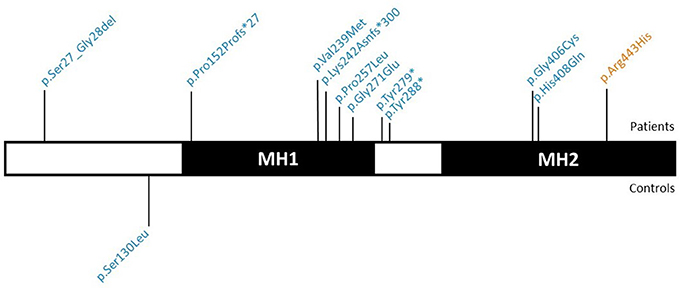
Figure 2. Graphical representation of the identified SMAD6 variants. SMAD6 has two major protein domains, a DNA-binding MH1 domain and a MH2 domain that interacts with components of the TGF-β and BMP signaling pathways. Variants above the protein have been found in patients, while those below the protein occurred in control individuals. Variants in blue are absent from the ExAC database, variants in orange have an ExAC MAF below 0.01%. TGF-β, Transforming growth factor-β; BMP, Bone morphogenetic protein; ExAC, Exome Aggregation Consortium; MAF, Minor Allele frequency.
For two SMAD6 mutation carriers (P89, p.Gly271Glu; P99, p.Pro152Profs*27), gDNA of family members was available for segregation analysis (Supplementary Figure 1). Although neither of these probands had a documented family history of BAV/TAA, a brother of P89 has been diagnosed with a sinus of Valsalva aneurysm (45 mm) and carried the SMAD6 mutation. The mutation was also observed in an unaffected daughter (age 28) of the proband (Supplementary Figure 1). Three unaffected siblings at ages 54, 58, and 64 did not carry the mutation. No gDNA was available from a sister of P99 with unspecified aortic valve problems. The p.Pro152Profs*27 mutation was found in an unaffected daughter (age 39) of P99 but was absent in his 37 year-old unaffected son (Supplementary Figure 1).
We also provide a corrected Figure 2 and Supplementary Table 2.
Conflict of Interest Statement
The authors declare that the research was conducted in the absence of any commercial or financial relationships that could be construed as a potential conflict of interest.
Supplementary Material
The Supplementary Material for this article can be found online at: http://journal.frontiersin.org/article/10.3389/fphys.2017.00730/full#supplementary-material
References
Keywords: bicuspid aortic valve, thoracic aortic aneurysm, SMAD6, targeted gene panel, variant burden test
Citation: Gillis E, Kumar AA, Luyckx I, Preuss C, Cannaerts E, van de Beek G, Wieschendorf B, Alaerts M, Bolar N, Vandeweyer G, Meester J, Wünnemann F, Gould RA, Zhurayev R, Zerbino D, Mohamed SA, Mital S, Mertens L, Björck HM, Franco-Cereceda A, McCallion AS, Van Laer L, Verhagen JMA, van de Laar IMBH, Wessels MW, Messas E, Goudot G, Nemcikova M, Krebsova A, Kempers M, Salemink S, Duijnhouwer T, Jeunemaitre X, Albuisson J, Eriksson P, Andelfinger G, Dietz HC, Verstraeten A, Loeys BL and Mibava Leducq Consortium (2017) Corrigendum: Candidate Gene Resequencing in a Large Bicuspid Aortic Valve-Associated Thoracic Aortic Aneurysm Cohort: SMAD6 as an Important Contributor. Front. Physiol. 8:730. doi: 10.3389/fphys.2017.00730
Received: 09 August 2017; Accepted: 08 September 2017;
Published: 25 September 2017.
Edited and reviewed by: Gerald A. Meininger, University of Missouri, United States
Copyright © 2017 Gillis, Kumar, Luyckx, Preuss, Cannaerts, van de Beek, Wieschendorf, Alaerts, Bolar, Vandeweyer, Meester, Wünnemann, Gould, Zhurayev, Zerbino, Mohamed, Mital, Mertens, Björck, Franco-Cereceda, McCallion, Van Laer, Verhagen, van de Laar, Wessels, Messas, Goudot, Nemcikova, Krebsova, Kempers, Salemink, Duijnhouwer, Jeunemaitre, Albuisson, Eriksson, Andelfinger, Dietz, Verstraeten, Loeys and Mibava Leducq Consortium. This is an open-access article distributed under the terms of the Creative Commons Attribution License (CC BY). The use, distribution or reproduction in other forums is permitted, provided the original author(s) or licensor are credited and that the original publication in this journal is cited, in accordance with accepted academic practice. No use, distribution or reproduction is permitted which does not comply with these terms.
*Correspondence: Bart L. Loeys, YmFydC5sb2V5c0B1YW50d2VycGVuLmJl
†These authors have contributed equally to this work.