 Fang Yenn Teo
 Faissal Aziz
 Silvia Di Francesco
 Kristian Förster
- 1Faculty of Science and Engineering, University of Nottingham Malaysia, Semenyih, Selangor, Malaysia
- 2Laboratory of Water, Biodiversity, and Climate Change, Faculty of Sciences Semlalia, Cadi Ayyad University, Marrakech, Morocco
- 3Engineering Department, University of Niccolò Cusano, Rome, Italy
- 4Institute of Ecology and Landscape, Weihenstephan-Triesdorf University of Applied Sciences, Freising, Germany
Editorial on the Research Topic
Potential and limitations of Nature-based Solutions (NbS) to global water challenges
Throughout human history, the idea of Nature-based Solutions (NbS) and the recognition of ecosystems' critical role in addressing societal challenges have been ingrained. Yet, NbS terminology only entered common lexicon in the early 2000s (Ruangpan et al., 2020). Increasing levels of attention over the last decade have been directed toward NbS in policy fora and scientific literature, mostly in an attempt to address the underestimated potential of NbS in the context of the current climate crisis.
NbS are defined as actions that are based on the operation of natural processes and implemented to achieve more sustainable and resilient societies. For instance, NbS for managing water availability include natural wetlands and their restoration as well as improvements in soil moisture and groundwater recharge (WWAP, 2018). NbS are cost-effective by definition and provide benefits to both biodiversity and human wellbeing (UNEP, 2022). Therefore, the defining feature of NbS is not whether the deployed solution is de facto natural, but whether natural processes are being employed and managed proactively to achieve desired objectives. NbS can function by conserving or rehabilitating natural ecosystems and enhancing or recreating natural processes in altered or artificial ecosystems at micro- or macro-scales.
In the context of water resources management, NbS are often deployed to solve or overcome some of the major contemporary water management issues or challenges, such as water security and scarcity. Especially the role of NbS in attenuating the impacts of opposing hydrological extremes, namely droughts and (pluvial) floods, make NbS, due to their water retention capabilities in the landscape, a cornerstone in the water-storage-continuum concept (McCartney and Smakhtin, 2010). Nonetheless, NbS are also applied routinely in circumstances where no critical local water problem exists, for example, attenuation of pollutants in the subsurface producing the generally safe and high quality of abstracted groundwater for water supplies (WWAP, 2018).
A critical aspect of NbS implementation, and arguably of their success, is whether their use is technologically and institutionally supported and whether all stakeholders are engaged in NbS development and deployment, which is still viewed as a major challenge (WWAP, 2018; Ruangpan et al., 2020; UNEP, 2022). Contrasting perceptions and valuation of the co-benefits by stakeholders can lead to trade-offs and potential conflicts (Giordano et al., 2020), hampering the deployment of NbS. Moreover, the “negative externalities from ‘gray’ alternatives are often not accounted for” (UNEP, 2022), which requires more emphasis on demonstrating the effectiveness of NbS in achieving the envisaged objectives in design (Anderson et al., 2021).
The present Research Topic contributes to exploring both merits and limitations of implementing NbS to address water challenges in policy and decision-making, highlighting the potential of NbS to address water management challenges across various sectors. Four different studies shed light on different aspects of NbS for water, including different ways how NbS help to mitigate pluvial and riverine flooding as well as agricultural adaptation with respect to water use as a response to droughts (see Figure 1).
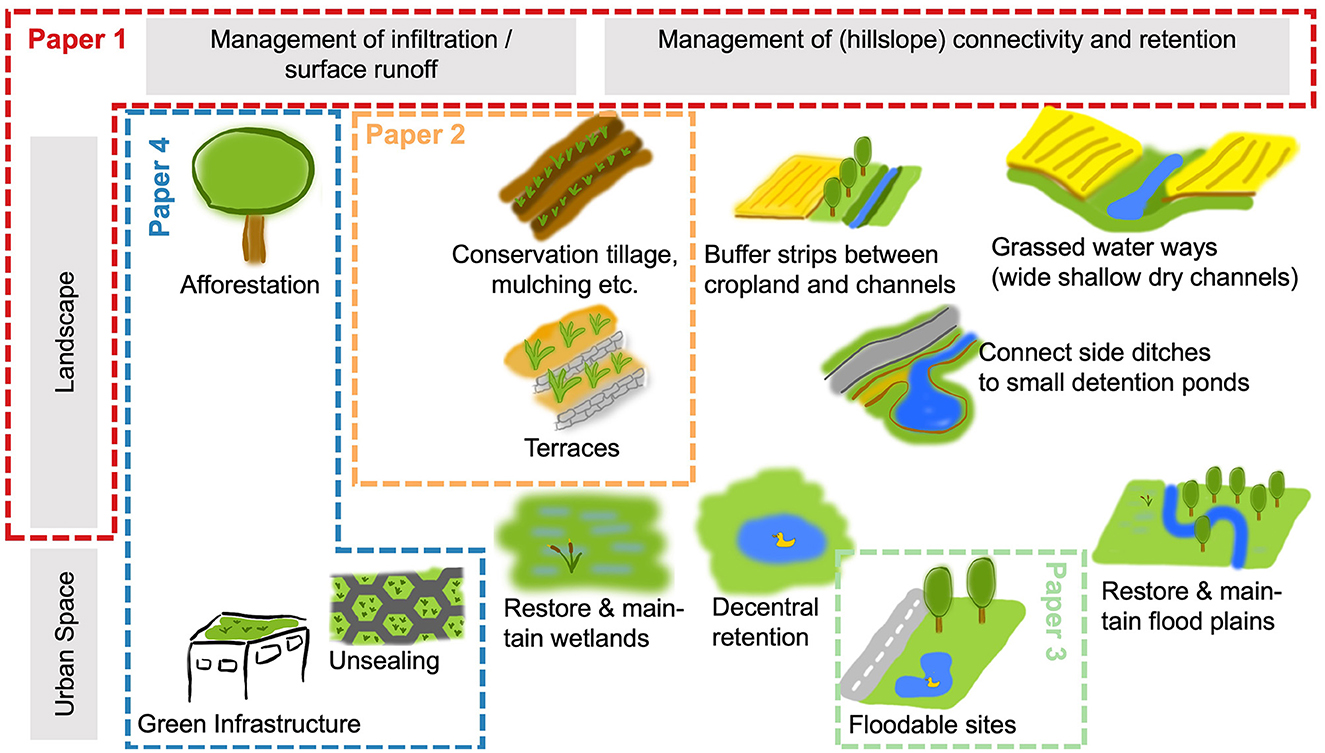
Figure 1. NbS types addressed by the four papers in this Research Topic. Two dimensions are considered. The left part considers measures for managing infiltration and surface runoff. In contrast, the right part compiles measures that alter flow paths, e.g., grassed waterways for retaining pluvial flooding and erosion (Fiener and Auerswald, 2017). The top row compiles measures at the landscape level, while the bottom line presents NbS for the urban space. Some measures (e.g., decentral retention is relevant in both cases). Figure inspired by WWAP (2018).
Among several measures, Pinos and Timbe (Paper 1) specifically address the term smart land management in order to mitigate riverine flooding in Peru. The idea of smart land management is here well in line with the concept of managing infiltration and flow paths in the landscape.
Wens et al. (Paper 2) explore agricultural adaptation decisions in response to drought risk. They employ a socio-hydrological agent-based model to analyze the way farmers adapt to drought risk under different assumptions. Adaptation measures include improving in-soil water storage using mulch cover (managing storage) and constructing terraces (managing infiltration, storage, and flow paths). Though their analyses also included measures like wells and drip irrigation, the relevance of the aforementioned NbS in agricultural adaptation is highlighted.
While the previous study mainly focuses on drought risk and adaptation of agricultural areas, Li et al. (Paper 3) demonstrates the results of a survey on the perception of flood risk in urban areas with an emphasis on the role of floodable areas in cities, which are foreseen to be temporally flooded. This concept is also suggested by van Hattum et al. (2016). The study highlights that most participants perceived flooded areas as less safe than classical retention ponds, highlighting the relevance of focusing on new strategies needed to increase the acceptance of NbS.
Finally, Wübbelmann et al. (Paper 4) quantify the effect of different NbS measures, including trees, green roofs and unsealing of paved areas in terms of flood-regulating ecosystem services. While the methodological framework is introduced by Wübbelmann et al. (2022), the current paper compares how NbS contribute to flood-regulating ecosystem services in urban areas under more extreme rainfall due to climate change. Even though the method demonstrates the limitations of NbS under extreme rainfall, it also highlights the role of an ecosystem services demand and supply budget approach to support planners and decision-makers.
Although only four studies with very different perspectives and analyses are compiled here, it can be said that they make an important contribution against the background of the challenges and opportunities outlined above. This holds especially true for the relevance of NbS as an efficient way to mitigate flooding in the landscape (Papers 1 and 4) and the question of how to increase the acceptance of these measures (Papers 2 and 3). The studies show, on the one hand, how decisions are made for the introduction of certain measures, including their effectiveness in economic terms (Paper 2) and on the other hand, also demonstrate the still not very pronounced openness toward certain measures (Paper 3). New concepts, including socio-hydrological modeling of NbS (Paper 2), extensive surveys on the effectiveness and perception of NbS (Paper 3) and new methodological approaches for planning purposes in an interdisciplinary context under the umbrella of ecosystems services (Paper 4) are promising approaches to feature the implementation of NbS in the future. Better interaction with people in NbS-related research is also envisioned in the new scientific decade of the International Association of Hydrological Sciences (IAHS), HELPING—Hydrology Engaging Local People IN one Global World.1
Author contributions
FT: Conceptualization, Writing—original draft, Writing—review and editing. FA: Conceptualization, Writing—review and editing. SD: Conceptualization, Writing—review and editing. KF: Conceptualization, Visualization, Writing—original draft, Writing—review and editing.
Conflict of interest
The authors declare that the research was conducted in the absence of any commercial or financial relationships that could be construed as a potential conflict of interest.
Publisher's note
All claims expressed in this article are solely those of the authors and do not necessarily represent those of their affiliated organizations, or those of the publisher, the editors and the reviewers. Any product that may be evaluated in this article, or claim that may be made by its manufacturer, is not guaranteed or endorsed by the publisher.
Footnotes
1. ^https://iahs.info/Initiatives/Topic-for-the-Next-IAHS-decade/helping-working-groups/ (accessed August 11, 2023).
References
Anderson, C. C., Renaud, F. G., Hanscomb, S., Munro, K. E., Gonzalez-Ollauri, A., Thomson, C. S., et al. (2021). Public acceptance of nature-based solutions for natural hazard risk reduction: survey findings from three study sites in Europe. Front. Environ. Sci. 9, 678938. doi: 10.3389/fenvs.2021.678938
Fiener, P., and Auerswald, K. (2017). “Grassed waterways” in Agronomy Monographs, eds. J. A. Delgado, G. F. Sassenrath, and T. Mueller. (Madison, WI: American Society of Agronomy and Crop Science Society of America, Inc.).
Giordano, R., Pluchinotta, I., Pagano, A., Scrieciu, A., and Nanu, F. (2020). Enhancing nature-based solutions acceptance through stakeholders' engagement in co-benefits identification and trade-offs analysis. Sci. Total Environ. 713, 136552. doi: 10.1016/j.scitotenv.2020.136552
McCartney, M., and Smakhtin, V. (2010). “Water storage in an era of climate change: addressing the challenge of increasing rainfall variability,” in Blue Paper. Colombo: International Water Management Institute.
Ruangpan, L., Vojinovic, Z., Di Sabatino, S., Leo, L. S., Capobianco, V., Oen, A. M. P., et al. (2020). Nature-based solutions for hydro-meteorological risk reduction: a state-of-the-art review of the research area. Nat. Hazards Earth Syst. Sci. 20, 243–270. doi: 10.5194/nhess-20-243-2020
UNEP (2022). Nature-based Solutions: Opportunities and Challenges for Scaling Up. Nairobi: United Nations Environment Programme. Available online at: https://wedocs.unep.org/20.500.11822/40783 (accessed August 09, 2023).
van Hattum, T., Blauw, M., Jensen, M. B., and de Bruin, K. (2016). Towards Water Smart Cities: Climate Adaptation is a Huge Opportunity to Improve the Quality of Life in Cities. Wageningen: Wageningen University & Research. Available online at: http://library.wur.nl/WebQuery/wurpubs/fulltext/407327 (accessed September 20, 2017).
Wübbelmann, T., Bouwer, L., Förster, K., Bender, S., and Burkhard, B. (2022). Urban ecosystems and heavy rainfall—a Flood Regulating Ecosystem Service modelling approach for extreme events on the local scale. One Ecosyst. 7, e87458. doi: 10.3897/oneeco.7.e87458
WWAP (2018). Nature-Based Solutions for Water. Paris: World Water Assessment Programme, UNESCO. Available online at: https://www.unesco.org/en/wwap/wwdr/2018 (accessed September 12, 2023).
Keywords: Nature-based Solutions (NbS), global water challenges, hydrological extremes, adaptation, infiltration, storage, connectivity
Citation: Teo FY, Aziz F, Di Francesco S and Förster K (2023) Editorial: Potential and limitations of Nature-based Solutions (NbS) to global water challenges. Front. Water 5:1278462. doi: 10.3389/frwa.2023.1278462
Received: 16 August 2023; Accepted: 07 September 2023;
Published: 22 September 2023.
Edited and reviewed by: Hafzullah Aksoy, Istanbul Technical University, Türkiye
Copyright © 2023 Teo, Aziz, Di Francesco and Förster. This is an open-access article distributed under the terms of the Creative Commons Attribution License (CC BY). The use, distribution or reproduction in other forums is permitted, provided the original author(s) and the copyright owner(s) are credited and that the original publication in this journal is cited, in accordance with accepted academic practice. No use, distribution or reproduction is permitted which does not comply with these terms.
*Correspondence: Fang Yenn Teo, RmFuZ1llbm4uVGVvQG5vdHRpbmdoYW0uZWR1Lm15; Kristian Förster, a3Jpc3RpYW4uZm9lcnN0ZXJAaHN3dC5kZQ==