BA
baidaa al-bander
Keele University
Keele, United Kingdom
667
Total downloads
8,360
Total views and downloads
Submit your idea
Select the journal/section where you want your idea to be submitted:
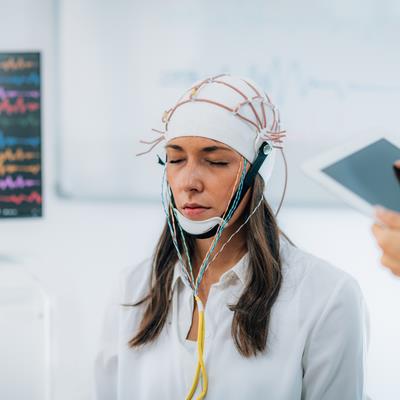
Brain-Computer Interfaces (BCIs) are emerging as transformative tools that enable direct communication between the human brain and external devices. With recent advancements in Electroencephalography (EEG) signal analysis and machine learning, BCIs have evolved from laboratory prototypes to applications in real-world environments. This Research Topic aims to explore the cutting-edge research integrating EEG signal processing and machine/deep learning techniques to develop BCIs that enhance and support daily human activities. The focus is on non-invasive BCIs that can be seamlessly integrated into everyday life, offering new avenues for assistive technologies, human augmentation, and neurorehabilitation.
This Research Topic seeks to bring together original research, comprehensive reviews, and innovative applications that push the boundaries of BCIs in daily activities. We welcome contributions that leverage EEG signals and apply machine learning or deep learning techniques to decode neural information in real-time, enabling practical BCI applications. Topics may include, but are not limited to, BCIs for motor control, emotion detection, and user intent prediction. Emphasis will be placed on interdisciplinary approaches that combine neuroscience, data science, signal processing, and artificial intelligence to address real-world challenges in BCI deployment.
1. EEG Signal Acquisition and Preprocessing:
• Advances in EEG hardware for real-world, portable BCI systems.
• Noise reduction, artifact removal, and feature extraction techniques for EEG signals in natural settings.
2. Machine Learning for EEG Signal Analysis:
• Novel algorithms and models for decoding EEG signals, including traditional machine learning approaches and deep learning architectures.
• Feature selection, dimensionality reduction, and optimization techniques for real-time BCI applications.
• Interpretability and explainability of machine learning models in EEG-based BCIs.
3. BCI Applications for Daily Activities:
• BCIs for hands-free control of devices in smart environments (e.g., smart home systems).
• Applications in assistive technology, such as aiding individuals with motor disabilities in daily tasks.
• Cognitive BCIs for monitoring attention, workload, and emotional states in real-world scenarios.
• Neurofeedback and personalised BCIs for cognitive and mental health enhancement.
4. Hybrid BCIs and Multimodal Approaches:
• Integration of EEG with other physiological signals (e.g., EMG, ECG) or sensor data (e.g., eye-tracking, motion sensors) for enhanced performance.
• Hybrid BCIs combining non-invasive brain signals with external input for improved accuracy in daily activities.
The Research Topic welcomes a variety of article types, including:
Original Research Articles, Review Articles, and Case Studies.
This Research Topic accepts the following article types, unless otherwise specified in the Research Topic description:
Articles that are accepted for publication by our external editors following rigorous peer review incur a publishing fee charged to Authors, institutions, or funders.
Keywords: BCI, daily activities, EEG, machine learning, deep learning
Important note: All contributions to this Research Topic must be within the scope of the section and journal to which they are submitted, as defined in their mission statements. Frontiers reserves the right to guide an out-of-scope manuscript to a more suitable section or journal at any stage of peer review.

Manuscripts can be submitted to this Research Topic via the main journal or any other participating journal.
Submit your idea
Select the journal/section where you want your idea to be submitted: