Improving the Delivery of Pre-exposure Prophylaxis (PrEP) to Eliminate Vertical HIV Transmission

Cover image for Research Topic "Improving the Delivery of Pre-exposure Prophylaxis (PrEP) to Eliminate Vertical HIV Transmission"
72kviews
Editorial: Improving the delivery of pre-exposure prophylaxis (PrEP) to eliminate vertical HIV transmission
Editorial16 April 2024
Editorial: Improving the delivery of pre-exposure prophylaxis (PrEP) to eliminate vertical HIV transmission

Firstly, community PrEP education is critical to reducing stigma and increasing support for PrEP. Three studies explored PrEP knowledge, attitudes, and beliefs among pregnant and postpartum women and their partners. PrEP was viewed as safe and effective; however, Hamoonga et al highlighted important concerns about side effects and potential negative impact on pregnancy and infant health. Fear of stigma was an important determinant of effective PrEP use with women without HIV including concern that partners or the community may perceive women as living with HIV or having multiple sex partners. In Eswatini (Khumalo et al), PrEP awareness was high but accurate PrEP knowledge was incomplete. Young et al identified PrEP misconceptions among clients who reported that PrEP improved health and could be used to treat sexually transmitted infections. Partner support was identified across several studies as a key determinant of PrEP uptake and continuation. Having a partner living with HIV was a major reason for initiating PrEP and was associated with higher adherence to both PrEP and ART. Routine data from Lesotho (Masenyetse et al) identified a 2-fold higher follow-up among PrEP users in relationships where one partner was living with HIV. Similarly, having multiple sex partners was a common reason for PrEP use and a determinant of PrEP continuation.Secondly, we learned about barriers and facilitators of the PrEP care continuum. Previous work has highlighted significant challenges with PrEP adherence which is critical for efficacy. 11 Khadka et al found that over 80% of pregnant adolescent girls and young women initiated PrEP in the first antenatal care visit. However, PrEP continuation reduced significantly with time and was <40% at 6-months despite the high prevalence of STIs. Similarly, Masenyetse et al found that 40% of PrEP initiators in routine care among pregnant and postpartum had no follow-up visit, signally that barriers to PrEP continuation persist. Hurwitz et al estimated overall PrEP adherence at 63% and identified several patterns of PrEP adherence during periconception among HIVexposed South African women. Changes in perceived HIV risk over time may impact PrEP adherence; however, the large drop-offs and poorer PrEP persistence among women who become pregnant while on PrEP are concerning.Thirdly, we derive insights from healthcare providers' experiences in delivering PrEP. Among providers who had no training or experience delivering PrEP (Pleaner et al), there were significant concerns about burdening already busy clinics and the impact on other service delivery. However, in Kenya (Wagner et. al), among providers with experience delivering PrEP, delivery was viewed more favorably, as adaptable and meeting patient needs. However, PrEP delivery required provider training, was more complex compared to other services and required additional resources (Hicks et al). Additionally, daily dosing for PrEP requiring frequent refills and access to services (e.g. long distances to clinics and waiting time) were important barriers (Hammonga et al). Sila et.al found that an intervention package including video education, HIV self-testing, and PrEP dispensing delivered at maternal and child health clinics significantly increased the proportion of clients counselled about PrEP and client satisfaction but was associated with increased waiting time. These findings demonstrate the need for continued research to optimize PrEP delivery.Finally, this collection addresses PrEP effectiveness and safety in pregnancy. Fairlie et.al reviewed data on the safety profiles of available PrEP candidates including oral TDF-containing regimens, long-acting cabotegravir and the dapivirine ring. Except TDF-containing regimens, safety data on other PrEP agents is very limited in pregnancy and postpartum. They also reviewed existing drug surveillance systems in high-and low-income settings and suggested that PrEP surveillance be integrated into multiple surveillance systems. While the cost of building such systems is high, they argue that the extent of PrEP use warrants investment. Scott et al , found an increase in tenofovir/emtricitabine drug clearance throughout pregnancy, suggesting current dosing schedules may be inadequate to provide protective drug levels. Zewdie et.al found significant bone mineral density loss among pregnant women using oral TDF-based PrEP, which was likely attributed to pregnancy and not PrEP. This study was limited by small numbers of pregnant women not exposed to PrEP. Additional research is needed for robust comparisons between PrEP-exposed and unexposed populations.In conclusion, this collection highlights important gaps in PrEP delivery among pregnant and lactating people. Ongoing discovery research will likely address pharmacokinetics and expand PrEP options; however, understanding how to scale-up PrEP delivery will require continued evaluation and adaptation to meet the needs of pregnant and postpartum women and in different regions. To understand, from the perspective of both women and men, how male partners were involved in supporting women's oral PrEP use during pregnancy and postpartum and the impact this support had on their PrEP adherence.

To understand the bidirectional impact of women's PrEP use on antiretroviral therapy (ART) use among male partners living with HIV.IDIs with purposively recruited pregnant women and their partners (30 women and 20 men) -mix of the male population to include men living with HIV, unknown male HIV status. Women included met HIV risk indications for PrEP.

1,939 views

2 citations

ORIGINAL RESEARCH
8 January 2024
The effect of daily oral PrEP use during pregnancy on bone mineral density among adolescent girls and young women in Uganda
Kidist Zewdie, 12 more and Renee Heffron

3,197 views

3 citations

ORIGINAL RESEARCH
27 October 2023
Uptake of and intention to use oral pre-exposure prophylaxis for HIV among pregnant and post-natal women in Eswatini: a cross-sectional survey
Philisiwe Ntombenhle Khumalo, 6 more and Godfrey Woelk

4,358 views

7 citations

Safety surveillance for PrEP in pregnant and breastfeeding women
SYSTEMATIC REVIEW
29 September 2023
Safety surveillance for PrEP in pregnant and breastfeeding women
Lee Fairlie, 10 more and Ushma Mehta

5,932 views

15 citations

ORIGINAL RESEARCH
4 October 2023
Adherence to daily, oral TDF/FTC PrEP during periconception among HIV-exposed South African women
Kathleen E. Hurwitz, 12 more and Lynn T. Matthews

3,423 views

5 citations

Evaluating the use of oral pre-exposure prophylaxis among pregnant and postpartum adolescent girls and young women in Cape Town, South Africa
CLINICAL TRIAL
19 September 2023
Evaluating the use of oral pre-exposure prophylaxis among pregnant and postpartum adolescent girls and young women in Cape Town, South Africa
Nehaa Khadka, 10 more and Dvora L. Joseph Davey
Background: Adolescent girls and young women (AGYW) have elevated risk of incident HIV in South Africa. Despite growing availability of daily oral pre-exposure prophylaxis (PrEP) for HIV prevention, little is known about PrEP use during pregnancy and postpartum serviced at antenatal care(ANC) facility.We used data from HIV-uninfected pregnant women aged 16-24 in Cape Town, South Africa enrolled in the PrEP in pregnancy and postpartum (PrEP-PP) cohort study at their 1 st ANC visit. Using the PrEP cascade framework, the outcomes were PrEP initiation (prescribed TDF-FTC at baseline), continuation (returned for prescription) and persistence(quantifiable tenofovir diphosphate[TFV-DP] in dried blood). Exposures were baseline HIV risk score (0-5), condomless sex, >1 sexual partner, partner living with HIV/ unknown serostatus, laboratory diagnosed STI, hazardous alcohol use before pregnancy (AUDIT≥3). We used logistic regression to examine associations between HIV risk and PrEP adjusting for a priori confounders.Results: Of 486 pregnant women, 16% were "adolescents" (16-18 years) and 84% were "young women" (19-24 years). ANC initiation was later for adolescents than young women (median=28 weeks [20-34] vs 23 weeks [16-34], P=0.04). About 41% had a STI diagnosis at baseline. Overall, 83% of AGYW initiated PrEP at 1 st ANC; PrEP continuation was 63% at 1 month, 54% at 3 months and 39% at 6 months. About 27% consistently continued PrEP through 6 months and 6% stopped and restarted. AGYW with a higher HIV risk (score≥2 vs ≤1) had increased odds of continuing PrEP (aOR, 1.85 [95% CI, 1.12-3.03]) through 6 months adjusting for potential confounders. Barriers to PrEP continuation included being postpartum (vs. pregnant) and having lower sexual risk factors. TFV-DP was detected among 49% of AGYW and 6% had daily adherence to PrEP at 3 months.Conclusions: AGYW had high oral PrEP initiation, but just over one-third continued on PrEP by 6 months. Pregnant AGYW who had more HIV risk (condomless sex, sex frequency, and STIs) were more likely to continue on PrEP through postpartum period. Pregnant AGYW who are pregnant and postpartum require counseling and other support including community delivery, peer support to improve their effective PrEP use through postpartum period.

5,798 views

21 citations

ORIGINAL RESEARCH
8 August 2023
Male partners’ support and influence on pregnant women’s oral PrEP use and adherence in Malawi
Alinda M. Young, 10 more and Lauren M. Hill

2,964 views

15 citations

ORIGINAL RESEARCH
31 July 2023
Oral HIV pre-exposure prophylaxis use among pregnant and postpartum women: results from real-world implementation in Lesotho
Lieketseng J. Masenyetse, 6 more and Laura K. Beres

3,179 views

7 citations

ORIGINAL RESEARCH
6 July 2023
Integrating PrEP in maternal and child health clinics in Kenya: analysis of a service availability and readiness assessment (SARA) survey
Sarah Hicks, 10 more and Anjuli D. Wagner

3,768 views

6 citations

Introduction and integration of PrEP and sexual and reproductive health services for young people: Health provider perspectives from South Africa
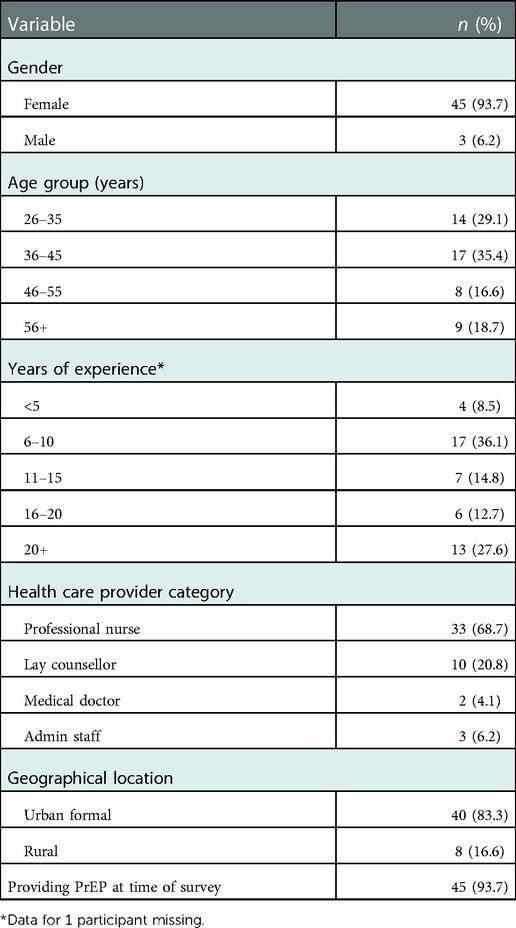
South Africa has one of the largest HIV epidemics in the world, with particularly high prevalence among adolescent girls and young women (AGYW). Oral PrEP was introduced in the public sector in 2016 in a phased manner. Given the important role played by health providers, research was undertaken to understand their experiences of and attitudes towards introduction of PrEP as a new HIV prevention method, and its integration within broader sexual and reproductive health (SRH) services for youth. A survey was undertaken with 48 purposively sampled health providers working in primary health care facilities and mobile clinics in three provinces in South Africa. Qualitative analysis was performed on free-text responses to open-ended questions in the survey, using an inductive approach to code the data in NVivo v.12 software. Health providers expressed concerns about adding a new service to an already overburdened health system, and worried that young people seeking PrEP would divert staff from other critical services. While most recognised the benefits and opportunities afforded by HIV and SRH service integration, providers highlighted the extra time and resources such integration would require. Many were anxious that PrEP would encourage disinhibition and increase unprotected sex among AGYW, and held judgemental attitudes about young people, seen as largely incapable of taking responsibility for their health. Findings underscore the importance of consulting health providers about implementation design and providing channels for them to express their misgivings and concerns, and training needs to be designed to address provider attitudes and values. Opportunities need to be sought to strengthen the provision of adolescent and youth friendly services – including adolescent-health provider dialogues. Insights from this study can assist in guiding the introduction of new HIV prevention methods into the future.

5,640 views

37 citations

ORIGINAL RESEARCH
19 April 2023
“PrEP protects us”: Behavioural, normative, and control beliefs influencing pre-exposure prophylaxis uptake among pregnant and breastfeeding women in Zambia
Twaambo Euphemia Hamoonga, 3 more and Benjamin H. Chi

4,176 views

20 citations