 Julio Cesar Santos-Pelaez1
 Santos Triunfo Leiva-Espinoza2
 Erick Espinoza-Núñez3
 David Saravia-Navarro4*Carlos Luis Castillo-Torrejon4Julio H. I. Cruz-Delgado4
 Dieter Fritz Klauer-Garcia4David Pavel Casanova Nuñez Melgar4
- 1Estación Experimental Agraria Amazonas, Instituto Nacional de Innovación Agraria (INIA), Chachapoyas, Peru
- 2Grupo de Investigación en Procesos en Sanidad Vegetal, Instituto de Investigación para el Desarrollo Sustentable de Ceja de Selva, Universidad Nacional Toribio Rodríguez de Mendoza, Chachapoyas, Amazonas, Peru
- 3Department of Horticulture, Universidad Nacional Agraria La Molina, Lima, Peru
- 4Dirección de Investigación y Desarrollo Tecnológico, Instituto Nacional de Innovación Agraria (INIA), Lima, Peru
The cultivation of yellow pitahaya (Hylocereus megalanthus) is increasing in tropical regions due to its nutritional value and market potential. Yet, agronomic strategies integrating nutrient and hormonal regulation remain scarcely studied. This research evaluated the combined effect of potassium (K2O) and gibberellic acid (GA3) on yield and fruit quality in field-grown pitahaya in the Peruvian Amazon using a 4 × 2 factorial randomized block design with four potassium doses (0, 50, 100, 150 kg ha⁻¹) and two GA3 levels (0 and 50 mg L⁻¹). The combination of 100 kg K2O ha⁻¹ and 50 mg L⁻¹ GA3 significantly improved fruit performance, with fruit weight (369.5 g), yield (12 t ha⁻¹), volume (322 cm³), and soluble solids (22.8°Brix), while acidity decreased (pH 4.87 vs. 4.55 in the control). Potassium alone had a limited impact on fruit weight per plant, but under GA3 application, a quadratic response was evident, with maximum values between 100–110 kg K ha⁻¹. Multivariate analyses confirmed that yield gains were driven by increases in fruit size and quality, with fertilized treatments clearly separated from controls. These findings demonstrate a synergistic interaction between potassium and GA3, providing a basis for precision fertilization protocols that enhance yield and quality in high-value tropical fruit systems.
1 Introduction
The yellow pitahaya (Hylocereus megalanthus) is a tropical fruit rich in fiber, vitamin C, and betalains, with a high antioxidant content that supports human health by helping to reduce oxidative stress, premature aging, diabetes, and colon cancer (Verona-Ruiz et al., 2020; Attar et al., 2022; Rosa et al., 2022). In recent years, its cultivation has expanded in tropical countries due to favorable edaphoclimatic conditions and its considerable economic potential. However, the yield and quality of pitahaya fruits are strongly influenced by agronomic management, particularly nutrient supply and the use of growth regulators (Santos-Pelaez et al., 2024).
Potassium is an essential macronutrient for plant growth, ranked third in importance after nitrogen and phosphorus (Torabian et al., 2021; Mostofa et al., 2022). It plays a key role in enhancing resilience to environmental stress, metabolism, and reproductive functions (Wang et al., 2013; Fernandes et al., 2018; Olaniyan et al., 2022). Its influence on photosynthesis is particularly critical, as it facilitates leaf expansion and CO2 uptake (Hu et al., 2022; Rawat et al., 2022). Moreover, potassium regulates metabolic pH, transpiration, and osmotic balance through stomatal opening and closure (Sarwar et al., 2023; Arshad et al., 2024). Despite this, knowledge of how K nutrition directly affects H. megalanthus is limited, and further studies are required to define optimal K management for this crop.
Gibberellins, particularly gibberellic acid (GA3), are plant hormones that regulate stem elongation, flowering, and fruit development through coordinated interactions with other phytohormones (Zhang et al., 2012; Miceli et al., 2019; Castro-Camba et al., 2022). In fruit crops such as grapes, GA3 application has been shown to increase berry size and improve fruit quality by modulating hormonal signaling (He et al., 2020). However, specific information about the role of GA3 in pitahaya reproductive development and fruit quality remains scarce.
The yield and quality of pitahaya are influenced by genetic and environmental factors, as well as soil, water, and nutrient management (Verona-Ruiz et al., 2020; Santos-Pelaez et al., 2024). In intensive systems, precise fertilization and growth regulators are essential to maximize productivity and fruit quality, particularly for international markets (Horibe, 2021). While individual effects of these inputs have been studied, their combined influence in pitahaya remains largely unknown. Exploring the interaction between potassium and gibberellic acid is thus both novel and crucial for tropical fruit production.
Optimizing fertilizer and growth regulator use can improve profitability and reduce environmental impacts from excessive agrochemical use (Zhang et al., 2012; Rosa et al., 2022; Chavez and Rivadeneira, 2024). The targeted application of potassium and GA3 could enhance sustainable production, aligning with consumer demands and agricultural standards (Rabelo et al., 2020; Olaniyan et al., 2022; Tel-Zur, 2022). Given pitahaya’s growing economic importance, scientific research is needed to refine input management. This study evaluates the synergistic effects of potassium and GA3 to identify optimal combinations for improving yield and fruit quality in yellow pitahaya.
2 Materials and methods
2.1 Study area
The study was conducted in the Nuevo Horizonte Annex of the Valera district in the Bongará province, Amazonas region, Peru (6°01’58” S, 77°54’54” W, 1420 m a.s.l.) (Figure 1). This area has a subtropical climate (Supplementary Figure S1) with an average temperature of 19.3°C, a relative humidity of 84.9%, and an average annual rainfall of 930 mm. The soil in this area is a sandy loam with a pH of 6.02 and an electrical conductivity (EC) of 0.16 mS/m. These characteristics were determined through analysis at the Soil and Water Research Laboratory of Universidad Nacional Toribio Rodríguez de Mendoza (UNTRM) – Amazonas, Peru.

Figure 1. Location of the study area (Bongara, Amazonas, Peru).
2.2 Area of study and crop management
A randomized complete block design (RCBD) with a 4×2 factorial arrangement was used, comprising four potassium (K) levels (0, 50, 100, 150 kg ha⁻¹) and two gibberellic acid (GA3) levels (0 and 50 mg L⁻¹). The eight treatment combinations were replicated across five blocks, for a total of 40 experimental units and 800 plants. Plant spacing was 3 m × 3 m, each unit consisted of five plants, of which the three central plants were evaluated to minimize border effects. Potassium rates were selected based on the initial soil nutrient status and local fertilization practices, ranging from deficiency to high-input management. The GA3 dose (50 mg L⁻¹) was chosen from preliminary pitahaya trials and studies in other fruit crops (e.g., grape, citrus), where effective responses were reported in the 10–100 mg L⁻¹ range (Miceli et al., 2019; He et al., 2020; Eshghi et al., 2025; Shaban et al., 2025). Potassium chloride (60% K2O) was applied in two equal splits: one during vegetative growth and one at flower bud initiation. GA3 (Agrogibb®, CaPEAGRO, 10% GA3) was sprayed foliarly at 50 mg L⁻¹ in three applications: after fruit set and every 20 days thereafter, covering key stages of fruit development.
2.3 Variables evaluated
Table 1 presents the variables used to characterize the production and quality of the fruit under study. Yield parameters (number and weight of fruit, yield per hectare: shown in Figure 2, physical dimensions (length, diameter, volume, firmness, thickness), components (shell and pulp weight), and chemical attributes (acidity, total soluble solids, citric acid) are detailed.

Table 1. Production and quality variables of the fruit under study.

Figure 2. Representative fruits of yellow pitahaya in each of the treatments were evaluated.
2.4 Statistical analysis
An analysis of variance (ANOVA) was performed for a 4×2 factorial experiment arranged in a randomized complete block design (RCBD) with five blocks. When significant differences were detected, means were compared using Tukey’s HSD test (α = 0.05). Data assumptions of normality (Shapiro–Wilk test) and homogeneity of variances (Levene’s test) were verified; log or square-root transformations were applied when necessary. Boxplots were used to visualize the distribution of data and to compare the effect of GA3 across potassium levels, supported by Student’s t-tests. Pearson correlation analysis was applied to evaluate associations among traits. Multivariate analyses included principal component analysis (PCA) with standardized variables, and a heatmap was generated to illustrate relationships among traits and treatments.
To identify the optimum potassium dose, a second-degree polynomial model was fitted to the data. The quadratic function used to describe the fruit weight per plant (FWP) in response to potassium fertilization was:
where β0\beta_0β0, β1\beta_1β1, and β2\beta_2β2 are the regression coefficients, and represents the potassium dose (kg ha⁻¹). To estimate the dose that maximizes fruit weight per plant, the following expression was applied:
corresponding to the vertex of the quadratic curve. Confidence intervals (95%) for the optimum dose were calculated using bootstrapping.
All these analyses were carried out using R programming codes with libraries such as: tidyverse (Wickham et al., 2019), tidyplots (Engler, 2025), ggplot2 (Wickham, 2016), agricolae (Mendiburu, 2006), patchwork (Pedersen, 2025), factoextra (Kassambara and Mundt, 2020), ggpubr (Kassambara, 2023), reshape2 (Wickham, 2007), RcolorBrewer (Holtz, 2022), gridExtra (Auguie and Antonov, 2017), cowplot (Wilke, 2025), pheatmap (Kolde, 2025), inti (Lozano-Isla et al., 2025) and GGally (Schloerke et al., 2024) of R software version 4.5.0 (R, C. T, 2025) and the graphical interface of RStudio version 2025.05.0 + 496 (Posit Software, P, 2025).
3 Results
3.1 Combined effect of potassium and gibberellin on yield and quality of yellow pitahaya
Application of potassium and gibberellin significantly affected several yield and fruit quality traits in yellow pitahaya (Hylocereus megalanthus) (Figure 3, 4; Supplementary Tables S2a–c). Fruit weight showed the strongest response (p< 0.001), with treatment K100GA50 achieving the highest value (369.5 ± 9.7 g), followed by K150GA50 (344.3 ± 17.0 g) and K150GA0 (328.3 ± 8.3 g). Yield per hectare was also maximized under K100GA50 (12.0 ± 1.25 t ha⁻¹), significantly higher than the control (K0GA0: 7.3 ± 2.3 t ha⁻¹) and the other treatments. Fruit weight per plant increased notably with the combined application of 100 kg ha⁻¹ K and 50 mg L⁻¹ GA3 (10.8 ± 1.1 kg plant⁻¹), confirming a synergistic effect on productivity. These findings indicate that GA3 enhanced the crop response to potassium fertilization, with the intermediate K dose (100 kg ha⁻¹) outperforming the highest dose (150 kg ha⁻¹) when combined with GA3.

Figure 3. Tukey’s multiple comparison of means (HSD test, α = 0.05) and interaction effects of potassium and gibberellic acid (GA3) treatments on yield and fruit quality traits of yellow pitahaya. Different letters above bars indicate statistically significant differences among treatment combinations. Variables include floral and yield components, fruit dimensions, and chemical attributes as defined in Table 1: (a) Number of flower buds; (b) Number of set fruit; (c) Number of harvested fruit; (d) Fruit weight (g); (e) Fruit weight per plant (kg); (f) Yield (t ha-1); (g) Fruit length (mm); (h) Fruit diameter (mm); (i) Fruit volume (cm3); (j) Fruit firmness (N); ((k) Peel thickness (mm); (l) Pulp thickness (mm); (m) Peel weight (g); (n) Pulp weight (g); (o) Fruit juice acidity (pH); (p) Total soluble solids (°Brix); (q) Citric acid content (% (w/v)).

Figure 4. Boxplots showing the effect of gibberellic acid (GA3; 0 vs. 50 mg L-1) across potassium levels on yield and fruit quality traits of yellow pitahaya. Comparisons were performed using Student’s t-test, with p-values displayed to indicate the significance of differences between GA3 treatments. Variables include floral and yield components, fruit dimensions, and chemical attributes as defined in Table 1: (a) Number of flower buds; (b) Number of set fruit; (c) Number of harvested fruit; (d) Fruit weight (g); (e) Fruit weight per plant (kg); (f) Yield (t ha-1); (g) Fruit length (mm); (h) Fruit diameter (mm); (i) Fruit volume (cm3); (j) Fruit firmness (N); (k) Peel thickness (mm); (l) Pulp thickness (mm); (m) Peel weight (g); (n) Pulp weight (g); (o) Fruit juice acidity (pH); (p) Total soluble solids (°Brix); (q) Citric acid (% w/v).
Fruit length and diameter were not significantly affected by GA3 at any potassium level (p > 0.05; Figures 3g–h). However, treatment K100GA50 recorded the greatest length (95.3 ± 7.3 mm) and diameter (73.3 ± 3.4 mm) and was also associated with the largest fruit volume (322.2 ± 39.4 cm³). Similar high volumes were obtained under K150GA0 (326.2 ± 26.3 cm³) and K150GA50 (325.8 ± 26.9 cm³), indicating that both potassium fertilization and GA3 application contribute to the development of larger fruits. Pulp weight increased significantly with the combination of K100 and GA3 (212.5 ± 29.9 g) compared to K100 without GA3 (Figure 4n). In contrast, pulp thickness showed differences only between K150GA0 and the control (K0GA0), reaching its highest value (71.5 ± 0.12 mm).
Regarding fruit quality, total soluble solids (TSS) reached the maximum under K100GA50 (22.78 ± 0.69°Brix), reflecting a higher sugar concentration. Fruit juice acidity (pH) remained stable across treatments (p > 0.05), except for a slight reduction in K50GA0 (4.55 ± 0.12) compared to the control (K0GA0: 4.73 ± 0.09). Overall, K100GA50 and K150GA0 significantly enhanced both yield and quality traits, confirming that either the synergistic effect of potassium and GA3 or higher potassium supply alone can be effective strategies for optimizing yellow pitahaya production.
3.2 Correlation analysis
Correlation analysis revealed consistent patterns among productive and quality traits of yellow pitahaya (Figure 5). Strong positive associations were observed between the number of flower buds (NFB), set fruits (NSF), and harvested fruits (NHF), with the highest correlation between NSF and NHF (r = 0.93***), indicating that nearly all set fruits reached harvest. Fruit weight per plant (FWP) and yield (Y) were perfectly correlated (r = 1.00***), confirming their direct equivalence.
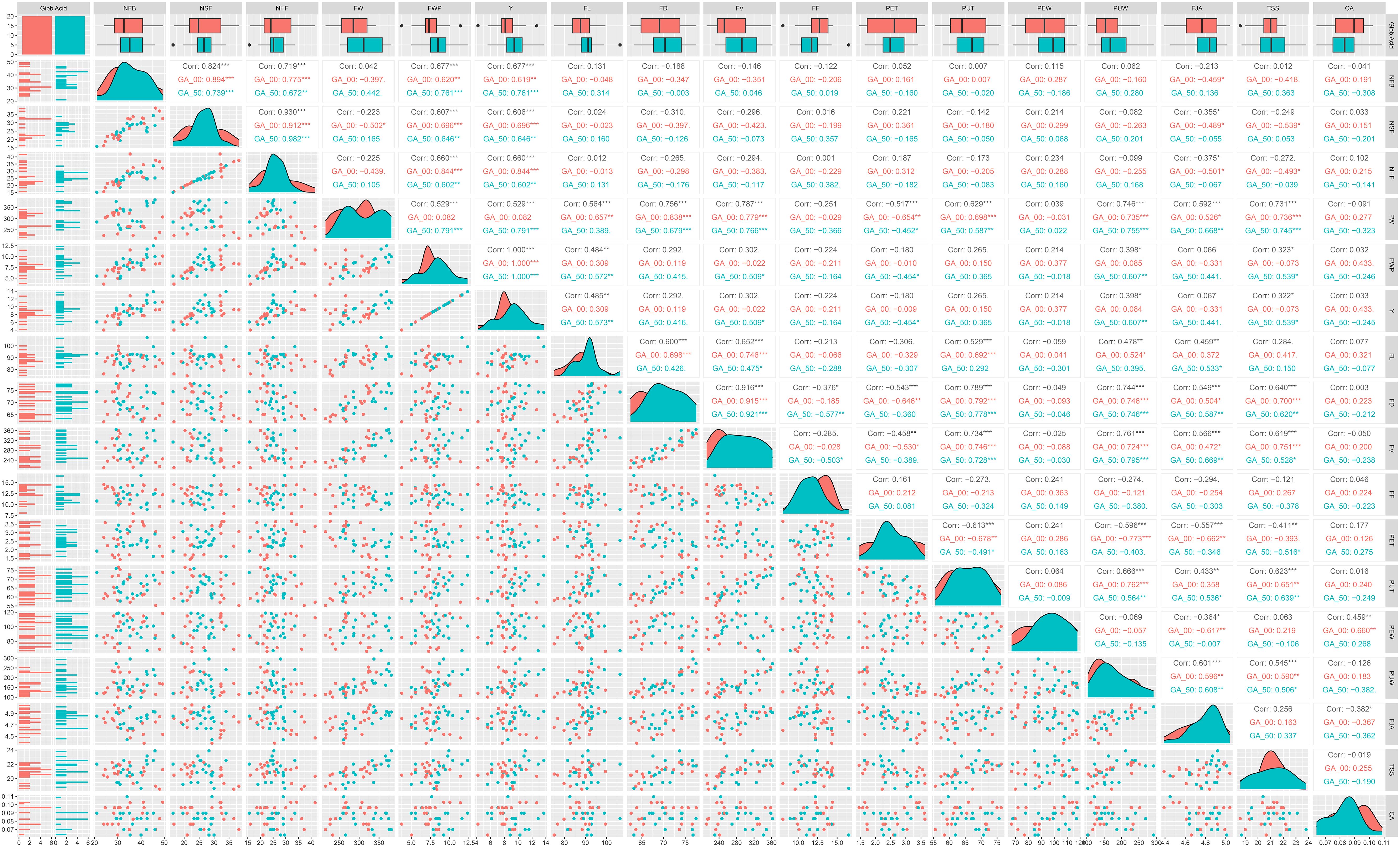
Figure 5. Correlogram with Pearson-r, histograms, box plots, and density graphs for the 17 quality and performance variables. Blue indicates a positive trend (directly proportional) and red a negative trend (inversely proportional) between two variables. Numerical Pearson-r values range from -1 to 1 and are accompanied by their correlation significance (*, **, ***), or non-significant. The variables are number of flower buds (NFB), number of set fruits (NSF), number of harvested fruits (NHF), weight per fruit (FW), weight of fruits per plant (FWP), yield (Y), fruit length (FL), fruit diameter (FD), fruit volume (FV), fruit firmness (FF), peel thickness (PET), pulp thickness (PUT), peel weight (PEW), pulp weight (PUW), fruit juice acids (FJA), total soluble solids (TSS) and citric acid (AC).
Morphometric traits also showed close relationships: fruit diameter (FD) correlated strongly with fruit volume (FV) (r = 0.92***) and fruit weight (FW) (r = 0.79***). Pulp thickness (PUT) was positively related to FD (r = 0.79***), FV (r = 0.73***), and firmness (FF) (r = 0.73***). Pulp weight (PUW) exhibited robust associations with FW (r = 0.75***), FD (r = 0.74***), and FV (r = 0.76***), reinforcing the link between fruit size and pulp development.
Regarding internal quality, total soluble solids (TSS) were positively correlated with FW (r = 0.73***) and Y (r = 0.62***), suggesting that larger fruits accumulated more sugars. Conversely, TSS was negatively correlated with firmness (r = −0.62***) and PUT (r = −0.61***), indicating that softer fruits with thinner pulp tended to have higher sugar content. Fruit juice acidity (FJA) showed weak negative correlations with NSF and NHF, while citric acid (CA) displayed near-zero coefficients, suggesting independence from other traits.
Overall, these results highlight that fruit size components (diameter, volume, and pulp weight) are strongly interdependent and directly influence both yield and sugar accumulation, whereas acidity traits remain largely independent.
3.3 Multivariate analysis: principal components analysis – heat map
Principal component analysis (PCA) (Figures 6a–c) revealed that the first two dimensions explained 62.3% of the total variance, with dimension 1 accounting for 37.8% and dimension 2 for 24.5%. Productivity-related traits, including fruit weight per plant (FWP) and yield (Y), showed long vectors aligned with dimension 1, confirming their dominant role in explaining overall variation. The close proximity of set fruits (NSF) and harvested fruits (NHF) also reflected their strong positive relationship.

Figure 6. Principal component analysis (PCA) and heat map of yield and quality traits in Hylocereus megalanthus. (a–c) PCA biplots showing the distribution of treatments (K × GA3) and the contribution of yield and fruit quality variables to the first two dimensions (Dim1 = 37.8%, Dim2 = 24.5%). (d) Heat map with standardized z scores illustrating the relative intensity of traits across treatments, accompanied by a hierarchical clustering dendrogram.
Morphometric variables reinforced these patterns: fruit diameter (FD) and volume (FV) clustered in the same direction along dimension 1, while fruit length (FL) was positively associated with fruit weight (FW). In contrast, peel thickness (PET) oriented opposite to FWP and Y, suggesting that thicker peels may be linked with reduced productivity. Dimension 2 captured quality-related traits, particularly the association between pulp thickness (PUT) and firmness (FF), indicating partial independence from yield variables. Citric acidity (CA) showed near-zero loadings, confirming its limited contribution to the multivariate structure.
The heat map (Figure 6d) supported these groupings. Treatments with 150 kg K2O (K150GA0 and K150GA50) achieved the highest standardized scores (z = 1.5–2.0) in FWP, FD, and total soluble solids (TSS), while unfertilized controls (K0GA0 and K0GA50) exhibited negative z scores (–1.2 to –1.0) in the same traits. Pulp weight (PUW) was notably higher in K150GA50 (z = 1.5) compared to K0GA0 (z = –0.9). The dendrogram clearly separated fertilized from unfertilized treatments, highlighting the decisive impact of potassium fertilization and GA3 biostimulation on pitahaya productivity and quality.
3.4 Scatter plot with quadratic regression fit
Response of Fruit Weight per Plant (FWP) and Fruit Weight (FW) to potassium doses (0, 50, 100, 150 kg K ha⁻¹) under two levels of gibberellic acid (GA). Each panel corresponds to either Gibberellic acid 0 mg L⁻¹ or Gibberellic acid 50 mg L⁻¹ (Figure 7 and Supplementary Table S3). Solid points represent estimated marginal means (EMMs) with their 95% confidence intervals (CIs); semi-transparent points show plot-level observations (points per block). For FWP, a significant K × GA interaction was detected, so potassium effects are presented within each GA level. At GA 50 mg L⁻¹, the quadratic curve (displayed only when the curvature test is significant, p< 0.05) suggests a maximum at ~100–110 kg K ha⁻¹, with the vertex and its 95% CI indicated on the curve; at GA 0 mg L⁻¹, the pattern is primarily increasing within the evaluated range, and no curve is plotted (p ≥ 0.05). For FW, a significant K × GA interaction was also observed. At GA 0 mg L⁻¹, mean fruit weight increases with potassium across the entire range (no significant curvature), whereas at GA 50 mg L⁻¹, a curvilinear response is evident: the highest value occurs at 100 kg K ha⁻¹, followed by a slight decline at 150 kg K ha⁻¹, consistent with significant curvature (the curve and CI are shown, and the vertex is annotated). Overall, the figure highlights that GA modulates the shape of the response to K: at GA 50 mg L⁻¹, clear optima are evident within the range for FWP (and a plateau/slight decline for FW), whereas at GA 0 mg L⁻¹, the trend is predominantly linear increasing with no detectable vertex.

Figure 7. Fruit weight per plant (FWP) and fruit weight (FW) in response to potassium (0, 50, 100, 150 kg K ha⁻¹) under gibberellic acid (GA) levels (0 and 50 mg L⁻¹). Both traits showed significant K × GA interactions: at GA 50 mg L⁻¹, quadratic responses indicated optima at ~100–110 kg K ha⁻¹, while at GA 0 mg L⁻¹ responses increased linearly without curvature.
4 Discussion
The yellow pitahaya (Hylocereus megalanthus) has attracted increasing interest in Peru, particularly in the Amazon region, due to its nutritional value and market potential in both fresh and processed products (Zhang et al., 2012; Hernández-Ramos et al., 2023; Santos-Pelaez et al., 2024). However, there is still a lack of agronomic studies identifying effective management strategies to optimize fruit yield and quality. Our findings address this gap by demonstrating that the combined application of potassium and gibberellic acid (GA3) significantly enhances productivity and fruit quality, with the most consistent effects observed at 100 kg K2O ha⁻¹ plus 50 mg L⁻¹ GA3.
The quadratic response of fruit weight per plant (FWP) under GA3, evidenced in Figure 7, indicates the existence of an optimum dose of approximately 100–110 kg K ha⁻¹. This interaction was absent in the absence of GA3, where potassium effects followed a linear trend. Similarly, for fruit weight (FW), GA3 modulated the shape of the response: linear increases without GA3, but a curvilinear pattern with GA3, peaking at 100 kg K ha⁻¹ before plateauing or slightly declining at higher doses. These results confirm that GA3 not only enhances growth responses but also defines physiological thresholds for potassium efficiency, validating the hypothesis of synergy between the two factors.
Previous studies in H. megalanthus reported that potassium alone improved flowering and yield but did not significantly alter fruit weight or morphology (Sanjaya et al., 2019; Sarwar et al., 2023; Shah et al., 2023). Likewise, combined use of phytohormones with NPK improved fruit set but had limited effects on size traits. Our study contrasts with these findings by showing that the integration of GA3 into potassium fertilization programs significantly increases fruit weight (+44%) and volume (+23%), confirming the importance of hormonal modulation during post-set stages. These results align with reports in Hylocereus undatus, where advanced agronomic practices including growth regulators improved postharvest traits (Lenahan et al., 2006; Nakagawa et al., 2012) (Lenahan et al., 2006; Nakagawa et al., 2012).
The physiological basis for these responses is consistent with the known role of gibberellins in promoting cell elongation and expansion. In grapes, GA3 applications (50–200 mg L⁻¹) increase fruit mass and diameter by up to 25%, while in rambutan, 200 ppm GA3 improves fruit weight, °Brix, and pulp/peel ratio (Zhang et al., 2012; Xie et al., 2022; Shah et al., 2023). In our experiment, 50 mg L⁻¹ GA3 increased soluble sugars by 16.2% (°Brix) and reduced acidity by 6.4% (pH increase), consistent with GA-mediated regulation of carbohydrate and organic acid metabolism (Xiong et al., 2020; Izawa, 2021; Shah et al., 2025a, 2025b).
The action of gibberellins on cell elongation and expansion is well documented in fruit crops. In seedless grapes, doses of 50–200 mg L⁻¹ of GA3 increased fruit diameter and mass by up to 25%. Similarly, in rambutan, 200 ppm of GA3 was found to significantly improve fruit weight, total soluble solids, and pulp/peel ratio (Zhang et al., 2012; Miceli et al., 2019; Xie et al., 2022; Shah et al., 2023). In the present study, by applying 50 mg L⁻¹ of GA3, increases of 16.2% in °Brix and 6.4% in pH were obtained, corroborating that gibberellin promotes sugar accumulation and reduces acidity, possibly by modulating the expression of genes related to the biosynthesis of carbohydrates and organic acids (Xiong et al., 2020; Izawa, 2021; Shah et al., 2025a, 2025b).
Potassium plays a pivotal role in osmoregulation, enzymatic activation, and stomatal regulation. Deficiency restricts photosynthesis and the transport of assimilates, limiting fruit size and weight (Almeida et al., 2014; Villette et al., 2020; Jesus et al., 2021; Huang et al., 2023). In this study, 100 kg ha⁻¹ K2O increased yield per plant by 48.6% and yield per hectare by 64% compared with the control. Such responses exceed those reported in other CAM crops such as pineapple, where potassium increased yield but did not exhibit strong synergy with GA3 (Zegbe and Serna-Pérez, 2017; Cajazeira et al., 2018; Cunha et al., 2021; Magalhães et al., 2024).
Multivariate analyses further supported these findings. PCA grouped FWP and yield (Y) as the main contributors to Dim1, while fruit diameter and volume clustered together, confirming size as the main driver of productivity gains. The heat map highlighted K150GA0 and K100GA50 as the best-performing treatments, clustering separately from controls. This pattern underscores the combined effect of potassium nutrition and GA3 stimulation on both yield and internal quality.
Peel thickness (PET) showed a weak negative correlation with productivity (r = –0.22), suggesting a potential trade-off. However, firmness (19.4 N) remained stable, ensuring adequate postharvest resistance. Previous studies demonstrated that firmness and postharvest losses in yellow pitahaya vary by variety and harvest season (Osuna-Enciso et al., 2011; Vásquez C. et al., 2016; Jiménez-Esparza et al., 2017). Thus, the moderate reduction in PET observed here does not compromise handling quality.
From an agronomic standpoint, the K100GA50 combination emerges as the most effective, improving yield (+64%), fruit weight (+44%), and quality indices (°Brix +33%; pH +8%) without negative effects on firmness. Nevertheless, future research should validate these results under diverse soil-climate conditions and across production cycles. Long-term evaluations are also needed to assess the persistence of these qualitative improvements and their interactions with irrigation, plant density, and integrated nutrient management. At the molecular level, transcriptomic and metabolomic studies could elucidate the regulatory mechanisms underlying the synergistic effects of GA3 and potassium on pitahaya productivity and fruit quality.
5 Conclusions
This study provides experimental evidence that potassium fertilization and gibberellic acid (GA3) act synergistically to improve the yield and quality of yellow pitahaya (Hylocereus megalanthus). The combined application of 100 kg K2O ha⁻¹ and 50 mg L⁻¹ GA3 produced the best agronomic responses, increasing yield by 64%, fruit weight by 44%, and improving quality traits such as soluble solids (+16%) and pH (+6%) compared to controls. Importantly, under GA3 application, the response to potassium followed a quadratic pattern, with maximum values observed between 100–110 kg K ha⁻¹, while in the absence of GA3 the response was mainly linear within the tested range. These results confirm the synergistic interaction between potassium and GA3 in promoting fruit development, sugar accumulation, and overall productivity. From a practical perspective, these findings support the integration of hormonal regulation into nutrient management programs to design precision fertilization protocols for high-value tropical crops such as pitahaya.
Data availability statement
The original contributions presented in the study are included in the article/Supplementary Material. Further inquiries can be directed to the corresponding author.
Author contributions
DS-N: Software, Validation, Formal analysis, Visualization, Writing – original draft, Writing – review & editing, Resources, Project administration JS-P: Conceptualization, Methodology, Formal analysis, Investigation, Writing – original draft, Supervision, Funding acquisition. SL-E: Methodology, Investigation, Writing – review & editing. EE-N: Data curation, Investigation, Writing – original draft. CC-T: Investigation, Writing – review & editing, Visualization. JC-D: Supervision, Writing – review & editing. DK-G: Writing – review & editing. DM: Supervision, Project administration, Funding acquisition, Writing – review & editing.
Funding
The author(s) declare financial support was received for the research and/or publication of this article. This research was supported by the National Institute of Agrarian Innovation (INIA), Peru, through the PROFRUT project (CUI N° 2532404).
Conflict of interest
The authors declare that the research was conducted in the absence of any commercial or financial relationships that could be construed as a potential conflict of interest.
Generative AI statement
The author(s) declare that no Generative AI was used in the creation of this manuscript.
Any alternative text (alt text) provided alongside figures in this article has been generated by Frontiers with the support of artificial intelligence and reasonable efforts have been made to ensure accuracy, including review by the authors wherever possible. If you identify any issues, please contact us.
Publisher’s note
All claims expressed in this article are solely those of the authors and do not necessarily represent those of their affiliated organizations, or those of the publisher, the editors and the reviewers. Any product that may be evaluated in this article, or claim that may be made by its manufacturer, is not guaranteed or endorsed by the publisher.
Supplementary material
The Supplementary Material for this article can be found online at: https://www.frontiersin.org/articles/10.3389/fagro.2025.1677288/full#supplementary-material
References
Almeida E. I. B., Corrêa M. C. D. M., Crisostomo L. A., de Araújo N. A., and do Vale Silva J. C. (2014). Nitrogênio e potássio no crescimento de mudas de pitaia [Hylocereus undatus (Haw.) Britton & Rose. Rev. Bras. Frutic. 36, 1018–1027. doi: 10.1590/0100-2945-296/13
Arshad I., Saleem M., Akhtar M., Shani M. Y., Farid G., Jarecki W., et al. (2024). Enhancing fruit retention and juice quality in ‘Kinnow’ (Citrus reticulata) through the combined foliar application of potassium, zinc, and plant growth regulators. Horticulturae 10, 1245. doi: 10.3390/horticulturae10121245
Attar Ş.H., Gündeşli M. A., Urün I., Kafkas S., Kafkas N. E., Ercisli S., et al. (2022). Nutritional analysis of red-purple and white-fleshed pitaya (Hylocereus) species. Molecules 27, 808. doi: 10.3390/molecules27030808
Auguie B. and Antonov A. (2017). gridExtra: Miscellaneous Functions for “Grid” Graphics. Available online at: https://cran.r-project.org/web/packages/gridExtra/index.html (Accessed June 18, 2025).
Cajazeira J. P., Corrêa M. C. d. M., Almeida E. I. B., Queiroz R. F., and Mesquita R. O. (2018). Growth and gas exchange in white pitaya under different concentrations of potassium and calcium. Revista Ciência Agronômica 49, 112–121. doi: 10.5935/1806-6690.20180013
Castro-Camba R., Sánchez C., Vidal N., and Vielba J. M. (2022). Plant development and crop yield: the role of gibberellins. Plants 11, 2650. doi: 10.3390/plants11192650
Chavez C. L. L. and Rivadeneira A. A. D. (2024). Potencial uso de la pitahaya roja (Hylocereus monacanthus) en la industria alimentaria. Rev. Multidisciplinaria Desarrollo Agropecuario Tecnológico Empresarial Y Humanista. 6, 8–8. doi: 10.61236/dateh.v6i2.829
Cunha J. M., Freitas M. S. M., de Carvalho A. J. C., Caetano L. C. S., Vieira M. E., Peçanha D. A., et al. (2021). Pineapple yield and fruit quality in response to potassium fertilization. J. Plant Nutr. 44, 865–874. doi: 10.1080/01904167.2021.1871755
Engler J. B. (2025). Tidyplots empowers life scientists with easy code-based data visualization. iMeta 4, e70018. doi: 10.1002/imt2.70018
Eshghi S., Samadnejhad H., and Sayyad-Amin P. (2025). Interaction of gibberellic acid, potassium nitrate and role of pollen sources on physicobiochemical traits of grape. Sci. Rep. 15, 14768. doi: 10.1038/s41598-025-98856-6
Fernandes D. R., Moreira R. A., Cruz M. D. C. M., Rabelo J. M., and de Oliveira J. (2018). Improvement of production and fruit quality of pitayas with potassium fertilization. Acta Sci. Agron. 40, e35290. doi: 10.4025/actasciagron.v40i1.35290
He J., Xin P., Ma X., Chu J., and Wang G. (2020). Gibberellin metabolism in flowering plants: an update and perspectives. Front. Plant Sci. 11. doi: 10.3389/fpls.2020.00532
Hernández-Ramos L., Mateos M., del R. G., Castillo-González A. M., and Ybarra-Moncada M. C. (2023). Integrated Postharvest of Pitahaya fruits (Hylocereus ocamponis) stored at different temperatures. J. Prof. Assoc. Cactus Dev. 25, 59–77. doi: 10.56890/jpacd.v25i.521
Holtz Y. (2022). R Color Brewer’s palettes. Available online at: https://www.r-graph-gallery.com/38-rcolorbrewers-palettes.html (Accessed April 22, 2025).
Horibe T. (2021). Cactus as crop plant ― Physiological features, uses and cultivation ―. Environ. Control Biol. 59, 1–12. doi: 10.2525/ecb.59.1
Hu W., Lu Z., Gu H., Ye X., Li X., Cong R., et al. (2022). Potassium availability influences the mesophyll structure to coordinate the conductance of CO2 and H2O during leaf expansion. Plant Cell Environ. 45, 2987–3000. doi: 10.1111/pce.14405
Huang H., Zhao X., Xiao Q., Hu W., Wang P., Luo Y., et al. (2023). Identification of key genes induced by different potassium levels provides insight into the formation of fruit quality in grapes. Int. J. Mol. Sci. 24, 1218. doi: 10.3390/ijms24021218
Izawa T. (2021). What is going on with the hormonal control of flowering in plants? Plant J. 105, 431–445. doi: 10.1111/tpj.15036
Jesus L. M. D., Souza T. A. A., Souza M. R., Castro A. V., Queiroz R. B., and Martins J. C. (2021). Effect of mixed organic and inorganic fertilizers on growth, leaf macronutrient contentsnand yield of pitayaA [(Hylocereus undatus) under field conditions. Colloquium Agrariae. ISSN: 1809-8215 17, 22–37. doi: 10.5747/ca.2021.v17.n6.a466
Jiménez-Esparza L. O., González-Parra M. M., Yanez-Yanes Á.W., Cruz-Tobar S. E., and Villacís-Aldaz L. A. (2017). Características organolépticas de frutas de pitahaya amarilla (Cereus triangularis Haw.) bajo dos condiciones de almacenamiento. J. Selva Andina Biosphere 5, 160–167. doi: 10.36610/j.jsab.2017.050200160
Kassambara A. (2023). ggpubr: “ggplot2” Based Publication Ready Plots. Available online at: https://cran.r-project.org/web/packages/ggpubr/index.html (Accessed April 22, 2025).
Kassambara A. and Mundt F. (2020). factoextra: Extract and Visualize the Results of Multivariate Data Analyses. Available online at: https://cran.r-project.org/web/packages/factoextra/index.html (Accessed April 22, 2025).
Kolde R. (2025). pheatmap: Pretty Heatmaps. Available online at: https://cran.r-project.org/web/packages/pheatmap/index.html (Accessed June 18, 2025).
Lenahan O. M., Whiting M. D., and Elfving D. C. (2006). Gibberellic Acid Inhibits Floral Bud Induction and Improves `Bing’ Sweet Cherry Fruit Quality. HortScience. 14, 654–659. doi: 10.21273/HORTSCI.41.3.654
Lozano-Isla F., QuipoLab, and Inkaverse (2025). inti: Tools and Statistical Procedures in Plant Science. Available online at: https://cran.r-project.org/web/packages/inti/index.html (Accessed June 18, 2025).
Magalhães R. M. F., Edvan R. L., Nascimento K. S., Nascimento R. R., Silva I. R., Lacerda J. J. J., et al. (2024). Effect of the association of levels of potassium and nitrogen from coated urea on the forage potential of cactus pear in Brazilian savannah soil. Commun. Soil Sci. Plant Anal. 55, 3317–3329. doi: 10.1080/00103624.2024.2391992
Mendiburu F. D. (2006). agricolae: Statistical Procedures for Agricultural Research. Available online at: https://CRAN.R-project.org/package=agricolae (Accessed July 29, 2025).
Miceli A., Moncada A., Sabatino L., and Vetrano F. (2019). Effect of gibberellic acid on growth, yield, and quality of leaf lettuce and rocket grown in a floating system. Agronomy 9, 382. doi: 10.3390/agronomy9070382
Mostofa M. G., Rahman M., Ghosh T. K., Kabir A. H., Abdelrahman M., Rahman Khan A., et al. (2022). Potassium in plant physiological adaptation to abiotic stresses. Plant Physiol. Biochem. 186, 279–289. doi: 10.1016/j.plaphy.2022.07.011
Nakagawa M., Honsho C., Kanzaki S., Shimizu K., and Utsunomiya N. (2012). Aislamiento y análisis de expresión de genes del metabolismo de giberelinas y similares a T del locus de floración en árboles de mango de producción bienal. Scientia Hortic. 139, 108–117. doi: 10.1016/j.scienta.2012.03.005
Olaniyan F. T., Alori E. T., Adekiya A. O., Ayorinde B. B., Daramola F. Y., Osemwegie O. O., et al. (2022). The use of soil microbial potassium solubilizers in potassium nutrient availability in soil and its dynamics. Ann. Microbiol. 72, 45. doi: 10.1186/s13213-022-01701-8
Osuna-Enciso T., Ibarra-Zazueta M. E., Muy-Rangel M. D., Valdez-Torres J. B., Villarreal-Romero M., and Hernández-Verdugo S. (2011). Calidad postcosecha de frutos de pitahaya (Hylocereus undatus Haw.) coseChado en tres estados de madurez. Rev. Fitotecnia Mexicana 34, 63–63. doi: 10.35196/rfm.2011.1.63
Pedersen T. L. (2025). patchwork: El compositor de tramas. Available online at: https://patchwork.data-imaginist.com.
Posit Software, P (2025). Posit. Available online at: https://www.posit.co/ (Accessed July 29, 2025).
Rabelo J. M., Cruz M., do C. M., Santos N. C., Alves D. D. A., Lima J. E., et al. (2020). Increase of nutrients export and production of pitaya whit potassium fertilization. Comunicata Scientiae 11, e3276–e3276. doi: 10.14295/cs.v11i0.3276
Rawat J., Pandey N., and Saxena J. (2022). “Role of potassium in plant photosynthesis, transport, growth and yield,” in Role of Potassium in Abiotic Stress. Eds. Iqbal N. and Umar S. (Springer Nature, Singapore), 1–14. doi: 10.1007/978-981-16-4461-0_1
R, C. T (2025). R: The R Project for Statistical Computing. Available online at: https://www.r-project.org/ (Accessed July 29, 2025).
Rosa A. J. O.-L., Contreras-López E., Elías-Peñafiel C., Muñoz-Jauregui A. M., Yuli-Posadas R.Á., and Cóndor-Salvatierra E. J. (2022). Nutritional and physicochemical profile of the pitahaya cultivated in the central coast of Peru. Rev. la Facultad Agronomía la Universidad del Zulia 39, e223911–e223911. doi: 10.47280/RevFacAgron(LUZ).v39.n1.11
Sanjaya W., Indratmi D., and Sufianto S. (2019). Applications Various Extracts of Plant On Stem Growth Response of Red Dragon Fruit (Hylocereus polyrhizus). J. Trop. Crop Sci. Technol. 1 (1), 33–43. doi: 10.22219/jtcst.v1i1.7875
Santos-Pelaez J. C., Saravia-Navarro D., Cruz-Delgado J. H. I., del Carpio-Salas M. A., Barboza E., and Casanova Nuñez Melgar D. P. (2024). Phenotypic diversity of morphological traits of pitahaya (Hylocereus spp.) and its agronomic potential in the amazonas region, Peru. Agriculture 14, 1968. doi: 10.3390/agriculture14111968
Sarwar G., Anwar T., Malik M., Rehman H., Danish S., Alahmadi T. A., et al. (2023). Evaluation of potassium-enriched biochar and GA3 effectiveness for Improving wheat growth under drought stress. BMC Plant Biol. 23, 615. doi: 10.1186/s12870-023-04613-0
Schloerke B., Cook D., Larmarange J., Briatte F., Marbach M., Thoen E., et al. (2024). GGally: Extension to “ggplot2.” Available online at: https://cran.r-project.org/web/packages/GGally/index.html (Accessed May 7, 2025).
Shaban A. E., El-Banna M. I., and Rashedy A. A. (2025). Potassium and methionine mitigate the alternate bearing of Balady mandarin via reducing gibberellins and increasing salicylic acid and auxins. Sci. Rep. 15, 20141. doi: 10.1038/s41598-025-04943-z
Shah K., Chen J., Chen J., and Qin Y. (2023). Pitaya Nutrition, biology, and biotechnology: A review. Int. J. Mol. Sci. 24, 13986. doi: 10.3390/ijms241813986
Shah K., Zhu X., Zhang T., Chen J., Chen J., and Qin Y. (2025a). Gibberellin-3 induced dormancy and suppression of flower bud formation in pitaya (Hylocereus polyrhizus). BMC Plant Biol. 25, 47. doi: 10.1186/s12870-024-05880-1
Shah K., Zhu X., Zhang T., Chen J., Chen J., and Qin Y. (2025b). Transcriptome analysis reveals sugar and hormone signaling pathways mediating flower induction in pitaya (Hylocereus polyrhizus). Int. J. Mol. Sci. 26, 1250. doi: 10.3390/ijms26031250
Tel-Zur N. (2022). Breeding an underutilized fruit crop: a long-term program for Hylocereus. Hortic. Res. 9, uhac078. doi: 10.1093/hr/uhac078
Torabian S., Farhangi-Abriz S., Qin R., Noulas C., Sathuvalli V., Charlton B., et al. (2021). Potassium: A vital macronutrient in potato production—A review. Agronomy 11, 543. doi: 10.3390/agronomy11030543
Vásquez C. W., Aguilar K., Vilaplana R., Viteri D. P., Viera W., and Valencia-Chamorro S. (2016). Calidad del fruto y pérdidas poscosecha de pitahaya amarilla (Selenicereus megalanthus Haw.) en Ecuador. Quito, Ecuador: Instituto Nacional de Investigaciones Agropecuarias (INIAP). Available online at: http://repositorio.iniap.gob.ec/handle/41000/4860 (Accessed April 22, 2025).
Verona-Ruiz A., Urcia-Cerna J., Paucar-Menacho L. M., Verona-Ruiz A., Urcia-Cerna J., and Paucar-Menacho L. M. (2020). Pitahaya (Hylocereus spp.): Cultivo, características fisicoquímicas, composición nutricional y compuestos bioactivos. Scientia Agropecuaria 11, 439–453. doi: 10.17268/sci.agropecu.2020.03.16
Villette J., Cuéllar T., Verdeil J.-L., Delrot S., and Gaillard I. (2020). Grapevine potassium nutrition and fruit quality in the context of climate change. Front. Plant Sci. 11. doi: 10.3389/fpls.2020.00123
Wang M., Zheng Q., Shen Q., and Guo S. (2013). The critical role of potassium in plant stress response. Int. J. Mol. Sci. 14, 7370–7390. doi: 10.3390/ijms14047370
Wickham H. (2007). reshape2: Remodelar datos de forma flexible: un reinicio del paquete Reshape. Available online at: https://cran.r-project.org/web/packages/reshape2/index.html (Accessed April 22, 2025).
Wickham H. (2016). “Programming with ggplot2,” in ggplot2: Elegant Graphics for Data Analysis. Ed. Wickham H. (Springer International Publishing, Cham), 241–253. doi: 10.1007/978-3-319-24277-4_12
Wickham H., Averick M., Bryan J., Chang W., McGowan L. D., François R., et al. (2019). Welcome to the Tidyverse. Available online at: https://joss.theoj.org/papers/10.21105/joss.01686 (Accessed April 22, 2025).
Wilke C. O. (2025). cowplot: Tema de trama simplificado y anotaciones de trama para “ggplot2.” Available online at: https://cran.r-project.org/web/packages/cowplot/index.html (Accessed June 18, 2025).
Xie S., Liu Y., Chen H., Yang B., Ge M., and Zhang Z. (2022). Effects of gibberellin applications before flowering on the phenotype, ripening, and flavonoid compounds of Syrah grape berries. J. Sci. Food Agric. 102, 6100–6111. doi: 10.1002/jsfa.11962
Xiong R., Liu C., Xu M., Wei S., Huang J., and Tang H. (2020). Transcriptomic analysis of flower induction for long-day pitaya by supplementary lighting in short-day winter season. BMC Genomics 21, 329. doi: 10.1186/s12864-020-6726-6
Zegbe J. A. and Serna-Pérez A. (2017). Seasonal changes and nutrient concentrations of “Cristalina” Cactus pear cladodes in response to NPK fertilization. Commun. Soil Sci. Plant Anal. 48, 769–777. doi: 10.1080/00103624.2017.1298783
Zhang F., Cui Z., Chen X., Ju X., Shen J., Chen Q., et al. (2012). “Chapter one - integrated nutrient management for food security and environmental quality in China,” in Advances in Agronomy (San Diego, CA, United States: Elsevier Academic Press), vol. 116, 1–40. doi: 10.1016/B978-0-12-394277-7.00001-4
Keywords: Hylocereus megalanthus, gibberellic acid (GA3), potassium fertilization, fruit quality, synergistic interaction
Citation: Santos-Pelaez JC, Leiva-Espinoza ST, Espinoza-Núñez E, Saravia-Navarro D, Castillo-Torrejon CL, Cruz-Delgado JHI, Klauer-Garcia DF and Melgar DPCN (2025) Synergistic effects of potassium and gibberellin on the yield and quality of yellow pitahaya (Hylocereus megalanthus) fruits in the Peruvian Amazon. Front. Agron. 7:1677288. doi: 10.3389/fagro.2025.1677288
Received: 31 July 2025; Accepted: 23 October 2025;
Published: 24 November 2025.
Edited by:
Davey Jones, Bangor University, United KingdomReviewed by:
Pe Rajasekharan, Indian Institute of Horticultural Research (ICAR), IndiaMuhammad Ather Nadeem, University of Sargodha, Pakistan
Copyright © 2025 Santos-Pelaez, Leiva-Espinoza, Espinoza-Núñez, Saravia-Navarro, Castillo-Torrejon, Cruz-Delgado, Klauer-Garcia and Melgar. This is an open-access article distributed under the terms of the Creative Commons Attribution License (CC BY). The use, distribution or reproduction in other forums is permitted, provided the original author(s) and the copyright owner(s) are credited and that the original publication in this journal is cited, in accordance with accepted academic practice. No use, distribution or reproduction is permitted which does not comply with these terms.
*Correspondence: David Saravia-Navarro, ZGF2aWRzYXJhdmlhbkBnbWFpbC5jb20=