 Ricai Luo
 Adnan Khalil2
 Ali Ahmad
 Muhammad Azeem
 Muhammad Faisal Nadeem
- 1School of Mathematics and Physics, Hechi University, Hechi, China
- 2Department Computer Sciences, Al-Razi Institute Saeed Park, Lahore, Pakistan
- 3College of Computer Science and Information Technology, Jazan University, Jazan, Saudi Arabia
- 4Department of Mathematics, Riphah Institute of Computing and Applied Sciences, Riphah International University Lahore, Lahore, Pakistan
- 5Department of Mathematics, Institute for Mathematical Research, Universiti Putra Malaysia, Serdang, Malaysia
- 6Department of Mathematics, COMSATS University Islamabad, Lahore Campus, Lahore, Pakistan
Let G = (V(G), E(G)) be a graph with no loops, numerous edges, and only one component, which is made up of the vertex set V(G) and the edge set E(G). The distance d(u, v) between two vertices u, v that belong to the vertex set of H is the shortest path between them. A k-ordered partition of vertices is defined as β = {β1, β2, …, βk}. If all distances d(v, βk) are finite for all vertices v ∈ V, then the k-tuple (d(v, β1), d(v, β2), …, d(v, βk)) represents vertex v in terms of β, and is represented by r(v|β). If every vertex has a different presentation, the k-partition β is a resolving partition. The partition dimension of G, indicated by pd(G), is the minimal k for which there is a resolving k-partition of V(G). The partition dimension of Toeplitz graphs formed by two and three generators is constant, as shown in the following paper. The resolving set allows obtaining a unique representation for computer structures. In particular, they are used in pharmaceutical research for discovering patterns common to a variety of drugs. The above definitions are based on the hypothesis of chemical graph theory and it is a customary depiction of chemical compounds in form of graph structures, where the node and edge represent the atom and bond types, respectively.
1. Introduction
Mathematics plays a key role in social science such as computer science, physics, and chemistry. If L = {l1, l2, …, lk} is a graph's ordered set of vertices and v ∈ G, then the k-tuple r(v|L) = (r(v, l1), r(v, l2), …, r(v, lk)). The notation r is the representation of v with regard to L, and the symbol L is said to be a resolving set if the different vertices of G have different representations regard to L. H's metric dimension, indicated by dim(H), is the minimal number of vertices in the resolving set. The task of computing a graph's locating set is a Non-deterministic Polynomial time problem or NP-hard (Lewis et al., 1983). These ideas have been mentioned in the literature (Chvatal, 1983; Slater, 1988; Khuller et al., 1996; Chartrand et al., 2000a, 2003; Buczkowski et al., 2003; Caceres et al., 2007).
Another form of dimension is partition dimension, which is similar to the metric dimension (Chartrand et al., 2000b) as follows: The k-ordered partition is designed as β = {β1, …, βk} and r(v|β) = {d(v, β1), d(v, β2), …, d(v, βk)} are named as k-tuple representations. If each v in V(G) has a unique representation with regard to β, then the resolving partition of the vertex set is termed β, and the least value of the resolving partition set of V(G) is called the partition dimension of G and is indicated as pd(G) (Chartrand et al., 2000b). The metric dimension problem's computational complexity and NP-hardness were studied in Lewis et al. (1983). Because computing the pd is a more advanced variant of computing the metric dimension, it is likewise an NP-complete task. For simple graphs, there is a well-known inequality between dim, and pd (Chartrand et al., 2000b).
A n × n matrix A = axy is a Toeplitz matrix if axy = ax+1,y+1 for each x, y = 1, 2, ..., n − 1. A loopless and having no multi-edges graph termed as Tn is Toeplitz graph if the matrix is the symmetric Toeplitz matrix. The Topelitz graph Tn〈t1, t2, t3, …, tp〉, where 0 < t1 < t2 < …tp < n with V(H) = {1, 2, 3, …, n} has E(H) = {(x, y), 1 ≤ x ≤ y ≤ n}, iff y − 1 = tq for some q, 1 ≤ q ≤ p (Liu et al., 2019). Let n = 5, k = 2, t1 = 1, t2 = 3, and t3 = 4. Figure 1 highlight the adjacency matrix T and its corresponding Toeplitz graphs T5〈1, 3, 4〉.
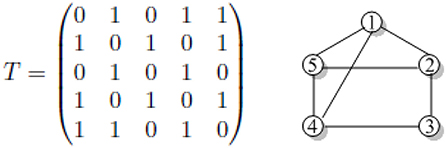
Figure 1. The corresponding Toeplitz graph and the adjacency matrix T T5〈1, 3, 4〉.
Toeplitz matrices play a major role in physical data-processing and in determining the discrete form of an integral and differential equations are considered as applications. Furthermore, matrices also contributed in process of stationary, the theories of polynomials of orthogonals and moment problem (Heinig and Rost, 1984) for more details reader can see (Ku and Kuo, 1992; Hua et al., 2010).
The researchers in Harary and Melter (1976) founded the concept of resolvability in graphs. Chartrand et al. (2000b) first time introduced the concept of pd. Javaid and Shokat (2008) discussed the pd of wheel graphs. Yero and Velázquez (2010) computed the pd of the cartesian product of graphs. Fehr et al. (2006) disproved a conjecture regarding the pd of products of graphs. The upper bound for the pd of the parallel composition of any graph was studied by Mohan et al. (2019). They also came up with an exact solution for the parallel composition of pathways of various lengths. Some updated references are (Ahmad et al., 2021; Ali et al., 2021; Azeem et al., 2021, 2022; Shanmukha et al., 2022a,b,c; Usha et al., 2022).
Resolvability of the graph has application in many fields of science such as in chemistry for representing chemical compounds (Browsable, 1998), Djokovic-Winkler relation (Caceres et al., 2007), strategies for the mastermind game (Chvatal, 1983), pattern recognition and image processing, hierarchical data structures (Melter and Tomescu, 1984), and robots navigation in networks (Khuller et al., 1994). For a better understanding of this topic, some very detailed articles are (Chartrand et al., 2000b; Saenpholphat and Zhang, 2002; Javaid et al., 2012; Velazquez et al., 2012; Velázquez et al., 2014; Yero et al., 2014; Siddiqui and Imran, 2015; Alatawi et al., 2022; Alshehri et al., 2022; Khabyah et al., 2022; Koam et al., 2022,a,b; Nadeem et al., 2022).
The theorems that follow are quite useful for calculating the pd of graphs.
Theorem 1 (Chartrand et al., 2000b). “Let G be a connected graph of order n ≥ 2. Then pd(G) = 2 if and only if G = Pn”.
Theorem 2 Chartrand et al. (2000b) “Let ϕ be a resolving partition of ε(⋎) and ϵ1, ϵ2 ∈ ε(⋎). If d(ϵ1, w) = d(ϵ2, w) for all vertices w ∈ ε(⋎)\(ϵ1, ϵ2), then ϵ1, ϵ2 belong to different classes of ϕ.”
This study's findings the pd of Toeplitz graph with two generators 1 and t in Section 2 and Toeplitz graph partition dimension with three generators 1, 2, and t in Section 3.
2. Partition dimension of Tn〈1, t〉
The coming section is containing the discussion on the pd of the Toeplitz graph Tn〈1, t〉, for t ≥ 2 the pd of the graph is three.
Theorem 2.1. A Toeplitz graph with n ≥ 4 is Tn〈1, 2〉. After that, pd(Tn〈1, 2〉) = 3.
Proof. Let the Toeplitz graph with n ≥ 4 is Tn〈1, 2〉 Then we will show that the Toeplitz graph with generators 1 and 2 consist a resolving partition set, β = {β1, β2, β3} with three elements, where β1 = {v1}, β2 = {vk}k≡0(mod 2), β3 = {vk}k≡1(mod 2). Let β = {β1, β2, β3} resolve the vertices of graph G with V(G) = β1 ∪ β2 ∪ β3.
When k = 1, 2, …, n. In terms of resolving partition set β, we have the following representations of vk.
Because all of the representations of different vertices are distinct
Conversely: Now, we will show that pd(Tn〈1, 2〉) ≥ 3. Suppose on contrary that pd(Tn〈1, 2〉) = 2. We know that pd(G) = 2, iff G is a path graph by Theorem 1, it is not possible for Tn〈1, 2〉. Thus,
Hence, from Inequalities (2) and (3), we have
Theorem 2.2. Let a Toeplitz graph Tn〈1, 3〉 with n ≥ 5. Then pd(Tn〈1, 3〉) = 3.
Proof. Let a Toeplitz graph Tn〈1, 3〉 with n ≥ 5. We will show that the Toeplitz graph with generators 〈1, 3〉 consist of a resolving partition set, β = {β1, β2, β3} with three elements, where β1 = {v1}, β2 = {v2, …, vt}, β3 = {vt+1, …, vn}. There are two cases for β:
Case 1: If 1 ≤ k ≤ 3, then we can write the representation of vk with respect to β as
where this shows that all the representations are different so β resolves the vertex set of graph Tn〈1, 3〉.
Case 2: If 4 ≤ k ≤ n, then we can write the representation of vk with respect to β a
where and k − 1 ≡ j(mod 3), this shows that all the representations are different, thus,
Conversely: We will prove that pd(Tn〈1, 3〉) ≥ 3. On contrary suppose that pd(Tn〈1, 3〉) = 2. Theorem 1 demonstrates that pd(G) = 2, iff G is a path graph, then it is not possible for Tn〈1, 3〉. Thus,
Hence, from Inequalities (4) and (5), we have
Theorem 2.3. Let a Toeplitz graph with notation Tn〈1, t〉 with even generator t ≥ 4, n ≥ t+2. Then pd(Tn〈1, t〉) = 3.
Proof. Let a Toeplitz graph with notation Tn〈1, t〉 with even generator t ≥ 4, n ≥ t+2. The Toeplitz graph with generators 〈1, t〉 consisting of a resolving partition set will be demonstrated. β = {β1, β2, β3}, where β1 = {v1}, β3 = {∀vk|vk ∉ β1, β2}. There are three cases with respect to vk, which are the following;
Case 1: When We have the following representation of vk with regard to resolving partition set β;
where
Case 2: When We have the following representation of vk with respect to resolving partition set β;
where z = 1 when and otherwise z = 0.
Case 3: When We have the following representation of vk with respect to resolving partition set β;
where z = 1 when k = 1 and otherwise z = 0.
It is clear that no two vertices have the same representation, implying that there are not any two vertices with the same representation.
On contrary, we shall now demonstrate that pd(Tn〈1, t〉) ≥ 3. Suppose on the contrary that pd(Tn〈1, t〉) = 2. We know that by Theorem 1, it is not possible for even t of graph Tn〈1, t〉. Thus,
Hence, from Inequalities (6) and (7), we have
Theorem 2.4. Let a Toeplitz graph Tn〈1, t〉 with odd t ≥ 5, n ≥ t+2. Then pd(Tn〈1, t〉) = 3.
Proof. Let a Toeplitz graph Tn〈1, t〉 with odd t ≥ 5, n ≥ t+2. We will show that the Toeplitz graph with generators 1 and t, consists of a resolving partition set, β = {β1, β2, β3} with three elements, where β1 = {v1, v2, vt+1}, β3 = {∀vk|vk ∉ {β1, β2}}.
There are two cases for β1
where , and
There are two cases for β2
where and where and
For β3, we have the following values
From all these cases of β1, β2, and β3
We conclude that all representations are unique, and no two vertices have identical representations.
In contrary, we shall now demonstrate that pd(Tn〈1, t〉) ≥ 3. Suppose on the contrary that pd(Tn〈1, t〉) = 2. We know that by Theorem 1, it is not possible for odd t of graph Tn〈1, t〉. So
Hence, from Inequalities (8) and (9), we can say that
3. Partition dimension of Tn〈1, 2, t〉
In this section, we are going to discuss the partition dimension of Tn〈1, 2, t〉. If t = 3, 4, 5, and t = 2i, i ≥ 3, n ≥ t + 2 then partition dimension is 4.
Theorem 3.1. Let Tn〈1, 2, t〉 be a Toeplitz graph. Then pd(Tn〈1, 2, t〉) = 4.
Proof. We split our theorem into three cases.
Case A: When t = 3, 4, 5.
Let Tn〈1, 2, t〉 be a Toeplitz graph with t = 3, 4, 5, n ≥ t+2, then we will show that vertices of the Toeplitz graph with three generators consist of a resolving partition set, β = {β1, β2, β3, β4} where β1 = {v1}, β2 = {v2}, β3 = {v3, …, vt}, and β4 = {vt+1, …, vn}. Then there are the three cases that follow:
Case 1: If k ≡ 1(mod t), then we can write the unique position of vk regarding β as;
where , and This shows that all the representations are different so β resolves the vertices of Tn〈1, 2, t〉
Case 2: If k ≡ 2, 3(mod t), we can write the representations of vk regarding β as;
where and This indicates that all the representations are different so β resolves the vertices of Tn〈1, 2, t〉.
Case 3: If k ≡ 4, 5(mod t), we can write the representations of vk with respect to β as
where This shows that all the representations are different so β resolve the vertices. From all three cases, we conclude that
Case B: When t = 6, 8.
Let β = {β1, β2, β3, β4} be a resolving partition set. Where β1 = {v1}, β2 = {v2, vt}, β3 = {v3, …, vt−2}, and β4 = {vt−1, vt+1, …, vn}. We have different cases on vk, which are following;
There are two cases for β1;
where z1 = 1 when k = even, z = 1 when k ≡ 0(mod 8) and otherwise both are 0.
There are three cases for β2;
where z = 0 when 5 ≤ k ≤ t−1 and otherwise z = 2, and z1 has defined in β1.
There are three cases for β3;
There is the only case for β4;
It is clear that no two vertices have the same representation, implying that there are no two vertices with the same representation.
Case C: When t = 2i, i ≥ 5.
Let β = {β1, β2, β3, β4} be a resolving partition set. Where β1 = {v2}, β2 = {v6}, β3 = {va}, and β4 = {∀vk|vk ∉ β1, β2, β3}. where
The following is a representation of all vertices vk with regard to the resolving partition set β.
There are two cases for β1;
There are four cases for β2;
There are four cases for β3;
where z1 = 0 when k = even, otherwise 1 and z2 = 1 when k = odd, otherwise 0.
There is the only case for β4;
It is clear that no two vertices have the same representation, implying that there does not exist two vertices with the same representation.
Converse A, B, and C:
We will show that pd(Tn〈1, 2, t〉) ≥ 4. On contrary, suppose that pd(Tn〈1, 2, t〉) = 3.
Different cases on behalf of our assumption that pd(Tn〈1, 2, t〉) is 3. If where βn consists of sets of different resolving partition set that are following:
Case 1: β1 = {v1, v2}, β2 = {v3, v4}, then we have the following different vertices with same representation;
Case 2: β1 = {v1, v3}, β2 = {v2, v4}, then we have the following different vertices with same representation;
Case 3: β1 = {v1, v2, v3}, β2 = {v4}, then we have the following different vertices with same representation;
Case 4: β1 = {v1, v2}, β2 = {v3}, then we have the following different vertices with same representation;
Case 5: β1 = {v1}, β2 = {v2, v3}, then we have the following different vertices with same representation;
Case 6: β1 = {v1, v2, v4}, β2 = {v3}, then we have the following different vertices with same representation;
Case 7: β1 = {v1, v3, v4}, β2 = {v2}, then we have the following different vertices with same representation;
Case 8: β1 = {v1}, β2 = {v2, v4}, then we have the following different vertices with same representation;
Case 9: β1 = {v1}, β2 = {v2, v3, v4}, then we have the following different vertices with same representation;
Case 10: β1 = {v1}, β2 = {v2, v3, v5}, then we have the following different vertices with same representation;
Case 11: β1 = {v1, v5}, β2 = {v2, v4}, then we have the following different vertices with same representation;
Case 12: β1 = {v1, v4}, β2 = {v3, v5}, then we have the following different vertices with same representation;
Case 13: β1 = {v1, v4}, β2 = {v2, v5}, then we have the following different vertices with same representation;
Case 14: β1 ≡ 1(mod 3), β2 ≡ 2(mod 3), β3 ≡ 0(mod 3), then we have the following different vertices with same representation;
According to the above cases, we can easily conclude that our supposition is wrong, and we can not resolve the vertices of Tn〈1, 2, t〉 into three resolving partition sets. Thus,
Hence, from Inequalities (1-3) and (13), we can say that
4. Conclusion and open problems
In this study, we looked at different families of Toeplitz graphs and established that the partition dimension of each family is the constant, if the Toeplitz graph consists of two generators, then pd(Tn〈1, t〉)=3, where t ≥ 2 and if Toeplitz graph consists of three generators, pd(Tn(〈1, 2, t〉)) = 4, where t = 3, 5 and t = 2i and i ≥ 2.
In this paper, inequality (1) also satisfied the metric dimension results (Liu et al., 2019) with our results for partition dimension (Figure 2).
Open Problem 1. The partition dimension of the Toeplitz graph with two generators k ≥ 2, s ≥ 3 and gcd(k, s) = 1, is constant, bounded or unbounded?
Open Problem 2. The partition dimension of the Toeplitz graph with three generators k ≥ 2, s ≥ 3, t ≥ 4 and gcd(k, s, t) = 1, is constant, bounded or unbounded?
Open Problem 3. If the generators of the Toeplitz graph are increasing then the partition dimension either increasing or decreasing ?
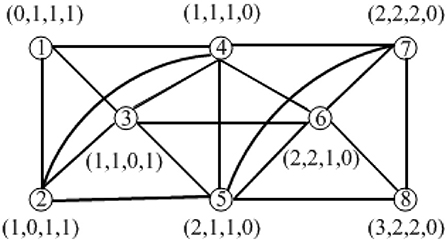
Figure 2. Toeplitz graph T8〈1, 2, 3〉 with partition dimension 4.
Data availability statement
The original contributions presented in the study are included in the article/supplementary material, further inquiries can be directed to the corresponding authors.
Author contributions
RL conceived of the presented idea. AK developed the theory and performed the computations. AA and MA verified the analytical methods. GI and MN investigated and supervised the findings of this work. All authors discussed the results and contributed to the final manuscript.
Funding
This study was supported by the National Science Foundation of China (11961021 and 11561019), Guangxi Natural Science Foundation (2020GXNSFAA159084), and Hechi University Research Fund for Advanced Talents (2019GCC005).
Conflict of interest
The authors declare that the research was conducted in the absence of any commercial or financial relationships that could be construed as a potential conflict of interest.
Publisher's note
All claims expressed in this article are solely those of the authors and do not necessarily represent those of their affiliated organizations, or those of the publisher, the editors and the reviewers. Any product that may be evaluated in this article, or claim that may be made by its manufacturer, is not guaranteed or endorsed by the publisher.
References
Ahmad, A., Ali, N. A., Koam, Siddiqui, M. H. F., Azeem, M., et al. (2021). Resolvability of the starphene structure and applications in electronics. Ain Shams Eng. J. 13, 101587. doi: 10.1016/j.asej.2021.09.014
Alatawi, M. S., Ahmad, A., Koam, A. N. A., Husain, S., and Azeem, M. (2022). Computing vertex resolvability of benzenoid tripod structure. AIMS Math. 7, 6971–6983. doi: 10.3934/math.2022387
Ali, N. A., Koam, Ahmad, A., Asim, M. A., and Azeem, M. (2022b). Computation of vertex and edge resolvability of benzenoid tripod structure. J. King Saud Univer. Sci. 34, 102208. doi: 10.1016/j.jksus.2022.102208
Ali, N. A., Koam, Ahmad, A., and Azeem, M. (2021). Metric and fault-tolerant metric dimension of hollow coronoid. IEEE Access 9, 81527–81534. doi: 10.1109/ACCESS.2021.3085584
Alshehri, H., Ahmad, A., Alqahtani, Y., and Azeem, M. (2022). Vertex metric-based dimension of generalized perimantanes diamondoid structure. IEEE Access 10, 43320–43326. doi: 10.1109/ACCESS.2022.3169277
Azeem, M., Imran, M., and Nadeem, M. F. (2021). Sharp bounds on partition dimension of hexagonal Möbius ladder. J. King Saud Univer. Sci. 34, 101779. doi: 10.1016/j.jksus.2021.101779
Azeem, M., Jamil, M. K., Javed, A., and Ahmad, A. (2022). Verification of some topological indices of Y-junction based nanostructures by M-polynomials. J. Math. 2022, 8238651. doi: 10.1155/2022/8238651
Browsable, M. A. J. (1998). “Structure-activity datasets R. Carb-Dorca, ” in Advances in Molecular Similarity, ed P. Mezey (London: JAI Press Connecticut), 153–170.
Buczkowski, P. S., Chartrand, G., Poisson, C., and Zhang, P. (2003). On k-dimensional graphs and their bases. Periodica Math. Hung. 46, 9–15. doi: 10.1023/A:1025745406160
Caceres, J., Hernando, C., Mora, M., Pelayo, I. M., Puertas, M. L., Seara, C., et al. (2007). On the metric dimension of Cartesian product of graphs. SIAM J. Disc. Math. 2, 423–441. doi: 10.1137/050641867
Chartrand, G., and Zhang, P. (2003). The theory and applications of resolvability in graphs. Congress. Numer. 160, 47–68.
Chartrand, G., Eroh, L., Johnson, M. A., and Oellermann, O. R. (2000a). Resolvability in graphs and the metric dimension of a graph. Discrete Appl. Math. 105, 99–113. doi: 10.1016/S0166-218X(00)00198-0
Chartrand, G., Salehi, E., and Zhang, P. (2000b). The partition dimension of a graph. Aequat. Math. 59, 45–54. doi: 10.1007/PL00000127
Fehr, M., Gosselin, S., and Oellermann, O. R. (2006). The partition dimension of Cayley digraphs. Aequat. Math. 71, 1–18. doi: 10.1007/s00010-005-2800-z
Heinig, G., and Rost, K. (1984). Algebric Methods for Toeplitz-Like Matrices Operators. Boston, MA: Birkhäuser.
Hua, Y., Wen-Quan, W., and Zhong, L. (2010). “Application of Toeplitz matrix in image restoration,” in 2010 IEEE Fifth International Conference on Bio-Inspired Computing (Changsha: IEEE).
Javaid, I., Raja, N. K., Salman, M., and Azhar, M. N. (2012). The partition dimension of circulant graphs. World Appl. Sci. J. 18, 1705–1717. doi: 10.5829/idosi.wasj.2012.18.12.1590
Javaid, I., and Shokat, S. (2008). On the partition dimension of some wheel graphs. J. Prime Res. Math. 4, 154–164.
Khabyah, A. A., Jamil, M. K., Koam, A. N. A., Javed, A., and Azeem, M. (2022). Partition dimension of COVID antiviral drug structures. Math. Biosci. Eng. 19, 10078–10095. doi: 10.3934/mbe.2022471
Khuller, S., Raghavachari, B., and Rosenfeld, A. (1994). Localization in Graphs. Technical Report. UMIACS-TR-94-R-92, College Park, MD: University of Maryland.
Khuller, S., Raghavachari, B., and Rosenfeld., S. (1996). Landmarks in graphs. Discrete Appl. Math. 70, 217–229. doi: 10.1016/0166-218X(95)00106-2
Koam, A. N. A., Ahmad, A., Azeem, M., Khalil, A., and Nadeem, M. F. (2022a). On adjacency metric dimension of some families of graph. J. Funct. Spaces. 2022, 6906316. doi: 10.1155/2022/6906316
Koam, A. N. A., Ahmad, A., Azeem, M., and Nadeem, M. F. (2022). Bounds on the partition dimension of one pentagonal carbon nanocone structure. Arabian J. Chem. 15, 103923. doi: 10.1016/j.arabjc.2022.103923
Ku, T. K., and Kuo, C. J. (1992). Design and analysis of Toeplitz preconditioners. IEEE Trans. Signal Process. 40, 129–141. doi: 10.1109/78.157188
Lewis, H. R., Garey, M. R., and Johnson, D. S. (1983). Computers and Intractability. A guide to the theory of NP-completeness. W.H. Freeman and Company, San Franciscoc 1979. J. Symbolic Logic. 48, 498–500. doi: 10.2307/2273574
Liu, J. B., Nadeem, M. F., Siddiqui, H. M. A., and Nazir, W. (2019). Computing metric dimension of certain families of Toeplitz graphs. IEEE Access 4, 1–8. doi: 10.1109/ACCESS.2019.2938579
Melter, R. A., and Tomescu, I. (1984). Metric bases in digital geometry. Comput. Vis. Graphics Image Process. 25, 113–121. doi: 10.1016/0734-189X(84)90051-3
Mohan, C. M., Santhakumar, S., Arockiaraj, M., and Liu, J. B. (2019). Partition dimension of certain classes of series parallel graphs. Theor. Comput. Sci. 778, 47–60. doi: 10.1016/j.tcs.2019.01.026
Nadeem, M. F., Qu, S., Ahmad, A., and Azeem, M. (2022). Metric dimension of some generalized families of Toeplitz graphs. Math. Problems Eng. 2022, 9155291. doi: 10.1155/2022/9155291
Saenpholphat, V., and Zhang, P. (2002). “Connected partition dimensions of graphs,” in Discussiones Mathematicae 305 Graph Theory, Vol. 22 (Zielona Góra: University of Zielona Góra), 305–323.
Shanmukha, M. C., Kumar, K. N. A., Basavarajappa, N. S., and Usha, A. (2022b). Neighborhood topological indices of metal organic networks. Jnanabha 52, 174–181.
Shanmukha, M. C., Usha, A., Praveen, B. M., and Douhadji, A. (2022a). Degree based molecular descriptors and QSPR analysis of breast cancer drugs. J. Math. 2022, 1–13. doi: 10.1155/2022/5880011
Shanmukha, M. C., Usha, A., Siddiqui, M. K., Asefa Fufa, S., and Tuah, A. (2022c). Degree-based molecular descriptors of guar gum and its chemical derivatives. J. Chem. 2022, 7371538. doi: 10.1155/2022/7371538
Siddiqui, H. M. A., and Imran, M. (2015). Computation of metric dimension and partition dimension of nanotubes. J. Comput. Theor. Nanosci. 12, 199–203. doi: 10.1166/jctn.2015.3717
Usha, A., Shanmukha, M. C., Praveen, B. M., Krishnan, S. Y., and Shilpa, K. C. (2022). Variation of adriatic and wiener indices for different cycle lengths and paths. Discrete Math. Algorithms Appl. doi: 10.1142/S1793830922501257
Velazquez, J. A. R., Yero, I. G., and Kuziak, D. (2012). The partition dimension of corona product graphs. arXiv:1010.5144. doi: 10.48550/arXiv.1010.5144
Velázquez, P. A. R., Yero, I. G., and Lemańska, M. (2014). On the partition dimension of trees. Discrete Appl. Math. 166, 204–209. doi: 10.1016/j.dam.2013.09.026
Yero, I. G., Jakovac, M., Kuziak, D., and Taranenko, A. (2014). The partition dimension of strong product graphs and cartesian product graphs. Discrete Math. 331, 43–52. doi: 10.1016/j.disc.2014.04.026
Keywords: Toeplitz graph, resolving sets, constant partition dimension, bounds on partition dimension, partition resolving set
Citation: Luo R, Khalil A, Ahmad A, Azeem M, Ibragimov G and Nadeem MF (2022) Computing the partition dimension of certain families of Toeplitz graph. Front. Comput. Neurosci. 16:959105. doi: 10.3389/fncom.2022.959105
Received: 01 June 2022; Accepted: 21 September 2022;
Published: 14 October 2022.
Edited by:
Muhammad Javaid, University of Management and Technology, PakistanReviewed by:
Shanmukha M. C., Bapuji Dental College and Hospital, IndiaShaojian Qu, Nanjing University of Information Science and Technology, China
Copyright © 2022 Luo, Khalil, Ahmad, Azeem, Ibragimov and Nadeem. This is an open-access article distributed under the terms of the Creative Commons Attribution License (CC BY). The use, distribution or reproduction in other forums is permitted, provided the original author(s) and the copyright owner(s) are credited and that the original publication in this journal is cited, in accordance with accepted academic practice. No use, distribution or reproduction is permitted which does not comply with these terms.
*Correspondence: Ricai Luo, aGN4eWxvckAxMjYuY29t; Muhammad Azeem, YXplZW1hbGk3MDA5QGdtYWlsLmNvbQ==