 Umberto Scacco1,2*
 Alessia Battistoni3Fulvio Garibaldi4
 Saša Raicevich1Carlo Rondinini3
 Fabrizio Serena5
 Leonardo Tunesi1
 Marino Vacchi6
 Tomaso Fortibuoni1
- 1Italian Institute for Environmental Protection and Research, ISPRA, Rome, Italy
- 2Department of Marine Eco-Biology (DEBM), University of Tuscia, Viterbo, Italy
- 3Department of Biology and Biotechnologies, Global Mammal Assessment Program, Sapienza University of Rome, Rome, Italy
- 4Department of Earth, Environment and Life Sciences, DISTAV, University of Genoa, Genoa, Italy
- 5Institute of Marine Biological Resources and Biotechnology (IRBIM), National Research Council (CNR), Mazara del Vallo, Italy
- 6Institute for the Study of the Anthropic Impacts and the Sustainability of the Marine Environment (IAS), National Research Council of Italy (CNR), Genoa, Italy
This brief research report presents the 2022 updated IUCN Red List for the cartilaginous fish fauna (76 species) recorded in the Italian seas and compares it with the 2013 assessment. Overall, the number of Data Deficient (DD) species decreased in favor of both threatened and unthreatened categories. Out of five DD species in the 2013 assessment, three acquired the status of threatened species (Vulnerable or higher) and two an unthreatened (Least Concern or higher) status in the 2022 assessment. Additionally, the classification for one species changed from Least Concern in 2013 to DD in 2022. The comparison between assessments showed no significant change in the average extinction risk status of cartilaginous fish populations of the Italian seas. Even though 2013-DD species decreased in number, the latter still remains high in the updated Italian IUCN Red List assessment.
1 Introduction
Because of the Italian peninsula's unique position in the Mediterranean Sea, Italian marine waters are emblematic for the study of marine life inhabiting this basin, which is considered a biodiversity “hot spot” at the global scale (1). This is particularly true for the cartilaginous fish fauna, composed of one holocephalan and 75 elasmobranch species. The latter group is divided almost equally between batoids (rays and skates) and squaloids (sharks). Some of these species are endemic to the Mediterranean, whereas some others are occasional vagrant visitors within the basin and Italian seas (2, 3). Cartilaginous fishes have unique bio-ecological characteristics among marine vertebrates (4). Since most chondrichthyan species are characterized by low-resilience, slow growth, delayed maturity, and low fecundity rates (5, 6), they exhibit very low recovery rates to continued overfishing (7, 8), as well as to new threats, such as climate change, habitat loss, and marine pollution (9–12). This has led to the repeated reporting of alarming global declines in populations of rays, skates, sharks, and chimeras on various scales [Pacoureau et al. (13) and references therein]. On 1948, the International Union for the Conservation of Nature (IUCN) introduced the Red Lists as a tool to assess, at different geographical scales, the extinction risk status at the species level. Since 1994, assessments have been based on a system of quantitative and scientifically rigorous categories and criteria, the latest version of which dates back to 2001 (14). These categories and criteria, globally applicable to all living species except microorganisms, represent the most comprehensive inventory of species threatened with extinction and are the global standard for assessing extinction risk. Official guidelines exist for application at sub-global scales, including national scales (15, 16). The Italian IUCN Committee, therefore, called for the present assessments also to ensure the availability, at the national level, of the information required to identify the appropriate management measures to pursue the objectives of the Convention on Biological Diversity fully (17) and the 2030 European Biodiversity Strategy (18) for these species. Indeed, the Red List evaluation helps compare information on species' conservation status based on strict and replicable criteria and threats across different geographical scales. For instance, it has been recently shown that the severity of IUCN assessments for the Mediterranean elasmobranch species depends on the interaction between the species-specific characteristics of the life history traits (19) and the variation in the intensity of the fishing threat posed by different fishing gears on different species at a given geographic scale (20). In addition, the different assessment cycles allow comparison of the species extinction risk over time. Knowing the trends in the health status of cartilaginous fish populations can help prioritize conservation measures and data collecting, especially for data deficient species. In this short note, we present the outcomes of the 2022 updates of the IUCN Red List for the cartilaginous fish fauna recorded in the Italian seas, and we compare it with the previous 2013 assessment. We focus, in particular, on species that changed risk category between the 2013–2022 cycles of the Italian IUCN Red List assessment, and we discuss the outcome in the light of possible management scenarios.
2 Materials and methods
2.1 Assessment method
The 2022 update of the IUCN Red List for elasmobranch species of the Italian seas was carried out by applying the methods recommended by the IUCN. The assessment of extinction risk was based on the IUCN Red List Categories and Criteria version 3.1 (14), the Guidelines for the Use of IUCN Red List Categories and Criteria version 10 (21), and the Guidelines for the Application of IUCN Categories and Criteria at the Regional Level version 3.0 (15, 16).
2.2 Assessment protocol
An area larger than territorial waters was considered for cartilaginous fish species (Figure 1), as the latter are generally highly mobile animals for which the limited extent of national waters is of little significance for assessing their populations' status. Assessors (the authors) collected the following information for each species assessed: Taxonomy (and taxonomic notes, if necessary), Distribution information, Population information, Environmental preferences, Major threats, Conservation measures in place and needed, Essential literature references for assessing the extinction risk into categories, Extinction risk according to IUCN categories and criteria (NA: not applicable; LC: least concern; NT: near threatened; VU: vulnerable; EN: endangered; CR: critically endangered) and subcategories for the threatened species (VU, EN, and CR).
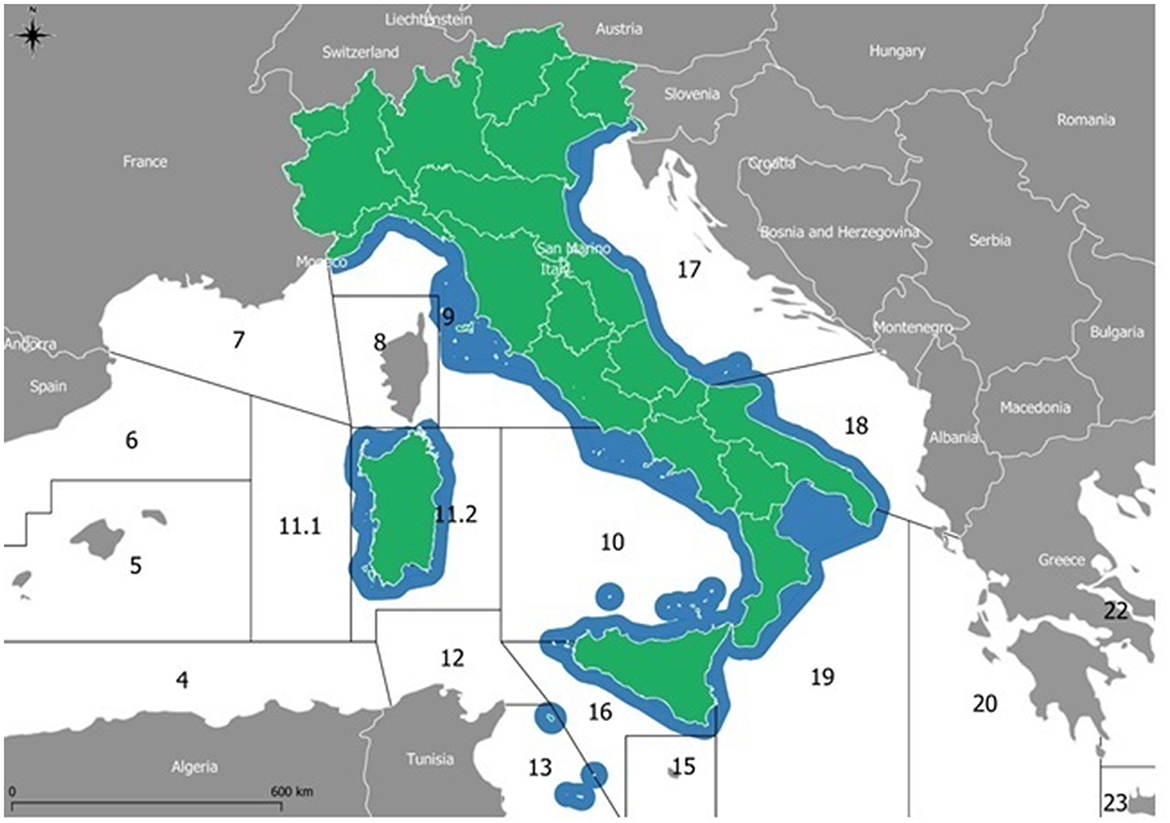
Figure 1. Assessment areas used in the 2013 and 2022 red list assessments for cartilaginous species of the Italian seas. National waters are represented in blue, and delimitations with corresponding official reference numbers are shown for the Geographical Sub Areas (GSAs) where fishing campaigns of the International bottom trawl survey in the Mediterranean (MEDITS) program are regularly carried out.
2.3 Statistical analyses
We used the nonparametric Friedman ANOVA and the Kendall concordance coefficient to assess and compare the overall statistical significance of the intraspecific differences in the extinction risk assessment between the 2013 and 2022 cycles of the Italian IUCN Red List. For this purpose, we coded IUCN categories as follows:
The Friedman test was used as a nonparametric alternative to a one-way analysis of variance for repeated measures to compare dependent samples due to the nature of the data. On the other hand, the Kendall concordance coefficient is generally used to verify the concordance hypothesis between two or more ranking categories. Contingency tables and associated χ2 tests were used to detect significant differences in the relative frequency of the number of species between single (NA included) and aggregated (TNT: total not threatened =LC + NT; vs TT: total threatened = VU + EN+ CR) IUCN extinction risk categories between the 2013 and 2022 assessments. The tables were arranged separately, with seven or two columns as categories and two rows as assessments for single and aggregated categories, respectively. The analysis was chosen due to the associated chi-square test and resulting p-value for statistical significance of difference and level of dependence between proportions.
For each extinction risk category, we calculated the value of the percent difference in the number of species between the 2022 and 2013 cycles (D% 2022 − 2013) of the Italian IUCN Red List assessment as follows
with X as the number of species in a given category by the year of assessment as subscript. Therefore, positive values from the formula indicate categories that increased in the number of species by a given relative percentage in 2022 compared to the 2013 IUCN assessment.
3 Results
3.1 Friedman ANOVA
Friedman ANOVA returned significant results in comparing assessments of single species between the 2013 and 2022 IUCN evaluation cycles (χ2 = 129.29, N = 2, D.F. = 76, p < 0.001). Although the two data series showed a high concordance (Kendal tau = 0.87, mean rank = 0.92), the 2013-DD species decreased in favor of other categories in the 2022 assessment. In particular, we obtained a change of extinction risk category for six elasmobranch species (Figure 2A). Three 2013-DD species were assigned to a threat category in 2022 (VU or higher), namely the bigeye thresher shark Alopias superciliosus (CR), the shortfin mako shark Isurus oxyrinchus (EN) and the kitefin shark Dalatias licha (VU). In addition, two species were assigned to non-threat categories (LC and NT), namely the nurse-hound catshark Scyliorhinus stellaris and the little gulper shark Centrophorus uyato (NT). The common eagle ray Myliobatis aquila shifted from the LC in 2013 to the DD category in the 2022 assessment (Figure 2A). All extinction risk categories, apart from NA, showed a percent variation in the number of species in comparison between assessments (Figure 2B).

Figure 2. (A) Intra-specific variation in the IUCN extinction risk assessment between 2013 (gray area) and 2022 (white area) for the Italian IUCN assessment cycles of cartilaginous fish species. (B) Variation in the number of species (on the left y-axis) across IUCN extinction risk categories between 2013 and 2022 Italian assessments. The dotted dark line with dark indicators represents the values (in labels) of percent variation in the number of species (on the right y-axis) between the 2013 and 2022 assessments. (C) Contributions to the total chi-squared variation in the frequency of occurrence of the number of cartilaginous species by IUCN extinction risk category between the 2013 and 2022 Italian assessment cycles. NA, Not Assessed; DD, Data Deficient; LC, Least Concern; NT, Near Threatened; VU, Vulnerable; EN, Endangered; CR, Critically Endangered. TT, Total Threatened (VU + EN + CR); TNT, Total Not Threatened (LC + NT).
3.2 Contingency tables
The relative frequency of species number by IUCN category did not show significant differences (p < 0.05) between the two assessments (N = 152, χ2 = 1.45, D.F. = 6, p < 0.10). The limited variation observed was mainly determined by the changes in the number of species within the NT and VU categories between the assessments (about 70% of contribute to total variation) (Figure 2C). In fact, although very low, the number of species of both categories in 2013 doubled in the 2022 Italian IUCN assessment (Figure 2C), showing the highest absolute value of percent variation in the number of species relative to other categories (Figure 2B). DD species contributed importantly to total variation as well, representing about 18% of the total variation (Figure 2C), with the number of species in the 2013 assessment decreasing by 11.8 % as compared to 2022 (Figure 2B). Differently, 2013 EN and CR categories increased in species number by 25.0% and 11.1%, respectively, in the 2022 IUCN assessment (Figure 2B). Despite the quite high values of relative difference between assessments, EN and CR categories contributed together only about 11% relative to the total variation (Figure 2C). NA species were equally present and 2013 LC species decreased in the 2022 assessment with the lowest percent variation (6.3%) compared to other categories (Figure 2B). The LC and NA species showed consequently very low and null contributions to the total variation (Figure 2C), respectively. In comparing not threatened (TNT) to threatened species (TT), the difference in the relative frequency of the species number was not significantly different between the two assessments (N = 68, χ2 = 0.08, DF = 1, p > 0.05). However, both groupings had more species in 2022 than in the 2013 assessment, particularly the TT group (Figure 2B). All details of the 2013 and 2022 assessments are reported in Supplementary material 1.
4 Discussion
The reduction in the number of DD species was the most important achievement obtained for the 2022 Italian IUCN Red List assessment compared with the previous assessment for cartilaginous fish species. The increase in scientific knowledge available for some species and experts' agreement after discussion allowed changes from DD status to a defined extinction risk category for six species. The two pelagic species (the shortfin mako and the bigeye thresher shark) worsened extinction risk status, being actually assessed as EN A2b and CR A2b, respectively. The prevalence of juveniles of these species recently observed in the fishery bycatch of pelagic longlines and passive nets of Italian and Mediterranean waters [Scacco et al. (22) and references therein] might be a sign of poor population condition with few reproductive individuals and reduced resilience. Additionally, the rising concern for the population condition of the bigeye thresher shark recently stimulated the introduction of the EU Reg. EU, 2022/109 Art. 25 that prohibits direct fishing of this species (23). Additionally, A. superciliosus is frequently misidentified with A. vulpinus, which is currently assessed as CR. The deep-water kitefin shark, newly assessed as VU A4b, exhibited a steady decline, as indicated by local scientific trawl surveys (24–26), with a strong recommendation to monitor its occurrence in deep-sea fisheries. The nurse-hound catshark and the little gulper shark were assessed both as near threatened (NT) for criterion A2b. In fact, the former species showed a general decline (20–25% in the last three generations, 45–60 years) observed since the 1970s, especially locally (27). The latter species is bycatch of bottom longlines and gillnets fisheries on the continental slope, where this species tends to aggregate (28, 29), with a steady population decline of 20–25% in the last three generations (48–60 years) (MEDITS data). The common eagle ray returned to the DD category as being a good example of a species fitting this assessment. At the same time, the species shows large aggregations, as observed in many MPAs (30), as well as strong fluctuations in the bycatch of pelagic gear (31, 32).
Overall, the average extinction risk status of cartilaginous fish populations did not show significant variation between the 2013 and 2022 assessments for the Italian waters. In fact, the number of species assessed in new categories was roughly balanced between threatened and non-threatened categories. Despite the reduction in DD species obtained in the 2022-updated assessment, their number is still worryingly high on the Italian IUCN Red List. Whatever the extinction risk status of a DD species, the problem is that the DD category might hide a concerning extinction risk status for several species at both the local (33) and larger scale (20, 34, 35). On the other hand, a Green List, complementary to the IUCN Red List for elasmobranchs, has been proposed based on the likely link between some signs of population recovery recently observed for a limited number of elasmobranch species, and the globally increased implementation of conservation actions (36). According to the definition, DD species are a research priority, and the areas where these are concentrated are those where field surveys are most needed to collect new data for a defined assessment of extinction risk. Precisely, the availability of the information required to take the appropriate management measures at the national level is one of the key elements required to fully pursue the objectives of the 2030 European Biodiversity Strategy for these species.
Data availability statement
The raw data supporting the conclusions of this article will be made available by the authors, without undue reservation.
Ethics statement
The requirement of ethical approval was waived by International Union for the Conservation of the Nature for the studies involving animals because it is a IUCN Red List assessment. The studies were conducted in accordance with the local legislation and institutional requirements.
Author contributions
US: Conceptualization, Data curation, Formal analysis, Funding acquisition, Investigation, Methodology, Project administration, Resources, Software, Supervision, Validation, Visualization, Writing—original draft, Writing—review & editing. AB: Data curation, Investigation, Methodology, Validation, Writing—review & editing. FG: Data curation, Investigation, Methodology, Validation, Writing—review & editing. SR: Data curation, Investigation, Methodology, Validation, Writing—review & editing. CR: Data curation, Investigation, Methodology, Validation, Writing—review & editing. FS: Data curation, Investigation, Methodology, Validation, Writing—review & editing. LT: Data curation, Investigation, Methodology, Validation, Writing—review & editing. MV: Data curation, Investigation, Methodology, Validation, Writing—review & editing. TF: Data curation, Investigation, Methodology, Resources, Validation, Writing—review & editing.
Funding
The author(s) declare that no financial support was received for the research, authorship, and/or publication of this article.
Acknowledgments
We thank M. Bottaro, C. Mancusi, C. Mazzoldi and G. Notarbartolo Di Sciara for providing their expertise in the 2013 cycle of the IUCN Italian red list assessment of cartilaginous fish. We are particularly grateful to the referees who reviewed this manuscript.
Conflict of interest
The authors declare that the research was conducted in the absence of any commercial or financial relationships that could be construed as a potential conflict of interest.
The author(s) declared that they were an editorial board member of Frontiers, at the time of submission. This had no impact on the peer review process and the final decision.
Publisher's note
All claims expressed in this article are solely those of the authors and do not necessarily represent those of their affiliated organizations, or those of the publisher, the editors and the reviewers. Any product that may be evaluated in this article, or claim that may be made by its manufacturer, is not guaranteed or endorsed by the publisher.
Supplementary material
The Supplementary Material for this article can be found online at: https://www.frontiersin.org/articles/10.3389/frish.2024.1356358/full#supplementary-material
References
1. Coll M, Piroddi C, Steenbeek J, Kaschner K, Ben Rais Lasram F, Aguzzi J, et al. The biodiversity of the Mediterranean sea: estimates, patterns, and threats. PLoS ONE. (2010) 5:e11842. doi: 10.1371/journal.pone.0011842
2. Tortonese E. Fauna d'Italia Vol. 02 -Leptocardia, Ciclostomata, Selachii. Bologna: Calderini Edizioni, 334. (1956).
3. Ebert DA, Dando M, Fowler S. Sharks of the World: A Complete Guide. Princeton, NJ: Princeton University Press (2021) p. 624. doi: 10.1515/9780691210872
4. Carrier JC, Musick JA, Heithaus MR. Biology of Sharks and Their Relatives, 2nd ed. Boca Raton, FL: CRC Press. (2012).
5. Cortés E. Demographic analysis as an aid in shark stock assessment and management. Fish Res. (1998) 39:199–208. doi: 10.1016/S0165-7836(98)00183-0
6. Cortés E. Incorporating uncertainty into demographic modelling: application to shark populations and their conservation. Cons Biol. (2002) 16:1048–62. doi: 10.1046/j.1523-1739.2002.00423.x
7. Froese R, Demirel N, Coro G, Kleisner KM, Winker H. Estimating fisheries reference points from catch and resilience. Fish Fish. (2017) 18:506–26. doi: 10.1111/faf.12190
8. Dulvy NK, Fowler SL, Musick JA, Cavanagh RD, Kyne PM, Harrison LR, et al. Extinction risk and conservation of the world's sharks and rays. Elife. (2014) 3:e00590. doi: 10.7554/eLife.00590
9. Valente T, Sbrana A, Scacco U, Jacomini C, Bianchi J, Palazzo L, et al. Exploring microplastic ingestion by three deep-water elasmobranch species: a case study from the Tyrrhenian Sea. Environ Pollut. (2019) 253:342–50. doi: 10.1016/j.envpol.2019.07.001
10. Delaval A, Wagner CI, Schwanck T, Wood FR, Jones CS, Hoarau G, et al. Endangered Coastal Elasmobranchs of the North-East Atlantic. Reference Module in Earth Systems and Environmental Sciences. Amsterdam: Elsevier Inc. (2021).
11. Swift DG, Portnoy DS. Identification and delineation of essential habitat for elasmobranchs in estuaries on the Texas. Coast Estuar Coast. (2021) 44:788–800. doi: 10.1007/s12237-020-00797-y
12. Espinoza M, Araya-Arce T, Chaves-Zamora I, Chinchilla I, Cambra M. Monitoring elasmobranch assemblages in a data-poor country from the Eastern Tropical Pacific using baited remote underwater video stations. Sci Rep. (2020) 10:17175. doi: 10.1038/s41598-020-74282-8
13. Pacoureau N, Rigby CL, Kyne PM, Sherley RB, Winker H, Carlson JK, et al. Half a century of global decline in oceanic sharks and rays. Nature. (2021) 589:567–71. doi: 10.1038/s41586-020-03173-9
14. IUCN. IUCN Red List Categories and Criteria: Version 3.1. Gland, Cambridge: IUCN Species Survival Commission. IUCN. (2001).
15. IUCN. Guidelines for application of IUCN Red List Criteria at regional levels: Version 3.0. In: IUCN. Species Survival Commission. Gland, Cambridge: IUCN. (2003).
16. IUCN. Guidelines for Application of IUCN Red List Criteria at Regional and National Levels: Version 4.0. Gland, Cambridge: IUCN. (2012).
17. CBD. Convention on Biological Diversity. (1992). Available online at: https://www.cbd.int/doc/legal/cbd-en.pdf (accessed June 1, 2023).
18. European Commission. Biodiversity Strategy for 2030. (2022). Available online at: https://environment.ec.europa.eu/strategy/biodiversity-strategy-2030_en (accessed August 20, 2023).
19. Cheung WWL, Pitcher TJ, Pauly D. A fuzzy logic expert system to estimate intrinsic extinction vulnerabilities of marine fishes to fishing. Biol Cons. (2005) 124:97–111. doi: 10.1016/j.biocon.2005.01.017
20. Scacco U, Di Crescenzo S, Sbrana A. Exploring fishing threat at fleet segment and subregional scale: Least expert knowledge and a resilience versus disturbance-based approach as conservation's tools for cartilaginous fish. Ecol Evol. (2023) 13:e9881. doi: 10.1002/ece3.9881
21. IUCN. Guidelines for Using the IUCN Red List Categories and Criteria. Version 10. In: Prepared by the Standards and Petitions Subcommittee. Gland, Cambridge: IUCN. (2013).
22. Scacco U, Gennari E, Di Crescenzo S, Fanelli E. Looking into the prevalence of bycatch juveniles of critically endangered elasmobranchs: a case study from pelagic longlines and trammel net fishery in the Asinara Gulf (NW Sardinia). Front Mar Sci. (2023) 10:1303961. doi: 10.3389/fmars.2023.1303961
23. EU. EU Reg. EU, 2022/109 Art. 25. (2022). Available online at: https://eur-lex.europa.eu/legalcontent/IT/TXT/?uri=CELEX%3A32022R0109 (accessed June 20, 2022).
24. Finucci B, Walls RHL, Guallart J, Kyne PM. Dalatias licha. In: The IUCN Red List of Threatened Species: e.T6229A3111662. (2018). doi: 10.2305/IUCN.UK.2018-2.RLTS.T6229A3111662.en
25. Falsone F, Gancitano V, Geraci ML, Sardo G, Scannella D, Serena F, et al. Assessing the stock dynamics of elasmobranchii off the southern coast of sicily by using trawl survey data. Fishes. (2022) 7:136. doi: 10.3390/fishes7030136
26. Finucci B, Bineesh KK, Cotton CF, Dharmadi Kulka DW, Neat FC, Pacoureau N, et al. Centrophorus uyato. The IUCN Red List of Threatened Species 2020: e.T41745A124416090. (2020). doi: 10.2305/IUCN.UK.2020-3.RLTS.T41745A124416090.en
27. Clodia Database. Banca dati della pesca a Chioggia, Adriatico settentrionale. (2022). Available online at: http://chioggia.biologia.unipd.it/banche-dati/ (accessed June 15, 2022).
28. Serena F, Baino R, Rey J, Papacostantinou C, Relini G. Catch composition and abundance of deep-sea elasmobranches based on the MEDITS trawl survey. In: FAO Report on DEEP SEA 2003, an International Conference on Governance and Management of Deep-sea Fisheries. Queenstown, New Zealand, 1-5 December. FAO Fisheries Report No. 772. Rome: FAO p. 395–408. (2005).
29. Carpentieri P, Nastasi A, Sessa M, Srour A. Incidental catch of vulnerable species in Mediterranean and Black Sea fisheries: A review. In: GFCM Studies and Reviews No. 101. Rome: FAO. (2021).
30. Grancagnolo D, Arculeo M. Summer aggregation of common eagle ray, Myliobatis aquila (Chondrichthyes: Myliobatidae), in the Marine Protected Area of the Egadi Islands (southwestern Tyrrhenian Sea). J Integr Biogeogr. (2021) 36:a002. doi: 10.21426/B636051230
31. La Mesa G, Annunziatellis A, Filidei E, Fortuna CM. Bycatch of myliobatid rays in the central mediterranean sea: the influence of spatiotemporal, environmental, and operational factors as determined by generalized additive modeling. Mar Coast Fish. (2016) 8:382–94. doi: 10.1080/19425120.2016.1167795
32. Bonanomi S, Pulcinella J, Fortuna CM, Moro F, Sala A. Elasmobranch bycatch in the Italian Adriatic pelagic trawl fishery. PLoS ONE. (2018) 13:e0191647. doi: 10.1371/journal.pone.0191647
33. Tiralongo F, Messina G, Lombardo BM. Discards of elasmobranchs in a trammel net fishery targeting cuttlefish, Sepia officinalis Linnaeus 1758, along the coast of Sicily (central Mediterranean Sea). Reg Stud Mar Sci. (2018) 20:60–3. doi: 10.1016/j.rsma.2018.04.002
34. Walls RHL, Dulvy NK. Eliminating the dark matter of data deficiency by predicting the conservation status of Northeast Atlantic and Mediterranean Sea sharks and rays. Biol Cons. (2020) 246:108459. doi: 10.1016/j.biocon.2020.108459
35. Nuez I, Giovos I, Tiralongo F, Penadés-Suay J, Cetkovic I, Di Lorenzo M, et al. Assessing the current status of Hexanchus griseus in the Mediterranean Sea using local ecological knowledge. Mar Pol. (2023) 147:105378. doi: 10.1016/j.marpol.2022.105378
Keywords: threatened species, sharks, rays, skates, chimeras, Mediterranean
Citation: Scacco U, Battistoni A, Garibaldi F, Raicevich S, Rondinini C, Serena F, Tunesi L, Vacchi M and Fortibuoni T (2024) Tracking IUCN extinction risk at sub-regional scale: lessons from comparing Italian Red List assessments for cartilaginous species within a decade (2013–2022). Front. Fish Sci. 2:1356358. doi: 10.3389/frish.2024.1356358
Received: 15 December 2023; Accepted: 15 January 2024;
Published: 05 February 2024.
Edited by:
Rafael Miranda, University of Navarra, SpainReviewed by:
Francesco Tiralongo, University of Catania, ItalySimon Dedman, Florida International University, United States
Copyright © 2024 Scacco, Battistoni, Garibaldi, Raicevich, Rondinini, Serena, Tunesi, Vacchi and Fortibuoni. This is an open-access article distributed under the terms of the Creative Commons Attribution License (CC BY). The use, distribution or reproduction in other forums is permitted, provided the original author(s) and the copyright owner(s) are credited and that the original publication in this journal is cited, in accordance with accepted academic practice. No use, distribution or reproduction is permitted which does not comply with these terms.
*Correspondence: Umberto Scacco, dW1iZXJ0by5zY2FjY29AaXNwcmFtYmllbnRlLml0