 Dung Ho My Nguyen1,2†
 Thitipong Panthum1,2†
 Jatupong Ponjarat1Nararat Laopichienpong1,2Ekaphan Kraichak3Worapong Singchat1,2Syed Farhan Ahmad1,2Narongrit Muangmai4Surin Peyachoknagul1Uthairat Na-Nakorn5
 Kornsorn Srikulnath1,2,6,7,8,9*
- 1Laboratory of Animal Cytogenetics and Comparative Genomics (ACCG), Department of Genetics, Faculty of Science, Kasetsart University, Bangkok, Thailand
- 2Special Research Unit for Wildlife Genomics (SRUWG), Department of Forest Biology, Faculty of Forestry, Kasetsart University, Bangkok, Thailand
- 3Department of Botany, Kasetsart University, Bangkok, Thailand
- 4Department of Fishery Biology, Faculty of Fisheries, Kasetsart University, Bangkok, Thailand
- 5Department of Aquaculture, Faculty of Fisheries, Kasetsart University, Bangkok, Thailand
- 6Center for Advanced Studies in Tropical Natural Resources, National Research University-Kasetsart University, Kasetsart University, Bangkok, Thailand
- 7Center of Excellence on Agricultural Biotechnology (AG-BIO/PERDO-CHE), Bangkok, Thailand
- 8Omics Center for Agriculture, Bioresources, Food and Health, Kasetsart University (OmiKU), Bangkok, Thailand
- 9Amphibian Research Center, Hiroshima University, Higashihiroshima, Japan
An investigation of sex-specific loci may provide important insights into fish sex determination strategies. This may be useful for biotechnological purposes, for example, to produce all-male or all-female fish for commercial breeding. The North African catfish species, Clarias gariepinus, has been widely adopted for aquaculture because its superior growth and disease resistance render the species suitable for hybridization with other catfish to improve the productivity and quality of fish meat. This species has either a ZZ/ZW or XX/XY sex determination system. Here, we investigate and characterize these systems using high-throughput genome complexity reduction sequencing as Diversity Arrays Technology. This approach was effective in identifying moderately sex-linked loci with both single-nucleotide polymorphisms (SNPs) and restriction fragment presence/absence (PA) markers in 30 perfectly sexed individuals of C. gariepinus. However, SNPs based markers were not found in this study. In total, 41 loci met the criteria for being moderately male-linked (with male vs. female ratios 80:20 and 70:30), while 25 loci were found to be moderately linked to female sex. No strictly male- or female-linked loci were detected. Seven moderately male-linked loci were partially homologous to some classes of transposable elements and three moderately male-linked loci were partially homologous to functional genes. Our data showed that the male heterogametic XX/XY sex determination system should co-exist with the ZZ/ZW system in C. gariepinus. Our finding of the co-existence of XX/XY and ZZ/ZW systems can be applied to benefit commercial breeding of this species in Thailand. This approach using moderately sex-linked loci provides a solid baseline for revealing sex determination mechanisms and identify potential sex determination regions in catfish, allowing further investigation of genetic improvements in breeding programs.
Introduction
Aquaculture plays an important role in global food production (Belton and Thilsted, 2014; Loring et al., 2019). However, the availability of land and water resources for aquaculture is currently limited, while susceptibility to new diseases is increasing (Ayyam et al., 2019; Lebel et al., 2019). This has facilitated continuous improvements in breeding programs by cross-breeding between different species to generate new hybrid varieties that can tolerate high stocking densities (Dunham and Masser, 2012; Zhou et al., 2018). Clariid catfish (Clarias spp.) are commonly distributed in freshwater from the River Orange in South Africa to the Nile in North Africa, as well as in parts of Asia (Israel, Syria, Southern Turkey, and Southeast Asia) (Skelton and Teugels, 1992; Teugels and Adriaens, 2003; Na-Nakorn et al., 2004a). With good flesh quality (taste and firmness), the bighead catfish (Clarias macrocephalus, Günther, 1864) is one of the most economically important freshwater fish in Southeast Asia (Günther, 1864; Teugels et al., 1999). However, it is difficult to develop sustainable breeding management programs because of the low growth rate and high susceptibility to disease (Jarimopas et al., 1988; Na-Nakorn et al., 1993; Senanan et al., 2004). The North African catfish species (C. gariepinus, Burchell, 1822) was introduced for hybridization with bighead catfish to improve the productivity and quality of the fish meat (Burchell, 1822; Nukwan et al., 1990). A hybrid was developed by crossing artificially male North African catfish and female bighead catfish (Senanan et al., 2004). This F1 hybrid catfish exhibits a rapid growth rate and has a high disease resistance, which has led to the propagation of these hybrids in the aquaculture market. They now represent more than 90% of catfish production in Thailand (Na-Nakorn et al., 2004a). The F1 hybrids are physically more vigorous than either parental species, but their mass production has been limited by reproductive failure (Koolboon et al., 2014; Ponjarat et al., 2019). Ponjarat et al. (2019) asserted that hybrid dysgenesis between the bighead catfish and North African catfish is caused by karyotypic and genomic differences, resulting in meiotic arrest and subsequent apoptosis of gametocytes. However, the F1 hybrid can occasionally cross-breed in captivity, whereby the female hybrids are fertile, with the potential to produce large numbers of backcross progeny that shows fertility and low embryo mortality, whereas the male hybrids are sterile (Na-Nakorn et al., 2004b; Abol-Munafi et al., 2006). Sex hormones have been applied in an attempt to promote spermatogenesis, but the F1 male hybrids have always remained sterile (Abol-Munafi et al., 2006). The complexity of sex determination interaction between the two species might influence differences in fertility between F1 male and female hybrids (Ponjarat et al., 2019).
The North African catfish species, C. gariepinus has been widely adopted for aquaculture within and outside its native ranges (Van der Bank, 1998; Dai et al., 2011; Wachirachaikarn and Na-Nakorn, 2019), and is considered the tropical catfish species best suited to aquaculture (Clay, 1979; Okonkwo and Obiakor, 2010), leading to the application of C. gariepinus for cross-breeding with other clariid catfish (Rahman et al., 2013). They have been extensively distributed around the world (Vitule et al., 2006; Na-Nakorn and Brummentt, 2009). The farming of C. gariepinus is rapidly expanding due to its superior growth and disease resistance against fungi, viruses and bacteria (Akoll and Mwanja, 2012; Taukhid et al., 2015). C. gariepinus that carried the MHC-II marker showed better growth and were significantly different from other catfish (Suprapto et al., 2017). Moreover, they are also important for biological research such as genome manipulation (Bongers et al., 1995; Galbusera et al., 2000; Erondu et al., 2011; Nwachi and Dasuki, 2017). However, the problematics of taxonomy and systematics are complex and need thorough revision with inclusion of populations from different geographic origins (Teugels, 1982, 1984, 1986). Historically, several stocks of C. gariepinus have been introduced to Thailand (Wachirachaikarn and Na-Nakorn, 2019), and genetic diversity of a few has been identified significantly different between Thailand and Nigeria (Falaye et al., 2011; Wachirachaikarn and Na-Nakorn, 2019). Therefore, a proper understanding of the sex determination system of C. gariepinus in Thailand is necessary to assist in breeding programs of this species and its hybrid.
The family of air-breathing or labyrinth catfish (Clariidae) is one of the largest among the Siluriformes (Burgess, 1989). Clariid fish comprise 14 genera with 115 species found in India, Syria, Southern Turkey, Southeast Asia, and Africa. Most have the highly conserved karyotype with diploid chromosome number (2n) ranging from 48 to 56, with the exception of C. pachynema (2n = 66), and one population of C. batrachus (2n = 104) (Jianxun et al., 1991; Eyo and Effiong, 2005; Malla and Ganesh, 2009; Maneechot et al., 2016). These findings show that C. gariepinus phylogenetically exhibits both the XX/XY and ZZ/ZW system (Figure 1). However, significant variation in fish sex chromosome systems has been recorded, not only among closely related species (such as in tilapias, ricefishes, or sticklebacks; Takehana et al., 2008; Ross et al., 2009; Ser et al., 2010; Cnaani, 2013) but also between different populations of the same species (e.g., Eigenmannia virescens and Ancistrus cf. dubius; Almeida-Toledo et al., 2001; Mariotto et al., 2004;, Mariotto and Miyazawa 2006; Fernandes et al., 2019). Recent genotyping using next-generation sequencing, such as Diversity Arrays Technology (DArTseqTM) developed by Diversity Arrays Technology Pty Ltd., (Canberra, ACT, Australia), is an effective method for the identification of sex-linked loci in non-model species. The variability in SNP loci generates presence/absence polymorphism in restriction sites (so-called PA markers) and these may facilitate the identification of divergent genomic regions present in one sex only, thus pointing to a putative region of suppressed recombination on a presumed sex chromosome. To identify the sex determination system in the C. gariepinus, we applied DArTseqTM in captive-bred individuals scored with phenotypic sex. The mapped DArTseqTM sequences were then used to search for homologies with other ‘model’ teleosts (Japanese rice fish: Oryzias latipes, zebrafish: Danio rerio, and Japanese pufferfish: Takifugu rubripes), and amniotes (chicken: Gallus gallus). Our findings also provide novel insights into the evolutionary history of sex determination in catfish.
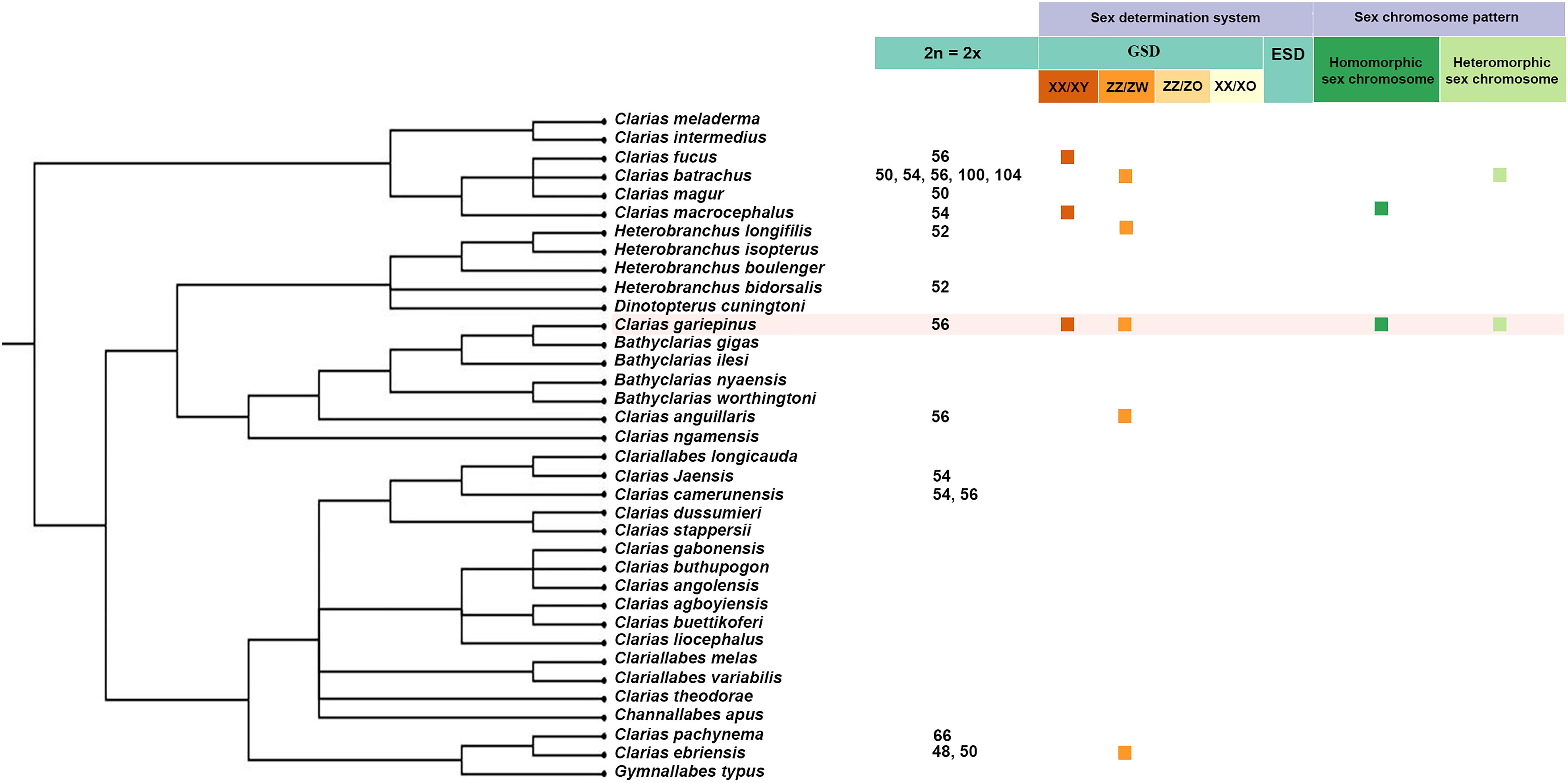
Figure 1. Phylogenetic tree showing number of chromosomes and sex determination system of the Clariidae family (Ozouf-Costaz et al., 1990; Teugels et al., 1992; Na-Nakorn, 1995; Bakhoum, 1996; Liu et al., 1996; Eding et al., 1997; Pandey and Lakra, 1997; Kovács et al., 2001; Eyo and Effiong, 2005; Malla and Ganesh, 2009; Okonkwo and Obiakor, 2010; Awodiran et al., 2015; Maneechot et al., 2016).
Materials and Methods
Specimens and DNA Extraction
Fifteen male and fifteen female individuals of North African catfish (C. gariepinus) were collected with weight of 1.7–2.0 kg and length of 35–40 cm. The sampled individuals were randomly picked from a large breeding stock to avoid the probability of high incidence of siblings in our pool. The sex of each individual was identified by external morphology and internal examination of gonadal morphology (Kitano et al., 2007; Esmaeili et al., 2017; Ponjarat et al., 2019). Hence, the sex of all specimens obtained from the Department of Aquaculture, Faculty of Fisheries, Kasetsart University (Bangkok, Thailand) was determined to avoid potentially wrong sexing due to sex reversal. The fins were removed for DNA extraction. Animal care and all experimental procedures were approved by the Animal Experiment Committee, Kasetsart University (Approval No. ACKU61-SCI-026), and conducted in accordance with the Regulations on Animal Experiments at Kasetsart University. Whole genomic DNA was extracted following the standard salting-out protocol as previously described (Supikamolseni et al., 2015). The quality of extracted DNA was evaluated by gel electrophoresis, and samples with high-molecular weight DNA were stored at −20°C until required for DArTseqTM library construction.
DArT Sequencing and Genotyping
A detailed description of the DArTseqTM methodology can be found in Jaccoud et al. (2001). The method often produces 69 base pairs (bp) long sequences. Genotyping of multiple loci was performed using DArTseqTM (Diversity Arrays Technology Pty Ltd., Canberra, Australian Capital Territory, Australia) for SNP loci and in silico DArT (PA of restriction fragments in the representation; PA loci) to determine the candidate sex-specific loci between male and female individuals. Approximately 100 ng of DNA from each sample was used for the development of DArTseqTM arrays. DNA samples were subjected to digestion/ligation reactions as described by Kilian et al. (2012) and digested with PstI and a second restriction endonuclease (SphI). Ligation reactions were performed using two adaptors: a PstI compatible adaptor consisting of an Illumina flow-cell attachment sequence, primer sequence, and a unique barcode sequence; and a SphI compatible adaptor consisting of an Illumina flow-cell attachment region. Ligated fragments were then amplified by PCR using the following parameters: initial denaturation at 94°C for 1 min, followed by 30 cycles of 94°C for 20 s, 58°C for 30 s, and 72°C for 45 s with a final extension step at 72°C for 7 min. Equimolar amounts of amplification products from each individual were pooled and subjected to Illumina’s proprietary cBot1 bridge PCR followed by sequencing on the Illumina HiSeq 2000 platform. Single read sequencing was run for 77 cycles.
Sequences were processed using proprietary DArTseqTM analytical pipelines (Ren et al., 2015). Initially, the HiSeq 2000 output (FASTQ file) was processed to filter poor-quality sequences. Two different thresholds of quality were applied. For the barcode region (allowing parsing of sequences into specific sample libraries), we applied stringent selection (minimum Phred pass score of 30, minimum pass length percentage 75). For the remainder of the sequence, relaxed thresholds were applied (minimum Phred pass score 10, minimum pass length percentage 50). Approximately 2,000,000 sequences per individual were identified and used in marker calling. Finally, identical sequences were combined into “fastqcoll” files that were used in the secondary proprietary pipeline (DArTsoft14) for SNP and PA loci calling. To this end, we used the “reference-free” algorithm implemented in DArTsoft14. The sequence clusters were then parsed into SNP and in silico DArTseqTM markers utilizing a range of metadata parameters derived from the quantity and distribution of each sequence across all samples in the analysis. Multiple libraries of the same individual were included in the DArTseqTM genotyping process, enabling reproducibility scores to be calculated for each candidate marker. Outputs by DArTsoft14 were then filtered on the basis of reproducibility values, average count for each sequence (sequencing depth), balance of average counts for each SNP allele, and call-rate (proportion of samples for which the marker was scored).
Marker Selection and DArT Sequencing Analysis
Sex-specific loci were derived from the analysis of SNP co-dominant markers and PA as dominant markers. The SNP data were coded as “0” for the reference allele homozygote (the most common allele), “1” for the SNP allele homozygote, “2” for the heterozygote, or “–” as the double null/null allele homozygote (absence of a SNP fragment in the genomic representation). The PA data were coded as “1” for presence, “0” for absence, or “–” for putative heterozygosity. For sex-linked markers in an XX/XY sex-determination system, reference alleles are expected to be located on the X-chromosome. Here, “SNP alleles” were those that showed polymorphism relative to the reference allele. In an XX/XY system, SNP alleles should be associated with the Y sex chromosome, and located in or near to the male-determination region if the allele is tightly Y-specific. If the two sex chromosomes recombine, SNP alleles should occasionally appear on the X chromosome. Some males might then be homozygous for SNP alleles at particular loci, with females being heterozygous, exhibiting a copy of the SNP allele but the probability of a female being homozygous for a SNP allele should be low. For evaluation of loci associated with an XX/XY system, loci with female homozygosity frequencies for the reference allele of at least 70% were retained, whereas those with homozygosity at the SNP allele at no more than 30% and heterozygosity at no more than 30% were discarded. For males, loci with homozygosity frequencies for the reference allele of at most 30% and heterozygosity of at least 70% were retained. However, this allowed sex-linked loci to show a higher degree of SNP allele homozygosity for males if recombination occurred. For PA markers, loci that had restriction fragments sequenced in at least 70% of males and not sequenced in at least 70% of females were selected. The SNP and PA loci sequenced for 80%, 90%, and 100% of males were also included in a separate dataset. Loci passing the 100% filtering criterion were designated as perfectly sex-linked, whereas those passing at 70–90% were called moderately sex-linked loci. An opposite similar approach was carried out for targeting loci with a ZZ/ZW system.
Calculation of the Hamming distance was performed to determine the number of combined loci between male and female individuals for pairwise differences in SNP and PA loci using the “rdist” function of R version 3.5.1 statistical software (R Core Team, 2019). Heatmaps were plotted using the ggplot2 R package (R Core Team, 2019). The Hamming distance represents the number of pairwise differences between all individuals across all loci. To examine the genetic association between each locus and phenotypic sex assignment from the SNP and PA loci, the Cochran-Armitage trend test (CATT) was performed using the “catt” function of R version 3.5.1 with the HapEstXXR package (R Core Team, 2019; Sven and Klaus, 2019). The CATT results were similar to those of a chi-square test to assess whether the proportion of different genotypes followed the null expectation. Polymorphism information content (PIC), as an index for evaluation of the informativeness of SNP and PA loci, was calculated for each locus and ranged from 0 (fixation of one allele) to 0.5 (frequencies of the two alleles are equal).
Estimation of Expected Sex-Linked Markers
The probability of candidate loci showing random associations with sex under a small sample size was estimated (Lambert et al., 2016). The formula Pi = 0.5n describes the probability of a locus being perfectly sex-linked by chance, where P is the probability for a given locus, i is sex-linked, 0.5 is the probability that either a female is homozygous or a male is heterozygous at a given locus, and n is the number of individuals sequenced at the locus. After sequencing, we multiplied P by the number of high-quality SNPs produced to estimate the number of SNPs expected to exhibit a perfectly sex-linked pattern by chance.
Comparison of Potential Sex-Linked Loci
We scored all candidate loci, the frequency of analyzed loci was not strictly (100%) sex-linked. A three-sample chi-square for PA loci and heterozygosity for SNP loci assuming unequal variances (based on results from the descriptive statistics) was performed to determine whether these three groups were significantly different from each other using the chi-square test with the R package “stats” for PA loci, and the Kruskal-Wallis test using the R package “stats” and the Nemenyi test using the R package “PMCMR” for SNP loci, to determine the mean heterozygosity and standard deviation for each (Gruber and Georges, 2019). All candidate loci were plotted against each individual using the ‘glPlot’ function in the R package ‘dartR’ (Gruber and Georges, 2019; R Core Team, 2019).
Homology Searching
For all sex-linked loci that reached our criteria and had statistically significant associations with phenotypic sex, a Basic Local Alignment Search Tool (BLAST) search was performed to investigate the homologies of the sex-linked SNP/PA loci against a selection of available teleost fish genomes (Japanese rice fish: O. latipes) (Accession No. GCF_002234675.1) (Kasahara et al., 2007), zebrafish: D. rerio (Accession No. GCA_000002035.4) (Broughton et al., 2001), Japanese pufferfish: T. rubripes (Accession No. GCA_901000725.2) (Elmerot et al., 2002), amniote reference genomes (chicken: G. gallus) (Accession No. AADN00000000.5) (International Chicken Genome Sequencing Consortium, 2004). We selected the aforementioned species as representative reference genomes in the homology search analysis due to the availability of their high-quality gene annotations and near complete up-to-date assemblies. The BLAST homology search was performed in two rounds. First we aligned sex-linked loci against the reference fish genome, and then we mapped the homologous genes to further clarify their location on sex chromosomes of high-quality annotated genomes representing vertebrate and invertebrate species. Using the BLASTn program, sex-linked loci were used to search the NCBI database2 and RepBase version 19.11 (Bao et al., 2015) (Genetic Information Research Institute, http://www.girinst.org/). This is a specialized nucleotide sequence collection for repeated or other significant sequences that only reports E-values lower than 0.05 and query coverage with similarity of more than 50%.
Results
Determination of Sex-Linked Loci in North African Catfish
We sequenced 42,752 SNP loci and 118,118 PA loci. PIC values ranged from 0.49 to 0.50 for all loci. To determine whether XX/XY or ZZ/ZW sex chromosomes drive sex determination in C. gariepinus, we compared a number of SNP and PA after filtering with a gradually varying set of criteria. For the ZZ/ZW type, filtering using the criterion of 30:70 male:female presented only 25 PA loci as moderately female-linked and no SNP loci. Proportional pairwise Hamming distance between males and females using moderately sex-linked PA loci showed within-sex distances of 0.563 ± 0.011 in males and 0.403 ± 0.014 in females, and showed between-sex distances of 0.675 ± 0.007 for PA loci. The CATT results verified a significant locus association with phenotypic sex for 25 PA (χ2 = 5.07–11.63; p < 0.001) loci. Moreover, 20:80 male:female yielded only one PA loci as moderately female-linked and no SNP loci. Hamming distance between males and females using moderately sex-linked PA loci showed within-sex distances of 0.543 ± 0.049 in males and 0.343 ± 0.047 in females. Between-sex distances showed 0.707 ± 0.03 PA loci. CATT verified a significant locus association with sex phenotype for one PA (χ2 = 9.07; p < 0.001) locus (Figure 2). No SNP or PA loci associated with females was found for the criteria of 10:90 and 0:100 male:female (Figure 3, Table 1). Chi-square tests showed that 30:70 and 20:80 filtering criteria indicated no significant differences in males (χ2 = 1.2226 × 10⁻³¹; p = 1) and females (χ2 = 1.0206 × 10⁻³¹; p = 1) for PA.
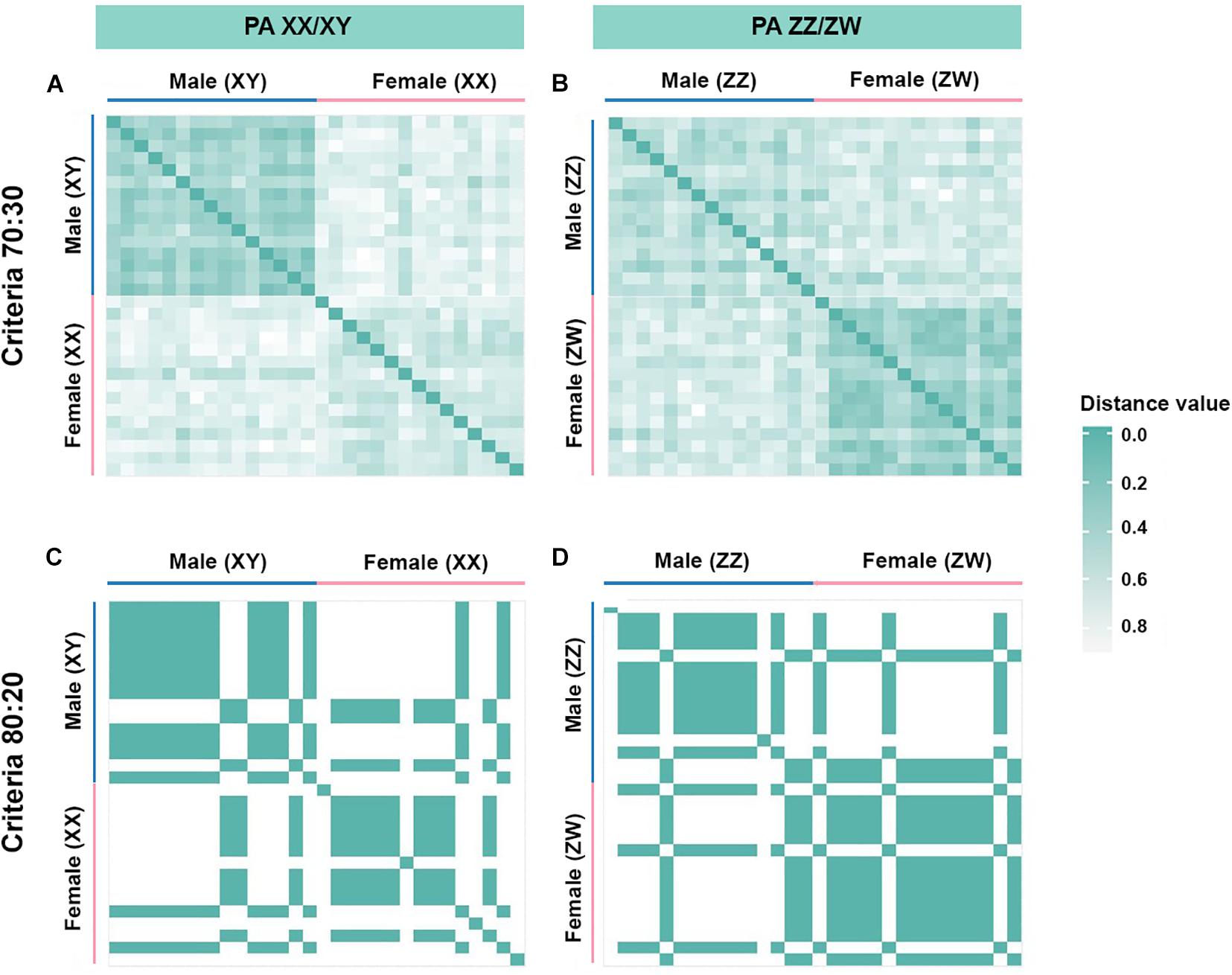
Figure 2. Hamming distance between male and female individuals of African catfish (Clarias gariepinus). (A) restriction fragment presence/absence (PA) loci with the criterion 70:30 (male:female), (B) PA loci with the criterion 30:70 (male:female), (C) PA loci with the criterion 80:20 (male:female), (D) PA loci with the criterion 20:80 (male:female).
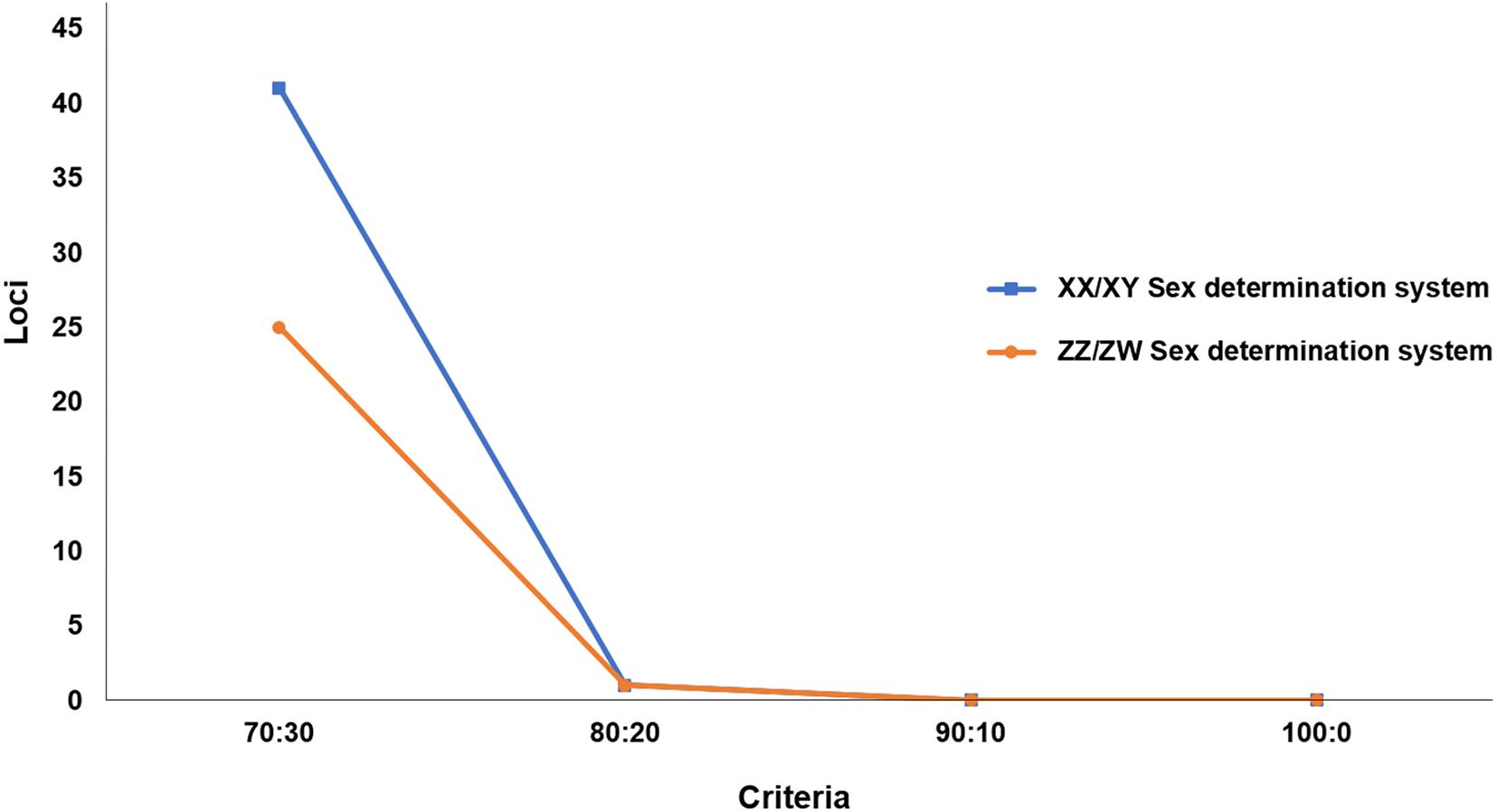
Figure 3. Graph showing number of loci for different hypotheses of sex determination systems after filtering with different criteria. X-axis indicates the number of loci and Y-axis shows the filter criteria.
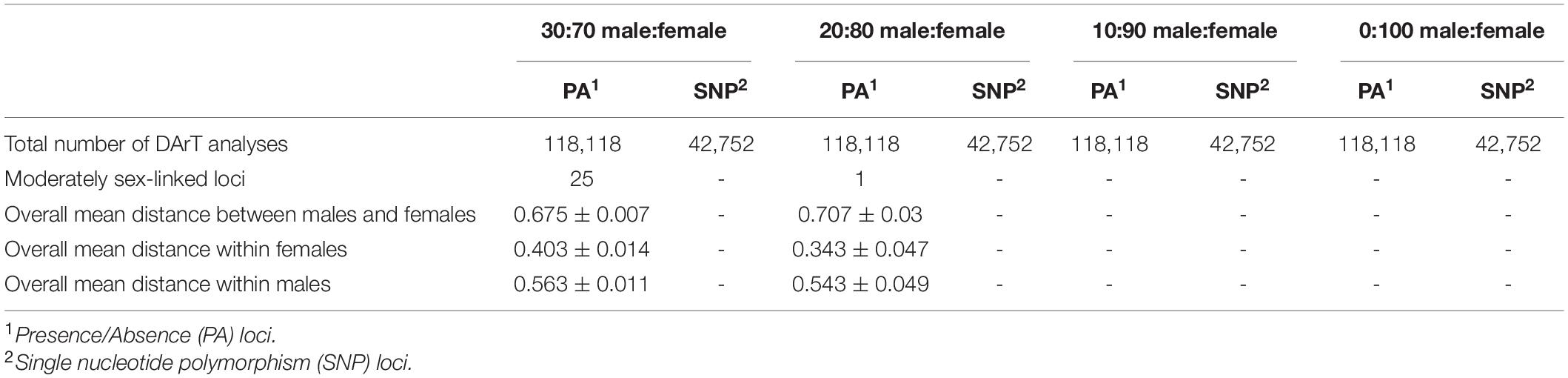
Table 1. DArT analysis of 15 males and 15 females of African catfish (Clarias gariepinus) (ZZ/ZW sex-determination type).
By contrast, for the XX/XY type, filtering using the criterion of 70:30 male:female yielded 42 PA loci as moderately male-linked loci and no SNP loci. Proportional pairwise Hamming distance between male and female African catfish using moderately sex-linked PA loci (under the null exclusive model) showed lower within-sex distances of 0.373 ± 0.01 in males and 0.624 ± 0.009 in females for PA loci. Between-sex distances showed 0.699 ± 0.006 for PA loci. CATT verified significant loci association with phenotypic sex for 41 PA (χ2 = 3.55–13.06; p < 0.001) loci. The criterion of 80:20 male:female yielded one PA locus as moderately male-linked. Hamming distance between males and females using moderately sex-linked PA loci showed within-sex distances of 0.343 ± 0.047 in males and 0.648 ± 0.047 in females, and between-sex distances of 0.773 ± 0.0028 for PAloci. CATT verified significant loci association with phenotypic sex for one PA (χ2 = 9.75; p < 0.001) locus (Figure 2). The criteria of 90:10 and 100:0 male:female did not show any PA locus as male-specific (Figure 3, Table 2). Chi-square tests revealed that the 70:30 and 80:20 filtering criteria produced no significant differences in males (χ2 = 4.5003 × 10⁻³²; p = 1) and females (χ2 = 2.4989 × 10⁻³²; p = 1) for PA. A glPlot revealed that the sample group showed greater similarity between sexes when moderately sex-linked loci were considered in both XX/XY and ZZ/ZW sex determination systems (Figure 4).
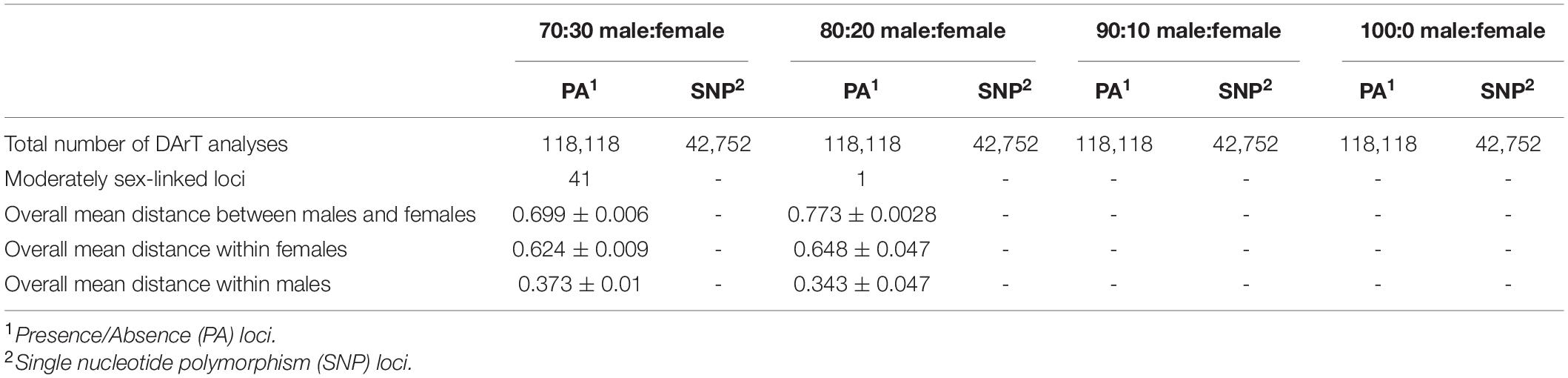
Table 2. DArT analysis of 15 males and 15 females of African catfish (Clarias gariepinus) (XX/XY sex-determination type).
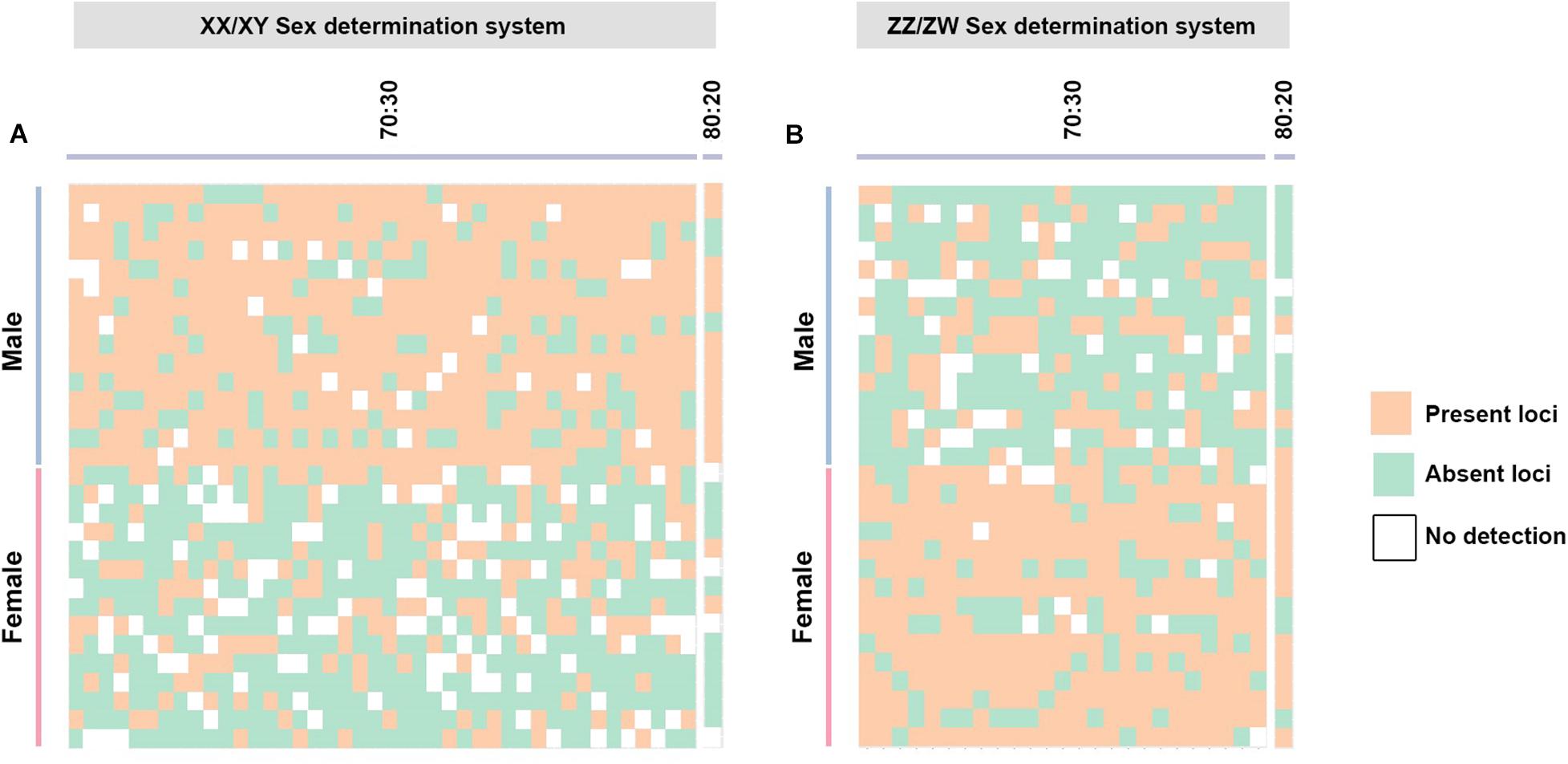
Figure 4. (A) Index of 41 moderately sex-linked loci with criterion of 70:30 (male:female) (XX/XY sex determination system) and (B) index of 25 moderately sex-linked loci with criterion of 30:70 (male:female) (ZZ/ZW sex determination system) created using the ‘glPolt’ function in the R package ‘dartR.’ Orange indicates loci presence, green is indicative of loci absence, and white indicates null loci.
Estimation of Expected Sex-Linked Markers
For a range of sample sizes and loci, a sample of 30 phenotypically sexed individuals is essential to minimize the probability of selecting less than one spurious sex-linked marker. The Pi probability that a single locus exhibited a perfectly sex-linked pattern by chance is 9.31 × 10⁻¹⁰. Considering that we analyzed the full dataset (no filtering) of 160,870 (including SNP and PA loci), this translates to an expected number of perfect sex-linked loci due to chance alone of 1.5 × 10⁻⁴.
Homology of Putative Sex-Linked Loci
In terms of a ZZ/ZW sex chromosome system, female moderately sex-linked loci of C. gariepinus had sequence homology with Japanese rice fish (O. latipes), Japanese pufferfish (T. rubripes), and zebrafish (D. rerio) genomes on the basis of global BLAST analyses of NCBI databases. No sequence homology was found with the chicken genome (Supplementary Table 1). We found that 2 of 25 PA loci were homologous with putative genes: PCDH2AB3 (E-values 2 × 10–11, Query Cover 100% and similarity 82.61%) and DCTN4 (E-values 4 × 10⁻⁸, Query Cover 68% and similarity 89.58%) from D. rerio (Wu, 2005; Bayés et al., 2017) (Supplementary Table 2). Moreover, 4 of 25 PA loci had partial homology with transposable elements, comprising 3 loci with similarity to Gypsy families and 1 locus of retroelement Rex1 (Supplementary Table 3). By contrast, for the XX/XY sex chromosome system, 3 out of 41 moderately male sex-linked PA loci of C. gariepinus had sequence homology with putative genes: ADD3 (E-values 2 × 10⁻⁴, Query Cover 71% and similarity 81.63%) from D. rerio (Pasquier et al., 2016), GUCD1 (E-values 0.038, Query Cover 56% and similarity 82.05%) from T. rubripes (Elmerot et al., 2002), and DNTA (E-values 0.003, Query Cover 52% and similarity 86.11%) from G. gallus (Bellott et al., 2017) (Supplementary Table 4), whereas 7 of 41 PA loci had partial homology with transposable elements consisting of 3 loci of Gypsy, 3 loci of Tc1/mariner families, and 1 locus of short interspersed nuclear elements (SINEs) (Supplementary Table 5). Moreover, one PA locus was matched with a non-coding region homologous to the chicken Z chromosome (GGAZ) (Supplementary Table 6).
Discussion
Fish sex chromosomes are often homomorphic (i.e., cytologically indistinguishable) which hampers their analysis (Otake et al., 2010; Gammerdinger and Kocher, 2018). Such a condition, however, seems to facilitate frequent sex chromosome turnovers (Gammerdinger and Kocher, 2018; Ieda et al., 2018). The variation in fish sex chromosome systems has been recorded among closely related species (such as in tilapias, ricefishes, or sticklebacks; Takehana et al., 2008; Ross et al., 2009; Ser et al., 2010; Cnaani, 2013) and also between different populations of the same species (e.g., Eigenmannia virescens and Ancistrus cf. dubius; Almeida-Toledo et al., 2001; Mariotto et al., 2004; Mariotto and Miyazawa, 2006; Fernandes et al., 2019). Given these facts, the identification of sex-linked loci is important for a thorough elucidation of the sex chromosome origin and evolution in teleosts, on both inter-specific and inter-population levels (Herpin and Schartl, 2015; Kottler and Schartl, 2018). An intriguing situation has been found in C. gariepinus, where several reports differed in the type of detected sex chromosome systems, suggesting either XX/XY or ZZ/ZW constitution (Ozouf-Costaz et al., 1990; Bakhoum, 1996; Liu et al., 1996; Eding et al., 1997; Váradi et al., 1999; Okonkwo and Obiakor, 2010). Here, DArTseqTM technology was applied to a large number of SNP/PA loci, allowing the prediction of sex-linked loci for C. gariepinus using a sample size of 30 individuals (15 males and 15 females). Many false-positive signals might be expected from such specimens due to their more diverse genetic background (Gamble et al., 2015); however, our data show the feasibility of our approach. The probability of one locus showing sex linkage spuriously was 9.31 × 10⁻¹⁰ from the full dataset (no filtering) of 160,870 loci (including SNP and PA loci), whereas the expected amount of perfect sex linkage was estimated to be 1.5 × 10⁻⁴; thus, identification of any sex-linked loci by chance seems unlikely. Our analysis reports the co-occurrence of male and female linked loci with a different proportion (70:30) across all the sampled specimens, suggesting that the XY and ZW systems can coexist inside the same fish individual. Our results indicate that sex chromosome turnover might still be in action in this species.
Both ZZ/ZW or XX/XY Sex Chromosome Systems Co-exist in North African Catfish
Most of the reported sex chromosome systems from Africa and Israel support the assumption that the ZZ/ZW system is the ancestral type for C. gariepinus (Ozouf-Costaz et al., 1990; Teugels et al., 1992; Eyo and Effiong, 2005). However, molecular marker, chromosome analysis, genome manipulation (both gynogenesis and androgenesis), and hormonal sex-reversal experiments with different sampled populations from Israel, Hungary and China have suggested a XX/XY system in C. gariepinus (Liu et al., 1996; Eding et al., 1997; Galbusera et al., 2000; Figure 5). Our study successfully identifies 41 SNP/PA loci as moderately male-linked loci, in contrast to 25 moderately female-linked loci. Based on the comparison between several teleost reference genomes, the loci were not all located in the same linkage group. One scenario might be that all loci are in the same linkage group for C. gariepinus but, just hypothetically, this chromosome pair was evolved by fusion. Comparison of moderately sex-linked loci between the two candidate systems showed that two female-linked loci had homology with putative protein-coding genes. One of these two loci was homologous to the DCTN4 gene located on the sex chromosome in platypus (Ornithorhynchus anatinus) (Warren et al., 2008) (Supplementary Table 7). By contrast, three moderately male-linked loci were homologous to protein-coding genes, including GUCD1, which is located on the sex chromosome of the monarch butterfly (Danaus plexippus plexippus), tongue sole (Cynoglossus semilaevis), fruit fly (Drosophila busckii), and dog (Canis lupus familiaris) (Supplementary Table 8) (Lindblad-Toh et al., 2005; Chen et al., 2014; Gu et al., 2019; Renschler et al., 2019). However, in this study, moderately male-linked markers were found simultaneously with moderately female-linked markers in the same individuals, as found in cichlids (Roberts et al., 2016). This suggests that the XX/XY sex determination system might co-exist with ZZ/ZW system in the same individuals of C. gariepinus.
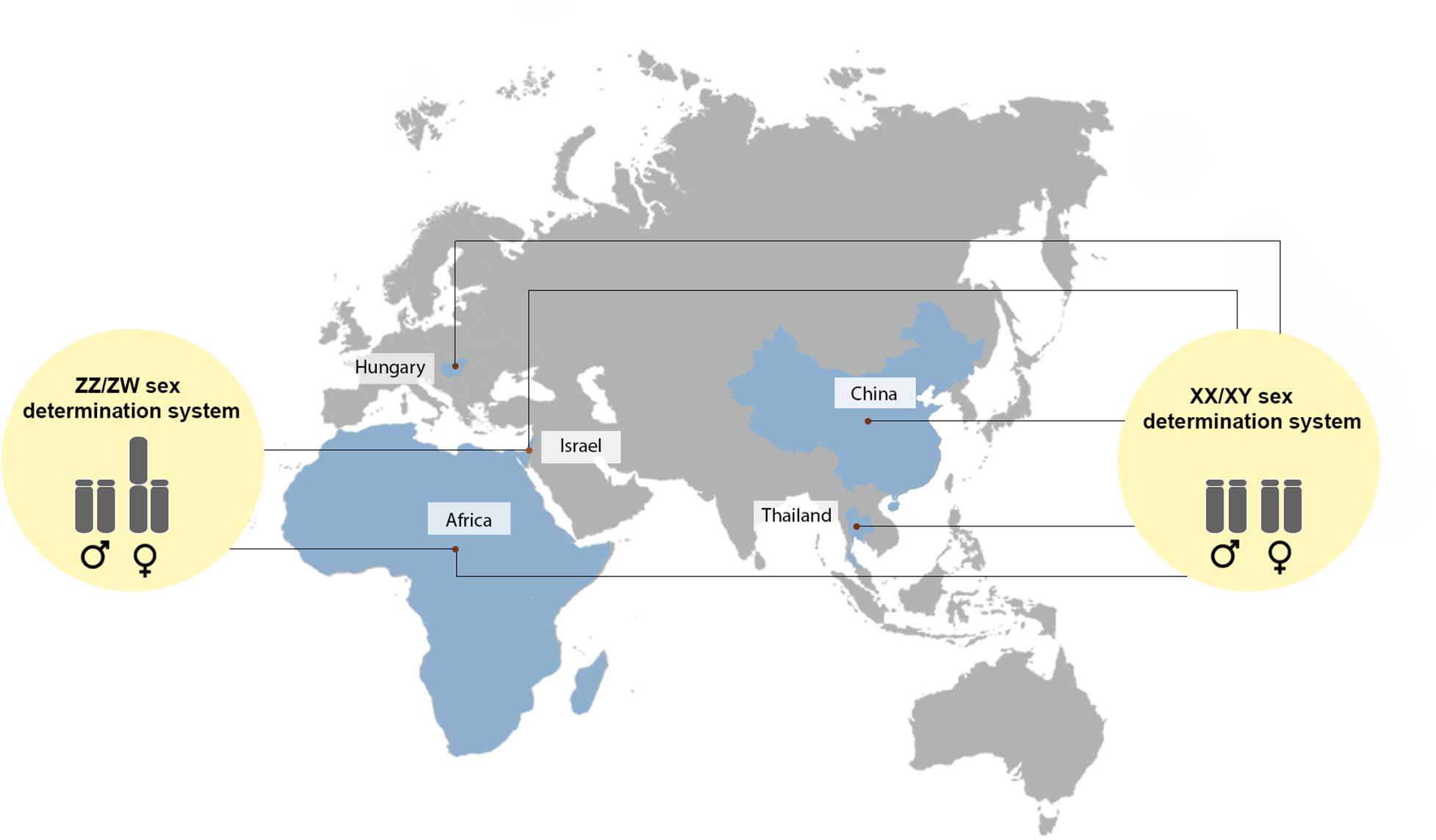
Figure 5. Population map indicating a male heterogamety (XX/XY) and female heterogamety (ZZ/ZW) belonging to different groups (Ozouf-Costaz et al., 1990; Teugels et al., 1992; Liu et al., 1996; Galbusera et al., 2000; Kovács et al., 2001; Maneechot et al., 2016; Ponjarat et al., 2019).
Genomic convergence has been detected by comparative cytogenetics studies in which unrelated sex chromosomes share sex chromosomal linkage homologies across distantly related species (Srikulnath et al., 2014, 2015; Ahmad et al., 2020; Koomgun et al., 2020; Laopichienpong et al., 2020; Singchat et al., 2020a,b). We found that a male-linked locus under the 70:30 criterion shared partial homology with ADD3 which is localized on GGA6, which is further orthologous to sex chromosomes of sand lizard (Lacerta agilis). In addition, another male-linked 70:30 locus had a partial homology with GUCD1 on GGA15 that is partially homologous to sex chromosomes of green anole (Anolis carolinensis), spiny softshell turtle (Apalone spinifera), and Chinese softshell turtle (Pelodiscus sinensis) (Figure 6; Kawagoshi et al., 2009; Alföldi et al., 2011; Badenhorst et al., 2013; Rovatsos et al., 2014; Srikulnath et al., 2014; Singchat et al., 2020a,b). Similar cases were also observed in which linkage homologies or small partial linkage homologies were conserved between teleost and amniote sex chromosomes (Kasahara et al., 2007; Cortez et al., 2014). Our results are only based on observations of certain PA loci showing homology to segments presented on some sex chromosomes of other amniotes or members of gene families, not exactly the identical gene. Moreover, lots of material between sex chromosomes and autosomes moves via transposition (in both directions); therefore, some genes can be independently co-opted to relocate to different linkage groups, with abundant evidence, typically in mammals (Mitchell et al., 1998; Uechi et al., 2002; Kuroiwa et al., 2010; Hughes et al., 2015). This could be further studied by other approaches such as whole genome sequencing and genome assembly. One moderately female-linked locus was observed in C. gariepinus corresponding to GGA13 and partially homologous to sex chromosomes of platypus (Ornithorhynchus anatinus) and W sex chromosome of Siamese cobra (Naja kaouthia) (Veyrunes et al., 2008; Singchat et al., 2018; Figure 6). Moderately sex-linked loci derived from 70:30 and 80:20 (male:female) filtering criteria indicate partial recombination between X and Y sex chromosomes. These loci are relatively close to potential male-determining regions but they are not intimately connected.
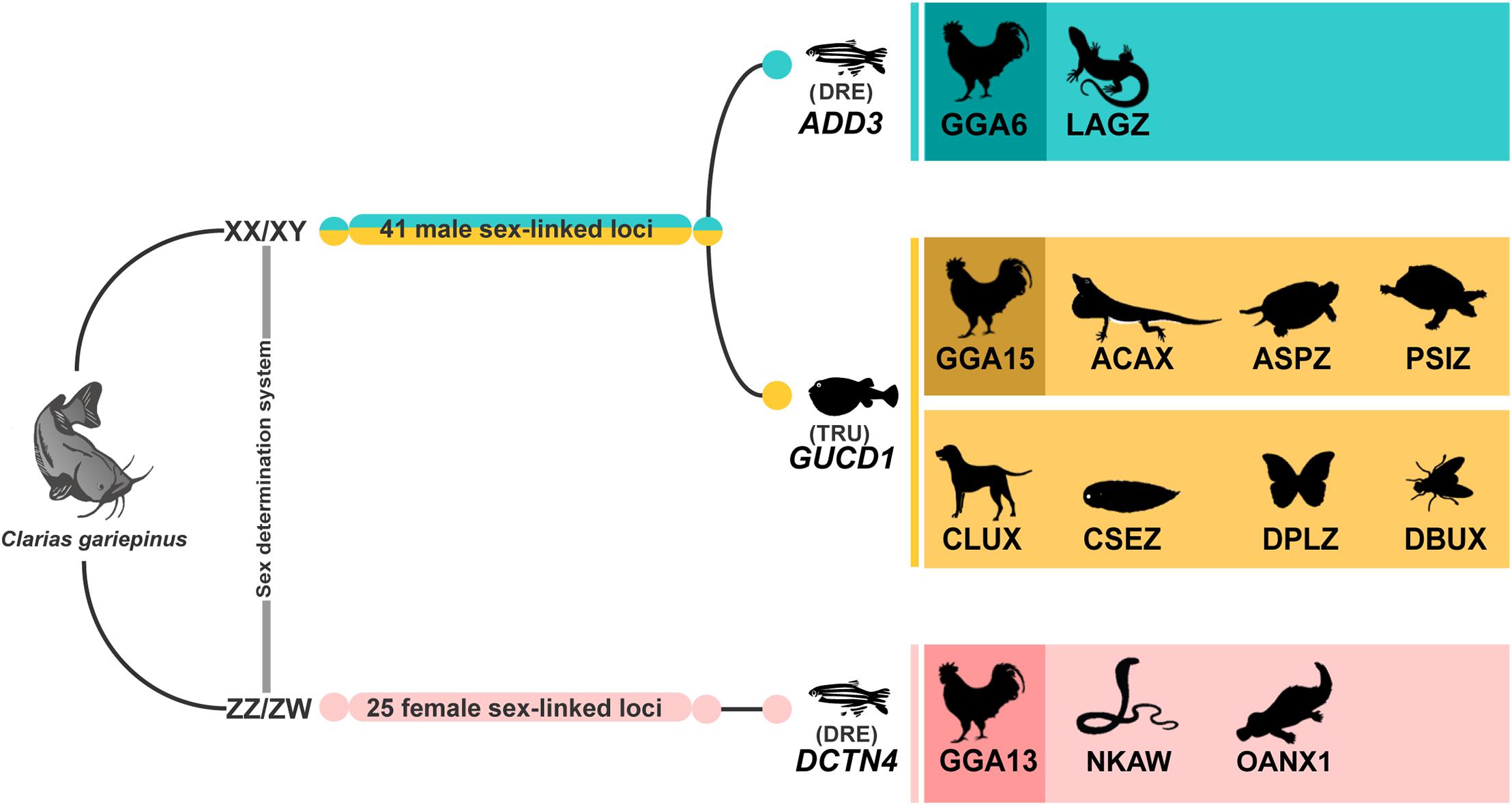
Figure 6. Moderately male-linked and female-linked loci of Africa catfish (Clarias gariepinus) showing partial homologies with putative genes: ADD3 (Danio rerio) (Pasquier et al., 2016), GUCD1 (Takifugu rubripes) (Elmerot et al., 2002) and DCTN4 (Danio rerio) (Bayés et al., 2017). These genes were located on chromosomes of chicken (Gallus gallus, GGA) and other amniote sex chromosomes, such as sand lizard (Lacerta agilis, LAG), green anole (Anolis carolinensis, ACA), spiny softshell turtle (Apalone spinifera, ASP), Chinese softshell turtle (Pelodiscus sinensis, PSI), dog (Canis lupus familiaris, CLU), tongue sole (Cynoglossus semilaevis, CSE), and invertebrates, such as fruit fly (Drosophila busckii, DBU), monarch butterfly (Danaus plexippus plexippus, DPL), and female-specific loci of African catfish (Clarias gariepinus) showing homologies with chicken (Gallus gallus, GGA), platypus (Ornithorhynchus anatinus, OAN), Siamese cobra (Naja Kaouthia, NKA). Chromosomal locations of genes in the amniotes were obtained from comparative gene mapping (chromosome mapping via a cytogenetic technique) and whole genome sequencing as the following sources: GGA from Matsuda et al. (2005), ACA from Alföldi et al. (2011), LAG from Srikulnath et al. (2014), ASP from Badenhorst et al. (2013), PSI from Kawagoshi et al. (2009), CLU from Lindblad-Toh et al. (2005), DBU from Renschler et al. (2019), CSE from Chen et al. (2014), DPL from Gu et al. (2019), OAN from Veyrunes et al. (2008), and NKA from Singchat et al. (2018).
Although transposable elements can be dispersed on many chromosomes or even throughout the entire genome, large amplification of the elements are often found on sex chromosomes in many organisms (Ahmad et al., 2020; Koomgun et al., 2020; Laopichienpong et al., 2020; Yoshido et al., 2020). The presence of accumulated TEs leads to the establishment of heterochromatin, and possibly also to TE recombination between non-homologous copies. The activity of transposable elements could play an important role in sex chromosome differentiation through mechanisms of chromosomal breakage, deletion, and rearrangement (Chalopin et al., 2015; Dechaud et al., 2019). Seven out of 41 male-linked SNP/PA loci were identical to transposable elements such as Gypsy, Mariner/Tc1, and SINE, which are commonly distributed on sex chromosomes in Japanese rice fish (O. latipes) and half-smooth tongue sole (C. semilaevis) (Chen et al., 2014; Inoue et al., 2017).
Same Species of North African Catfish at Different Localities Show Different Sex Determination Systems
Karyotypes of C. gariepinus from different localities of tropical Africa and Israel are very stable and exhibit the ZZ/ZW type (Ozouf-Costaz et al., 1990; Teugels et al., 1992; Bakhoum, 1996; Okonkwo and Obiakor, 2010). However, our analysis of C. gariepinus with sampled populations from Thailand indicates the presence of the XX/XY co-existing with ZZ/ZW type. Possibly, C. gariepinus has two different sex chromosome groups in Bangui, Central African Republic, West Africa, while other fish species such as the southern platyfish, Xiphophorus maculatus, exhibit a different mechanism of sex determination among diverse populations (Volff and Schartl, 2001). Similarly, both ZZ/ZW and XX/XY sex chromosome systems have been reported in the glass knifefish, Eigenmannia virescens. The ZW group is distributed in Mato Grosso do Sul State, Brazil, with the XY group in the Tietê River, Brazil (Almeida-Toledo et al., 2001; Fernandes et al., 2019), while Ancistrus cf. dubius revealed female heterogamety in the Paraguay River Basin, Brazil and male heterogamety in the Coxipó River, Brazil (Mariotto et al., 2004; Mariotto and Miyazawa, 2006). Another well-known example of ZW/XY co-occurrence has been reported in some fish species of cichlids such as Oreochromis niloticus, Oreochromis aureus, Astatotilapia burtoni and Metriaclima pyrsonotus. These species have a male heterogametic (XY) system and a female heterogametic (ZW) system on different linkage groups (Ser et al., 2010; Cnaani, 2013; Moore and Roberts, 2013; Conte et al., 2017; Gammerdinger and Kocher, 2018). The majority of the sex chromosome systems in clariid catfish show the ancestral karyotype with ZZ/ZW system (Agnèse et al., 1990; Volckaert and Agnèse, 1996). This suggests that the ZW group with differentiated sex chromosomes of C. gariepinus might be distributed in West Africa, whereas the turnover of sex chromosome systems might have occurred in ancestral homomorphic ZW sex chromosomes, resulting in the XY group. Historically, more than one stock of C. gariepinus has been introduced to Thailand but the origin of this population remains unknown (Wachirachaikarn and Na-Nakorn, 2019). Thus, it is necessary to identify potential geographic variation in sex linkage across these loci, and across boundary regions between the geographic groups, as well as examining the phylogenetic history for various populations of C. gariepinus. Moreover, it is very interesting to examine the mutual affinity of the two different systems of sex determination when they meet secondarily after divergence from each other. Specimen collection of C. gariepinus from Africa with the XY group is necessary to prove these hypotheses.
A distinct difference exists between growth rates of the two sexes in C. gariepinus (Henken et al., 1987; Falaye et al., 2011), and improvement of genome manipulation such as gynogenesis or androgenesis and hormone treatment procedures by early molecular sexing could be economically important for species aquaculture. Results of genome-wide SNP such as those from DArTseqTM methodology provide sex-specific SNP/PA loci in moderately sex-linked loci for identifying sex determination and sex-linked markers, although this can be applied only narrowly across species (Lambert et al., 2016; Hill et al., 2018). The next phase of this study requires a PCR-based approach for sex identification to provide a genotypic tool for the practical sexing of individuals, allowing accurate detection of sex in populations through insight into the evolutionary history of the Y chromosome. However, failure of the PCR validation step has often been observed after DArTseqTM or RADseq bioinformatics analysis (Gamble et al., 2015). This outcome might result from conserved regions in both sexes of sequences adjacent to sex-specific restriction sites (Gamble, 2016).
Conclusion
We have presented an approach of genome-wide SNP used to identify a notable number of moderately sex-linked loci given the small portion of the genome involved. Results of moderately linked (and lacking sex-specific) markers in both male and female individuals show that the male heterogametic XX/XY sex determination system should co-exist with ZW system in the same individuals of C. gariepinus, indicating a probable ongoing transition between two sex chromosome systems. However, it remains unclear whether the location of large genomic regions between X-specific and Y-specific fragments is associated with differentiation of sex chromosomes and sex-determination regions. It might be possible that the two C. gariepinus populations exhibit different sex chromosome systems. Thus, the possibility exists of within-species sex chromosome turnover, which could be further tested by other methods such as genome assembly. Further analysis of unrelated individuals from the wild is also required to understand the dynamics of the sex determination system in this lineage. Chromosome mapping using fluorescence in situ hybridization (FISH) technique on sex-specific loci should be performed on both mitotic and meiotic chromosomes, while immunostaining of synaptonemal complexes may show regions of asynapsis on putative sex chromosomes. A high-quality whole genome assembly for North African catfish will further enhance our understanding of the sex-determination mechanism and lead to the development of more robust assays for genotypic sex, allowing a much greater degree of genetic improvement in the breeding management of North African catfish, bighead catfish, and their hybrids.
Data Availability Statement
The full dataset and metadata from this publication are available from the Dryad Digital Repository. Dataset, https://doi.org/10.5061/dryad.prr4xgxj6.
Ethics Statement
The animal study was reviewed and approved by Animal care and all experimental procedures were approved by the Animal Experiment Committee, Kasetsart University (Approval No. ACKU61-SCI-026).
Author Contributions
DN, TP, and KS drafted the manuscript and conducted the experiments. DN, NL, EK, and KS conceived the ideas and designed the methodology. DN, EK, and KS participated in the data analysis. DN, TP, JP, NL, EK, WS, SA, NM, SP, UN-N, and KS reviewed the data and the manuscript. All authors gave final approval for publication.
Funding
This research was financially supported in part by the Royal Golden Jubilee Ph.D. program under the Thailand Research Fund (TRF) awarded to DN and KS (no. PHD01392561) and (nos. RSA6180075 and PHD60I0014) awarded to KS and WS, Kasetsart University, Thailand, the Graduate Program Scholarship from The Graduate School, Kasetsart University, Thailand awarded to TP and KS, the Center for Advanced Studies in Tropical Natural Resources, National Research University-Kasetsart University (CASTNAR, NRU-KU, Thailand) awarded to KS, a Postdoctoral Research at Kasetsart University awarded to SA and KS, and a Science Achievement Scholarship of Thailand (SAST) (no. 5917400296) from the Office of the Higher Education Commission, Thailand awarded to NL.
Conflict of Interest
The authors declare that the research was conducted in the absence of any commercial or financial relationships that could be construed as a potential conflict of interest.
Acknowledgments
We would like to thank the Department of Aquaculture, Faculty of Fisheries, Kasetsart University, Bangkok for all African catfish specimens.
Supplementary Material
The Supplementary Material for this article can be found online at: https://www.frontiersin.org/articles/10.3389/fgene.2020.562856/full#supplementary-material
Supplementary Table 1| Chromosomal locations for restriction fragment presence/absence (PA) loci of African catfish (Clarias gariepinus) BLAST in Japanese rice fish (Oryzias latipes), zebrafish (Danio rerio), Japanese pufferfish (Takifugu rubripes) and chicken (Gallus gallus) genomes (30:70, male:female) (ZZ/ZW sex-determination type).
Supplementary Table 2| Gene function and pathway for restriction fragment presence/absence (PA) loci of African catfish (Clarias gariepinus) from a BLAST search of Japanese rice fish (Oryzias latipes), Japanese pufferfish (Takifugu rubripes), zebrafish (Danio rerio) and chicken (Gallus gallus) genome (30:70, male:female) (ZZ/ZW sex-determination type).
Supplementary Table 3| Repeat search for restriction fragment presence/absence (PA) loci of African catfish (Clarias gariepinus) (30:70, male:female) (ZZ/ZW sex-determination type).
Supplementary Table 4| Gene function and pathway for restriction fragment presence/absence (PA) loci of African catfish (Clarias gariepinus) from a BLAST search of Japanese rice fish (Oryzias latipes), Japanese pufferfish (Takifugu rubripes), zebrafish (Danio rerio) and chicken (Gallus gallus) genome (70:30, male:female) (XX/XY sex-determination type).
Supplementary Table 5| Repeat search for restriction fragment presence/absence (PA) loci of African catfish (Clarias gariepinus) (70:30, male:female) (XX/XY sex-determination type).
Supplementary Table 6| Chromosomal locations for restriction fragment presence/absence (PA) loci of African catfish (Clarias gariepinus) BLAST in Japanese rice fish (Oryzias latipes), zebrafish (Danio rerio), Japanese pufferfish (Takifugu rubripes) and chicken (Gallus gallus) genomes (70:30, male:female) (XX/XY sex-determination type).
Supplementary Table 7| Homology for restriction fragment presence/absence (PA) loci of African catfish (Clarias gariepinus) from a BLAST search of Japanese rice fish (Oryzias latipes), Japanese pufferfish (Takifugu rubripes), zebrafish (Danio rerio) and chicken (Gallus gallus) genome (30:70, male:female) (ZZ/ZW sex-determination type).
Supplementary Table 8| Homology for restriction fragment presence/absence (PA) loci of African catfish (Clarias gariepinus) from a BLAST search of Japanese rice fish (Oryzias latipes), Japanese pufferfish (Takifugu rubripes), zebrafish (Danio rerio) and chicken (Gallus gallus) genome (70:30, male:female) (XX/XY sex-determination type).
Footnotes
References
Abol-Munafi, A. B., Liem, P. T., Ambak, M. A., and Siraj, S. S. (2006). Effects of maturational hormone treatment on spermatogenesis of hybrid catfish (Clarias macrocephalus x C. gariepinus). J. Sustain. Sci. Manag. 1, 24–31.
Agnèse, J. F., Oberdorff, T., and Ozouf–Costaz, C. (1990). Karyotypic study of some species of family Mochokidae (Pisces, Siluriformes): evidence of female heterogamety. J. Fish Biol. 37, 375–381. doi: 10.1111/j.1095-8649.1990.tb05868.x
Ahmad, S. F., Singchat, W., Jehangir, M., Panthum, T., and Srikulnath, K. (2020). Consequence of paradigm shift with repeat landscapes in reptiles: powerful facilitators of chromosomal rearrangements for diversity and evolution (running title: genomic impact of repeats on chromosomal dynamics in reptiles). Genes 11:827. doi: 10.3390/genes11070827
Akoll, P., and Mwanja, W. W. (2012). Fish health status, research and management in East Africa: past and present. Afr. J. Aquat. Sci. 37, 117–129. doi: 10.2989/16085914.2012.694628
Alföldi, J., Palma, F. D., Grabherr, M., Williams, C., Kong, L., Mauceli, E., et al. (2011). The genome of the Green anole lizard and a comparative analysis with birds and mammals. Nature 477, 587–591. doi: 10.1038/nature10390
Almeida-Toledo, L. F., Foresti, F., Péquignot, E. V., and Daniel-Silva, M. F. (2001). XX:XY sex chromosome system with X heterochromatinization: an early stage of sex chromosome differentiation in the Neotropic electric eel Eigenmannia virescens. Cytogenet. Cell Genet. 95, 73–78. doi: 10.1159/000057020
Awodiran, M. O., Majolagbe, F. A., Komolafe, O. O., Adewumi, A. A., Oyebola, O. O., and Oyewole, R. O. (2015). Cytogenetic study and serum protein characterization of Clarias gariepinus (Burchell, 1822) and Heterobranchus bidorsalis (Geoffroy Saint-Hillaire, 1809) in Southwestern Nigeria. Int. J. Biol. Chem. Sci. 8, 2377–2386. doi: 10.4314/ijbcs.v8i6.1
Ayyam, V., Palanivel, S., and Chandrakasan, S. (2019). “Land and water conservation: dealing with agriculture and aquaculture conflicts”, in Coastal Ecosystems of the Tropics – Adaptive Management, eds V. Ayyam, S. Palanivel, and S. Chandrakasan (Singapore: Springer Press), 391–406.
Badenhorst, D., Stanyon, R., Engstrom, T., and Valenzuela, N. (2013). A ZZ/ZW microchromosome system in the spiny softshell turtle, Apalone spinifera, reveals an intriguing sex chromosome conservation in Trionychidae. Chromosome Res. 21, 137–147. doi: 10.1007/s10577-013-9343-2
Bakhoum, A. S. H. (1996). Karyological studies on African catfish Clarias gariepinus (Burchell, 1822). Bull. Nat. Inst. Oceanogr. Fish A.R.E. 22, 245–253.
Bao, W., Kojima, K. K., and Kohany, O. (2015). Repbase update, a database of repetitive elements in eukaryotic genomes. Mob. DNA 6:11. doi: 10.1186/s13100-015-0041-9
Bayés, À, Collins, M. O., Reig-Viader, R., Gou, G., Goulding, D., and Izquierdo, A. (2017). Evolution of complexity in the zebrafish synapse proteome. Nat. Commun. 8:14613. doi: 10.1038/ncomms14613
Bellott, D. W., Skaletsky, H., Cho, T. J., Brown, L., Locke, D., Chen, N., et al. (2017). Avian W and mammalian Y chromosomes convergently retained dosage-sensitive regulators. Nat. Genet. 49, 387–394. doi: 10.1038/ng.3778
Belton, B., and Thilsted, S. H. (2014). Fisheries in transition: food and nutrition security implications for the global South. Glob. Food Sec. 3, 59–66. doi: 10.1016/j.gfs.2013.10.001
Bongers, A. B. J., Nguenga, D., Eding, E. H., and Richter, C. J. J. (1995). Androgenesis in the African catfish, Clarias gariepinus. Aquat. Living Resour. 8, 329–332. doi: 10.1051/alr:1995035
Broughton, R. E., Milam, J. E., and Roe, B. A. (2001). The complete sequence of the zebrafish (Danio rerio) Mitochondrial genome and evolutionary patterns in vertebrate Mitochondrial DNA. Genome Res. 11, 1958–1967. doi: 10.1101/gr.156801
Burchell, W. J. (1822). Travels in the Interior of Southern Africa. London: Creative Media Partners LLC.
Burgess, W. E. (1989). An Atlas of Freshwater and Marine Catfishes. A Preliminary Survey of the Siluriformes. New Jersey: T.F.H. Publications.
Chalopin, D., Volff, J. N., Galiana, D., Anderson, J. L., and Schartl, M. (2015). Transposable elements and early evolution of sex chromosomes in fish. Chromosome Res. 23, 545–560. doi: 10.1007/s10577-015-9490-8
Chen, S., Zhang, G., Shao, C., Huang, Q., Liu, G., Zhang, P., et al. (2014). Whole-genome sequence of a flatfish provides insights into ZW sex chromosome evolution and adaptation to a benthic lifestyle. Nat. Genet. 46, 253–260. doi: 10.1038/ng.2890
Clay, D. (1979). Population biology, growth and feeding of African catfish (Clarias gariepinus) with special reference to juveniles and their importance in fish culture. Arch. Hydrobiol. 87, 453–482.
Cnaani, A. (2013). The Tilapias’ chromosomes influencing sex determination. Cytogenet. Genome Res. 141, 195–205. doi: 10.1159/000355304
Conte, M. A., Gammerdinger, W. J., Bartie, K. L., Penman, D. J., and Kocher, T. D. (2017). A high quality assembly of the Nile Tilapia (Oreochromis niloticus) genome reveals the structure of two sex determination regions. BMC Genomics 18:341. doi: 10.1186/s12864-017-3723-5
Core Team, R. (2019). R: A Language and Environment for Statistical Computing. Vienna: R Foundation for Statistical Computing.
Cortez, D., Marin, R., Toledo-Flores, D., Froidevaux, L., Liechti, A., Waters, P. D., et al. (2014). Origins and functional evolution of Y chromosomes across mammals. Nature 508, 488–493. doi: 10.1038/nature13151
Dai, W., Wang, X., Guo, Y., Wang, Q., and Ma, J. (2011). Growth performance, hematological and biochemical responses of African catfish (Clarias gariepinus) reared at different stocking densities. Afr. J. Agric. Res. 6, 6177–6182. doi: 10.5897/AJAR11.1278
Dechaud, C., Volff, J., Schartl, M., and Naville, M. (2019). Sex and the TEs: transposable elements in sexual development and function in animals. Mob. DNA 10:42. doi: 10.1186/s13100-019-0185-0
Dunham, R., and Masser, M. (2012). Production of Hybrid Catfish. California, CA: Southeastern Regional Aquaculture Center.
Eding, E., Bouwmans, A., and Komen, J. (1997). “Evidence for a XX/XY sex determining mechanism in the African catfish Clarias gariepinus,” in Presentation at the Sixth International Symposium on Genetics in Aquaculture, (Stirling, Scotland).
Elmerot, C., Amason, U., Gojobori, T., and Janke, A. (2002). The mitochondrial genome of the pufferfish, Fugu rubripes, and ordinal teleost relationships. Gene 295, 163–172. doi: 10.1016/s0378-1119(02)00688-1
Erondu, E., Gabriel, U. U., and Akinrotimi, O. (2011). Genetic manipulation for enhanced aquaculture production in Nigeria. Biosci. Res. J. 23, 131–140.
Esmaeili, H. R., Sayyadzadeh, G., and Chermahini, M. A. (2017). Sexual dimorphism in two catfish species, Mystus pelusius (Solander, 1794) and Glyptothorax silviae Coad, 1981 (Teleostei: Siluriformes). Turk. J. Zool. 41, 144–149. doi: 10.3906/zoo-1509-22
Eyo, J., and Effiong, J. (2005). Cytogenetic variations in Clarias species (Clariidae: Surulifromis) of the Anambra River using leucocytes culture techniques. Anim. Res. Int. 2, 275–286.
Falaye, A. E., Omoike, A., Ajani, E. K., and Olanrewaju, A. N. (2011). Comparative growth performance and survival of monosex and mixed sex population of African catfish (Clarias gariepinus, Burchell, 1822) under culture system. Niger. J. Sci. 45, 75–81.
Fernandes, C. A., Curiel, M. H., Paiz, L. M., Baumgärtner, L., Piscor, D., and Margarido, V. P. (2019). A novel ZZ/ZW chromosome morphology type in Eigenmannia virescens (Gymnotiformes: Sternopygidae) from upper Paraná River basin. Biologia 75, 1563–1569. doi: 10.2478/s11756-019-00401-0
Galbusera, P., Volckaert, F. A. M., and Ollevier, F. (2000). Gynogenesis in the African catfish Clarias gariepinus (Burchell, 1822): III. induction of endomitosis and the presence of residual genetic variation. Aquaculture 185, 25–42. doi: 10.1016/S0044-8486(99)00339-7
Gamble, T. (2016). Using RAD-seq to recognize sex-specific markers and sex chromosome systems. Mol. Ecol. 25, 2114–2116. doi: 10.1111/mec.13648
Gamble, T., Coryell, J., Lynch, J., Ezaz, T., Scantlebury, D. P., and Zarkower, D. (2015). Restriction site-associated DNA sequences (RAD-seq) reveals an extraordinary number of transitions among gecko sex-determining systems. Mol. Biol. Evol. 32, 1296–1309. doi: 10.1093/molbev/msv023
Gammerdinger, W. J., and Kocher, T. D. (2018). Unusual diversity of sex chromosomes in African cichlid fishes. Genes 9:480. doi: 10.3390/genes9100480
Gruber, B., and Georges, A. (2019). DartR: Importing and Analysing SNP and Silicodart Data Generated by Genome-Wide Restriction Fragment Analysis. Available online at: https://cran.r-project.org/web/packages/dartR/index.html (accessed January 22, 2020).
Gu, L., Reilly, P. F., Lewis, J. J., Reed, R. D., Andolfatto, P., and Walters, J. R. (2019). Dichotomy of dosage compensation along the neo Z chromosome of the Monarch butterfly. Curr. Biol. 29, 4071–4077. doi: 10.1016/j.cub.2019.09.056
Günther, A. (1864). Catalogue of Fishes in the British Museum London. London: Natural History Museum Press.
Henken, A. M., Brunink, A. M., and Richter, C. J. J. (1987). Differences in growth rate and feed utilization between diploid and triploid African catfish, Clarias gariepinus (Burchell, 1822). Aquaculture 63, 233–242. doi: 10.1016/0044-8486(87)90075-5
Herpin, A., and Schartl, M. (2015). Plasticity of gene-regulatory networks controlling sex determination: of masters, slaves, usual suspects, newcomers, and usurpators. EMBO Rep. 6, 1260–1274. doi: 10.15252/embr.201540667
Hill, P. L., Burridge, C. P., Ezaz, T., and Wapstra, E. (2018). Conservation of sex-linked markers among conspecific populations of a viviparous skink, Niveoscincus ocellatus, exhibiting genetic and temperature-dependent sex determination. Genome Biol. Evol. 10, 1079–1087. doi: 10.1093/gbe/evy042
Hughes, J. F., Skaletsky, H., Koutseva, N., Pyntikova, T., and Page, D. C. (2015). Sex chromosome-to-autosome transposition events counter Y-chromosome gene loss in mammals. Genome Biol. 16:104. doi: 10.1186/s13059-015-0667-4
Ieda, R., Hosoya, S., Tajima, S., Atsumi, K., Kamiya, T., Nozawa, A., et al. (2018). Identification of the sex-determining locus in grass puffer (Takifugu niphobles) provides evidence for sex-chromosome turnover in a subset of Takifugu species. PLoS One 13:e0190635. doi: 10.1371/journal.pone.0190635
Inoue, Y., Saga, T., Aikawa, T., Kumagai, M., Shimada, A., Kawaguchi, Y., et al. (2017). Complete fusion of a transposon and herpesvirus created the Teratorn mobile element in medaka fish. Nat. Commun. 8:551. doi: 10.1038/s41467-017-00527-2
International Chicken Genome Sequencing Consortium (2004). Sequence and comparative analysis of the chicken genome provide unique perspectives on vertebrate evolution. Nature 432, 695–716. doi: 10.1038/nature03154
Jaccoud, D., Peng, K., Feinstein, D., and Kilian, A. (2001). Diversity arrays: a solid state technology for sequence information independent genotyping. Nucleic Acids Res. 29:E25. doi: 10.1093/nar/29.4.e25
Jarimopas, B., Kongwatananon, K., Rangdand, C., and Yamashita, R. (1988). Mangosteen sizing machine. Kasetsart J. Nat. Sci. 22, 91–96.
Jianxun, C., Xiuhai, R., and Qixing, Y. (1991). Nuclear DNA content variation in fishes. Cytologia 56, 425–429.
Kasahara, M., Naruse, K., Sasaki, S., Nakatani, Y., Qu, W., Ahsan, B., et al. (2007). The medaka draft genome and insights into vertebrate genome evolution. Nature 447, 714–719. doi: 10.1038/nature05846
Kawagoshi, T., Uno, Y., Matsubara, K., Matsuda, Y., and Nishida, C. (2009). The ZW micro-sex chromosomes of the Chinese soft-shelled turtle (Pelodiscus sinensis). Genome Res. 125, 125–131. doi: 10.1159/000227837
Kilian, A., Wenzl, P., Huttner, E., Carling, J., Xia, L., and Blois, H. (2012). Diversity arrays technology: a generic genome profiling technology on open platforms. Methods Mol. Biol. 888, 67–89. doi: 10.1007/978-1-61779-870-25
Kitano, J., Mori, S., and Peichel, C. L. (2007). Sexual dimorphism in the external morphology of the Threespine stickleback (Gasterosteus aculeatus). Copeia 2, 336–349.
Koolboon, U., Koonawootrittriron, S., Kamolrat, W., and Na-Nakorn, U. (2014). Effects of parental strains and heterosis of the hybrid between Clarias macrocephalus and Clarias gariepinus. Aquaculture 424–425, 131–139.
Koomgun, T., Laopichienpong, N., Singchat, W., Panthum, T., Phatcharakullawarawat, R., Kraichak, E., et al. (2020). Genome complexity reduction high-throughput genome sequencing of green iguana (Iguana iguana) reveal a paradigm shift in understanding sex-chromosomal linkages on homomorphic X and Y sex chromosomes. Front. Genet. 11:556267. doi: 10.3389/fgene.2020.556267
Kottler, V. A., and Schartl, M. (2018). The colorful sex chromosomes of Teleost fish. Genes 9:233. doi: 10.3390/genes9050233
Kovács, B., Egedi, S., Báritfai, R., and Orbán, L. (2001). Male-specific DNA markers from African catfish (Clarias gariepinus). Genetica 110, 267–276. doi: 10.1023/A:1012739318941
Kuroiwa, A., Ishiguchi, Y., Yamada, F., Shintaro, A., and Matsuda, Y. (2010). The process of a Y-loss event in an XO/XO mammal, the Ryukyu spiny rat. Chromosoma 119, 519–526. doi: 10.1007/s00412-010-0275-8
Lambert, M., Skelly, D. K., and Ezaz, T. (2016). Sex-linked markers in the North American green frog (Rana clamitans) developed using DArTseqTM provide early insight into sex chromosome evolution. BMC Genomics 17:844. doi: 10.1186/s12864-016-3209-x
Laopichienpong, N., Kraichak, E., Singchat, W., Sillapaprayoon, S., Muangmai, N., Suntrarachun, S., et al. (2020). Genome-wide SNP analysis of Siamese cobra (Naja kaouthia) reveals the molecular basis of transitions between Z and W sex chromosome and supports the presence of an ancestral super-sex chromosome in amniotes. Genomics S0888-7543, 30893–30894. doi: 10.1016/j.ygeno.2020.09.058
Lebel, L., Lebel, P., and Chuah, C. J. (2019). Water use by inland aquaculture in Thailand: stakeholder perceptions, scientific evidence, and public policy. Environ. Manage. 63, 554–563. doi: 10.1007/s00267-019-01143-0
Lindblad-Toh, K., Wade, C. M., Mikkelsen, T. S., Karlsson, E. K., Jaffe, D. B., Kamal, M., et al. (2005). Genome sequence, comparative analysis and haplotype structure of the domestic dog. Nature 438, 803–819. doi: 10.1038/nature04338
Liu, S., Yao, Z., and Wang, Y. (1996). Sex hormone induction of sex reversal in the teleost clarias lazera and evidence for female homogamety and male heterogamety. J. Exp. Zool. 276, 432–438.
Loring, P. A., Fazzino, D. V., Agapito, M., Chuenpagdee, R., Gannon, G., and Isaacs, M. (2019). “Fish and food security in small-scale fisheries,” in Transdisciplinarity for Small-Scale Fisheries Governance, eds R. Chuenpagdee and S. Jentoft, (Berlin: MARE Publication Series), 53–73. doi: 10.1007/978-3-319-94938-3_4
Malla, T. M., and Ganesh, N. (2009). Cytogenetic and tissue toxicity by synthetics indoor in freshwater catfish. Biomed. Pharmacol. J. 2, 885–889.
Maneechot, N., Yano, C. F., Bertollo, L. A., Getlekha, N., Molina, W. F., Ditchanroen, S., et al. (2016). Genomic organization of repetitive DNAs highlights chromosomal evolution in the genus Clarias (Clariidae, Siluriformes). Mol. Cytogenet. 9:4. doi: 10.1186/s13039-016-0215-2
Mariotto, S., and Miyazawa, C. S. (2006). Ancistrus cf. dubius (Siluriformes, Ancistrinae), a complex of species. 1. Chromosomic characterization of four populations and occurrence of sexual chromosomes of type XX/XY, in the Pantanal basin of Mato Grosso, Brazil. Caryologia 59, 299–304. doi: 10.1080/00087114.2006.10797929
Mariotto, S., Artoni, R. F., and Miyazawa, C. S. (2004). Occurrence of sexual chromosome, of the type ZZ/ZW, in Ancistrus cf. dubius (Loricariidae, Ancistrinae) of the Paraguay River basin, Mato Grosso, Brazil. Caryologia 57, 327–331. doi: 10.1080/00087114.2004.10589413
Matsuda, Y., Nishida-Umehara, C., Tarui, H., Kuroiwa, A., Yamada, K., Isobe, T., et al. (2005). Highly conserved linkage homology between birds and turtles: bird and turtle chromosomes are precise counterparts of each other. Chromosome Res. 13, 601–615. doi: 10.1007/s10577-005-0986-5
Mitchell, M. J., Wilcox, S. A., Watson, J. M., Lerner, J. L., Woods, D. R., Scheffler, J., et al. (1998). The origin and loss of the ubiquitin activating enzyme gene on the mammalian Y chromosome. Hum. Mol. Genet. 7, 429–434. doi: 10.1093/hmg/7.3.429
Moore, E. C., and Roberts, R. B. (2013). Polygenic sex determination. Curr. Biol. 23, R510–R512. doi: 10.1016/j.cub.2013.04.004
Na-Nakorn, U. (1995). “Comparison of cold and heat shock to induce diploid gynogenesisin Thai walking catfish (Clarias macrocephalus),” in Proceedings of the Thirty-Third Kasetsart University Annual Conference, (Bangkok).
Na-Nakorn, U., and Brummentt, R. V. (2009). Use and exchange of aquatic resources for food and aquaculture: Clarias catfish. Rev. Aquacult. 1, 214–223. doi: 10.1111/j.1753-5131.2009.01010.x
Na-Nakorn, U., Kamonrat, W., and Ngamsiri, T. (2004a). Genetic diversity of walking catfish, Clarias macrocephalus, in Thailand and evidence of genetic introgression from introduced farmed C. gariepinus. Aquaculture 240, 145–163. doi: 10.1016/j.aquaculture.2004.08.001
Na-Nakorn, U., Rangsin, W., and Boon-ngam, J. (2004b). Allotriploidy increases sterility in the hybrid between Clarias macrocephalus and Clarias gariepinus. Aquaculture 237, 73–88. doi: 10.1016/j.aquaculture.2004.02.032
Na-Nakorn, U., Rangsin, W., and Witchasunkul, S. (1993). Suitable conditions for induction of gynogenesis in the catfish, Clarias macrocephalus, using sperm of Pangasius sutchi. Aquaculture 118, 53–62. doi: 10.1016/0044-8486(93)90280-C
Nukwan, S., Tangtrongpairoj, M., Lawonyawut, K., and Veerasidth, P. (1990). “Backcrossing experiment of hybrid between Clarias macrocephalus and Clarias gariepinus,” in Proceedings of the 28th Kasetsart university conferences, (Bangkok).
Nwachi, F. O., and Dasuki, A. (2017). Culture of diploid and tetraploid (Clarias gariepinus) fed with 17α methyltestosterone. Fudma J. Agric. Agric. Tech. 3, 10–14.
Okonkwo, J. C., and Obiakor, M. O. (2010). Karyological and chromosomal study of catfish (Clariidae, Clarias gariepinus, Burchell, 1822) from Anambra river, Anambra state, Nigeria. Pak. J. Nutr. 9, 112–115. doi: 10.3923/pjn.2010.112.115
Otake, H., Masuyama, H., Mashima, Y., Shinomiya, A., Myosho, T., Nagahama, Y., et al. (2010). Heritable artificial sex chromosomes in the medaka, Oryzias latipes. Heredity 105, 247–256. doi: 10.1038/hdy.2009.174
Ozouf-Costaz, C., Teugels, G. G., and Legendre, M. (1990). Karyological analysis of three strains of the African catfish, Clarias gariepinus (Clariidae) used in aquaculture. Aquaculture 87, 271–277. doi: 10.1016/0044-8486(90)90064-T
Pandey, N., and Lakra, S. W. (1997). Evidence of female heterogamety, B-chromosome and natural tetraploidy in the Asian catfish, Clarias batrachus, used in aquaculture. Aquaculture 149, 31–37. doi: 10.1016/S0044-8486(96)01427-5
Pasquier, J., Cabau, C., Nguyen, T., Jouanno, E., Severac, D., Braasch, I., et al. (2016). Gene evolution and gene expression after whole genome duplication in fish: the PhyloFish database. BMC Genomics 17:368. doi: 10.1186/s12864-016-2709-z
Ponjarat, J., Singchat, W., Monkheang, P., Suntronpong, A., Tawichasri, P., Sillapaprayoon, S., et al. (2019). Evidence of dramatic sterility in F1 male hybrid catfish (male Clarias gariepinus (Burchell, 1822) x female C. macrocephalus (Gunther, 1864) resulting from the failure of homologous chromosome pairing in meiosis I. Aquaculture 505, 84–91. doi: 10.1016/j.aquaculture.2019.02.035
Rahman, M. A., Arshad, A., Marimuthu, K., Ara, R., and Amin, S. M. N. (2013). Inter-specific hybridization and its potential for aquaculture of fin fishes. Asian J. Anim. Vet. Adv. 8, 139–153. doi: 10.3923/ajava.2013.139.153
Ren, R., Ray, R., Li, P., Xu, J., Zhang, M., and Liu, G. (2015). Construction of a high-density DArTseqTM SNP-based genetic map and identification of genomic regions with segregation distortion in a genetic population derived from a cross between feral and cultivated-type watermelon. Mol. Genet. Genomics 290, 1457–1470. doi: 10.1007/s00438-015-0997-7
Renschler, G., Richard, G., Valsecchi, C. I. K., Toscano, S., Arrigoni, L., Ramirez, F., et al. (2019). Hi-C guided assemblies reveal conserved regulatory topologies on X and autosomes despite extensive genome shuffling. Genes Dev. 33, 1591–1612. doi: 10.1101/gad.328971.119
Roberts, N. B., Juntti, S. A., Coyle, K. P., Dumont, B. L., Stanley, M. K., Ryan, A. Q., et al. (2016). Polygenic sex determination in the cichlid fish Astatotilapia burtoni. BMC Genomics 17:835. doi: 10.1186/s12864-016-3177-1
Ross, J. A., Urton, J. R., Boland, J., Shapiro, M. D., and Peichel, C. L. (2009). Turnover of sex chromosomes in the stickleback fishes (Gasterosteidae). PLoS Genet. 5:e1000391. doi: 10.1371/journal.pgen.1000391
Rovatsos, M., Altmanová, M., Pokorná, M. J., and Kratochvíl, L. (2014). Novel X-linked genes revealed by quantitative polymerase chain reaction in the green anole, Anolis carolinensis. G3 4, 2107–2113. doi: 10.1534/g3.114.014084
Senanan, W., Kapuscinski, A. R., Na-Nakorn, U., and Miller, L. M. (2004). Genetic impacts of hybrid catfish farming (Clarias macrocephalus x C. gariepinus) on native catfish populations in central Thailand. Aquaculture 235, 167–184. doi: 10.1016/j.aquaculture.2003.08.020
Ser, J. R., Roberts, R. B., and Kocher, T. D. (2010). Multiple interacting loci control sex determination in lake Malawi cichlid fish. Evol. 64, 486–501. doi: 10.1111/j.1558-5646.2009.00871.x
Singchat, W., Ahmad, S. F., Sillapaprayoon, S., Muangmai, N., Duengkae, P., Peyachoknagul, S., et al. (2020a). Partial amniote sex chromosomal linkage homologies shared on snake W sex chromosomes support the ancestral super-sex chromosome evolution in amniotes. Front. Genet. 11:948. doi: 10.3389/fgene.2020.00948
Singchat, W., O’Connor, R. E., Tawichasri, P., Suntronpong, A., Sillapaprayoon, S., Suntrarachun, S., et al. (2018). Chromosome map of the Siamese cobra: did partial synteny of sex chromosomes in the amniote represent “a hypothetical ancestral super-sex chromosome” or random distribution? BMC Genomics 19:939. doi: 10.1186/s12864-018-5293-6
Singchat, W., Sillapaprayoon, S., Muangmai, N., Baicharoen, S., Indananda, C., Duengkae, P., et al. (2020b). Do sex chromosomes of snakes, monitor lizards, and iguanian lizards result from multiple fission of an “ancestral amniote super-sex chromosome”? Chromosome Res. 28, 209–228. doi: 10.1007/s10577-020-09631-4
Skelton, P. H., and Teugels, G. G. (1992). Neotype designation of the African catfish Clarias gariepinus (Burchell, 1822) (Pisces: Siluroidei: Clariidae). Lchthyol. Bull. 56:7.
Srikulnath, K., Matsubara, K., Uno, Y., Nishida, C., Olsson, M., and Matsuda, Y. (2014). Identification of the linkage group of the Z sex chromosomes of the Sand lizard (Lacerta agilis, Lacertidae) and elucidation of karyotype evolution in lacertid lizards. Chromosoma 123, 563–575. doi: 10.1007/s00412-014-0467-8
Srikulnath, K., Uno, Y., Nishida, C., Ota, H., and Matsuda, Y. (2015). Karyotype reorganization in the Hokou gecko (Gekko hokouensis, Gekkonidae): the process of microchromosome disappearance in Gekkota. PLoS One 10:e0134829. doi: 10.1371/journal.pone.0134829
Supikamolseni, A., Ngaoburanawit, N., Sumontha, M., Chanhome, L., Suntrarachun, S., Peyachoknagul, S., et al. (2015). Molecular barcoding of venomous snakes and species-specific multiplex PCR assay to identify snake groups for which antivenom is available in Thailand. Genet. Mol. Res. 14, 13981–13997.
Suprapto, R., Alimuddin, Nuryati, S., Imron, Marnis, H., and Iswanto, B. (2017). MHC-II marker potential linked to Motile Aeromonad Septicaemia disease resistance in African catfish (Clarias gariepinus). Indones. Aquac. J. 12, 21–28. doi: 10.15578/iaj.12.1.2017.21-28
Sven, K., and Klaus, R. (2019). HapEstXXR: Multi-Locus Stepwise Regression. Available online at: https://rdrr.io/cran/HapEstXXR/man/coding.baseline.allele.html (accessed February 12, 2020).
Takehana, Y., Hamaguchi, S., and Sakaizumi, M. (2008). Different origins of ZZ/ZW sex chromosomes in closely related medaka fishes, Oryzias javanicus and O. hubbsi. Chromosome Res. 16, 801–811. doi: 10.1007/s10577-008-1227-5
Taukhid, P. U., Sugiani, D., Sumiati, T., and Lusiastuti, A. M. (2015). Efficacious of in-active bacterial vaccines: Aeromonas hydrophila-AHL0905-2 (Hydrovac) and Streptococcus agalactiae-N14G (Streptovac) for prevention of bacterial diseases on freshwater aquaculture. J. Ris. Akuakultur. 10, 541–551.
Teugels, G. G. (1982). Preliminary results of a morphological study of the African species of the subgenus Clarias (Clarias) (Pisces, Clariidae). J. Nat. Hist. 16, 439–464.
Teugels, G. G. (1984). The nomenclature of African Clarias species used in aquaculture. Aquaculture 38, 373–374.
Teugels, G. G. (1986). A systematic revision of the African species of the genus Clarias (Pisces, Clariidae). Anns. S. Afr. Mus. 247:199.
Teugels, G. G., Ozouf-cost, C., Legendr, M., and Parren, M. (1992). A karyological analysis of the artificial hybridization between Clarias gariepinus (Burchell, 1822) and Heterobranchus longiflis Valenciennes, 1840 (Pisces; Clariidae). J. Fish Biol. 40, 81–86. doi: 10.1111/j.1095-8649.1992.tb02555.x
Teugels, G., and Adriaens, D. (2003). Taxonomy and phylogeny of Clariidae – an overview. Catfishes 2, 465–487.
Teugels, G., Diego, R. C., Pouyaud, L., and Legendre, M. (1999). Redescription of Clarias macrocephalus (Siluriformes: Clariidae) from South-East Asia. Cybium 23, 285–295.
Uechi, T., Maeda, N., Tanaka, T., and Kenmochi, N. (2002). Different origins of ZZ/ZW sex chromosomes in closely related medaka fishes, Oryzias javanicus and O. hubbsi of the X-linked ribosomal protein genes. Nucleic Acids Res. 30, 5369–5375.
Van der Bank, H. (1998). “Allozyme comparisons of fish used in aquaculture in South Africa,” in Genetics and Aquaculture in Africa, ed. J. F. Agnèse, (Paris: Genetics and aquaculture in Africa Press), 269–276.
Váradi, L., Benkó, I., Varga, J., and Horváth, L. (1999). Induction of diploid gynogenesis using interspecific sperm and production of tetraploids in African catfish, Clarias gariepinus Burchell (1822). Aquaculture 173, 401–411. doi: 10.1016/S0044-8486(98)00467-0
Veyrunes, F., Waters, P. D., Miethke, P., Rens, W., McMillan, D., Alsop, A. E., et al. (2008). Bird-like sex chromosomes of platypus imply recent origin of mammal sex chromosomes. Genome Res. 18, 965–973. doi: 10.1101/gr.7101908
Vitule, J. R. S., Umbria, S. C., and Aranha, J. M. R. (2006). Introduction of the African catfish Clarias gariepinus (Burchell, 1822) into Southern Brazil. Biol. Invasions 8, 677–681. doi: 10.1007/s10530-005-2535-8
Volckaert, F. A., and Agnèse, J. (1996). Evolutionary and population genetics of Siluroidei. Aquat. Living Resour. 9, 81–92.
Volff, J. N., and Schartl, M. (2001). Variability of genetic sex determination in Poeciliid fishes. Genetica 111, 101–110.
Wachirachaikarn, A., and Na-Nakorn, U. (2019). Genetic diversity of the North African catfish, Clarias gariepinus (Burchell, 1822) hatchery stocks in Thailand. Sci. Asia. 45, 301–308. doi: 10.2306/scienceasia1513-1874.2019.45.301
Warren, W. C., Hillier, L. W., Graves, J. A. M., Birney, E., Ponting, C. P., Grützner, F., et al. (2008). Genome analysis of the platypus reveals unique signatures of evolution. Nature 453, 175–183. doi: 10.1038/nature06936
Wu, Q. (2005). Comparative genomics and diversifying selection of the clustered vertebrate protocadherin genes. Genetics 169, 2179–2188.
Yoshido, A., Šíchová, J., Pospíšilová, K., Nguyen, P., Voleníková, A., Šafář, J., et al. (2020). Evolution of multiple sex-chromosomes associated with dynamic genome reshuffling in Leptidea wood-white butterflies. Heredity 125, 138–154. doi: 10.1038/s41437-020-0325-9
Keywords: fish, SNP, recombination, aquaculture, transposable element
Citation: Nguyen DHM, Panthum T, Ponjarat J, Laopichienpong N, Kraichak E, Singchat W, Ahmad SF, Muangmai N, Peyachoknagul S, Na-Nakorn U and Srikulnath K (2021) An Investigation of ZZ/ZW and XX/XY Sex Determination Systems in North African Catfish (Clarias gariepinus, Burchell, 1822). Front. Genet. 11:562856. doi: 10.3389/fgene.2020.562856
Received: 16 May 2020; Accepted: 07 December 2020;
Published: 05 January 2021.
Edited by:
Denis Baurain, University of Liège, BelgiumReviewed by:
Alexandr Sember, Institute of Animal Physiology and Genetics, Academy of the Sciences of the Czech Republic (ASCR), CzechiaCarole Rougeot, University of Liège, Belgium
Copyright © 2021 Nguyen, Panthum, Ponjarat, Laopichienpong, Kraichak, Singchat, Ahmad, Muangmai, Peyachoknagul, Na-Nakorn and Srikulnath. This is an open-access article distributed under the terms of the Creative Commons Attribution License (CC BY). The use, distribution or reproduction in other forums is permitted, provided the original author(s) and the copyright owner(s) are credited and that the original publication in this journal is cited, in accordance with accepted academic practice. No use, distribution or reproduction is permitted which does not comply with these terms.
*Correspondence: Kornsorn Srikulnath, a29ybnNvcm4uc0BrdS5hYy50aA==
†These authors share first authorship